Cooling Timeline of India: Fans → Air Coolers → ACs → Inverter ACs → Smart Climate Control
Indian summers are fierce. For centuries people cooled off with hand fans, punkahs, and wet khus screens. The electric ceiling fan became the heart of the home in the 1960s,
the humming desert cooler arrived in the 1980s, window ACs spread after the 1990s, energy-saving inverter ACs followed, and in the 2020s smart ACs can be switched on from a phone.
This timeline covers hand fans, punkahs, khus tattis, jaalis, and stepwells, India’s first air-conditioned cinema, 1960s ceiling and table fans, 1980s desert coolers,
1990s window and split ACs, star labels and inverter ACs, the India Cooling Action Plan, the 24°C default setting, BLDC fans, and smart climate control in the 2020s.
India is one of the hottest large countries in the world, and heatwaves are becoming longer and stronger. Staying cool is not a luxury — it protects health, helps children
study and adults work, keeps medicines and food safe, and lets people sleep. Cooling also uses a growing share of India’s electricity, so how we cool our homes matters for
family budgets and for the climate.
Big picture
India’s cooling journey in one view
Traditional buildings used shade, thick walls, courtyards, and water to stay cool. Electric fans reached cities in the early 1900s and most electrified homes by the 1960s.
Evaporative desert coolers became the 1980s summer upgrade, ACs spread after liberalisation in 1991, and efficient inverter ACs and star labels followed. Today smart ACs,
BLDC fans, and cool roofs are shaping how India handles rising heat. Related timelines:
electricity in India,
mobile phones,
artificial intelligence.
1933
First air-conditioned cinema
~8%
Homes with a room AC (2017–18)
24°C
Default AC setting from 2020
20–25%
Cooling demand cut targeted by 2037–38
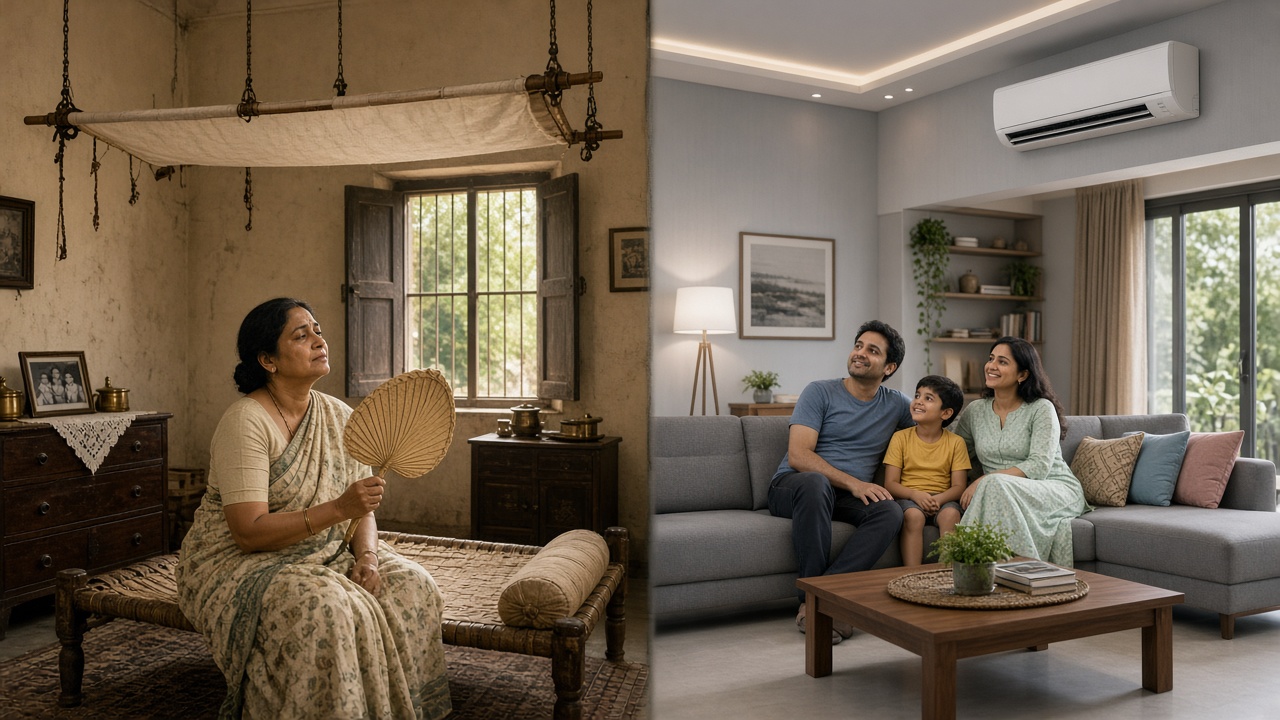
From palm-leaf fans and punkahs to split ACs in modern flats (artistic illustration).
Cooling Then vs Now at a Glance
Feature
Then
Now
Main device
Hand fans, punkahs, khus screens
Ceiling fans, coolers, inverter and smart ACs
Power source
Human effort, wind, and water
Grid electricity and rooftop solar
How it cools
Moving air and evaporating water
Moving air, evaporation, and refrigeration
Building design
Thick walls, courtyards, jaalis, high ceilings
Concrete flats; cool roofs and insulation returning
Drinking water
Clay matkas and surahis
Refrigerators and water coolers
Control
Pull a rope or wave a fan
Regulator, remote, app, or voice
Energy use
Old ceiling fan ~70–75 W
BLDC fan ~28–35 W; inverter AC saves ~30–40%
Summer nights
Sleeping on rooftops and verandas
Sleeping indoors with fans, coolers, or ACs
Public places
Shaded bazaars, stepwells, tree shade
Air-conditioned malls, metros, and offices
Environment
No emissions
High power demand and refrigerant gases; efficiency rules
🪭 Hand FansAncient – 1946
Hand Fans, Punkahs & Khus Screens
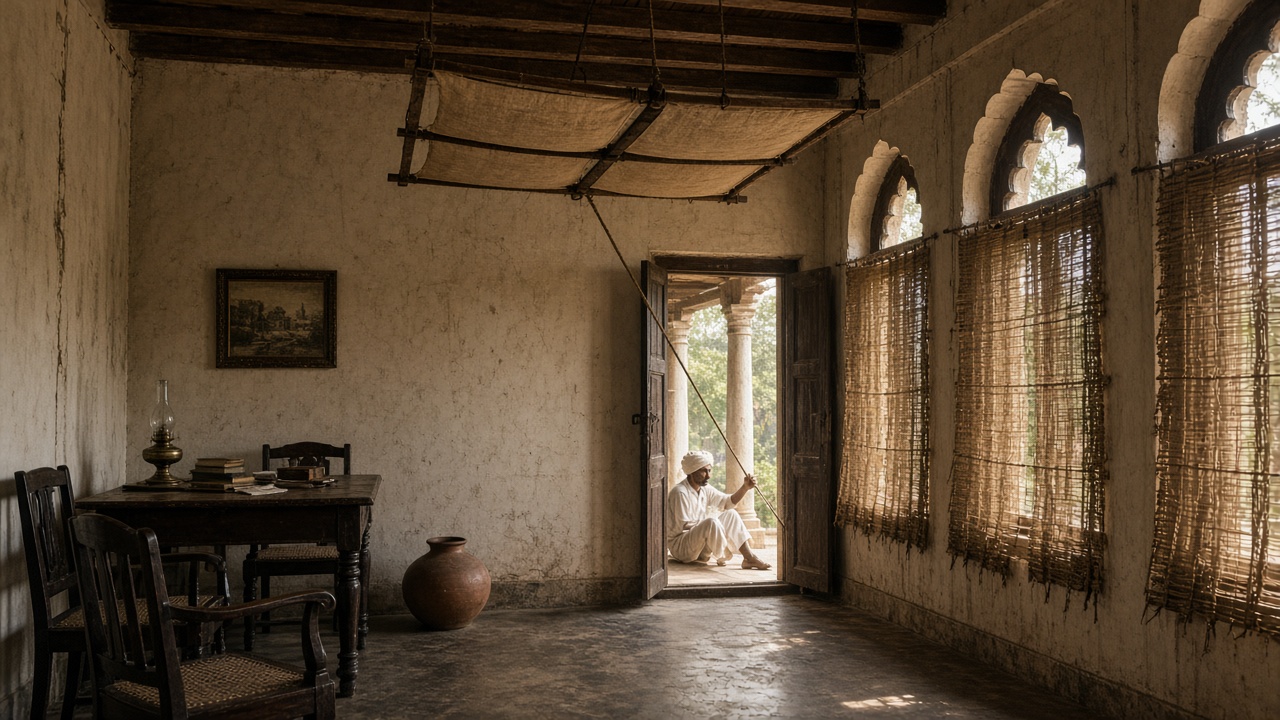
Long before electricity, Indians beat the heat with clever design and simple tools: woven hand fans, shaded courtyards, jaali screens, stepwells, and wet screens of fragrant khus grass. In colonial times the giant cloth punkah swung from ceilings, and the first electric fans and air-conditioned cinemas appeared in big cities.
A punkah-wallah pulls the cloth fan while wet khus screens cool the breeze (artistic illustration).
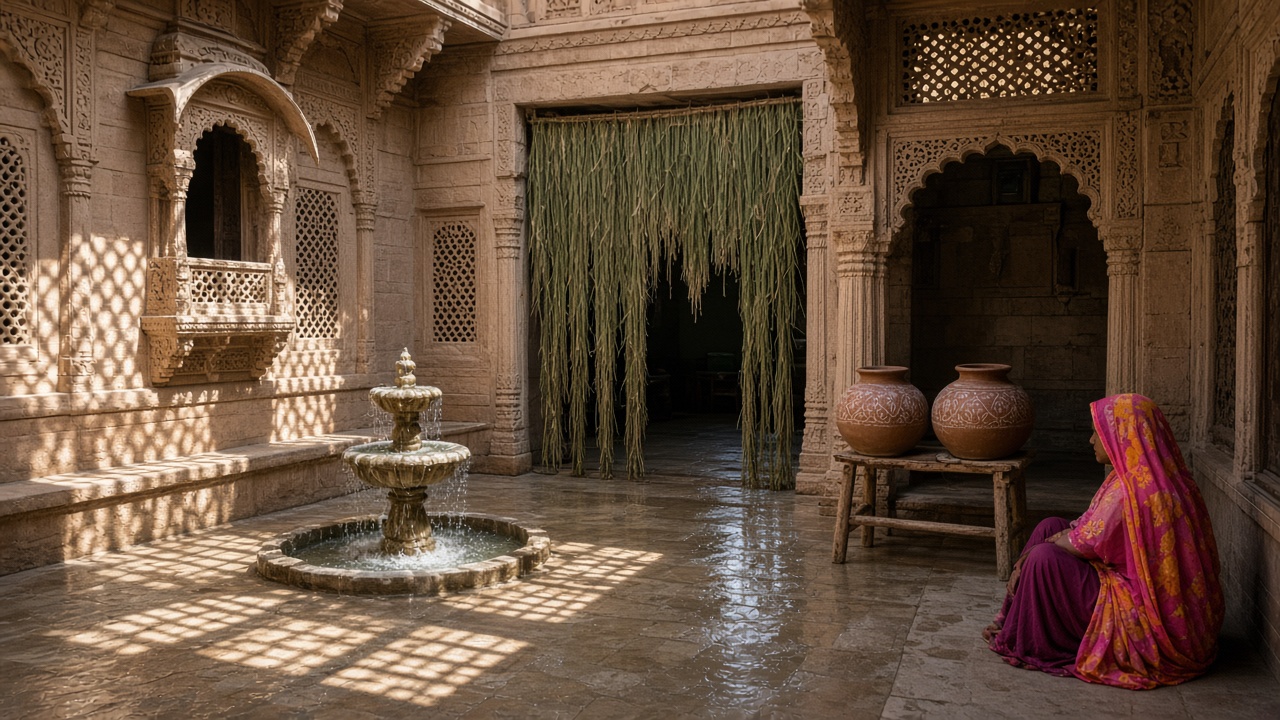
Ancient times: Palm-leaf and bamboo hand fans (pankhas), thick mud walls, shaded courtyards, and porous clay pots keep homes and water cool; stepwells in Gujarat and Rajasthan offer cool shelter in summer.
Mughal era: Screens of vetiver roots (khus tattis) are hung in doorways and sprinkled with water; the Ain-i-Akbari describes saltpetre being used to cool drinking water and ice brought from the hills for Akbar’s court.
1700s–1800s: The punkah — a large cloth fan hung from the ceiling and pulled by a punkah-wallah — becomes common in homes, offices, and courts; Jaipur’s Hawa Mahal (1799) uses hundreds of small windows to catch the breeze.
1900s–1940s: Electric ceiling fans reach city offices and rich homes; Regal Cinema in Bombay (1933) is described as India’s first air-conditioned cinema; Blue Star is founded in Bombay in 1943.
Technology
Hand fan: Palm leaf or bamboo.
Punkah: Rope-pulled ceiling fan.
Khus tatti: Wet grass screen.
Features
Human-powered: No electricity.
Evaporative cooling: Water cools the air.
Smart buildings: Shade and breeze.
🌀 Ceiling Fans1947 – 1979
Ceiling Fans & Table Fans
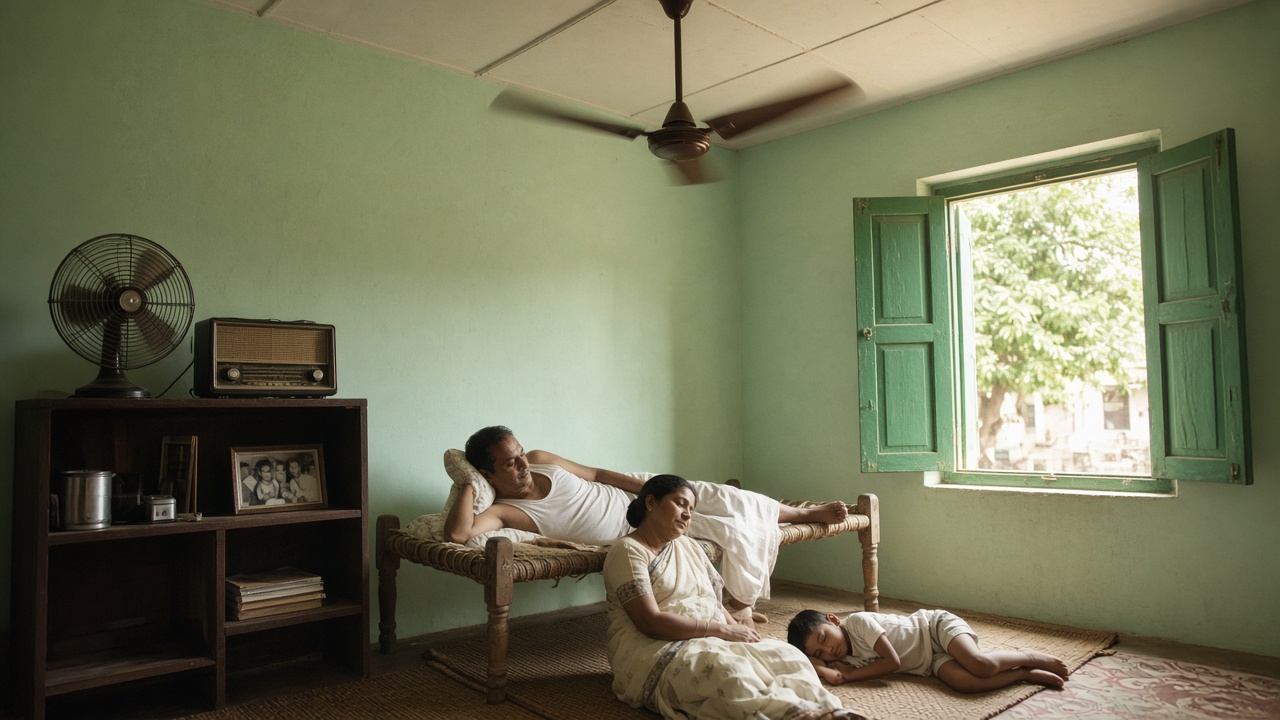
After Independence, Indian factories began making electric fans in large numbers. By the 1960s the ceiling fan was the heart of every electrified middle-class home, with table and pedestal fans in shops and offices. Air conditioning stayed in cinemas, hotels, banks, and offices, while families still slept on rooftops on hot nights.
By the 1960s the ceiling fan was the heart of the middle-class home (artistic illustration).
1950s: Indian fan makers such as Orient (1954) grow, and Voltas is set up in 1954 by Tata and Volkart Brothers to sell and install air conditioning and refrigeration.
1960s: The ceiling fan becomes the standard cooling device in electrified homes; heavy three-blade fans with step regulators are built to run for decades.
1960s–1970s: Air conditioning is found mainly in cinemas, hotels, hospitals, banks, and offices; at home people use fans, wet cloths, khus screens, and rooftop sleeping.
1970s: Rural electrification brings fans to more villages and small towns; frequent power cuts send families back to hand fans on hot nights.
Technology
Induction motor: Sturdy ceiling fans.
Step regulator: Speed control.
Table and pedestal fans: Portable air.
Features
Middle-class staple: A fan in every room.
AC in public: Cinemas and offices.
Power cuts: Back to hand fans.
💨 Coolers1980 – 1990
Desert Air Coolers
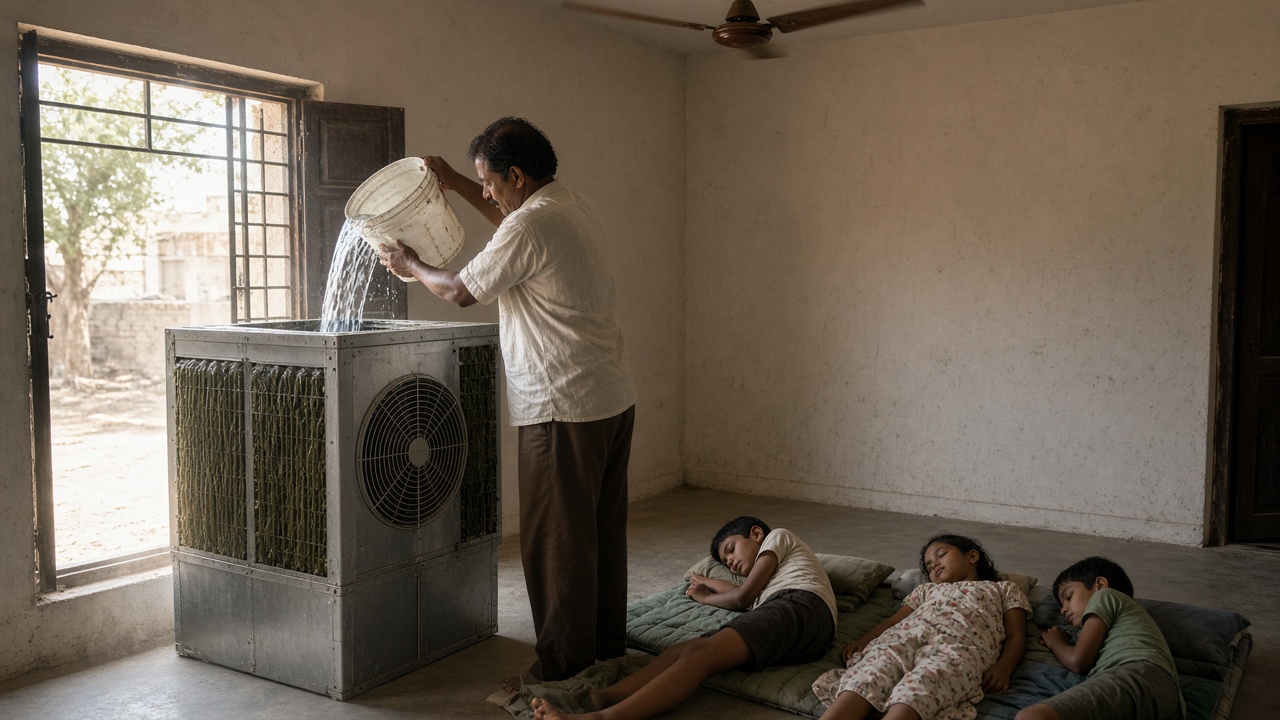
In the 1980s the big, humming desert cooler became the summer upgrade for millions of homes in north and west India. Built on the same idea as the khus tatti, it pulled hot, dry air through wet pads and blew cool air into the room — at a fraction of the cost of an AC.
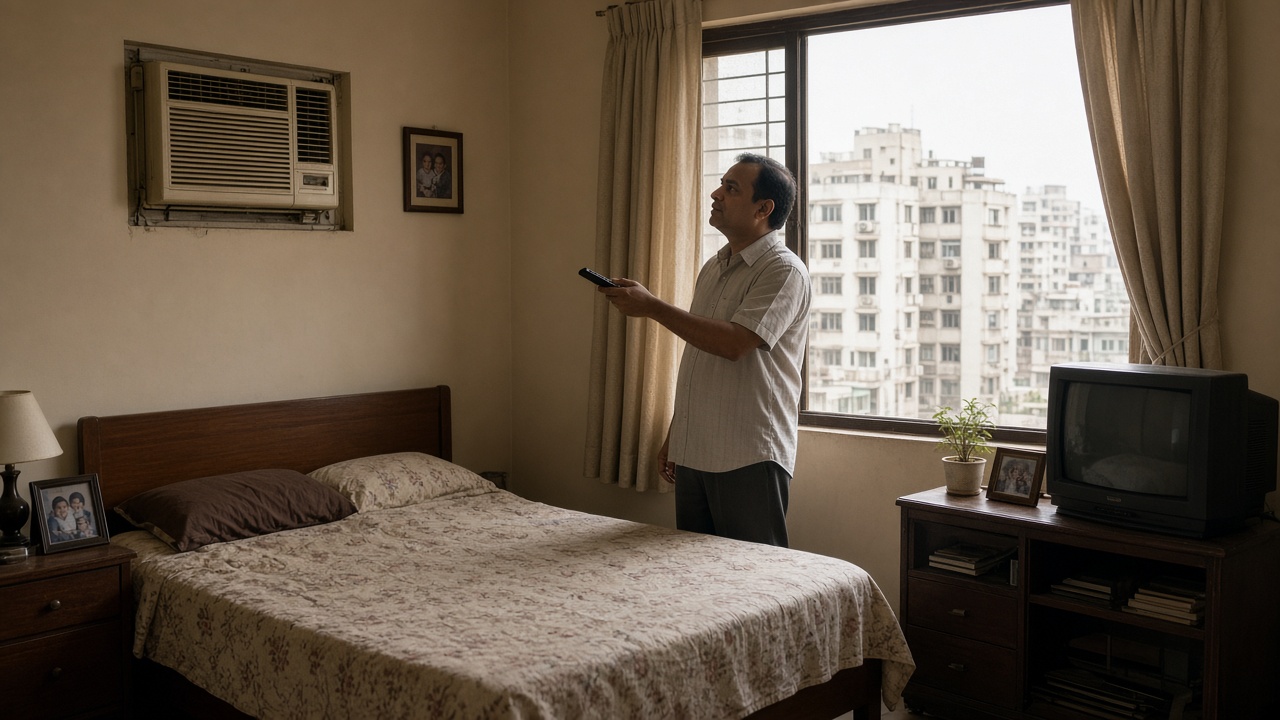
Filling the desert cooler with buckets of water was a daily summer job (artistic illustration).
1980s: Large sheet-metal desert coolers with khus or wood-wool pads, a water tank, a small pump, and a big fan spread across the hot, dry north and west; many are built by local workshops.
1980s: Coolers cost far less to buy and run than ACs, so they become common in homes, shops, and offices in cities such as Delhi, Jaipur, Lucknow, and Ahmedabad.
1988: Symphony is founded in Ahmedabad and later popularises branded plastic air coolers.
Late 1980s: Window ACs appear in some wealthy homes and offices, but high prices and import duties keep them rare.
Technology
Evaporative cooling: Water absorbs heat.
Khus and wood-wool pads: Hold water.
Pump and fan: Wet the pads, push air.
Features
Affordable: Low running cost.
Best in dry heat: Weak in humid weather.
Needs water: Refilled daily.
❄️ ACs1991 – 2009
Window & Split ACs
After the 1991 economic reforms, foreign brands arrived, prices fell, and the window AC became a symbol of success. Offices, shops, cars, and trains were air-conditioned, and in the 2000s quieter split ACs spread through new flats, malls, multiplexes, and IT offices.
The window AC became a status symbol in 1990s city homes (artistic illustration).
1991: Economic liberalisation lowers barriers; global brands such as Samsung (1995) and LG (1997) enter India, and AC prices begin to fall.
1990s: Window ACs spread in offices, shops, and upper-middle-class homes; air conditioning becomes common in cars, buses, and train coaches.
2000s: Quieter split ACs grow popular in flats; malls, multiplexes, metro trains, and IT offices are fully air-conditioned.
2001–2006: The Energy Conservation Act (2001) leads to the Bureau of Energy Efficiency (BEE, 2002); star labels for room ACs begin in 2006 and become mandatory in 2010.
Technology
Window AC: All-in-one box.
Split AC: Quiet indoor unit.
R-22 gas: Early refrigerant.
Features
Status symbol: Middle-class dream.
Falling prices: More brands.
High bills: Power-hungry.
⚡ Inverter ACs2010 – 2019
Inverter ACs & Star Labels
In the 2010s inverter ACs, which vary their compressor speed instead of switching on and off, cut electricity bills and kept rooms at a steady temperature. Star labels helped buyers choose efficient models, easy EMIs took ACs to smaller towns, and in 2019 India became one of the first countries to publish a national cooling plan.
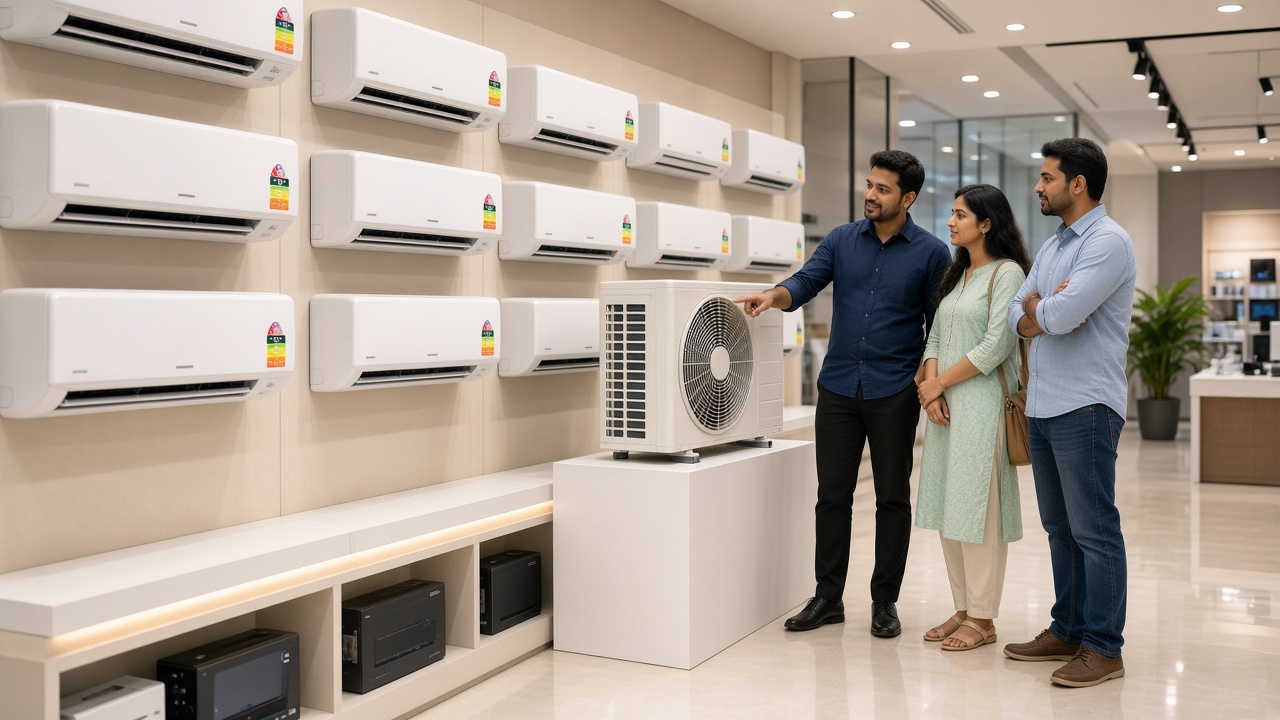
Star labels help buyers compare the efficiency of inverter ACs (artistic illustration).
2010s: Inverter ACs become popular because they typically use about 30–40% less electricity than fixed-speed ACs; branded plastic air coolers also grow.
2015–2018: BEE star labels for inverter ACs start (voluntary 2015, mandatory 2018), rated by the Indian Seasonal Energy Efficiency Ratio (ISEER), which reflects Indian temperatures.
2010s: Refrigerants such as R-32 and R-410A replace ozone-damaging R-22 in new ACs; online sales and EMIs take ACs to smaller towns.
2019: The India Cooling Action Plan (March 2019) aims to cut cooling demand by 20–25% and cooling energy by 25–40% by 2037–38; EESL begins selling super-efficient ACs.
Technology
Variable-speed compressor: Matches the load.
ISEER rating: Indian efficiency score.
R-32 refrigerant: Ozone-safe.
Features
Lower bills: Less power used.
Steady comfort: No big swings.
Wider reach: Small towns too.
📱 Smart ACs2020s – Future
Smart ACs & Smart Climate Control
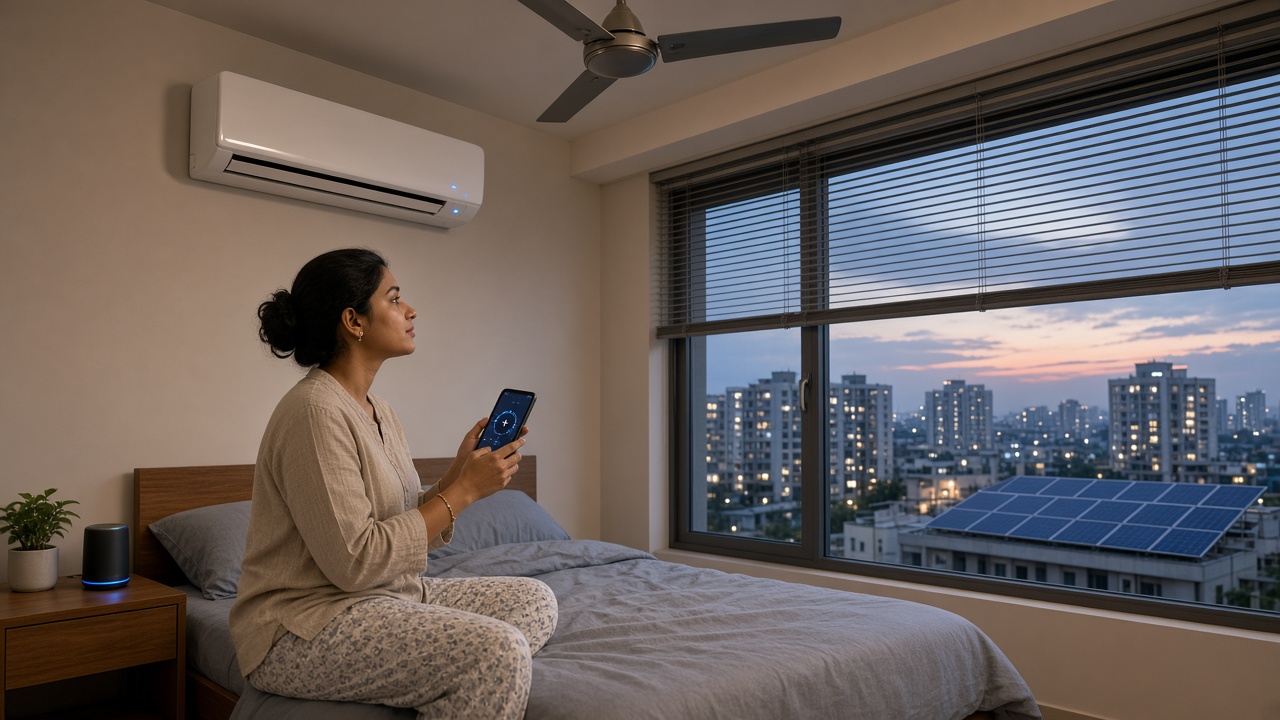
In the 2020s ACs connected to Wi-Fi, so families can cool a room before they reach home, set schedules, and track energy use from a phone. Energy-saving BLDC fans, the 24°C default setting, cool roofs, and heat action plans show India trying to keep people cool while using less power.
Smart ACs and BLDC fans are controlled from a phone, with rooftop solar nearby (artistic illustration).
2020: BEE makes 24°C the default temperature for new room ACs from 1 January 2020; each degree higher saves roughly 6% electricity.
2021: India ratifies the Kigali Amendment to phase down HFC refrigerant gases, and a Production Linked Incentive (PLI) scheme supports making AC components in India.
2020s: Wi-Fi ACs with app and voice control, AI cooling modes, and energy tracking spread; BLDC ceiling fans use about half the power of old fans, and star labels for ceiling fans become mandatory in 2023.
Heat resilience: Cities adopt heat action plans (Ahmedabad was first, in 2013) and cool roofs such as Telangana’s Cool Roofs Policy (2023); the future brings solar-powered cooling, district cooling, and climate-smart buildings.
Technology
Wi-Fi and AI control: Phone and voice.
BLDC fans: Half the power.
Solar cooling: Clean energy.
Features
Remote control: Cool before you arrive.
Energy tracking: Know your usage.
Heat safety: Cool roofs and plans.
Cooling Devices Compared
Device
How it cools
Typical power use
Best for
Hand fan
Moves air by hand
None
Personal use anywhere
Punkah
Large cloth fan pulled by rope
None (human effort)
Big rooms in the past
Khus tatti
Hot air passes through a wet grass screen
None (needs water)
Doorways in dry heat
Ordinary ceiling fan
Moves air; sweat evaporates faster
About 70–75 W
Every room
BLDC ceiling fan
Efficient brushless motor
About 28–35 W
Saving power
Desert air cooler
Air pulled through wet pads
About 150–250 W
Hot, dry climates
Window AC (1.5 ton)
Refrigeration; all parts in one box
About 1,500–2,000 W
Single rooms
Inverter split AC (1.5 ton)
Compressor speed changes with need
Varies; ~30–40% less than fixed-speed
Long daily use
Smart AC
Inverter AC with Wi-Fi and sensors
Like inverter ACs
Scheduling and remote control
Power figures are typical values; actual use depends on model, star rating, room size, and weather.
Cooling India in Numbers
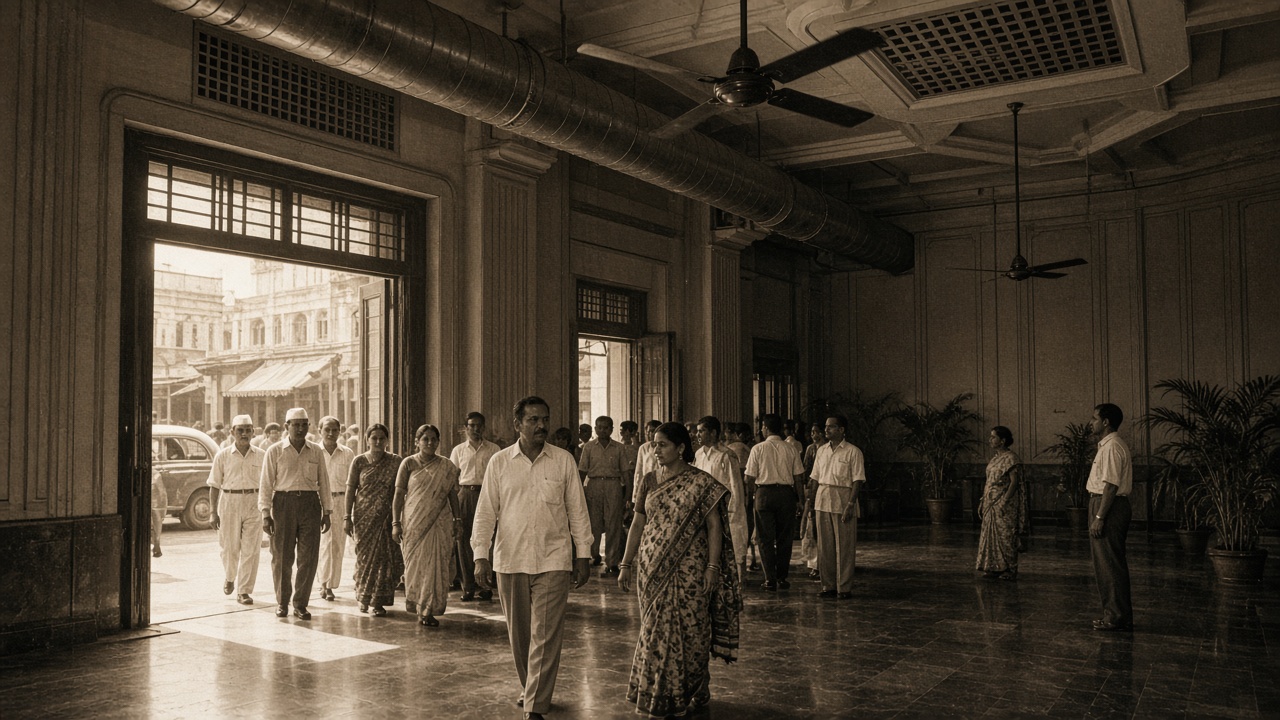
For decades, cinemas were where most Indians first felt air conditioning (artistic illustration).
Year / source
What happened or was found
1933
Regal Cinema, Bombay — described as India’s first air-conditioned cinema
1943 and 1954
Blue Star (1943) and Voltas (1954) founded
2006 / 2010
BEE star labels for room ACs launched / made mandatory
2017–18
About 8% of households own a room AC (India Cooling Action Plan)
2018
Star labels mandatory for inverter ACs
March 2019
India Cooling Action Plan launched
1 January 2020
24°C default temperature for new ACs
2021
Kigali Amendment ratified; PLI scheme for AC components
January 2023
Star labels mandatory for ceiling fans
2020s
Around 1 crore or more room ACs sold in India in a year
Figures are rounded and come from different official and industry estimates; AC ownership is rising quickly each year.
Traditional Ways India Stayed Cool
Jaalis, fountains, khus screens, and clay pots kept havelis cool without electricity (artistic illustration).
Method
Where
How it helps
Khus tatti
North India
Wet vetiver screen cools and scents the breeze
Jaali
Rajasthan, Gujarat, Mughal buildings
Stone lattice gives shade and speeds up airflow
Aangan (courtyard)
All India
Lets hot air rise out and draws in cooler air
Jharokha
Rajasthan
Overhanging windows catch breezes and give shade
Stepwell (baoli, vav)
Gujarat, Rajasthan, Delhi
Deep, shaded, water-cooled spaces
Matka and surahi
All India
Porous clay cools water by evaporation
Thick walls and lime plaster
All India
Slow down heat entering the home
Chhajja
All India
Stone or tiled sunshade over windows
Nalukettu courtyard
Kerala
Open centre and sloping roofs for ventilation
Rooftop sleeping
North and central India
Cooler night air on terraces
Cooling Timeline Summary
Year / Era
Milestone
Ancient times
Hand fans, courtyards, clay pots, stepwells
Mughal era
Khus tattis, saltpetre-cooled water, hill ice
1700s–1800s
Rope-pulled punkahs
1799
Hawa Mahal built in Jaipur
Early 1900s
Electric fans in city offices
1933
First air-conditioned cinema (Regal, Bombay)
1943
Blue Star founded
1954
Voltas founded; Orient fans begin
1960s
Ceiling fans in most electrified homes
1980s
Desert air coolers spread
1991
Liberalisation; AC prices start falling
2000s
Split ACs in flats, malls, and offices
2006–2010
AC star labels launched and made mandatory
2010s
Inverter ACs go mainstream
2013
Ahmedabad Heat Action Plan
2019
India Cooling Action Plan
2020
24°C default AC setting
2021
Kigali Amendment ratified
2023
Ceiling fan star labels mandatory
2020s
Smart ACs and BLDC fans
Test Your Knowledge
20 quick questions from the cooling timeline. Click each question to reveal the answer.
Answer: The roots of vetiver (khus) grass.
Answer: Pulling the rope of a large cloth ceiling fan (punkah).
Answer: Water seeps through the porous clay and evaporates, taking heat away.
Answer: Hawa Mahal.
Answer: A carved stone lattice screen that gives shade and lets air through.
Answer: Regal Cinema, Bombay (1933).
Answer: Tata and Volkart Brothers.
Answer: The 1960s.
Answer: On rooftops, terraces, and verandas.
Answer: Evaporative cooling.
Answer: Humid air already holds a lot of moisture, so little water evaporates and the air cools less.
Answer: Economic liberalisation.
Answer: A window AC has all parts in one box; a split AC has a quiet indoor unit and a separate outdoor compressor unit.
Answer: The Bureau of Energy Efficiency (BEE).
Answer: It changes its compressor speed to match the cooling needed instead of switching fully on and off.
Answer: Indian Seasonal Energy Efficiency Ratio.
Answer: 2019.
Answer: 24°C.
Answer: They use about half the electricity (around 28–35 W instead of 70–75 W).
Answer: Ahmedabad.
Classroom activity
Students Tasks
Use these prompts for discussion or projects on how India’s ways of staying cool changed over time.
Timeline understandingEnergy savingScience of coolingClimate awareness
Ask your grandparents how they kept cool in summer as children, and whether they ever used a hand fan, khus screen, or slept on the roof.
Make a timeline poster: ceiling fans (1960s), coolers (1980s), ACs (1990s), inverter ACs (2010s), and smart ACs (2020s).
List every fan, cooler, and AC in your home and find the star rating of each one.
Calculate the monthly electricity saved by replacing one 75 W ceiling fan with a 30 W BLDC fan used 12 hours a day.
Wrap a wet cloth around one bottle of water and leave another dry in the sun; compare their temperatures after an hour and explain why.
Explain why a desert cooler works well in Jaipur but not in Chennai.
Study a traditional building in your area and note features such as courtyards, jaalis, or thick walls that keep it cool.
Find out what your state or city does to protect people during heatwaves.
Design a “cool home” using shade, plants, cool roofs, and efficient appliances.
Debate: “Every home in India should have an AC.”
Continue exploring
Cooling changed with the power grid, mobile phones, the internet, and artificial intelligence. Explore these connected timelines next.
Click any panel to expand and explore the visual mood.
India’s cooling journey in pictures — punkahs and khus screens, haveli jaalis, the first air-conditioned cinemas, 1960s ceiling fans, 1980s desert coolers, 1990s window ACs, inverter ACs, smart ACs, and then versus now.
Punkah
Rope-pulled breeze
Jaalis & Khus
Cooling by design
AC Cinema
First taste of AC
1960s Ceiling Fan
Heart of the home
1980s Cooler
Wet pads, cool air
1990s Window AC
A new status symbol
Inverter ACs
Star-rated savings
Smart ACs
Cooling by app
Then vs Now
Punkah to smart AC
Explore all daily life timelines
Jump to any other daily life timeline on WorldTimelineHub.
Disclaimer: This content is AI-generated for educational purposes and may contain errors or outdated details. For correct and authoritative information, please refer to official and reliable sources such as government publications, manufacturers, museums, and academic references.