From Magna Carta’s limits on the king, to Atlantic revolutions, suffrage expansions, the UN human-rights charter, civil-rights marches, and today’s fights for privacy and voice online.
Rule of law -> RightsVotes for allCivil & digital rights
Why Democracy Matters
Democracy is not a single invention—it is a long struggle to constrain power, expand who counts as “the people,” and protect dignity under law. Charters, revolutions, ballots, rights declarations, and street movements each widened that circle.
This timeline follows Magna Carta, the US and French revolutions, suffrage, the UN Declaration, civil rights, and digital rights as linked turning points.
Big picture
Democracy in one view
Limits on kings, revolutionary constitutions, votes for more citizens, a global human-rights baseline, equal-citizenship struggles, and rights rewritten for the internet age.
At Runnymede in 1215, English barons forced King John to accept a written charter. Magna Carta did not create modern democracy, but it planted a powerful idea: even the sovereign is bound by law, and some liberties can be claimed against arbitrary power.
Magna Carta era: a charter that outlived its crisis.
Limits royal arbitrariness; affirms due process themes later generations cite.
Reissued and reinterpreted for centuries in English constitutional politics.
Becomes a global symbol of liberty—often more myth than medieval detail.
Popular Sovereignty1776–1789
US & French Revolutions
The American Declaration of Independence (1776) and Constitution framed government as deriving from the people. The French Revolution and the 1789 Declaration of the Rights of Man and of the Citizen proclaimed liberty, equality, and fraternity—while both revolutions left deep exclusions (enslaved people, women, colonies) that later movements would challenge.
Revolutions era: rights on parchment, power remade.
Written constitutions and rights declarations become templates worldwide.
Contradictions (slavery, empire, gender) fuel later democratic expansions.
Votes for More1800s–1900s
Suffrage
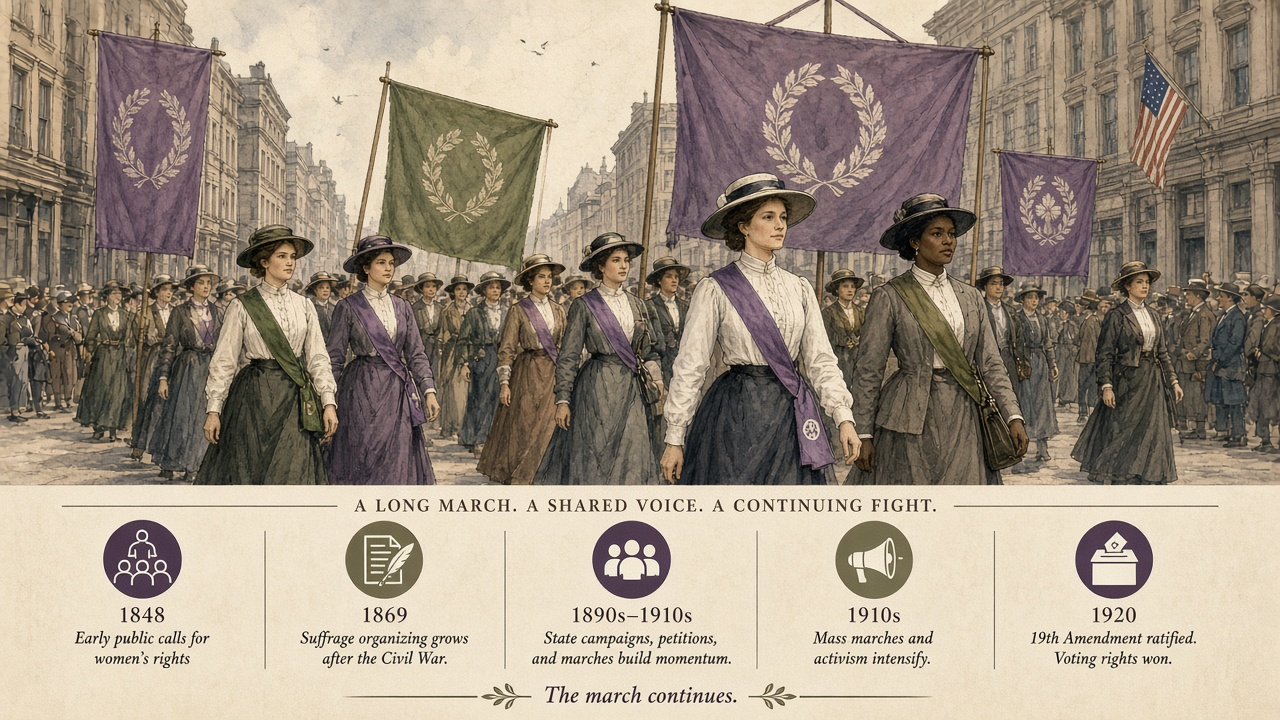
Democracy without a broad franchise is elite rule with elections. Across the 19th and early 20th centuries, reformers and militants fought to widen the vote—abolishing property tests for men, winning women’s suffrage in country after country, and linking voting rights to labour, race, and colonial freedom struggles.
Suffrage era: the ballot as a hard-won right.
Reform acts, petitions, strikes, and civil disobedience expand who can vote.
Women’s suffrage victories (e.g. NZ 1893, many after World War I) reshape politics.
Franchise gains remain uneven; exclusion by race and colony persists for decades.
Global Baseline1948
UN Declaration
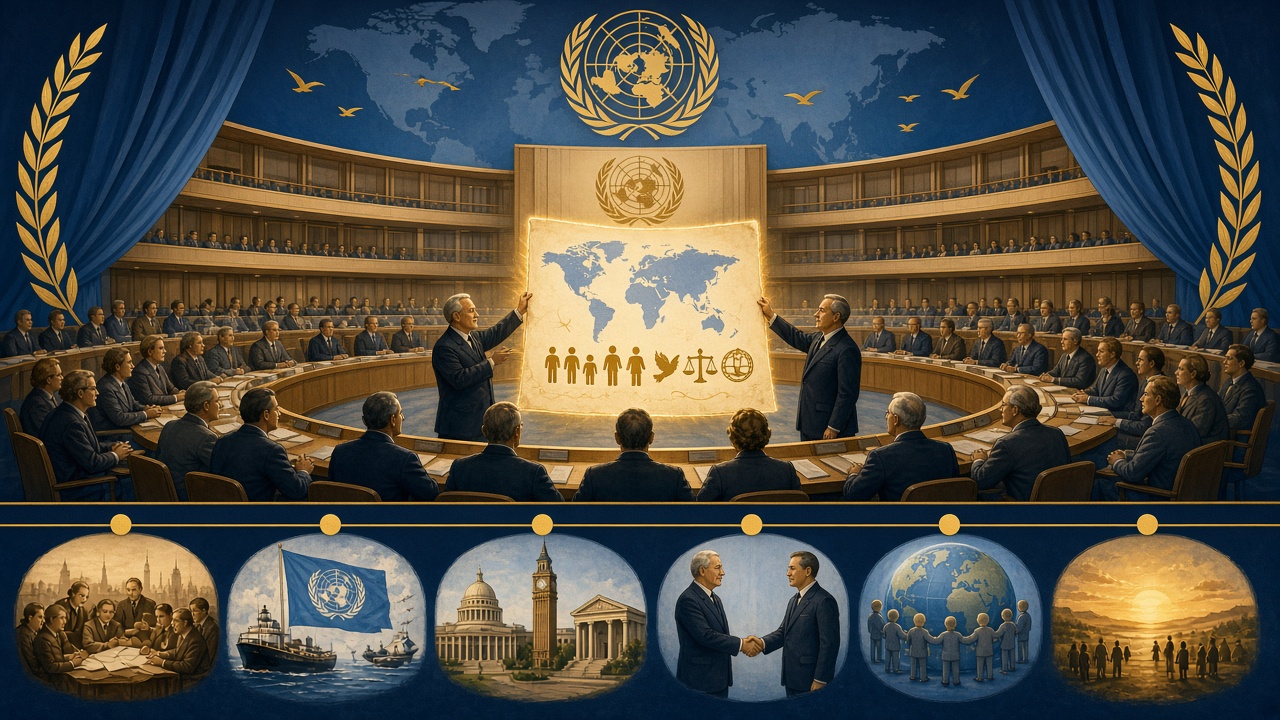
After the horrors of World War II, the United Nations General Assembly adopted the Universal Declaration of Human Rights (UDHR) on 10 December 1948. It is not a treaty by itself, but it became the moral and political baseline for dignity, equality, speech, conscience, education, and freedom from torture—cited by courts, constitutions, and activists worldwide.
UDHR era: rights claimed as universal, not merely national.
Drafted with global input; Eleanor Roosevelt chairs the drafting commission.
Informs later covenants, regional charters, and national bills of rights.
Implementation remains contested—aspiration vs practice.
Equal Citizenship1950s–1970s
Civil Rights
Paper rights are incomplete without equal protection. Mid-century civil-rights movements—from US desegregation and voting-rights campaigns to anti-apartheid and postcolonial citizenship fights—used marches, courts, and law to dismantle legal discrimination and demand that democracy include those long shut out.
Civil rights era: equality enforced, not only declared.
Landmark laws and court rulings attack segregation and voting barriers.
Non-violent protest and organised pressure reshape public opinion.
Global echo: decolonisation and anti-discrimination norms advance unevenly.
Rights Online1990s–Present
Digital Rights
As life moved onto networks, democracy faced new arenas: who controls data, who can speak, who is watched, and who is excluded by design. Digital rights campaigns seek privacy, encryption, platform accountability, open internet access, and democratic oversight of AI and surveillance—updating Magna Carta’s spirit for the cloud.
Digital rights era: liberty, privacy, and voice on networks.
Data-protection laws (e.g. GDPR) and privacy judgments redefine consent.
Debates over content moderation, disinformation, and free expression intensify.
Access, digital ID, and surveillance become core democratic questions.
Key Milestones
Milestone
When
Why it matters
Magna Carta sealed
1215
King bound by written limits; rule-of-law symbol.
US Declaration / Constitution
1776 / 1787
Popular sovereignty & constitutional republic.
French Rights of Man
1789
Liberty-equality language for modern politics.
Women’s suffrage waves
1890s–1920s+
Franchise expands beyond male-only electorates.
Universal Declaration of Human Rights
1948
Global dignity baseline after WWII.
Civil rights victories
1950s–70s
Equal protection pushed into practice.
Digital privacy & platform rules
1990s–
Rights remapped for networks and data.
Era Focus at a Glance
Era
Core claim
Old idea challenged
Magna Carta
Law above the king
Unchecked royal will
Revolutions
People as source of power
Divine-right monarchy
Suffrage
Broad voting rights
Elite-only franchise
UN Declaration
Universal human dignity
Rights as purely local favour
Civil rights
Equal citizenship in practice
Legalised discrimination
Digital rights
Liberty & privacy online
Unchecked data/surveillance power
Then vs Now
From sealed charters to encrypted chats.
Metric
Then
Now
Who rules
Monarchs / elites
Elected governments (unevenly)
Who votes
Few property holders
Universal adult franchise (many states)
Rights basis
Custom & privilege
Constitutions + human-rights norms
Public square
Print & assembly
Platforms + physical protest
Threats
Tyranny & exclusion
Those plus surveillance & disinfo
Future Predictions
Institutions: Stronger (or weaker) courts and election bodies will decide trust.
Technology: AI, deepfakes, and biometric ID will force new rights rules.
Inclusion: Youth, diaspora, and disability access will reshape participation.
Global norms: UDHR principles will keep colliding with authoritarian tech models.
India spotlight
Democracy & India
India’s freedom movement, Constitution (1950), and universal adult franchise made it the world’s largest democracy. Rights debates continue—from speech and equality to privacy and digital identity.
India spotlight: constitution, votes, and digital-age rights.
Freedom
Independence struggle
Non-violent mass politics and constitutional goals shape a democratic imagination.
1950
Constitution
Fundamental rights, directive principles, and adult franchise at scale.
Votes
Election machinery
Election Commission and vast general elections become global case studies.
Rights
Courts & movements
PIL, equality cases, and social movements expand living constitutionalism.
Digital
Privacy & DPI
Aadhaar, data protection, and online speech reshape citizenship online.
Strength: Scale of electoral democracy and constitutional ambition.
Need: Literacy, inclusion, and resilient institutions.
Debate: Balancing security, development, and digital rights.
Test Your Knowledge
20 questions on Magna Carta through digital rights. Click to reveal answers.
Answer: 1215.
Answer: The English king’s arbitrary power.
Answer: 1776.
Answer: 1789.
Answer: The right to vote.
Answer: Laws and customs long excluded women from the franchise.
Answer: 1948.
Answer: To set a global human-rights baseline after wartime atrocities.
Answer: Equal legal status, voting access, and an end to discrimination.
Answer: Marches, boycotts, lawsuits, voter registration, etc.
Answer: Privacy, online expression, data protection, anti-surveillance norms.
Answer: No—also rule of law, rights, and free civic space.
Jump to any other world history timeline on WorldTimelineHub.
Disclaimer: This content is AI-generated for educational purposes and may contain errors or outdated details. For correct and authoritative information, please refer to official and reliable sources such as government publications, manufacturers, museums, and academic references.