With a coastline of about 11,000 km, great rivers, reservoirs, and village ponds, India has always been a fishing nation. In 1950 it caught less than a million tonnes of fish,
mostly from the sea. Today it produces over 18 million tonnes — most of it farmed in ponds and tanks — and is the world’s second-largest fish producer.
This timeline covers Harappan fish hooks, kattumaram rafts, Chinese nets of Kochi, colonial fish-curing yards and the Fisheries Act of 1897, research institutes, the
Indo-Norwegian Project, induced carp breeding, trawlers and the EEZ, the shrimp boom, the Blue Revolution scheme, and PM Matsya Sampada Yojana.
Fish is a cheap, healthy source of protein and omega-3 fats for millions of Indians, especially in coastal states, Bengal, Assam, and the North-East. Fisheries support
the livelihoods of nearly three crore fishers and fish farmers, many of them poor and landless, and seafood is one of India’s biggest farm exports. Managing the sea
and inland waters wisely is essential so that fish stocks are not exhausted.
Big picture
India’s fisheries in one view
Traditional fishers used rafts, canoes, and hand-made nets for thousands of years. After independence, research institutes, mechanised boats, and the 1957 breakthrough
in induced carp breeding set the stage for fish farming. Shrimp farms and composite carp culture followed, and today most of India’s fish comes from aquaculture.
Related timelines:
White Revolution,
Green Revolution,
reservoirs and irrigation.
~18 MT
Fish produced, 2023–24
2nd
Largest fish producer (~8%)
~11,000 km
Coastline
~3 crore
Fishers and fish farmers
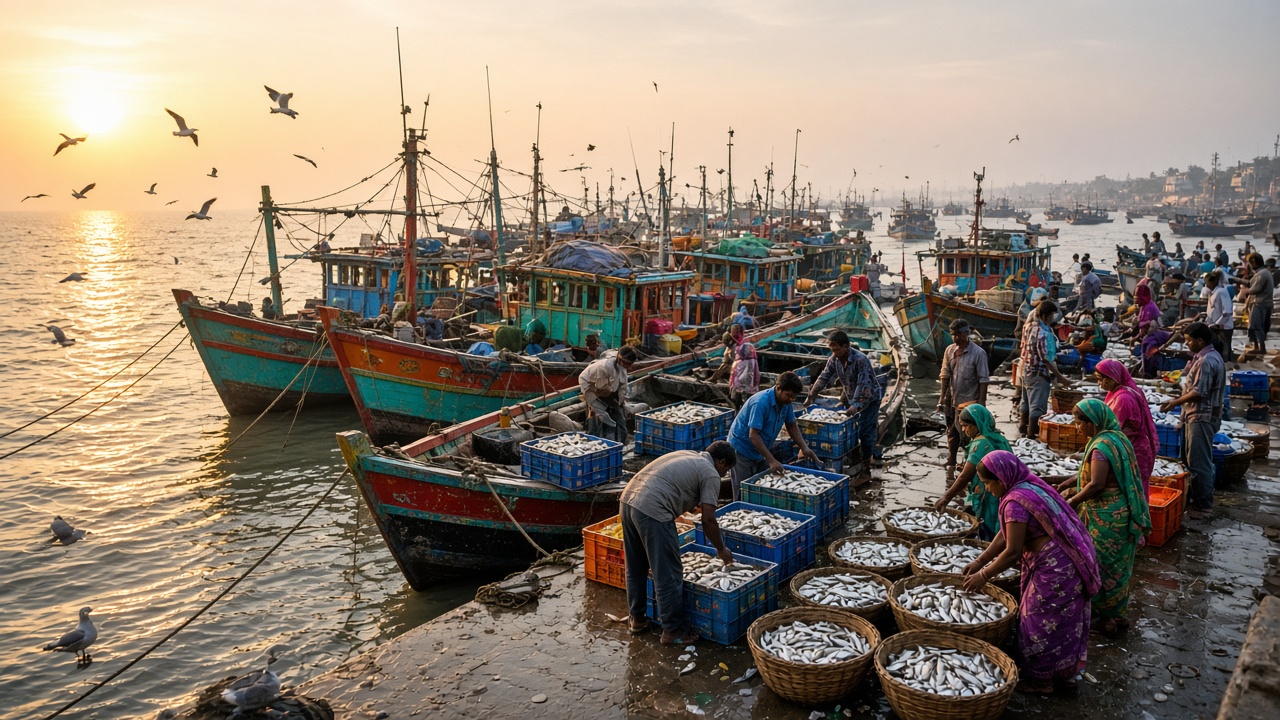
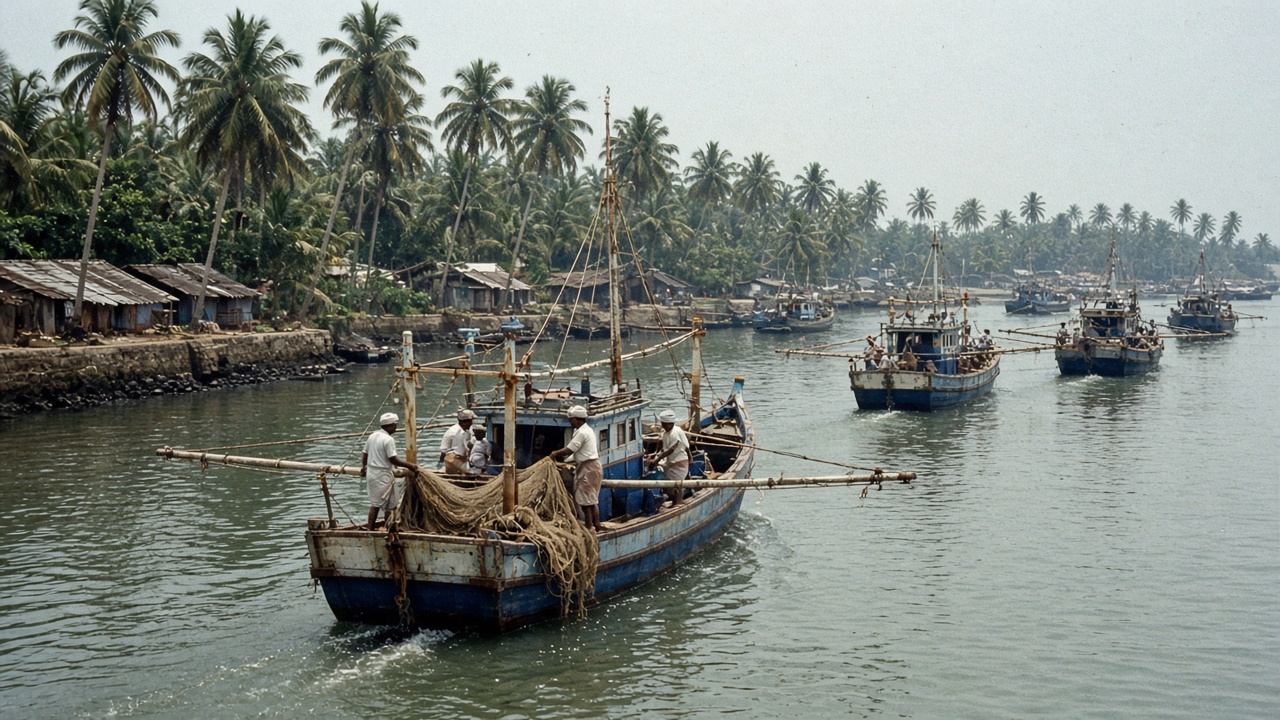
Fishing harbours come alive at dawn as boats unload the night’s catch (artistic illustration).
🛶 TraditionalAncient – 1800
Fish Hooks, Kattumarams & Chinese Nets
Fishing is one of India’s oldest occupations. Coastal and river communities built rafts and canoes, wove nets, and kept fish in temple tanks and village ponds long before modern science.
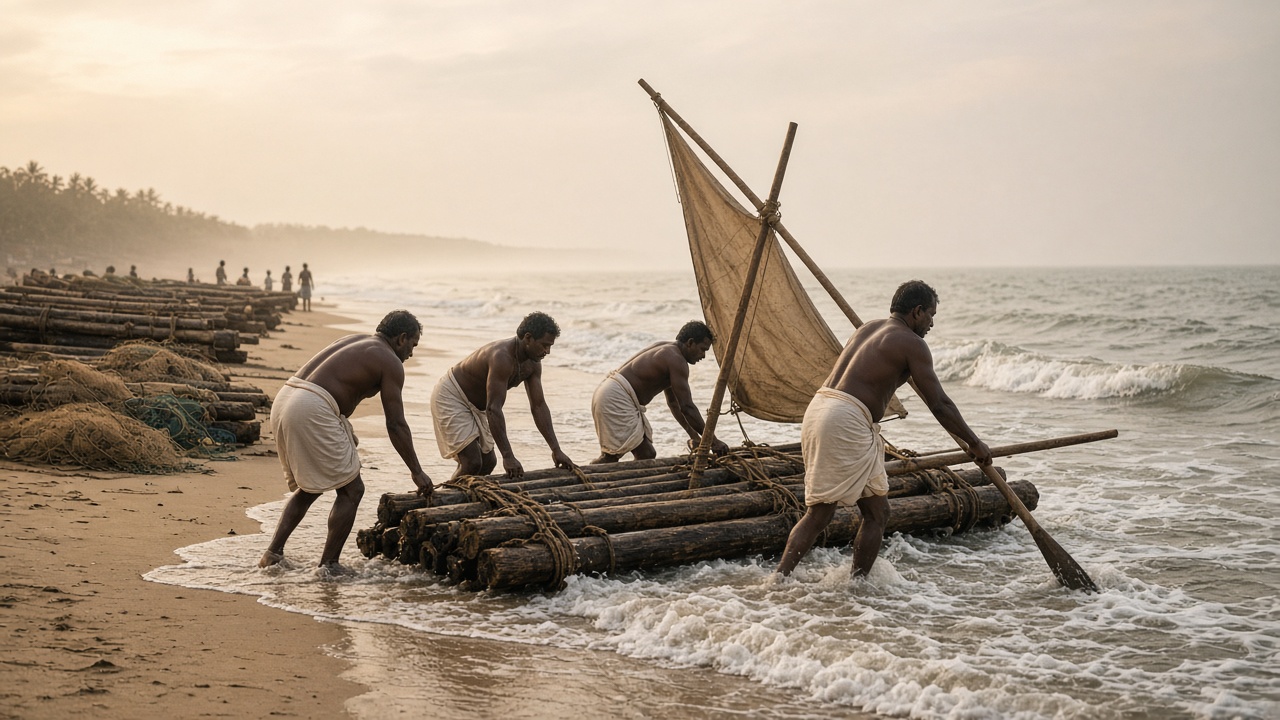
The Tamil kattumaram (“tied logs”) gave the world the word catamaran (artistic illustration).
Harappan era: Copper fish hooks and fish bones are found at Indus sites, and fish signs appear on seals.
Ancient period: The Arthashastra lists fisheries as a source of state revenue; kings protect fish in sacred waters.
12th century: The Manasollasa of King Someshvara III describes fish varieties and angling as a royal pastime.
14th–18th centuries: Chinese dip nets are said to arrive in Kochi with traders; kattumarams and plank boats work the coasts; Bengal farms fish in ponds.
Technology
Kattumaram: Log raft for surf.
Cotton nets: Hand-knotted.
Sun drying and salting: Preserving fish.
Features
Fishing castes: Skills passed in families.
Local markets: Fresh and dried fish.
Pond culture: Bengal and Assam tradition.
🧂 Curing Yards1800 – 1946
Fish-Curing Yards & the First Fisheries Laws
Colonial authorities set up fish-curing yards with cheap salt, passed the first fisheries law, and created fisheries departments in Madras and Bengal to study and develop fishing.
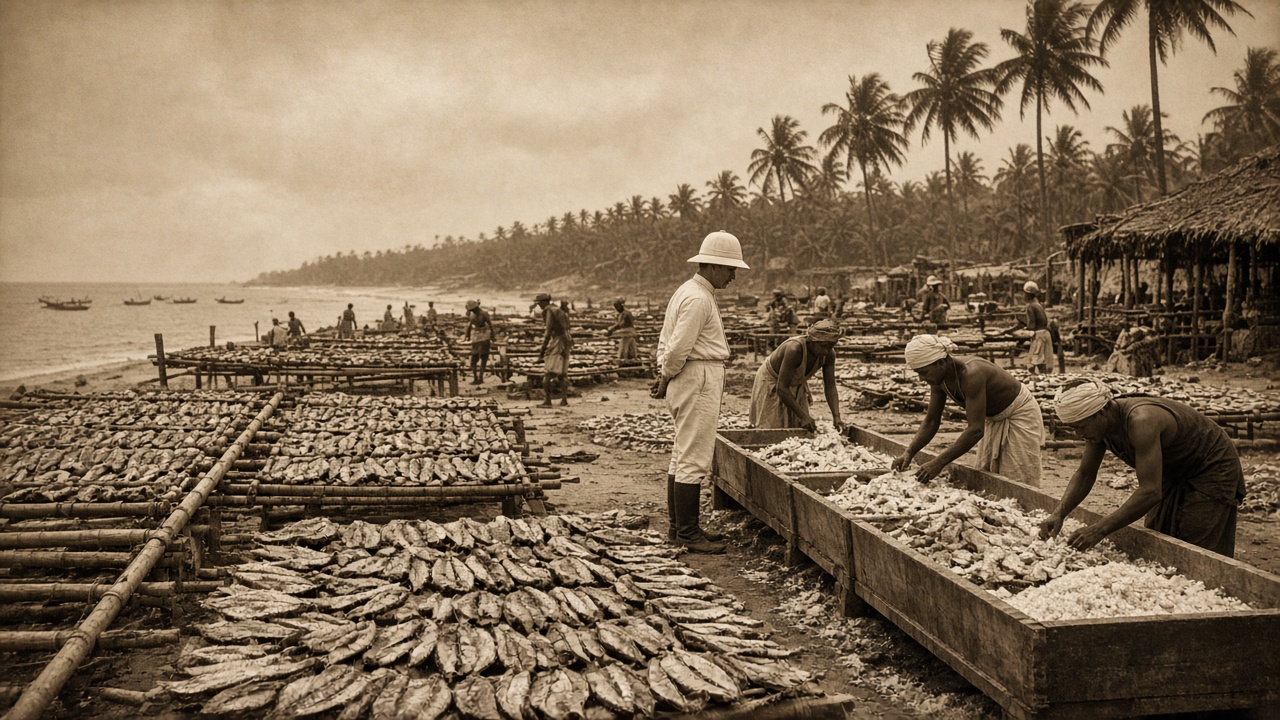
Salted and dried fish from curing yards travelled inland and abroad (artistic illustration).
Late 19th century: Fish-curing yards with duty-free salt open along the Madras and Malabar coasts.
1897: The Indian Fisheries Act, the first fisheries law, bans killing fish with explosives and poison.
1907–1908: A Fisheries Bureau is set up in Madras under Sir Frederick Nicholson; Bengal also creates a fisheries department.
1920s–1940s: Surveys study hilsa, sardine, and pond fisheries; a deep-sea fishing station is planned in Bombay (1946).
Technology
Curing yards: Salt and sun drying.
Fish oil and guano: Sardine products.
Railways: Dried fish inland.
Features
First law: Ban on destructive fishing.
Surveys: Early fish science.
Traditional craft: Still mostly unpowered.
🔬 Breakthroughs1947 – 1969
Research Institutes, Indo-Norwegian Project & Induced Breeding
Independent India founded marine and inland fisheries research stations, brought in mechanised boats with Norwegian help, and made a world-class breakthrough: breeding carps in hatcheries with hormone injections.
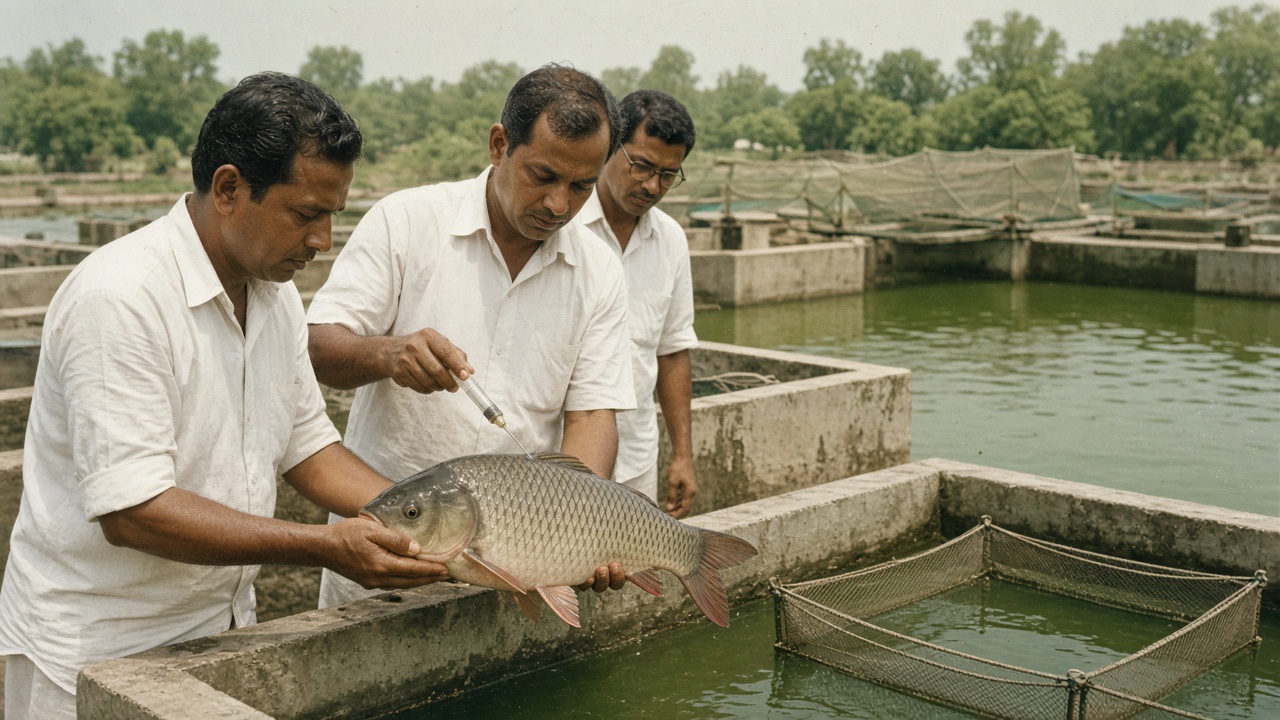
Hormone injections made carps spawn in hatcheries from 1957 (artistic illustration).
1947: The Central Marine Fisheries Research Station (now CMFRI) and the Central Inland Fisheries Research Station (now CIFRI) are set up.
1953: The Indo-Norwegian Project begins in Kerala, introducing mechanised boats, nylon nets, ice plants, and boatyards.
1957: On 10 July, Dr Hiralal Chaudhuri and Dr K. H. Alikunhi achieve induced breeding of carps; the Central Institute of Fisheries Technology opens in Kochi.
1959–1960s: Silver carp and grass carp are introduced from abroad; frozen prawn exports begin to grow.
Technology
Hypophysation: Pituitary hormone injection.
Mechanised boats: Diesel engines.
Nylon nets: Stronger and lighter.
Features
Fish seed: Available in hatcheries.
Foreign aid: Norway partnership.
Exports begin: Frozen prawns.
🚤 Expansion1970 – 1990
Trawlers, EEZ & Fish Farmers’ Agencies
Mechanised trawlers spread along the coasts, India claimed a vast Exclusive Economic Zone, and government agencies helped village farmers turn ponds into fish farms. The term “Blue Revolution” entered planning.
Trawlers greatly increased the marine catch — and led to conflicts with traditional fishers (artistic illustration).
1972: The Marine Products Export Development Authority (MPEDA) is set up to promote seafood exports.
Mid-1970s: Fish Farmers’ Development Agencies begin in districts; composite culture of Indian and exotic carps spreads.
1976: The Maritime Zones Act gives India a 200-nautical-mile Exclusive Economic Zone of about 2 million sq km.
1980–1990: Kerala passes a Marine Fishing Regulation Act (1980) and later a monsoon trawl ban (1988); the Seventh Plan (1985–90) promotes the Blue Revolution; CIFA opens in Bhubaneswar (1987).
Technology
Trawlers: Nets dragged along the seabed.
Outboard motors: Power for small craft.
Composite culture: Six carps in one pond.
Features
Village ponds: New income source.
Fisher conflicts: Trawlers vs. traditional boats.
Conservation: First fishing bans.
🦐 Shrimp Boom1991 – 2014
Shrimp Boom, Regulation & Recovery
Economic reforms and export demand triggered a shrimp farming boom along the coasts. Disease outbreaks, environmental damage, court cases, and the 2004 tsunami led to new rules and a more careful approach.
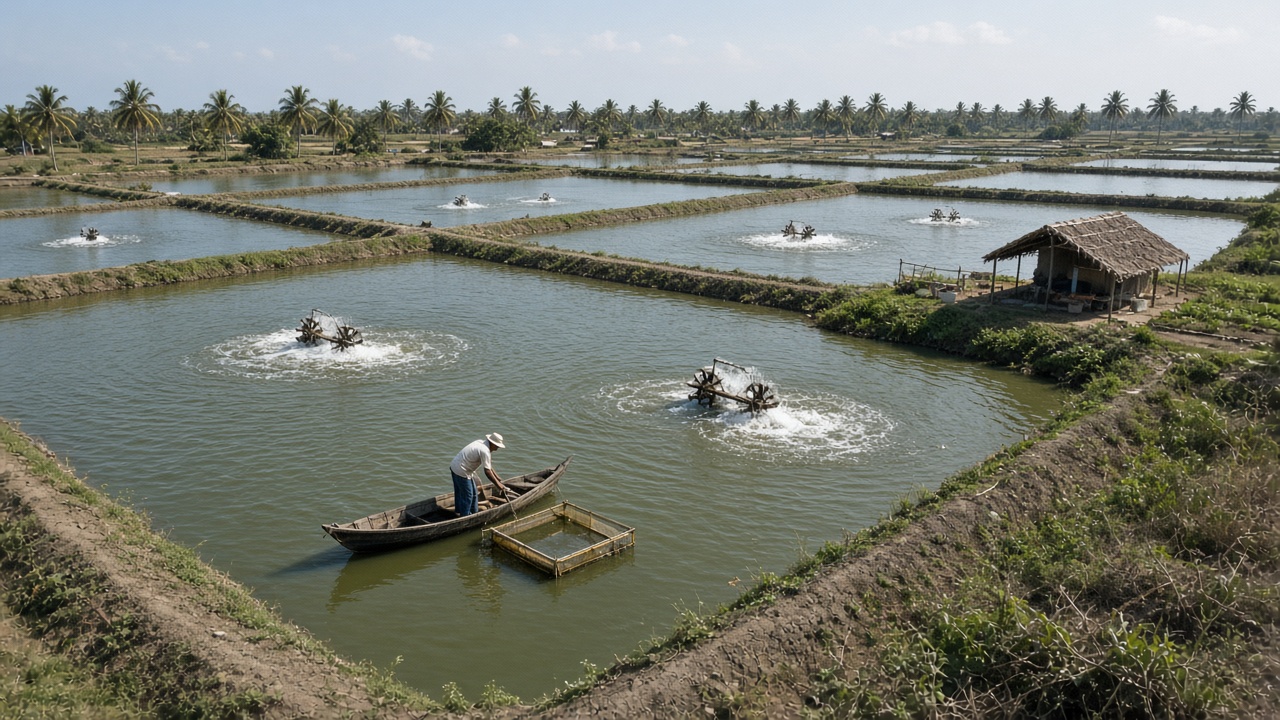
Paddle-wheel aerators keep shrimp ponds supplied with oxygen (artistic illustration).
Early 1990s: Shrimp farms spread rapidly in Andhra Pradesh, Tamil Nadu, Odisha, and West Bengal; tiger prawn exports soar.
1994–1996: White spot disease devastates farms (1994–95); the Supreme Court orders strict limits on coastal shrimp farms (1996).
2004–2006: The Indian Ocean tsunami devastates fishing villages (2004); the Coastal Aquaculture Authority Act is passed (2005); the National Fisheries Development Board is set up (2006).
2009–2014: Pacific white shrimp (vannamei) farming is permitted (2009) and becomes the main farmed shrimp; pangasius farming grows in Andhra Pradesh.
Technology
Aerators: Oxygen for dense ponds.
SPF seed: Disease-free shrimp larvae.
Cold chains: Freezing for export.
Features
Export earner: Frozen shrimp leads.
Environmental cost: Mangroves and salinity.
Regulation: Licensing of farms.
🌊 Blue Revolution2015 – Present
Blue Revolution Scheme, PMMSY & Modern Aquaculture
A dedicated Blue Revolution scheme, a separate fisheries ministry, and the large PM Matsya Sampada Yojana have pushed record fish production, cage and biofloc farming, seaweed culture, and better harbours and cold chains.
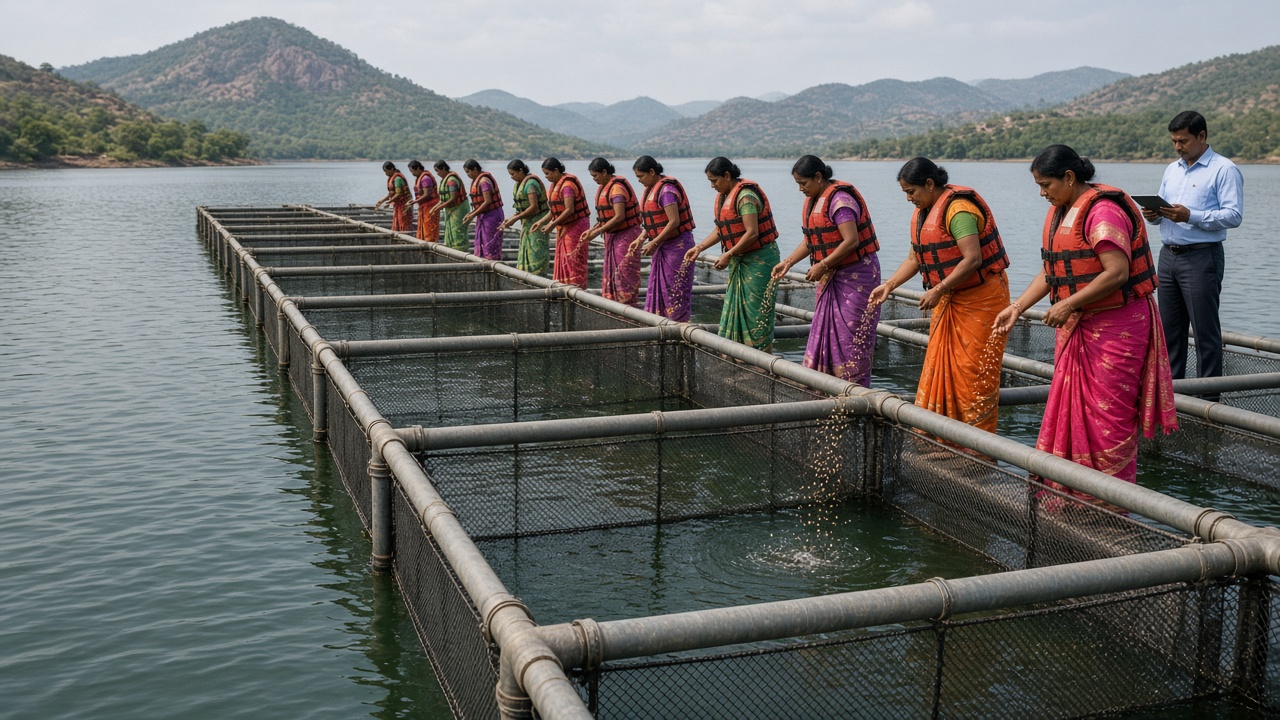
Cage culture in reservoirs gives women’s groups and fishers new income (artistic illustration).
2015–2016: The Blue Revolution scheme for integrated fisheries development begins; a uniform 61-day monsoon fishing ban is set for both coasts.
2018–2019: The Fisheries and Aquaculture Infrastructure Development Fund is created and Kisan Credit Cards are extended to fishers; a separate Department of Fisheries is formed (2019).
2020–2021: PM Matsya Sampada Yojana is launched with about ₹20,050 crore; seaweed farming and a seaweed park in Tamil Nadu are promoted.
2024–present: PM Matsya Kisan Samridhi Sah-Yojana supports formalising the sector; fish production reaches about 18 million tonnes and seafood exports top ₹60,000 crore.
Technology
Cage and pen culture: Fish in reservoirs.
Biofloc and RAS: Intensive tank farming.
Satellite advisories: Potential fishing zone alerts.
Features
Aquaculture leads: Most fish now farmed.
Fisher safety: Insurance and transponders.
Sustainability: Fishing bans and quotas.
Fishing Craft and Gear: Traditional to Modern
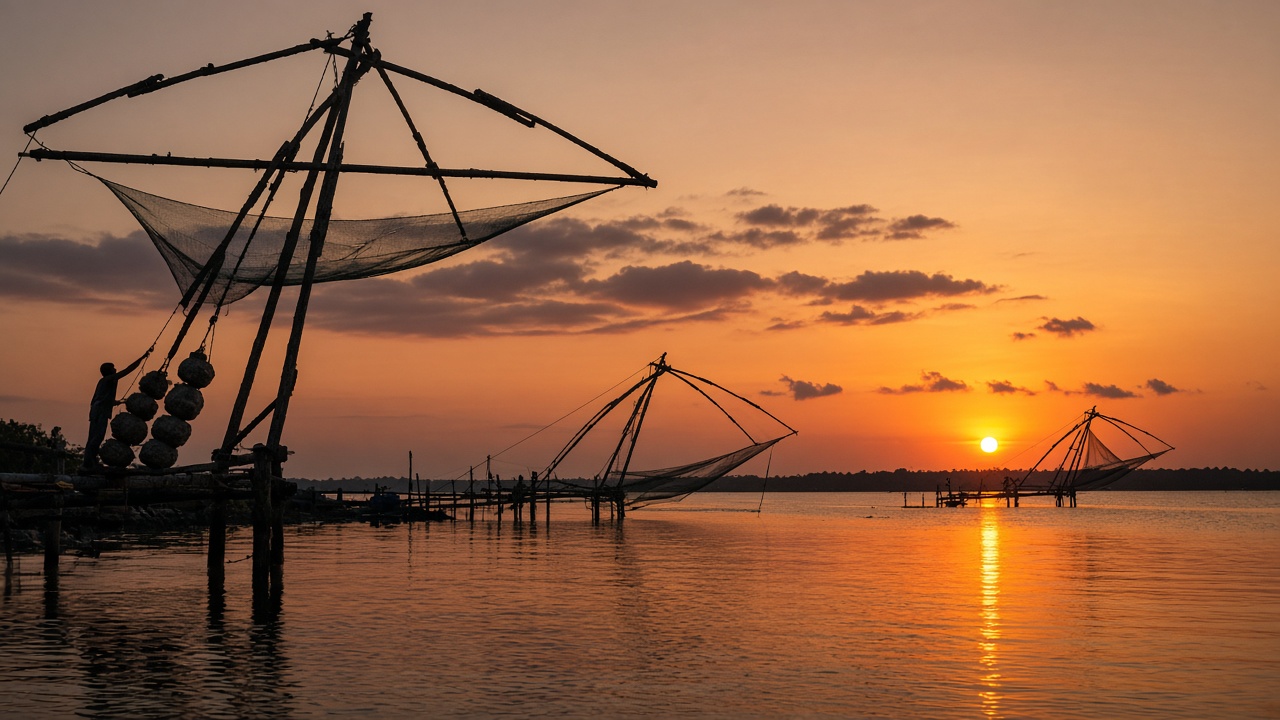
Kochi’s Chinese fishing nets are lowered and raised with stone counterweights (artistic illustration).
Craft / gear
Where
How it works
Kattumaram
Tamil Nadu and Andhra coasts
Raft of tied logs that rides through surf
Vallam
Kerala
Dugout or plank canoe for nets and lines
Masula boat
Andhra and Chennai coasts
Sewn-plank surf boat
Chinese dip net
Kochi, Kerala
Large net lowered and lifted on a wooden frame
Dol (stake) net
Gujarat and Maharashtra
Bag net fixed in tidal currents; catches Bombay duck
Gillnetter
All coasts and rivers
Wall of net that traps fish by their gills
Trawler
All coasts
Cone-shaped net dragged along the seabed
Purse seiner
Kerala, Karnataka, Goa
Net encircles shoals of sardine and mackerel
Floating cage
Reservoirs and sheltered sea
Fish raised inside net cages
Important Fish and Shellfish of India
Fish
Water
Known for
Rohu, catla, mrigal
Freshwater
Indian major carps; backbone of pond farming
Hilsa (ilish)
Sea and rivers
Prized in Bengal, Odisha, and Assam; migrates upriver to breed
Oil sardine
Marine
Kerala’s most common catch
Indian mackerel
Marine
Popular along the west coast (bangda, ayala)
Pomfret
Marine
Favourite in Mumbai and Gujarat
Bombay duck (bombil)
Marine
Dried and fried in Maharashtra and Gujarat
Seer fish (surmai, vanjaram)
Marine
High-value table fish
Tuna
Marine
Pole-and-line fishing in Lakshadweep
Vannamei and tiger shrimp
Brackishwater farms
India’s top seafood export
Pangasius
Freshwater farms
Fast-growing catfish, mainly in Andhra Pradesh
The Six Sectors of Indian Fisheries
Sector
What it is
Examples
Marine capture
Catching wild fish at sea
Sardine, mackerel, tuna, prawns
Inland capture
Catching fish in rivers, lakes, and reservoirs
Hilsa, river carps, reservoir fish
Freshwater aquaculture
Farming fish in ponds and tanks
Indian major carps, pangasius
Brackishwater aquaculture
Farming in coastal salty ponds
Vannamei and tiger shrimp, sea bass
Mariculture
Farming in the sea
Sea cages, mussels, seaweed
Ornamental fisheries
Breeding aquarium fish
Guppies, goldfish, native species
India’s Fish Production Over Time
Year
Fish (approx. million tonnes)
What was happening
1950–51
~0.75
Mostly marine catch by traditional craft
1960–61
~1.2
Mechanised boats and induced breeding
1970–71
~1.8
Trawlers spread
1980–81
~2.4
Fish Farmers’ Development Agencies
1990–91
~3.8
Blue Revolution in the Seventh Plan
2000–01
~5.7
Shrimp and carp farming grow
2010–11
~8.2
Inland fish overtakes marine
2020–21
~14.7
PMMSY launched
2023–24
~18.4
Record production
Blue Revolution & Fisheries Timeline Summary
Year / Era
Milestone
Harappan era
Copper fish hooks at Indus sites
12th century
Manasollasa describes fish and angling
14th–15th centuries
Chinese dip nets said to arrive in Kochi
1897
Indian Fisheries Act
1907
Madras Fisheries Bureau
1947
Marine and inland fisheries research stations
1953
Indo-Norwegian Project in Kerala
1957
Induced breeding of carps (10 July); CIFT Kochi
1959
Silver and grass carps introduced
1972
MPEDA formed
1970s
Fish Farmers’ Development Agencies
1976
Exclusive Economic Zone declared
1980
Kerala Marine Fishing Regulation Act
1985–90
Blue Revolution in the Seventh Plan
1994–95
White spot disease hits shrimp farms
1996
Supreme Court curbs coastal shrimp farms
2004
Indian Ocean tsunami
2005
Coastal Aquaculture Authority Act
2006
National Fisheries Development Board
2009
Vannamei shrimp farming permitted
2015
Blue Revolution scheme; uniform 61-day fishing ban
2019
Separate Department of Fisheries
2020
PM Matsya Sampada Yojana
2024
PM Matsya Kisan Samridhi Sah-Yojana
Test Your Knowledge
20 quick questions from the Blue Revolution and fisheries timeline. Click each question to reveal the answer.
Answer: Fisheries and aquaculture.
Answer: Catamaran.
Answer: Kochi, Kerala.
Answer: Killing fish with explosives and poison.
Answer: The Central Marine Fisheries Research Station (CMFRI) and the Central Inland Fisheries Research Station (CIFRI).
Answer: Norway (the Indo-Norwegian Project).
Answer: Induced breeding of carps using hormone injections.
Answer: 10 July.
Answer: Rohu, catla, and mrigal.
Answer: Seafood (marine products) exports.
Answer: 200 nautical miles.
Answer: The Seventh Five-Year Plan (1985–90).
Answer: White spot disease.
Answer: Pacific white shrimp (vannamei).
Answer: Andhra Pradesh.
Answer: Hilsa (ilish).
Answer: Pradhan Mantri Matsya Sampada Yojana.
Answer: 61 days.
Answer: Second.
Answer: Frozen shrimp.
Classroom activity
Students Tasks
Use these prompts for discussion or projects on fisheries and the Blue Revolution in India.
Mark India’s coastal states, major fishing harbours, and big reservoirs on a map.
Visit a local fish market and list the fish sold, noting which are freshwater and which are marine.
Make a line graph of India’s fish production from 1950–51 to 2023–24 using the table on this page.
Explain induced breeding in simple steps with a labelled diagram.
Compare traditional fishing craft with modern trawlers: benefits and problems.
Research why a monsoon fishing ban is important for fish stocks.
Debate: “Shrimp farming brings more harm than good to coastal areas.”
Interview a fisher or fish seller about how their work has changed over the years.
Design a poster on how plastic pollution harms fish and fishers.
Compare the Green, White, Yellow, and Blue Revolutions in one table.
Continue exploring
The Blue Revolution is one of India’s colourful farm revolutions. Explore the Green, White, and Yellow Revolutions and other agriculture timelines next.
Click any panel to expand and explore the visual mood.
India’s fisheries in pictures — kattumaram rafts, Chinese nets, fish-curing yards, carp hatcheries, trawlers, shrimp ponds, reservoir cages, and busy harbours.
Kattumaram
Log raft
Chinese Nets
Kochi
Curing Yard
Salted fish
Induced Breeding
1957
Trawlers
Mechanised fishing
Shrimp Farms
Coastal ponds
Cage Culture
Reservoir farming
Fishing Harbour
Dawn catch
Explore all agriculture timelines
Jump to any other agriculture timeline on WorldTimelineHub.
Disclaimer: This content is AI-generated for educational purposes and may contain errors or outdated details. For correct and authoritative information, please refer to official and reliable sources such as government publications, manufacturers, museums, and academic references.