The tomato is a newcomer to India — it arrived from the Americas only a few centuries ago — yet today almost every Indian curry, chutney, and rasam uses it, and India is the
world’s second-largest tomato grower. Goats and sheep, among the oldest farm animals in South Asia, supply red meat and support millions of small herders. Together they
make up the “Red Revolution”.
This timeline covers ancient goat and sheep herding, red spices before the tomato, Portuguese New World crops, the colonial vilayati baingan, IARI and IIHR tomato varieties,
goat and sheep research institutes, hybrids and ketchup, polyhouses and disease-resistant hybrids, the Tuta absoluta pest, Operation Greens, and the 2023 tomato price shock.
Tomatoes are one of India’s most widely grown and eaten vegetables, rich in vitamin C and the red pigment lycopene. They grow in almost every state and season, giving small
farmers quick cash — but their prices can swing wildly. Goats and sheep need little land, graze on scrub and crop stubble, and can be sold whenever a family needs money,
which is why goats are often called the “poor man’s cow”. Both the tomato and red meat sectors are about raising incomes, improving nutrition, and reducing waste.
Big picture
India’s Red Revolution in one view
Herders have raised goats and sheep in South Asia for about 9,000 years. The tomato arrived much later, was treated as a foreign curiosity under British rule, and only
became a kitchen staple after independence. Research institutes, hybrid seeds, polyhouses, and processing then made India a tomato giant, while goat and sheep farming
grew into a modern enterprise. Related timelines:
Pink Revolution,
Golden Revolution,
mandis and markets.
~20 MT
Tomatoes a year
2nd
Largest tomato producer
~149 M
Goats, 2019 census
~74 M
Sheep, 2019 census
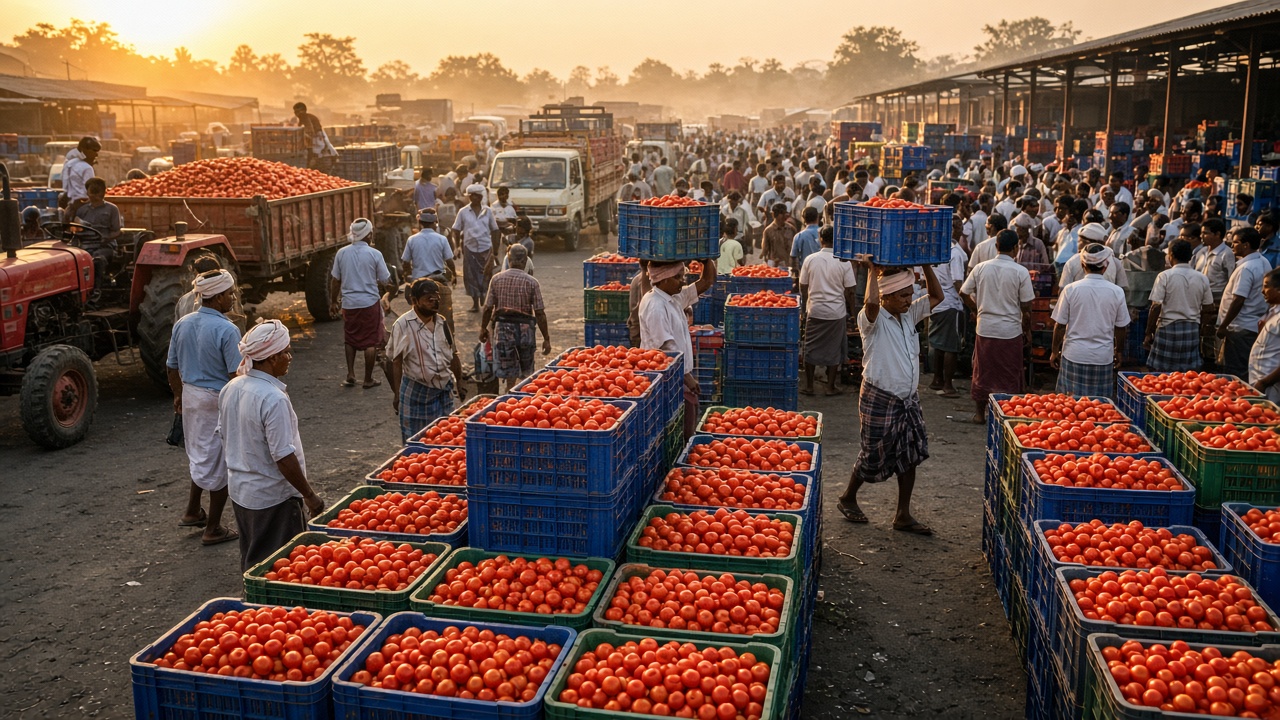
Markets such as Madanapalle and Kolar handle mountains of tomatoes every day (artistic illustration).
🐐 HerdersAncient – 1750
Herders, Red Spices & New World Crops
Goats and sheep were among the first animals tamed in South Asia, and pastoral communities have herded them ever since. There were no tomatoes in India until New World crops arrived with the Portuguese; sour and red flavours came from tamarind, kokum, and later chillies.
Chillies and, probably, tomatoes reached India through Portuguese Goa (artistic illustration).
c. 7000 BCE: Goats are domesticated at Mehrgarh (in present-day Pakistan); later Harappan sites have bones of goats, sheep, cattle, and buffalo.
Ancient period: Pastoral communities such as the Rabari, Gaddi, Dhangar, and Kuruba herd goats and sheep; tamarind, kokum, and curd give sour flavours.
1498–1600s: After Vasco da Gama reaches India (1498), the Portuguese bring chilli, potato, papaya, and pineapple — and probably the tomato, which originated in the Andes.
17th–18th centuries: Mutton dishes such as Kashmiri rogan josh get their red colour from Kashmiri chillies and ratanjot, not tomatoes, which are still rare.
Technology
Seasonal migration: Herds follow pastures.
Sun-dried chillies: Colour and heat.
Souring agents: Tamarind and kokum.
Features
Pastoral life: Goats and sheep.
New crops: From the Americas.
No tomato yet: Other red and sour tastes.
🌿 Kitchen Gardens1750 – 1946
Vilayati Baingan & Hill-Station Gardens
The British grew tomatoes in kitchen gardens and hill stations for their own tables, and Indians called the strange fruit the “foreign brinjal”. Slowly it spread to market gardens around cities. Meanwhile, government farms began breeding sheep for wool and mutton.
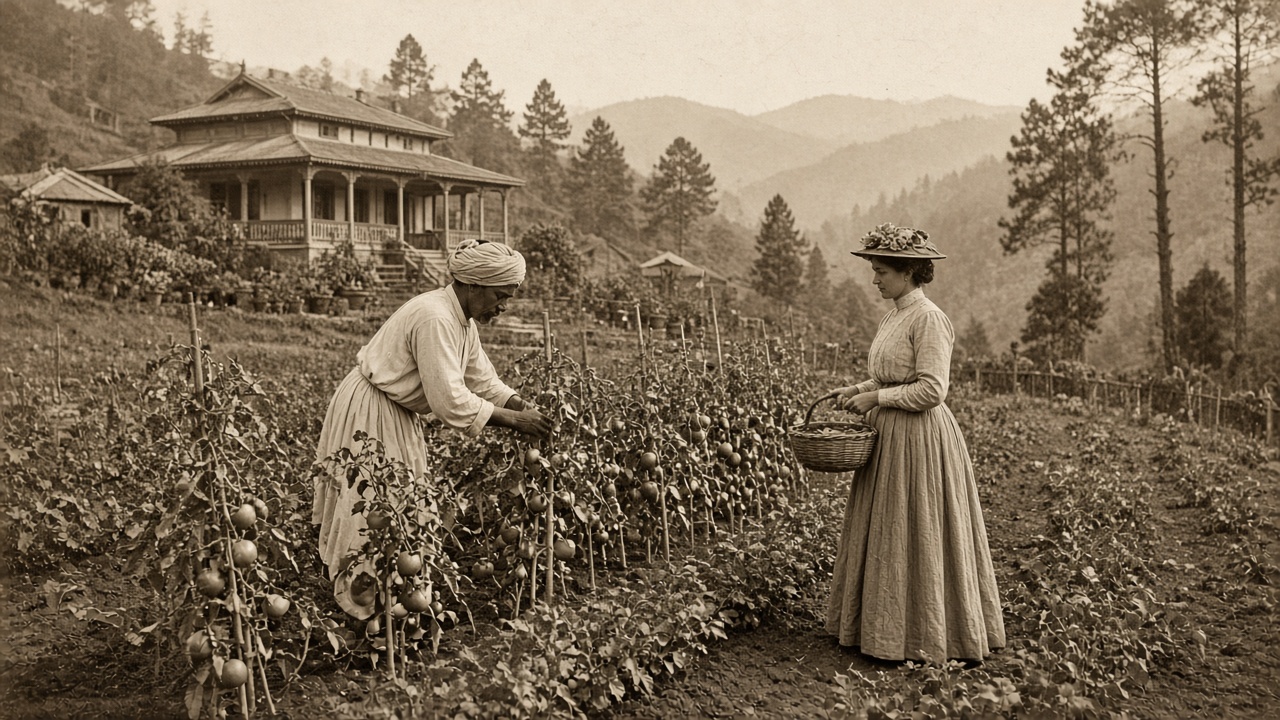
Tomatoes were first grown mainly for European tables (artistic illustration).
Early 1800s: British kitchen gardens grow tomatoes; Indians call them vilayati baingan (foreign brinjal) — biliti begun in Bengali.
1820: The Agricultural and Horticultural Society of India is founded in Calcutta and spreads seeds of European vegetables and fruits.
Late 1800s–1900s: Market gardens near Calcutta, Bombay, and hill stations supply tomatoes for soups, chutneys, and ketchup in Anglo-Indian cooking.
1905–1940s: Agricultural research begins at Pusa (1905); the Hissardale sheep is bred at the Hisar government livestock farm by crossing Merino and local Bikaneri sheep.
Technology
Imported seed: European tomato types.
Staking: Plants tied to canes.
Crossbreeding: Merino sheep crosses.
Features
Foreign fruit: Slow acceptance.
City gardens: Near colonial towns.
Livestock farms: Sheep breeding.
🍅 Kitchen Staple1947 – 1990
Tomato Enters Every Kitchen
After independence, tomatoes became a base for curries, dals, rasam, and chutneys across India. Research institutes bred Indian tomato varieties, and new institutes for sheep and goats improved breeds for meat, wool, and milk.
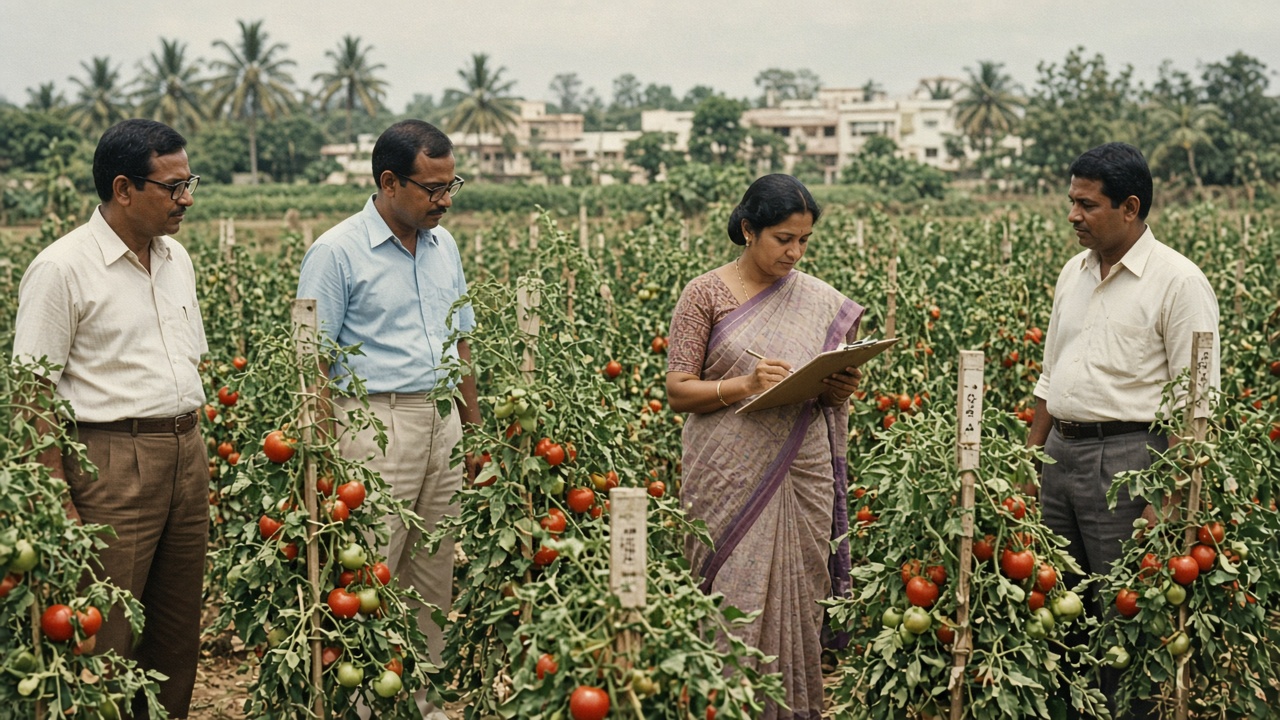
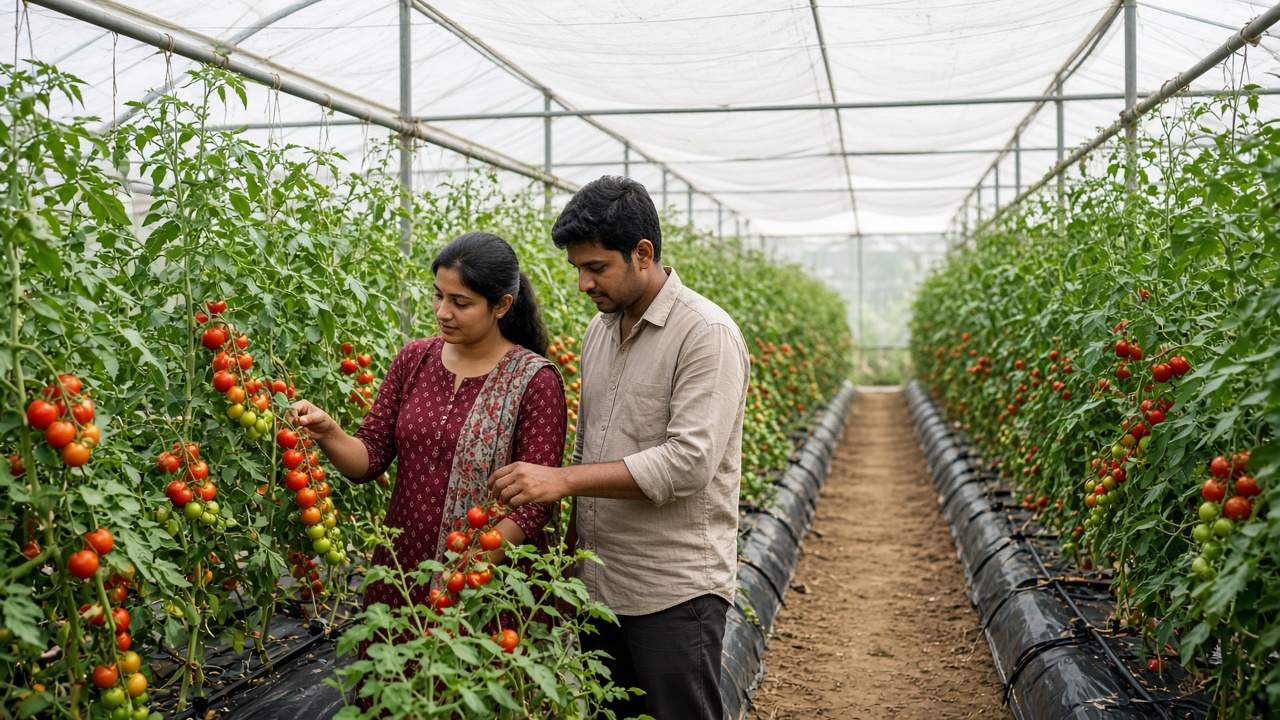
Indian scientists bred tomatoes suited to Indian soils and seasons (artistic illustration).
1950s–1960s: Tomato spreads in everyday cooking; IARI, New Delhi, releases early Indian varieties such as Pusa Ruby.
1962–1967: The Central Sheep and Wool Research Institute is set up at Avikanagar, Rajasthan (1962); the Indian Institute of Horticultural Research opens in Bengaluru (1967).
1970s–1979: IIHR releases “Arka” tomato varieties; the Central Institute for Research on Goats is founded at Makhdoom near Mathura (1979).
1980s: The National Horticulture Board is set up (1984); private seed companies begin selling hybrid tomato seed.
Technology
Improved varieties: Pusa and Arka.
Nursery raising: Healthy seedlings.
Breed improvement: Goats and sheep.
Features
Kitchen staple: Curry bases.
Research institutes: Crops and animals.
First hybrids: Higher yields.
🥫 Hybrids1991 – 2006
Hybrids, Ketchup & the Red Revolution Idea
Hybrid tomatoes spread rapidly in Karnataka, Andhra Pradesh, and Maharashtra, and yields rose. Ketchup, sauces, and tomato paste became big businesses, and the idea of a “Red Revolution” in tomatoes and meat came into use.
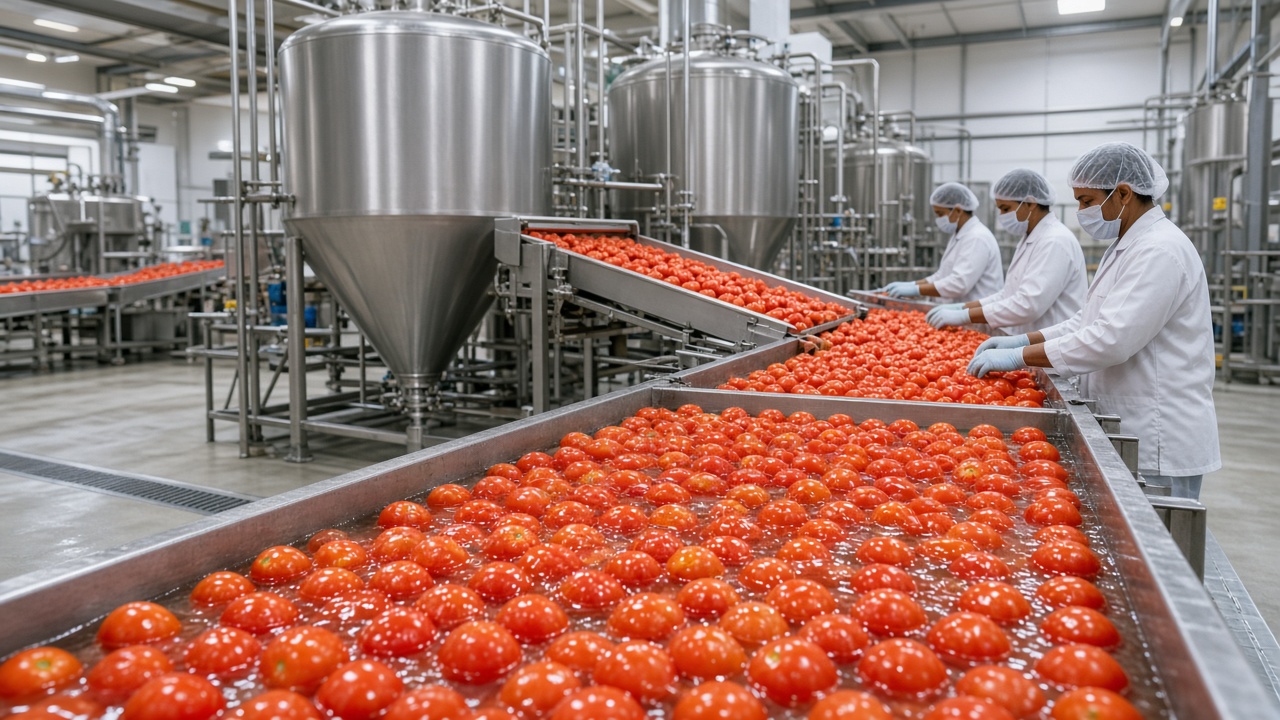
Processing turns surplus tomatoes into puree, paste, and ketchup (artistic illustration).
1990s: Hybrid tomatoes spread quickly; Kolar (Karnataka) and Madanapalle (Andhra Pradesh) grow into huge tomato markets.
1990s: Ketchup and sauce brands expand after liberalisation, and processing plants make tomato puree and paste.
1990s–2000s: “Red Revolution” is used informally for boosting tomato and meat production; goat and sheep numbers keep rising.
2005–2006: The National Horticulture Mission begins, supporting nurseries, protected cultivation, and post-harvest infrastructure.
Technology
F1 hybrids: Uniform, high-yielding plants.
Paste plants: Evaporators and aseptic packing.
Plastic crates: Less damage in transport.
Features
Higher yields: Hybrid boom.
Processed foods: Ketchup and sauces.
New term: Red Revolution.
🏠 Polyhouses2007 – 2014
Polyhouses, Resistant Hybrids & New Pests
Farmers adopted polyhouses, drip irrigation, and plastic mulch. Indian scientists released hybrids that resist several diseases at once, and India became the world’s second-largest tomato producer — but a new invasive pest arrived.
Polyhouses give higher yields and cleaner fruit all year round (artistic illustration).
2007–2010: Polyhouse and drip subsidies spread; cherry tomatoes and trellised hybrids appear near big cities.
2010: IIHR releases Arka Rakshak, a hybrid resistant to leaf curl virus, bacterial wilt, and early blight.
2013–2014: Tomato output reaches about 18–19 million tonnes, second only to China.
2014: The South American tomato leaf miner (Tuta absoluta) is first reported in India; a National Livestock Mission supports goat and sheep farming.
Technology
Polyhouses: Protected cultivation.
Drip and mulch: Water saving.
Pheromone traps: Pest monitoring.
Features
2nd in world: After China.
Disease resistance: Arka Rakshak.
New threats: Invasive pests.
📈 Operation Greens2015 – Present
Operation Greens, Price Shocks & Goat Farming
The government launched a special scheme to steady tomato, onion, and potato prices, but weather shocks still caused price spikes. Goat and sheep farming grew into a business for young entrepreneurs with support for breeding farms.
During the 2023 price spike, subsidised tomatoes were sold from vans (artistic illustration).
2018: Operation Greens is announced for tomato, onion, and potato (TOP) to support processing, storage, and transport; it is extended to more perishables in 2021.
2019: The 20th Livestock Census counts about 149 million goats and 74 million sheep.
2021: A revised National Livestock Mission supports goat, sheep, pig, and poultry breeding farms run by entrepreneurs.
2023–present: Tomato prices cross ₹200 per kg in July–August 2023, and NCCF and NAFED sell subsidised tomatoes; production stays around 20 million tonnes.
Technology
Solar drying: Tomato powder and flakes.
Price apps: Mandi rates on phones.
Artificial insemination: Better goat breeds.
Features
TOP crops: Price stability.
Price shocks: Weather risks.
Agri-business: Goat farming startups.
Famous Goat and Sheep Breeds of India
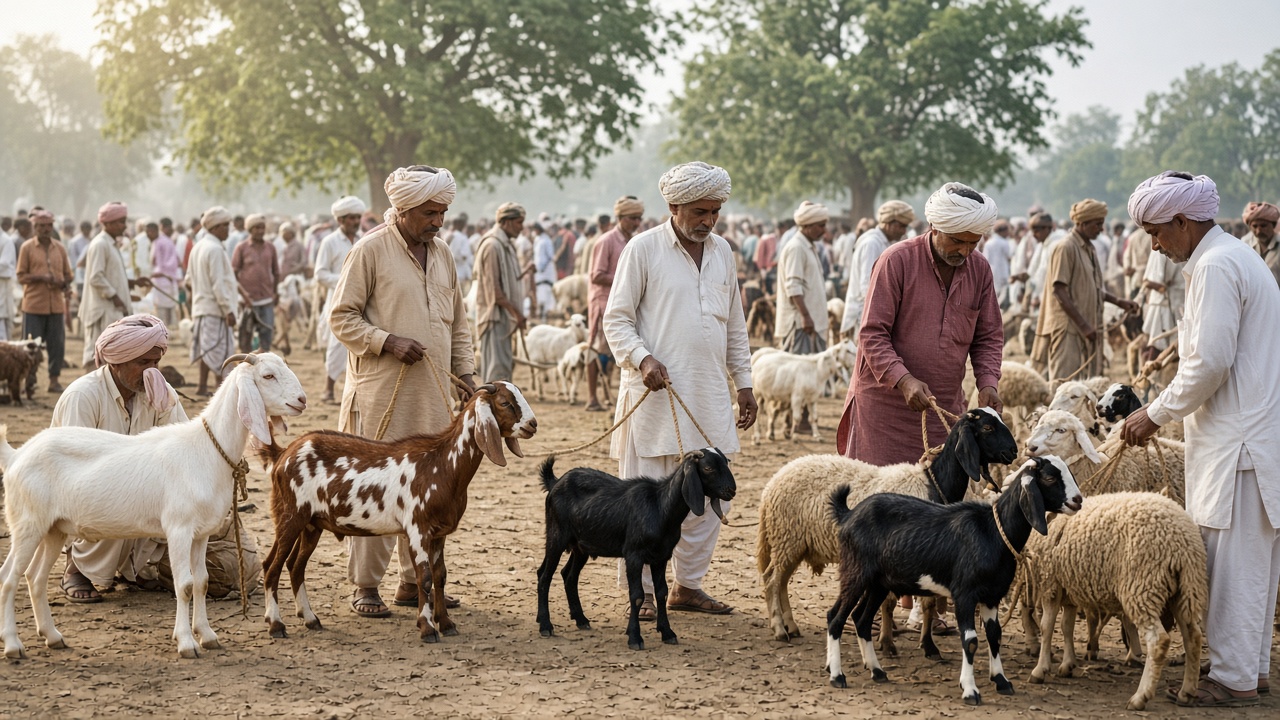
Weekly markets bring together goats and sheep of many breeds (artistic illustration).
Breed
Animal
Home region
Known for
Jamunapari
Goat
Etawah, Uttar Pradesh
Tall, long ears; milk and meat
Barbari
Goat
Uttar Pradesh
Small, suits stall-feeding
Black Bengal
Goat
West Bengal, Odisha, Assam
Tender meat, fine skin
Sirohi
Goat
Rajasthan
Hardy, meat and milk
Osmanabadi
Goat
Maharashtra
Meat breed of the Deccan
Beetal
Goat
Punjab
Large, milk and meat
Deccani
Sheep
Maharashtra, Karnataka, Telangana
Mutton
Nellore
Sheep
Andhra Pradesh
Tall mutton sheep
Marwari
Sheep
Rajasthan
Carpet wool
Madras Red
Sheep
Tamil Nadu
Hardy mutton sheep
Garole
Sheep
Sundarbans, West Bengal
Small, often gives twins
Indian Tomato Varieties and Types
Variety or type
Developed by
Feature
Desi (local) tomatoes
Farmers
Sour, juicy, good for curries and rasam
Pusa Ruby
IARI, New Delhi
Early Indian open-pollinated variety
Arka Vikas
IIHR, Bengaluru
Suited to rain-fed and dry areas
Arka Rakshak
IIHR, Bengaluru
Resists three major diseases
Private F1 hybrids
Seed companies
Firm fruit for long transport
Cherry tomatoes
Polyhouse growers
Small, sweet, for salads and hotels
Processing types
Research and industry
Thick flesh for puree and ketchup
Major Tomato-Growing States and Markets
State
Notable areas or markets
Andhra Pradesh
Madanapalle, Chittoor, Anantapur
Madhya Pradesh
Shivpuri, Jhabua, Dhar
Karnataka
Kolar, Chikkaballapur
Maharashtra
Nashik, Pune (Narayangaon), Satara
Gujarat
Anand, Vadodara, Sabarkantha
Odisha
Cuttack, Balangir, Kalahandi
Tamil Nadu
Krishnagiri, Dharmapuri
West Bengal
Winter tomatoes of the plains
India’s Tomato Production Over Time
Year
Tomatoes (approx. million tonnes)
What was happening
1991–92
~5
Hybrids begin to spread
2001–02
~7.5
Processing and ketchup grow
2011–12
~18.7
Polyhouses and National Horticulture Mission
2017–18
~19.8
Operation Greens planned
2022–23
~20.7
Price spike follows in 2023
Figures are rounded estimates from horticulture statistics and vary slightly between sources.
Red Revolution: Tomato & Meat Timeline Summary
Year / Era
Milestone
c. 7000 BCE
Goats domesticated at Mehrgarh
Harappan era
Goat and sheep bones at Indus sites
1498–1600s
Portuguese bring New World crops, probably including tomato
Early 1800s
Tomato grown in British gardens as vilayati baingan
1820
Agricultural and Horticultural Society of India, Calcutta
1905
Agricultural research begins at Pusa
1950s–1960s
Tomato enters everyday cooking; Pusa Ruby
1962
Central Sheep and Wool Research Institute, Avikanagar
1967
IIHR founded in Bengaluru
1979
Central Institute for Research on Goats, Makhdoom
1984
National Horticulture Board
1990s
Hybrid tomatoes; ketchup boom; Red Revolution term
2005–06
National Horticulture Mission
2010
Arka Rakshak hybrid released
2014
Tuta absoluta reported; National Livestock Mission
2018
Operation Greens for TOP crops
2019
About 149 million goats and 74 million sheep counted
2021
Revised National Livestock Mission; Operation Greens extended
2023
Tomato prices cross ₹200 per kg
Test Your Knowledge
20 quick questions from the Red Revolution tomato and meat timeline. Click each question to reveal the answer.
Answer: Tomatoes and red meat.
Answer: The Andes of South America.
Answer: The Portuguese.
Answer: Foreign brinjal — an old name for the tomato.
Answer: Mehrgarh.
Answer: Kashmiri chillies and ratanjot, not tomatoes.
Answer: Any two of Rabari, Gaddi, Dhangar, and Kuruba.
Answer: Hissardale.
Answer: Pusa Ruby.
Answer: Bengaluru, Karnataka.
Answer: Makhdoom, near Mathura, Uttar Pradesh.
Answer: It is cheap to keep, needs little land, and gives milk, meat, and quick cash.
Answer: Madanapalle (Andhra Pradesh) and Kolar (Karnataka).
Answer: Tomato leaf curl virus, bacterial wilt, and early blight.
Answer: China.
Answer: The South American tomato leaf miner, Tuta absoluta.
Answer: Tomato, Onion, and Potato.
Answer: About 149 million.
Answer: 2023.
Answer: Lycopene.
Classroom activity
Students Tasks
Use these prompts for discussion or projects on tomatoes, goats and sheep, and the Red Revolution in India.
Draw a world map showing the tomato’s journey from the Andes to Mexico, Europe, and India.
List ten Indian dishes that use tomato and ten traditional dishes that do not.
Grow a tomato plant in a pot and record its height, flowers, and fruits every week.
Track the price of tomatoes in a local market for a month and explain the changes.
Make a bar graph of India’s tomato production using the table on this page.
Mark the home regions of five goat and five sheep breeds on a map of India.
Explain why goats are important for landless and small farmers.
Suggest three ways to reduce the waste of tomatoes when prices crash.
Make homemade tomato chutney or puree and describe how processing adds value.
Compare the Green, White, Yellow, Blue, Silver, Golden, Gene, Protein, Pink, and Red Revolutions in one table.
Continue exploring
The Red Revolution is one of India’s colourful farm revolutions. Explore the Pink, Golden, Silver, Protein, Blue, White, Gene, Green, and Yellow Revolutions and other agriculture timelines next.
Click any panel to expand and explore the visual mood.
India’s Red Revolution in pictures — Portuguese Goa, hill-station gardens, research plots, tomato factories, polyhouses, subsidised tomato vans, goat markets, and giant tomato mandis.
New World Crops
Portuguese Goa
Vilayati Baingan
Colonial gardens
Research Plots
Pusa and Arka
Tomato Factory
Puree and ketchup
Polyhouse
Drip and mulch
Price Shock
Subsidised tomatoes
Goat Market
Many breeds
Tomato Mandi
Mountains of red
Explore all agriculture timelines
Jump to any other agriculture timeline on WorldTimelineHub.
Disclaimer: This content is AI-generated for educational purposes and may contain errors or outdated details. For correct and authoritative information, please refer to official and reliable sources such as government publications, manufacturers, museums, and academic references.