The chicken’s wild ancestor, the red junglefowl, still roams Indian forests. For centuries poultry meant a few hardy desi birds scratching around village homes. In 1950–51
India produced fewer than 2 billion eggs a year. Today it produces about 143 billion — making it the world’s second-largest egg producer.
This timeline covers the red junglefowl, the Aseel fighting cock and Kadaknath, colonial poultry farms and imported breeds, regional poultry farms and CPDOs, Venkateshwara
Hatcheries and NECC, the Silver Revolution in eggs, contract broiler farming, bird flu, and today’s record production.
Eggs and chicken are among the cheapest sources of high-quality protein, vitamins, and minerals, and are important in fighting malnutrition. Many states now serve eggs
in school midday meals. Poultry gives quick income to small farmers, landless families, and women who keep a few birds, and the commercial poultry industry supports
lakhs of jobs in hatcheries, feed mills, farms, transport, and shops.
Big picture
India’s poultry story in one view
Village families kept small flocks of desi birds for thousands of years. After independence, government poultry farms, research institutes, and — from the 1970s —
private hatcheries with high-yielding hybrid birds turned poultry into one of India’s fastest-growing farm sectors. Organised egg pricing and contract broiler
farming completed the Silver Revolution.
Related timelines:
White Revolution,
Blue Revolution,
Green Revolution.
~143 bn
Eggs produced, 2023–24
2nd
Largest egg producer
~103
Eggs per person per year
~85 crore
Poultry birds (2019 census)
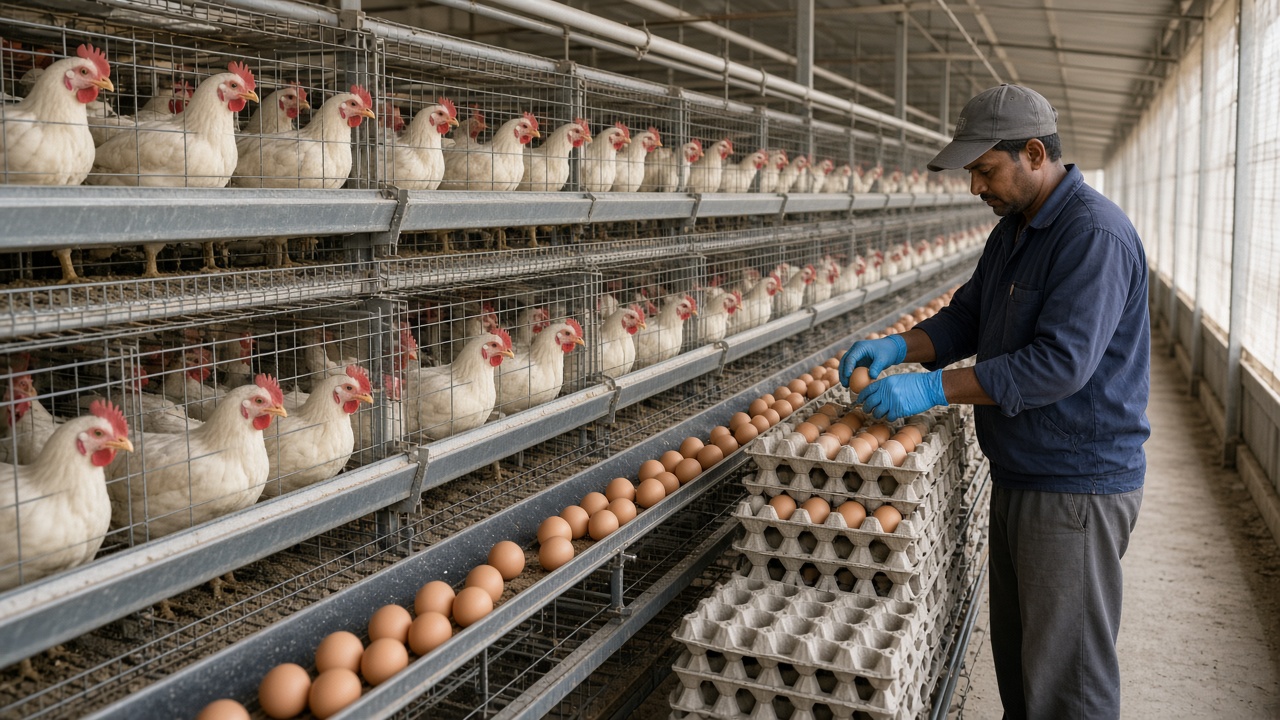
Large layer farms now produce most of India’s eggs (artistic illustration).
🐓 Desi BirdsAncient – 1850
Junglefowl, Aseel & Backyard Birds
The Indian subcontinent is home to the red junglefowl, the chicken’s wild ancestor. Village families kept hardy desi birds for eggs, meat, rituals, and sport, and developed famous breeds such as the Aseel and Kadaknath.
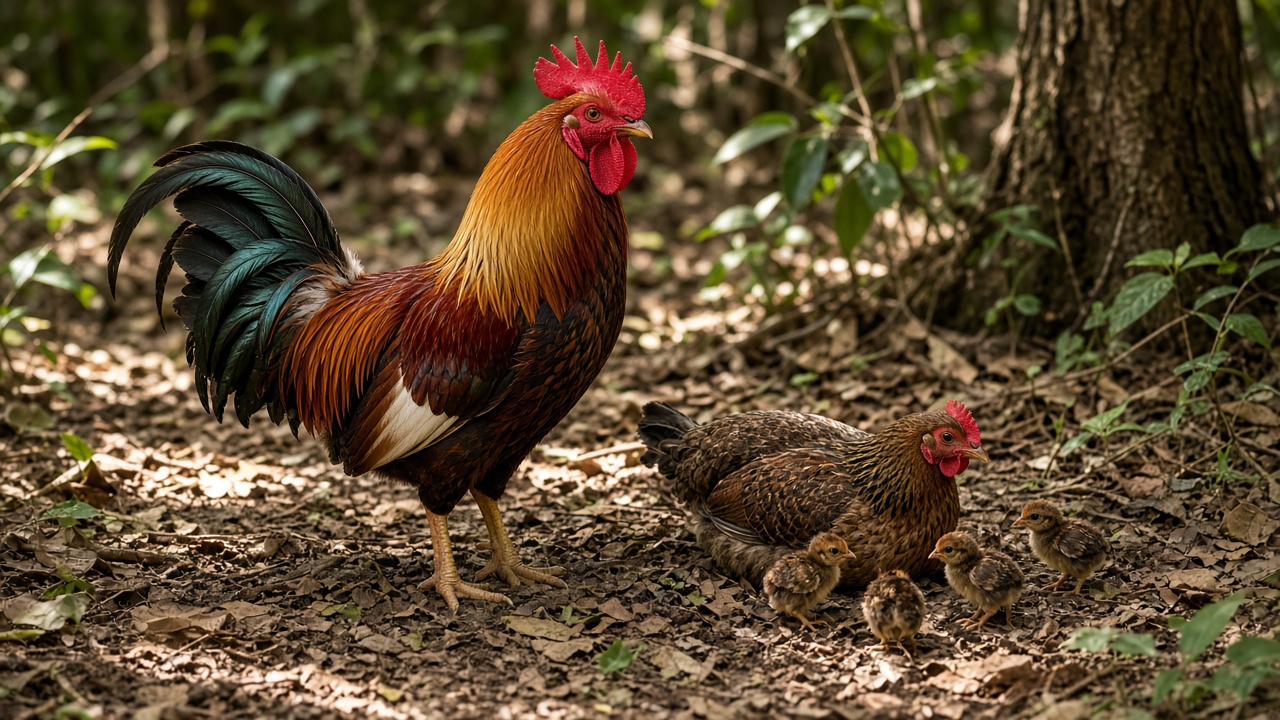
The red junglefowl of Indian forests is the main wild ancestor of the chicken (artistic illustration).
Prehistoric times: Red junglefowl live in the forests of India and South-East Asia; people in this wider region domesticate them into chickens.
Harappan era: Chicken bones and bird figurines are reported at some Indus sites, though how early chickens were kept is still debated.
Ancient–medieval period: The Aseel is bred as a strong fighting cock; texts such as the 12th-century Manasollasa describe cockfighting as a royal sport.
Tribal traditions: Bhil and Bhilala communities of Jhabua raise the black-meated Kadaknath; ducks are kept in the wetlands of Assam, Bengal, and Kerala.
Technology
Broody hens: Natural hatching of eggs.
Bamboo baskets: Night shelter for birds.
Scavenging: Birds feed on kitchen waste and insects.
Features
Hardy breeds: Resist heat and disease.
Low output: Only 40–60 eggs a year.
Women’s income: Birds sold in local markets.
🏛️ Colonial Farms1850 – 1946
Colonial Poultry Farms & Foreign Breeds
Indian birds travelled to Europe and America, where they helped create new breeds. At the same time, missions and government farms in India brought in high-laying foreign breeds and began studying poultry diseases.
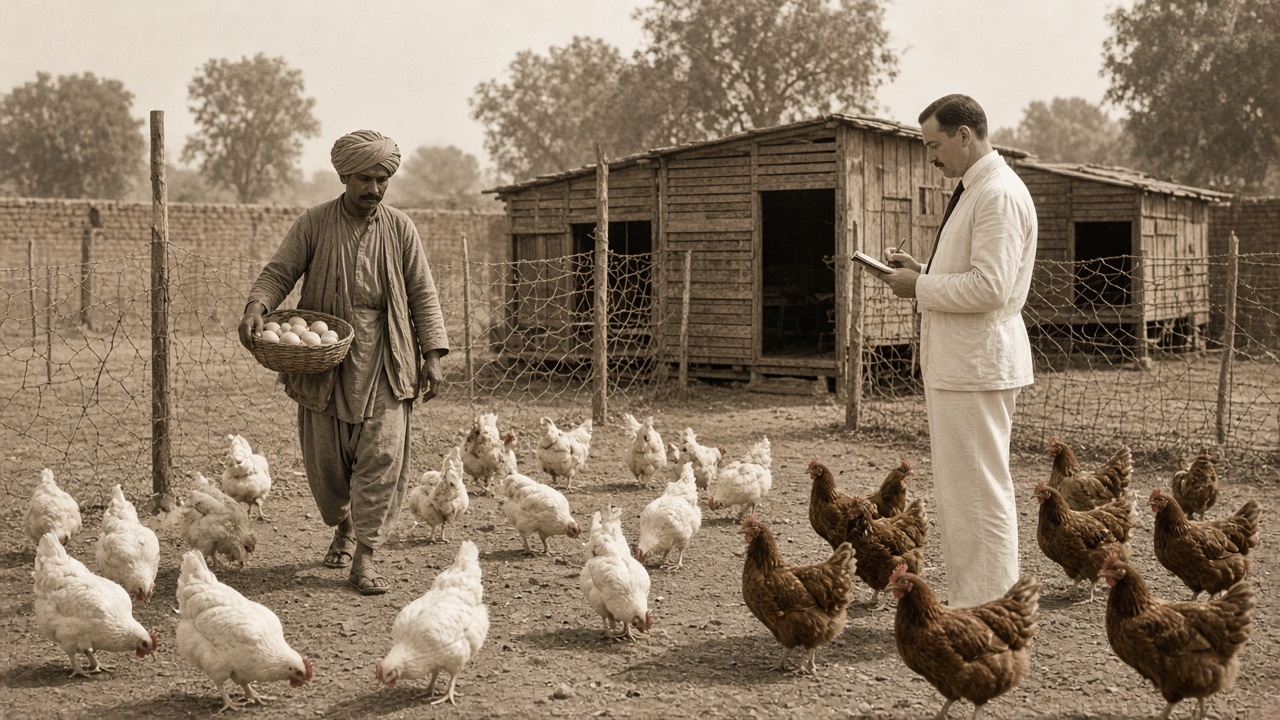
Mission and government farms introduced White Leghorns and Rhode Island Reds (artistic illustration).
1840s–1850s: Large Asian birds, including “Chittagong” fowl, are shipped to Britain and America and help create breeds such as the Brahma.
19th century: The Cornish (Indian Game) is developed in England from Aseel crosses; it later becomes a parent of the modern broiler chicken.
Early 20th century: Christian missions and government farms introduce White Leghorn, Rhode Island Red, and other exotic breeds.
1920s–1940s: Newcastle disease is identified at Ranikhet and named “Ranikhet disease”; the Imperial Veterinary Research Institute at Izatnagar starts poultry research.
Technology
Wire-fenced runs: Organised farms.
Early vaccines: Against Ranikhet disease.
Selective breeding: More eggs per hen.
Features
Exotic breeds: Leghorn and RIR arrive.
Global impact: Aseel genes in broilers.
Village flocks: Still mostly desi birds.
🐣 Planning1947 – 1969
Regional Poultry Farms & Planned Development
Five-Year Plans treated poultry as a way to improve nutrition and rural incomes. Government farms supplied improved chicks and trained farmers, and private hatcheries began importing hybrid birds.
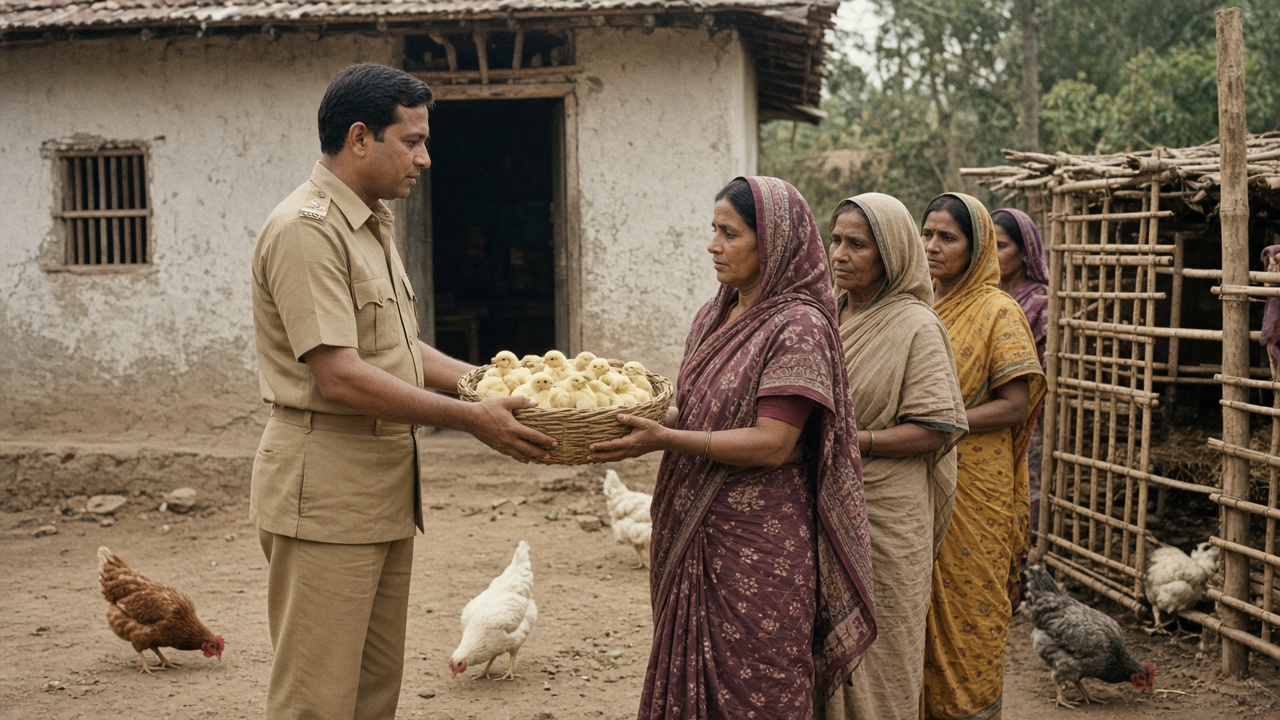
Extension officers distributed improved chicks to village families (artistic illustration).
1950s: Regional poultry farms are set up at Bengaluru, Bhubaneswar, Mumbai, and Chandigarh; they later become Central Poultry Development Organisations (CPDOs).
Late 1950s–1960s: The Applied Nutrition Programme promotes backyard poultry and eggs for better diets.
1960s: Intensive Poultry Development projects supply chicks, feed, and vaccines in selected districts.
Late 1960s: Private hatcheries start importing high-yielding hybrid layer and broiler stock from abroad.
Technology
Incubators: Hatching without hens.
Balanced feed: Grain and protein mixes.
Vaccination: Ranikhet and fowl pox.
Features
Government farms: Chicks and training.
Nutrition focus: Eggs for children.
First hybrids: Imported stock.
🥚 Silver Revolution1970 – 1990
Hatcheries, NECC & the Silver Revolution
Private hatcheries, national breeding research, and farmer-led egg pricing transformed poultry from a backyard activity into a modern industry. Egg production grew several times over — the Silver Revolution.
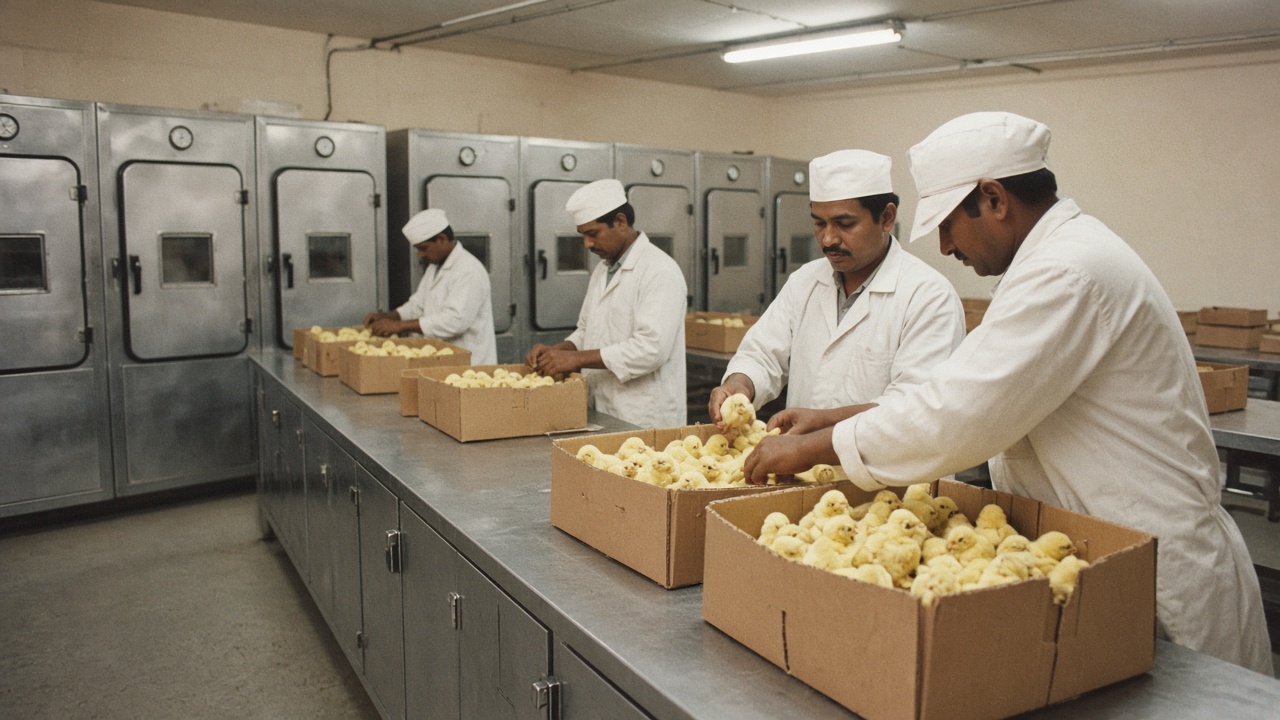
Commercial hatcheries supplied millions of day-old chicks to farmers (artistic illustration).
1971: Dr B. V. Rao founds Venkateshwara Hatcheries in Hyderabad; the All India Coordinated Research Project on Poultry Breeding begins around this time.
1979: The Central Avian Research Institute (CARI) is set up at Izatnagar, Uttar Pradesh.
1982: The National Egg Coordination Committee (NECC) is formed to set egg prices; its “Sunday ho ya Monday, roz khao ande” campaign becomes famous.
1988: The Project Directorate on Poultry (now ICAR-Directorate of Poultry Research) is set up in Hyderabad; egg output reaches about 20 billion a year.
Technology
Hybrid layers: 250+ eggs a year.
Cage housing: Clean, efficient laying.
Vaccine production: Made in India.
Features
Farmer power: NECC egg prices.
Private sector: Drives growth.
Egg promotion: Mass advertising.
🍗 Broiler Boom1991 – 2010
Broiler Boom, Contract Farming & Bird Flu
Rising incomes increased demand for chicken. Contract farming spread broiler sheds across southern villages, scientists released improved backyard birds, and the first bird flu outbreak tested the industry.
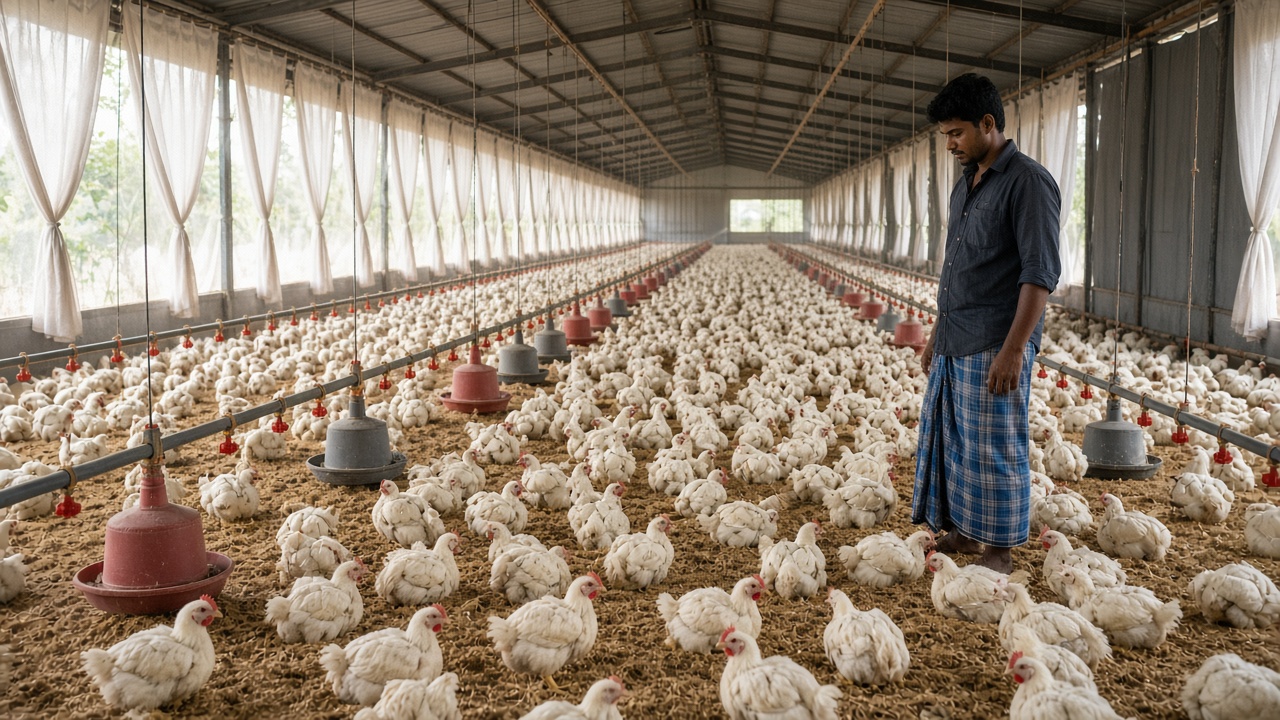
Contract farmers raise company chicks in their own sheds (artistic illustration).
Around 1990–1991: Suguna pioneers contract broiler farming in Tamil Nadu; the Vanaraja backyard bird is released by the Project Directorate on Poultry.
1990s: Namakkal in Tamil Nadu grows into India’s “egg city”; Keggfarms develops the Kuroiler bird for village families.
2000: The Gramapriya backyard layer is released; broiler meat becomes the fastest-growing meat in India.
February 2006: India’s first H5N1 bird flu outbreak strikes Navapur, Maharashtra; lakhs of birds are culled and chicken sales crash for weeks.
Technology
Fast broilers: Market weight in about 6 weeks.
Integrated firms: Hatchery to retail.
Biosecurity: Disinfection and culling.
Features
Contract income: Low risk for farmers.
South leads: AP, TN, Karnataka.
Backyard revival: Coloured dual-purpose birds.
📦 Modern Poultry2011 – Present
Record Eggs, GI Tags & Modern Poultry
India became the world’s second-largest egg producer. New schemes support rural poultry and infrastructure, while the industry faces rumours, bird flu, and concern over antibiotic use.
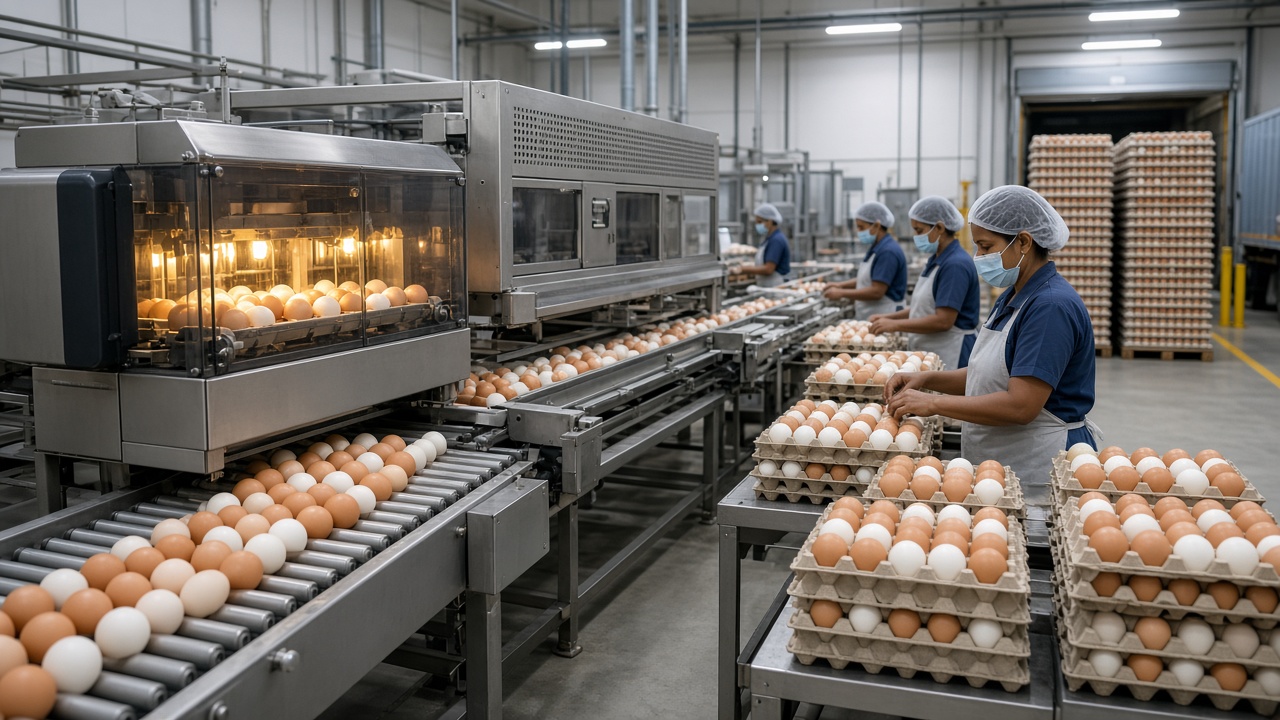
Grading, candling, and packing make eggs safer for city shoppers (artistic illustration).
2012–2015: An emu farming boom in Tamil Nadu collapses (2012); the National Livestock Mission begins (2014); the WTO rules against India’s bird-flu import ban (2015).
2018–2019: Kadaknath gets a GI tag (2018); colistin is banned as a growth promoter and the livestock census counts about 85 crore poultry birds (2019).
2020–2021: False COVID-19 rumours crash chicken prices; the Animal Husbandry Infrastructure Development Fund is launched; bird flu hits several states (2021).
2023–present: Egg production reaches about 143 billion, led by Andhra Pradesh; eggs in midday meals and packaged branded eggs expand.
Technology
Environment-controlled sheds: Cooling and automation.
Egg grading: Candling and cartons.
Cold chains: Frozen and processed chicken.
Features
Desi revival: Kadaknath and Aseel demand.
Food safety: Antibiotic limits.
Animal welfare: Debate on battery cages.
Indigenous and Improved Poultry Breeds
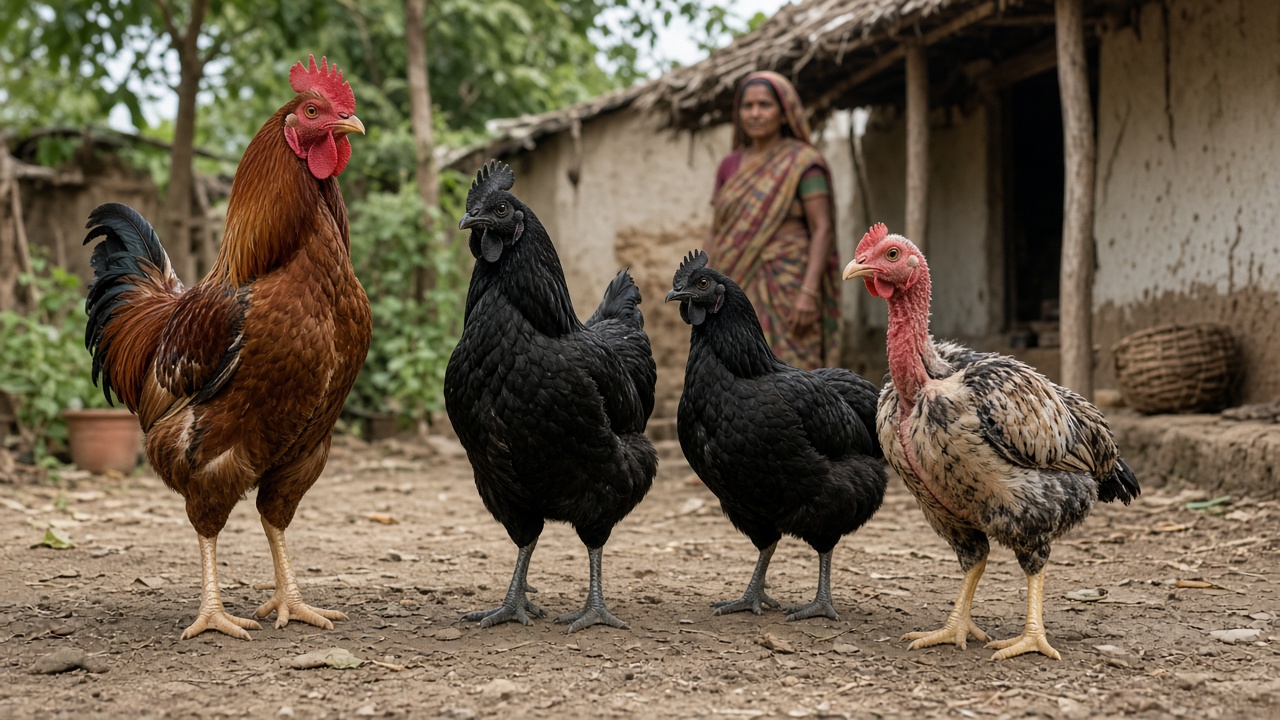
Desi breeds such as Aseel and Kadaknath are hardy and fetch high prices (artistic illustration).
Breed / bird
Home region
Known for
Aseel
Andhra Pradesh, Telangana, Odisha
Strong fighting cock; tasty meat; ancestor of the Cornish
Kadaknath
Jhabua, Madhya Pradesh
Black feathers, skin, and meat; GI tag in 2018
Chittagong (Malay)
Bengal and the North-East
Tall, heavy bird used in early breeding abroad
Busra
Maharashtra and Gujarat
Hardy light-bodied layer
Naked Neck
Kerala and other regions
Few neck feathers; copes well with heat
Frizzle
Many regions
Curled feathers
Nicobari
Andaman and Nicobar Islands
Small, good layer for an indigenous bird
Miri
Assam
Tribal backyard bird
Vanaraja
Developed in Hyderabad (1991)
Coloured dual-purpose backyard bird
Gramapriya
Developed in Hyderabad (2000)
Backyard layer giving brown eggs
Kuroiler
Developed by Keggfarms (1990s)
Hardy village bird for eggs and meat
Types of Poultry Farming in India
System
How it works
Where common
Backyard poultry
A few desi or improved birds scavenge around the home
Villages and tribal areas everywhere
Commercial layers
Thousands of hybrid hens in cages lay eggs daily
Andhra Pradesh, Namakkal, Telangana
Contract broilers
Company supplies chicks and feed; farmer raises birds
Tamil Nadu, Karnataka, Maharashtra
Hatcheries
Incubate eggs and sell day-old chicks
Near big poultry clusters
Duck farming
Ducks raised in paddy fields and wetlands
Kerala, Assam, West Bengal, Andhra Pradesh
Quail, turkey, and emu
Niche birds for meat and eggs; the emu boom of the 2000s later collapsed
Tamil Nadu, Karnataka, Andhra Pradesh
India’s Egg Production Over Time
Year
Eggs (approx. billion)
What was happening
1950–51
~1.8
Mostly backyard desi birds
1960–61
~2.9
Regional poultry farms and nutrition programmes
1970–71
~6.2
Hybrid layers and private hatcheries
1980–81
~10
Silver Revolution under way
1990–91
~21
NECC and commercial layer farms
2000–01
~36.6
Namakkal and Andhra clusters grow
2010–11
~63
Recovery after bird flu
2020–21
~122
COVID rumours and bird flu
2023–24
~143
Record production; about 103 eggs per person
Silver Revolution & Poultry Timeline Summary
Year / Era
Milestone
Prehistoric
Red junglefowl domesticated in South and South-East Asia
12th century
Manasollasa describes cockfighting
1840s–1850s
Asian fowl shipped abroad; Brahma breed developed
19th century
Cornish (Indian Game) bred from Aseel crosses
Early 1900s
White Leghorn and Rhode Island Red introduced
1920s
Ranikhet (Newcastle) disease identified
1950s
Regional poultry farms (later CPDOs)
1960s
Applied Nutrition Programme and intensive poultry projects
1971
Venkateshwara Hatcheries founded
1979
Central Avian Research Institute, Izatnagar
1982
National Egg Coordination Committee (NECC)
1988
Project Directorate on Poultry, Hyderabad
Around 1990
Contract broiler farming begins in Tamil Nadu
1991
Vanaraja backyard bird released
2000
Gramapriya backyard layer released
2006
First H5N1 bird flu outbreak, Navapur
2012
Emu farming boom collapses
2014
National Livestock Mission
2015
WTO ruling on bird-flu import ban
2018
Kadaknath GI tag
2019
Colistin banned as growth promoter; ~85 crore poultry counted
20 quick questions from the Silver Revolution and poultry timeline. Click each question to reveal the answer.
Answer: Eggs and poultry.
Answer: The red junglefowl.
Answer: Aseel.
Answer: Kadaknath.
Answer: 2018.
Answer: The Cornish (Indian Game).
Answer: Ranikhet (Ranikhet disease).
Answer: White Leghorn and Rhode Island Red.
Answer: Central Poultry Development Organisation.
Answer: Dr B. V. Rao.
Answer: Venkateshwara Hatcheries.
Answer: National Egg Coordination Committee, formed in 1982.
Answer: “… roz khao ande” (eat eggs every day).
Answer: Izatnagar, Uttar Pradesh.
Answer: Vanaraja and Gramapriya.
Answer: Namakkal.
Answer: Navapur, Maharashtra, in February 2006.
Answer: Andhra Pradesh.
Answer: Second (after China).
Answer: On the second Friday of October.
Classroom activity
Students Tasks
Use these prompts for discussion or projects on eggs, poultry, and the Silver Revolution in India.
Timeline understandingNutritionRural economyAnimal health
Mark India’s top egg-producing states and poultry clusters such as Namakkal on a map.
Make a line graph of India’s egg production from 1950–51 to 2023–24 using the table on this page.
Compare a desi hen with a hybrid layer: eggs per year, feed, hardiness, and price.
Draw the life cycle of a chicken from egg to adult, including incubation time.
Find out how contract broiler farming works and list its benefits and risks for farmers.
Research how bird flu spreads and how culling and biosecurity control it.
Collect egg prices from a local shop over a month and explain why they change.
Debate: “Backyard desi poultry is better for villages than large commercial farms.”
Design a poster on why eggs are good for children’s nutrition.
Compare the Green, White, Yellow, Blue, and Silver Revolutions in one table.
Continue exploring
The Silver Revolution is one of India’s colourful farm revolutions. Explore the Blue, White, Green, and Yellow Revolutions and other agriculture timelines next.
Click any panel to expand and explore the visual mood.
India’s poultry story in pictures — red junglefowl, colonial farms, backyard chicks, hatcheries, broiler sheds, egg packing, desi breeds, and modern layer farms.
Red Junglefowl
Wild ancestor
Colonial Farms
Leghorns arrive
Backyard Chicks
Village poultry
Hatcheries
Day-old chicks
Broiler Sheds
Contract farming
Egg Packing
Grading centre
Desi Breeds
Aseel & Kadaknath
Layer Farms
Billions of eggs
Explore all agriculture timelines
Jump to any other agriculture timeline on WorldTimelineHub.
Disclaimer: This content is AI-generated for educational purposes and may contain errors or outdated details. For correct and authoritative information, please refer to official and reliable sources such as government publications, manufacturers, museums, and academic references.