Pink Revolution & Meat Processing Timeline of India
India has one of the world’s largest livestock populations, and millions of families earn a living from rearing chickens, goats, sheep, buffaloes, and pigs. The
“Pink Revolution” is the name given to modernising how meat and poultry are produced, processed, stored, and sold — from open local markets to hygienic plants and cold chains.
This timeline covers ancient herding and food traditions, the Arthashastra, Mughal kitchens, colonial municipal slaughterhouses, cattle-protection and animal-welfare laws,
Deonar abattoir, APEDA, integrated poultry companies, FSSAI licensing, buffalo meat exports, state-level rule changes, disease control, and ready-to-cook products.
India is home to both large vegetarian communities and hundreds of millions of people who eat meat, chicken, or eggs. Livestock are a “living bank” for small and landless
farmers, and meat processing supports butchers, transporters, cold storage workers, leather and by-product industries, and exporters. Clean slaughterhouses, veterinary
inspection, and cold chains protect public health, reduce waste, and let farmers earn more. Meat and cattle are also culturally and politically sensitive subjects in India,
and the laws differ from state to state.
Big picture
India’s meat sector in one view
For most of history, meat was sold fresh in local markets by traditional butchers. Colonial cities added municipal slaughterhouses, and independent India passed
animal-welfare and cattle-protection laws. From the 1990s, poultry companies, export abattoirs, and food safety rules modernised the sector, and India became a leading
exporter of buffalo meat. Related timelines:
Silver Revolution,
White Revolution,
Blue Revolution.
~10 MT
Meat produced, 2023–24
~50%
Share of poultry meat
Top 3
Bovine (buffalo) meat exporter
~536 M
Livestock, 2019 census
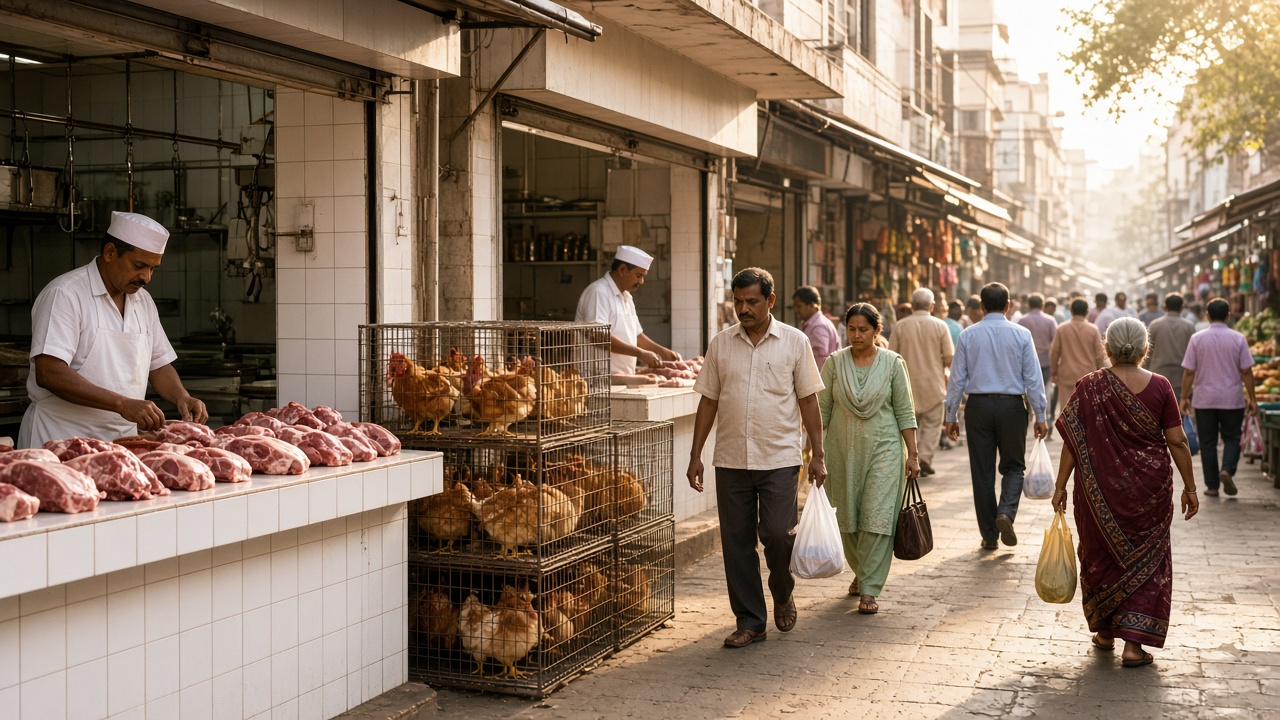
Most meat in India is still sold fresh in neighbourhood shops and markets (artistic illustration).
🍖 Royal KitchensAncient – 1750
Herders, Hunters & Royal Kitchens
Animals were reared for milk, work, wool, and meat from the earliest farming villages. At the same time, ideas of non-violence spread vegetarianism among many communities. Rulers regulated meat markets, and royal kitchens created famous meat dishes.
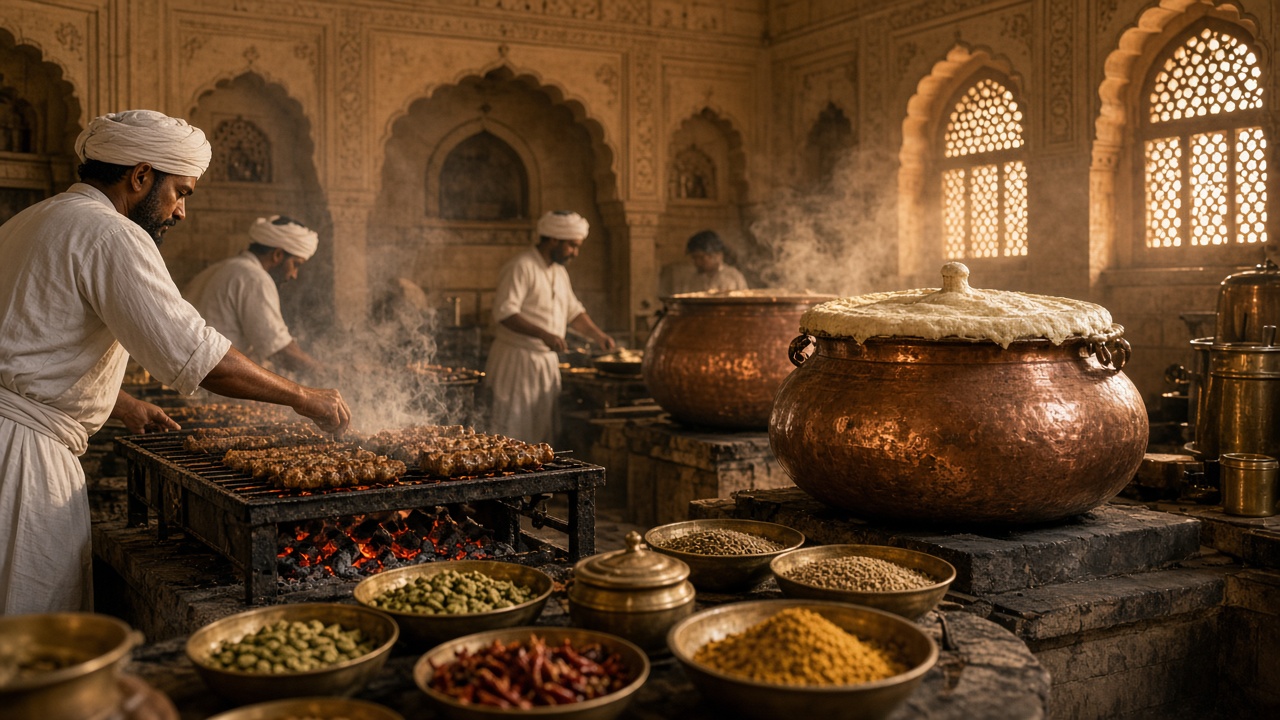
Mughal kitchens made kebabs, kormas, and biryanis famous (artistic illustration).
Harappan era: Bones of cattle, buffalo, sheep, goat, pig, and fish at Indus sites show that animals were reared and eaten.
1st millennium BCE: Buddhism and Jainism teach ahimsa (non-violence), and vegetarian diets spread among many communities.
c. 3rd century BCE: Ashoka’s edicts restrict the killing of many animals; the Arthashastra describes a superintendent of slaughterhouses (sunadhyaksha) who regulated meat sale.
16th–18th centuries: Mughal and Deccan kitchens develop kebabs, korma, nihari, and biryani; hill and North-East communities smoke and dry meat.
Technology
Salting and sun drying: Meat kept for months.
Smoking: Over kitchen fires.
Charcoal cooking: Tandoor and sigri.
Features
Local butchers: Fresh meat daily.
Diverse diets: Vegetarian and non-vegetarian.
Royal cuisine: Famous meat dishes.
🏛️ Municipal Markets1750 – 1946
Municipal Slaughterhouses & Army Supplies
Colonial city governments licensed butchers, built slaughterhouses and covered markets, and sent sanitary inspectors to check hygiene. Army cantonments needed a steady supply of meat and milk, and veterinary science began in India.
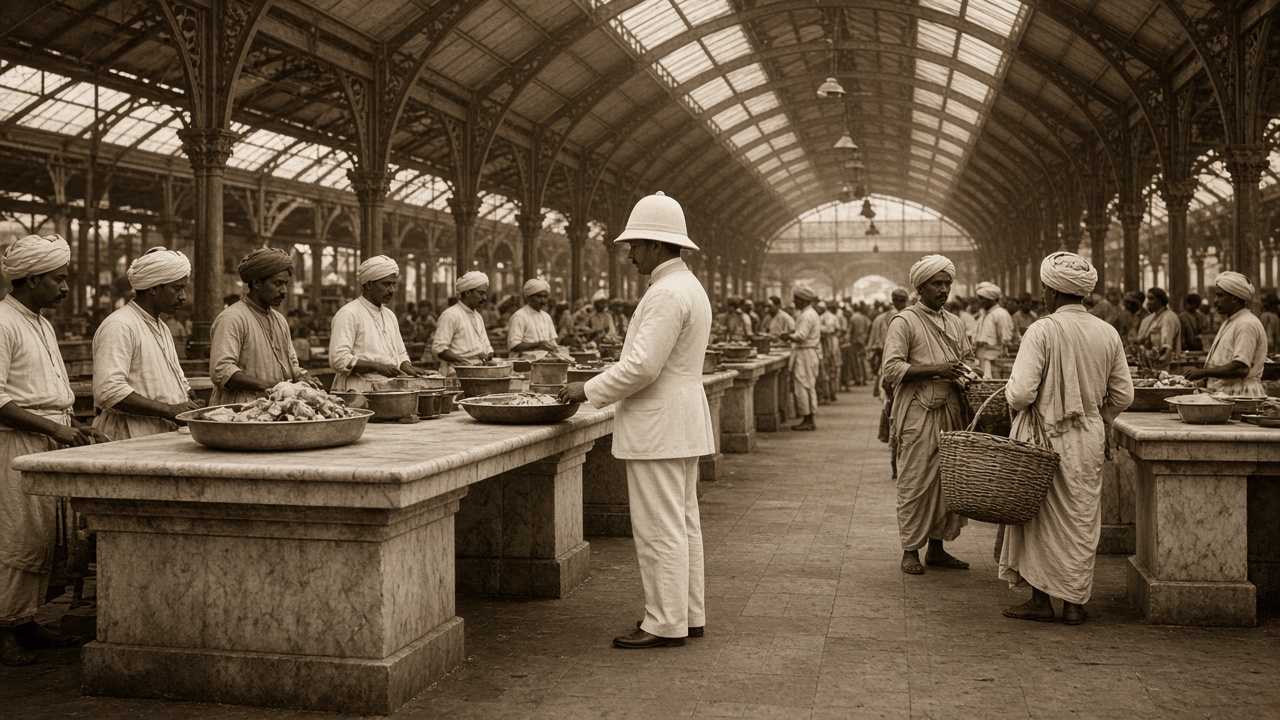
Covered markets and sanitary inspectors came to colonial cities (artistic illustration).
19th century: Municipalities in Bombay, Calcutta, and Madras license butchers and build municipal slaughterhouses away from city centres.
1869: Crawford Market opens in Bombay with separate halls for meat, fish, fruit, and vegetables.
1889–1890: Military Farms begin supplying troops; an Imperial Bacteriological Laboratory for animal diseases is set up (later IVRI); a Prevention of Cruelty to Animals Act is passed (1890).
1900s–1940s: Ice factories and cold stores appear in port cities; tanneries in Kanpur and Madras use hides; wartime armies need canned and dried meat.
Technology
Municipal abattoirs: Central slaughter sites.
Ice and cold stores: In port cities.
Veterinary science: Animal disease research.
Features
Licensing: Registered butchers.
Army demand: Cantonment supplies.
By-products: Leather industry grows.
📜 Laws1947 – 1990
Laws, Abattoirs & Early Exports
Independent India wrote cattle protection into its Constitution as a guiding principle and passed a national animal-welfare law. Big city abattoirs and meat food rules followed, and frozen buffalo meat exports to West Asia began to grow.
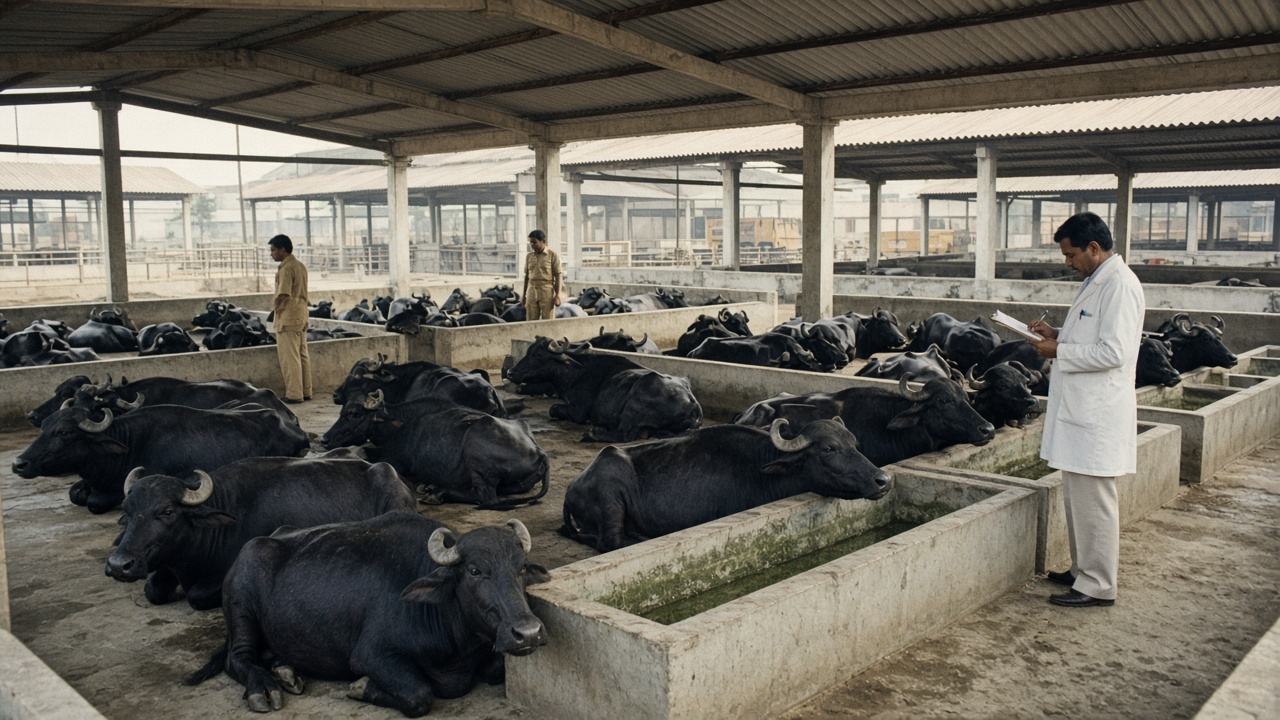
Animals are rested and checked by vets before processing (artistic illustration).
1950: Article 48 of the Constitution asks the state to organise animal husbandry on modern lines and to prohibit the slaughter of cows, calves, and other milch and draught cattle; states pass their own laws over the following decades.
1960–1962: The Prevention of Cruelty to Animals Act (1960) is passed, and the Animal Welfare Board of India is set up (1962).
1971–1973: The large Deonar abattoir opens in Mumbai (1971); the Meat Food Products Order (1973) sets licensing and hygiene rules for processed meat.
1970s–1980s: Frozen buffalo meat exports to West Asia grow; APEDA (1986) promotes meat exports; the first modern export abattoirs are built in the late 1980s.
Technology
Mechanised lines: In large abattoirs.
Blast freezing: For export meat.
Vet inspection: Before and after slaughter.
Features
State laws: Rules differ by state.
Animal welfare: National law.
Exports begin: Buffalo meat abroad.
🐔 Pink Revolution1991 – 2006
Liberalisation & the Pink Revolution Idea
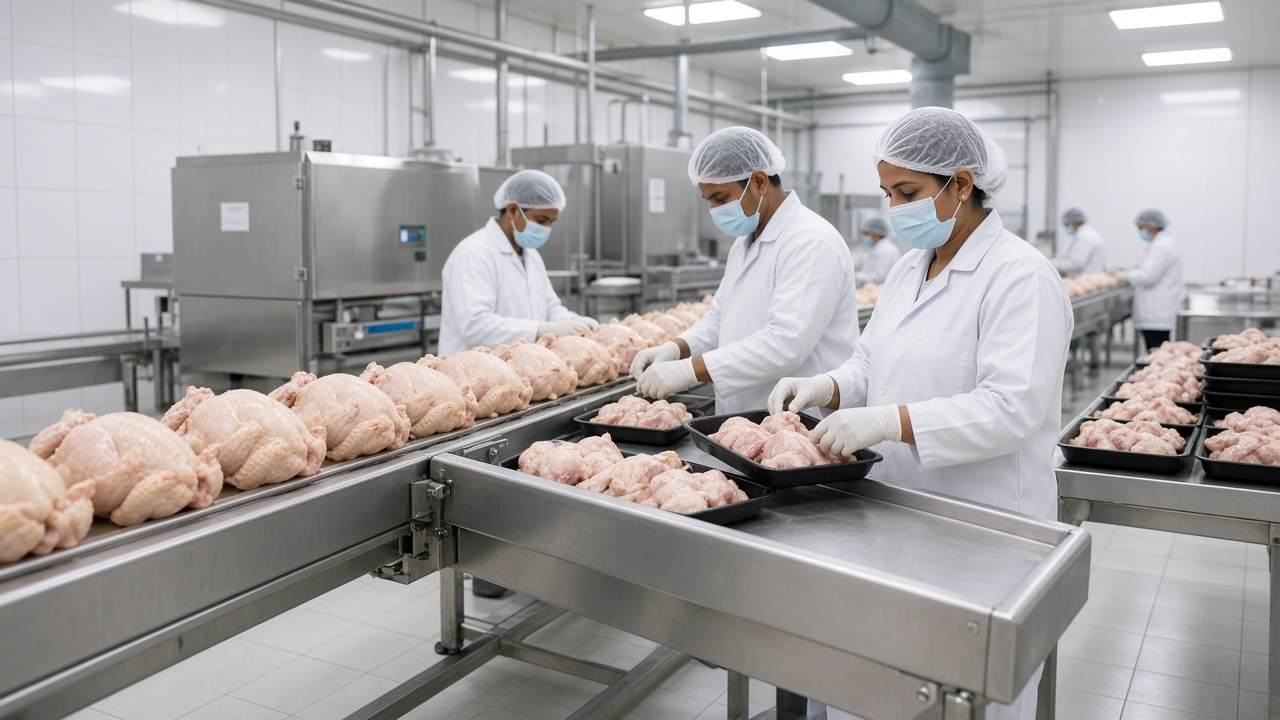
After economic reforms, private companies invested in poultry farms and processing plants, and exporters built modern integrated abattoirs. The term “Pink Revolution” came into use for this modernisation, and new rules and research centres followed.
Hygienic processing plants began packing chilled and frozen chicken (artistic illustration).
1990s: Liberalisation opens the food sector; companies such as Venky’s and Suguna expand integrated broiler farming, and processed chicken appears in city stores.
1990s: The term “Pink Revolution” is used for modernising meat and poultry processing; export abattoirs with rendering plants are set up in Uttar Pradesh, Punjab, Maharashtra, and Telangana.
1999: ICAR sets up the National Research Centre on Meat at Hyderabad for meat science and food safety research.
2001–2006: Slaughter House Rules (2001) allow slaughter only in licensed slaughterhouses with vet inspection; the Food Safety and Standards Act (2006) unifies food laws.
Technology
Integrated broiler chains: Farm to plant.
Chilling and freezing: Longer shelf life.
Rendering plants: Using by-products.
Features
Private investment: New plants.
New term: Pink Revolution.
Stricter rules: Licensed slaughter.
🚢 Export Boom2007 – 2014
Food Safety Law & the Buffalo Meat Export Boom
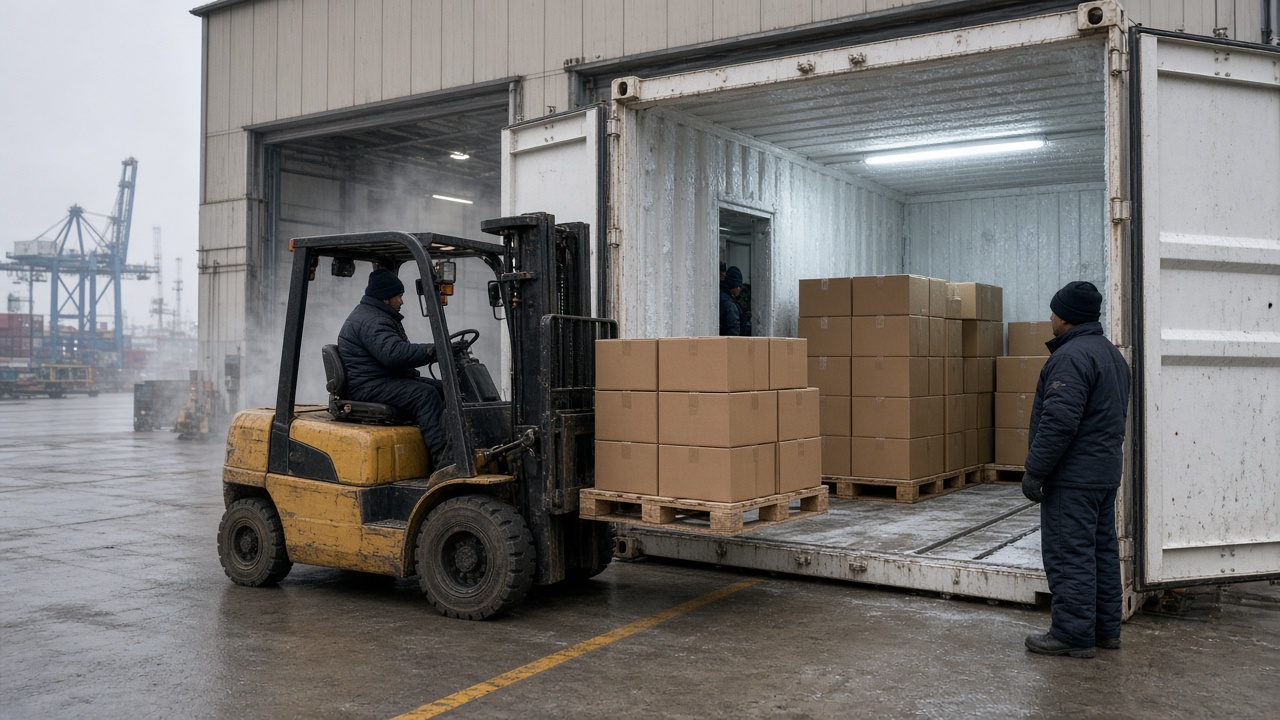
A new food regulator brought slaughterhouses and meat shops under licensing, and government schemes helped modernise abattoirs. Buffalo meat exports grew rapidly, and India became one of the world’s largest exporters of bovine meat.
Frozen buffalo meat travels in refrigerated containers to dozens of countries (artistic illustration).
2008–2009: FSSAI is set up (2008); a National Meat and Poultry Processing Board (2009) and a central scheme to modernise abattoirs support the industry.
2011: FSSAI licensing and registration regulations cover slaughterhouses, meat processing units, and meat shops.
2012–2014: Buffalo meat exports to Vietnam, Malaysia, Egypt, Indonesia, and West Asia rise sharply; by about 2014 India ranks among the top bovine meat exporters.
2014: The phrase “Pink Revolution” enters political debate during the general election, sparking public discussion about cattle, meat exports, and rural incomes.
Technology
Integrated export plants: APEDA-registered.
Lab testing: Residues and microbes.
Deboning and chilling: Export standards.
Features
FSSAI licensing: Meat shops and plants.
Export boom: Buffalo meat.
Public debate: A sensitive issue.
🧊 Cold Chain2015 – Present
Stricter Rules, Disease Control & Ready-to-Cook
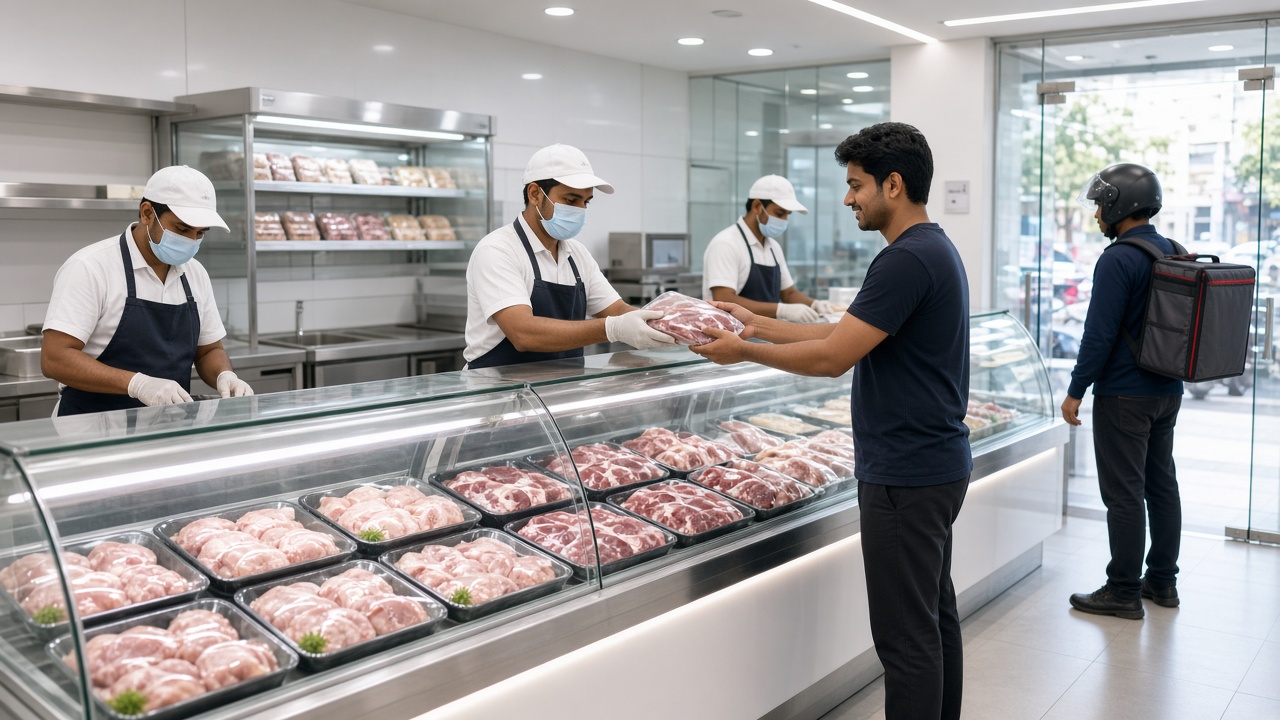
Several states tightened cattle-slaughter laws and closed unlicensed slaughterhouses, pushing the trade toward licensed plants. National vaccination drives, infrastructure funds, cold chains, and online meat brands changed how Indians buy meat.
Chilled packs and home delivery are changing how city families buy meat (artistic illustration).
2015–2017: Some states, such as Maharashtra and Haryana (2015), tighten cattle-slaughter laws; Uttar Pradesh closes unlicensed slaughterhouses (2017).
2017–2018: Central rules on selling cattle for slaughter in livestock markets are notified (2017), put on hold after court challenges, and later withdrawn.
2019–2020: The National Animal Disease Control Programme (2019) vaccinates against foot-and-mouth disease; the Animal Husbandry Infrastructure Development Fund (2020) supports meat plants.
2020s: Online meat brands and ready-to-cook products grow; meat output reaches about 10 million tonnes (2023–24), with poultry about half.
Technology
Cold chain: Chilled from plant to home.
Ear tags: Animal identification and vaccination records.
Apps: Online ordering and delivery.
Features
Licensed plants: Fewer informal units.
Disease control: Mass vaccination.
Ready-to-cook: Convenience foods.
Where India’s Meat Comes From
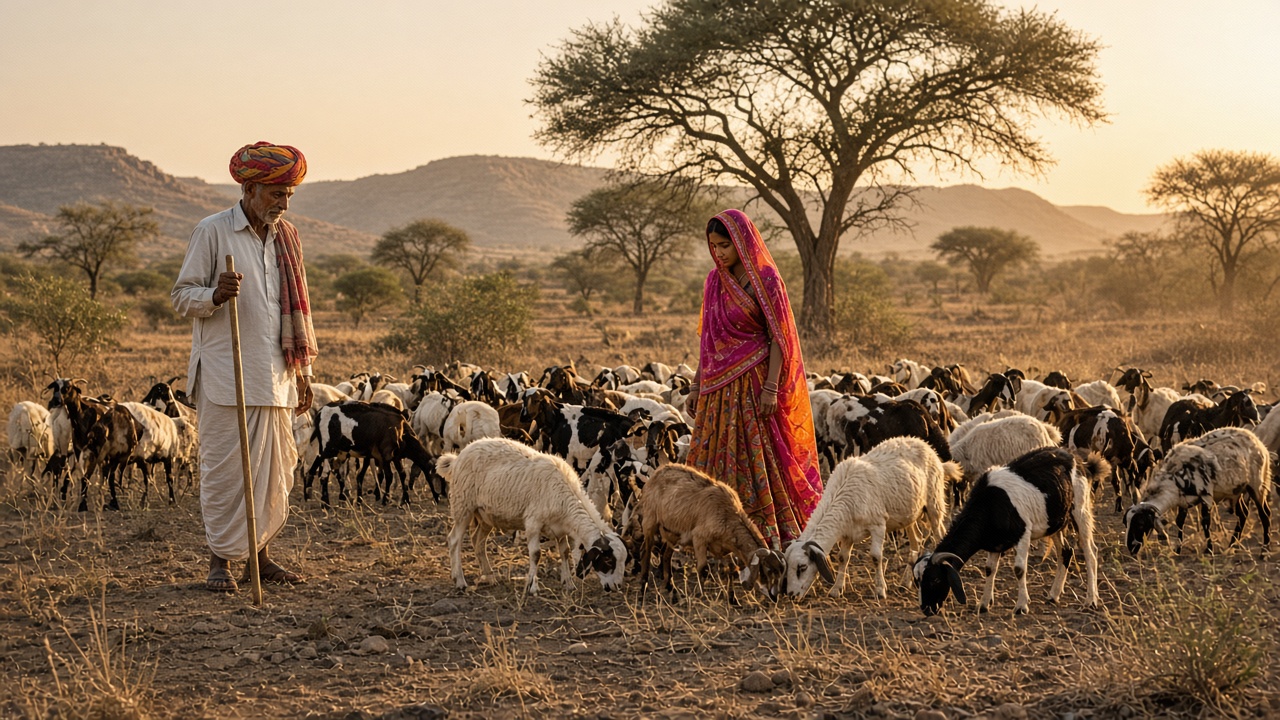
Goats and sheep are a key source of income for small and landless herders (artistic illustration).
Meat
Animal
Notes
Poultry (chicken)
Broiler and desi chickens
Largest share — roughly half of all meat produced
Buffalo meat (carabeef)
Water buffalo
Mostly from older or unproductive animals; India’s main meat export
Goat meat (chevon, often called mutton)
Goat
Popular across India; high demand at festivals
Sheep meat (mutton)
Sheep
Rajasthan, the Deccan, and South India
Pork
Pig
North-East India, Goa, and Kerala
Duck and other birds
Duck, quail, turkey
Kerala, Assam, and local markets
Cattle meat (beef)
Cattle
Allowed only in a few states under state laws; export prohibited
From Farm to Fork: How Meat Processing Works
Step
What happens
Why it matters
1. Rearing
Farmers raise animals and birds with feed, water, and vaccines
Healthy animals give safe meat
2. Transport
Animals are moved to licensed facilities under welfare rules
Reduces stress and injury
3. Ante-mortem check
A vet examines animals before slaughter
Keeps sick animals out of the food chain
4. Humane slaughter
Done only in licensed slaughterhouses
Animal welfare and hygiene
5. Post-mortem check
Carcasses are inspected and stamped
Detects disease and contamination
6. Chilling and freezing
Meat is chilled or blast-frozen quickly
Slows the growth of bacteria
7. Processing and packing
Cutting, deboning, packing, labelling
Convenience and longer shelf life
8. Cold chain and retail
Refrigerated trucks, stores, and delivery
Safe meat reaches consumers
Key Laws and Institutions
Year
Law or body
Purpose
1950
Article 48, Constitution of India
Guiding principle on modern animal husbandry and protecting cows and cattle
1960
Prevention of Cruelty to Animals Act
National animal-welfare law
1962
Animal Welfare Board of India
Advises on animal welfare
1973
Meat Food Products Order
Licensing and hygiene for processed meat (later merged into FSSAI rules)
1986
APEDA
Registers export plants and promotes meat exports
1999
ICAR-National Research Centre on Meat
Meat science and safety research
2001
Slaughter House Rules
Slaughter only in licensed slaughterhouses with vet inspection
2006 / 2011
Food Safety and Standards Act and regulations
FSSAI licensing of meat plants and shops
Various years
State cattle-preservation laws
Rules on cattle slaughter differ from state to state
India’s Meat Production Over Time
Year
Meat (approx. million tonnes)
What was happening
2010–11
~4.8
Abattoir modernisation scheme; FSSAI rules coming
2014–15
~6.7
Buffalo meat export boom
2018–19
~8.1
Shift to licensed slaughterhouses
2021–22
~9.3
Ready-to-cook and online sales grow
2023–24
~10.3
Poultry is about half of all meat
Figures are rounded official estimates; earlier years were measured differently and are not directly comparable.
Draw a flow chart of the eight farm-to-fork steps in meat processing using the table on this page.
Make a bar graph of India’s meat production from 2010–11 to 2023–24.
List five food safety rules a hygienic meat or chicken shop should follow.
Explain why cold chains are important for meat, milk, and fish.
Find out what livestock are reared in your district and how they support local families.
Mark India’s top buffalo meat export destinations on a world map.
Compare vegetarian and non-vegetarian sources of protein in a table.
Research how vaccination against foot-and-mouth disease helps farmers and exporters.
Discuss respectfully why food habits and laws about meat differ across Indian states.
Compare the Green, White, Yellow, Blue, Silver, Golden, Gene, Protein, and Pink Revolutions in one table.
Continue exploring
The Pink Revolution is one of India’s colourful farm revolutions. Explore the Silver, Protein, Blue, White, Gene, Golden, Green, and Yellow Revolutions and other agriculture timelines next.
Click any panel to expand and explore the visual mood.
India’s meat and poultry story in pictures — Mughal kitchens, colonial markets, abattoir lairages, poultry plants, reefer containers, modern meat stores, herders, and neighbourhood markets.
Mughal Kitchen
Kebabs and biryani
Colonial Market
Sanitary inspection
Vet Inspection
Healthy animals first
Poultry Plant
Hygienic processing
Meat Exports
Frozen and shipped
Modern Meat Store
Chilled and packed
Herders
Goats and sheep
Local Market
Fresh every morning
Explore all agriculture timelines
Jump to any other agriculture timeline on WorldTimelineHub.
Disclaimer: This content is AI-generated for educational purposes and may contain errors or outdated details. For correct and authoritative information, please refer to official and reliable sources such as government publications, manufacturers, museums, and academic references.