In 1950 India produced only about 17 million tonnes of milk, and big cities depended on private dairies and imported milk powder. Today India produces nearly a quarter
of the world’s milk — mostly from small farmers with two or three animals, organised into cooperatives that they own themselves.
This timeline covers ancient cattle culture, colonial military dairies, the 1946 Kaira farmers’ strike, Verghese Kurien and Amul, buffalo milk powder, the National Dairy
Development Board, Operation Flood, Mother Dairy, milk trains, India becoming the top producer, the Rashtriya Gokul Mission, and White Revolution 2.0.
Milk is a key source of protein, calcium, and vitamins for millions of vegetarian Indians. For rural families, a cow or buffalo is like a savings account that pays out
every day — especially for landless labourers and women, who do most of the dairy work. Dairying is now India’s single largest agricultural product by value, bigger
than rice and wheat combined.
Big picture
India’s milk story in one view
Cattle were wealth in ancient India, but milk stayed a local village business for centuries. In 1946 farmers in Kaira district formed their own cooperative, which
grew into Amul. Its success led to NDDB and Operation Flood, which linked villages to cities and made India the world’s biggest milk producer by 1998.
Related timelines:
Green Revolution,
Yellow Revolution,
mandis and markets.
1946
Kaira cooperative formed
1970
Operation Flood begins
~239 MT
Milk in 2023–24
~24%
Share of world milk
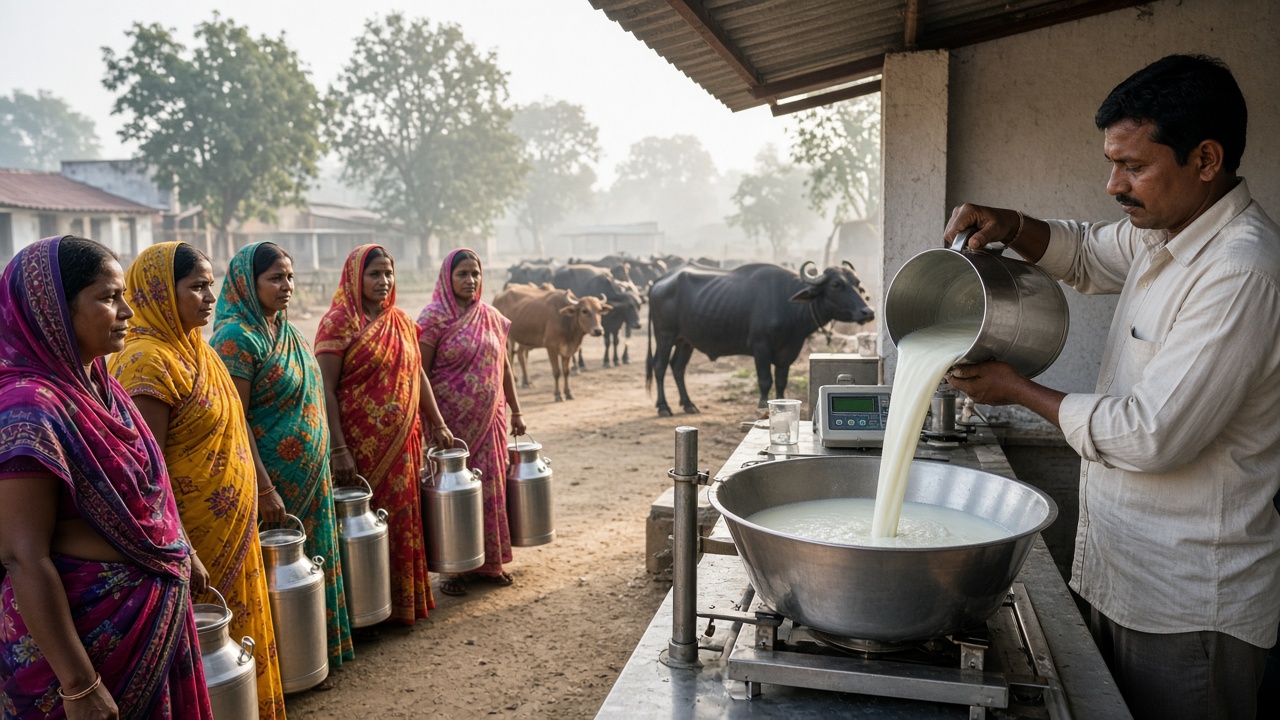
Every morning and evening, village cooperatives weigh and test farmers’ milk and pay by fat content (artistic illustration).
🐄 Cattle CultureAncient – 1857
Cattle Culture, Ghee & Village Gwalas
Humped zebu cattle were domesticated in the Indian subcontinent. Milk, curd, butter, and ghee became central to food, medicine, and ritual, and cattle were a measure of wealth.
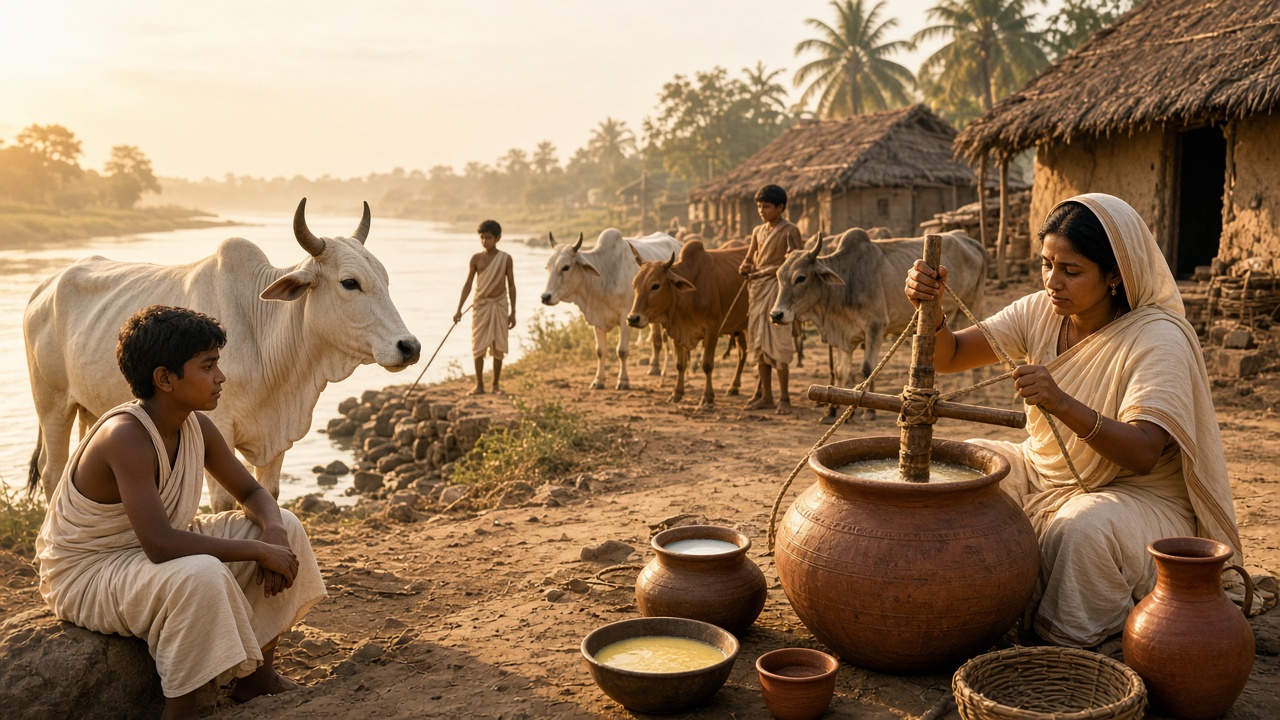
Churning curd into butter and ghee is one of India’s oldest kitchen skills (artistic illustration).
Indus Valley: Seals show humped zebu bulls; the zebu was domesticated in the subcontinent thousands of years ago.
Vedic period: Hymns praise cows and ghee; herds of cattle (go-dhan) measure a family’s wealth.
Classical and medieval periods: Stories of Krishna the cowherd spread; ghee, curd, and paneer-like foods appear in regional cuisines.
Pre-colonial times: Pastoral communities breed famous native cattle and buffaloes; village milkmen (gwalas) sell milk door to door.
Technology
Churn (mathani): Butter from curd.
Ghee: Long-lasting clarified butter.
Clay pots: Setting curd.
Features
Native breeds: Heat and disease tolerant.
Local sale: Milk sold within the village.
Sacred cow: Deep cultural respect.
✊ Kaira Strike1857 – 1946
Military Dairies, Polson & the Kaira Strike
The British set up dairies to supply their troops, and research on dairying began. In Gujarat, farmers selling to a private dairy got very low prices — until they went on strike and formed their own cooperative.
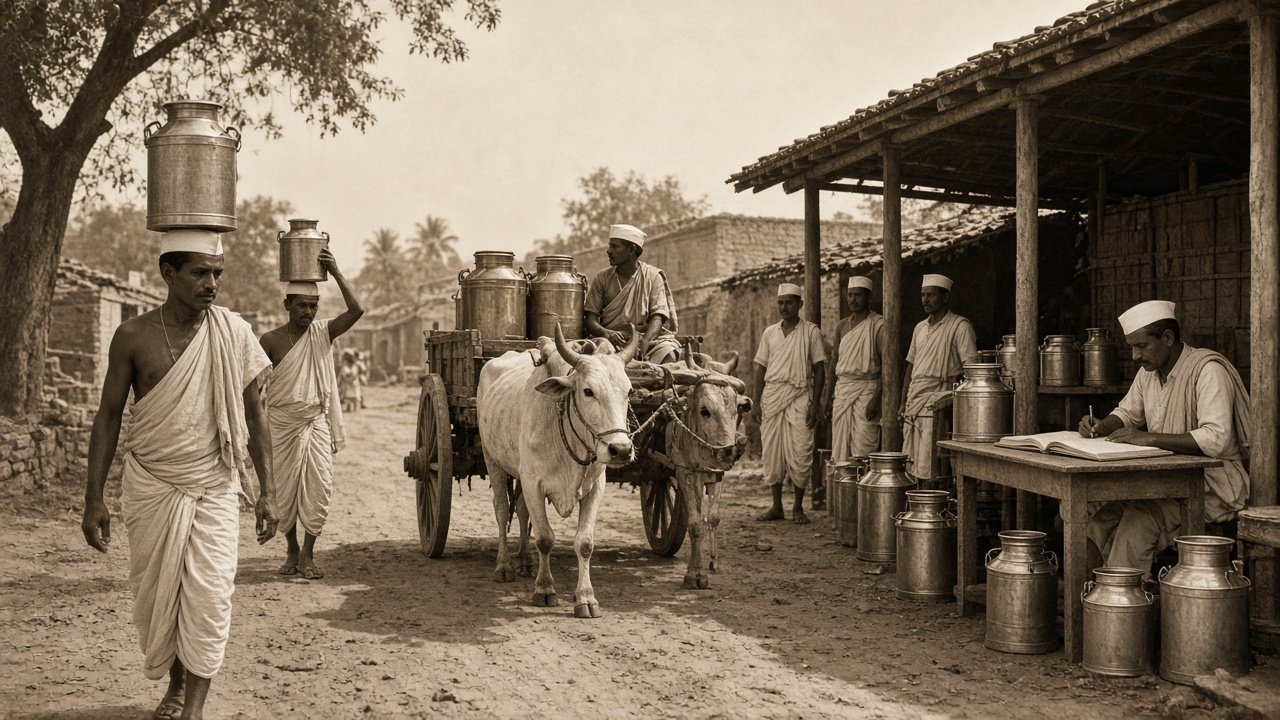
Kaira farmers pooled their milk in their own cooperative from 1946 (artistic illustration).
1889: The first military dairy farm opens at Allahabad to supply British troops with milk and butter.
1923: The Imperial Institute of Animal Husbandry and Dairying opens in Bangalore — the forerunner of today’s National Dairy Research Institute.
1930s–1940s: Polson Dairy in Anand buys milk from Kaira farmers cheaply to supply the Bombay Milk Scheme.
1946: Guided by Sardar Vallabhbhai Patel and led by Tribhuvandas Patel, farmers strike; the Kaira District Cooperative Milk Producers’ Union is registered on 14 December.
Technology
Pasteurisation: Safer city milk.
Butter factories: Military supply.
Cream separators: Early machines.
Features
Middlemen: Low prices for farmers.
City demand: Bombay, Calcutta, Delhi.
Farmer unity: Birth of the cooperative idea.
🧈 Amul1947 – 1969
Kurien, Amul & NDDB
A young engineer, Verghese Kurien, joined the Kaira cooperative and built a modern dairy owned by farmers. Anand’s success inspired the government to create a national board to copy the model everywhere.
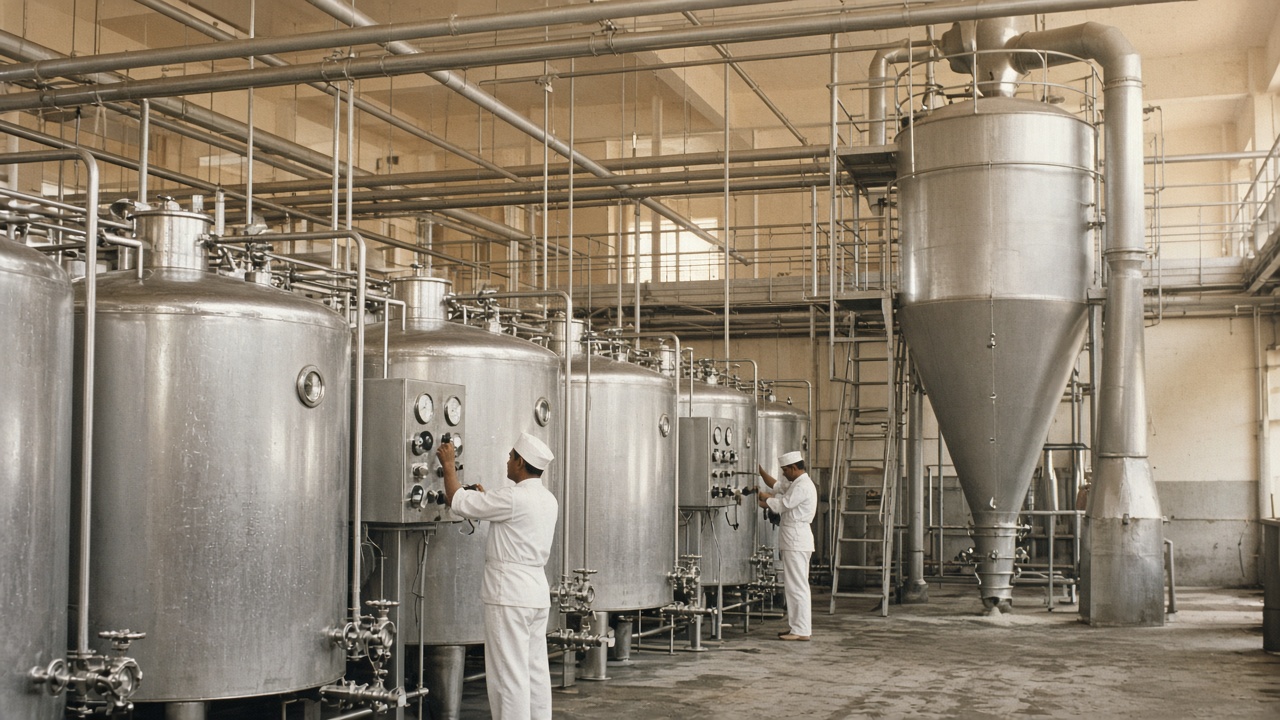
Cooperative dairy plants processed farmers’ milk into packed milk, butter, and powder (artistic illustration).
1949: Verghese Kurien arrives in Anand and begins working with Tribhuvandas Patel; Aarey Milk Colony is being set up in Bombay.
1955: The Anand dairy makes milk powder from buffalo milk, a world first; the Amul brand name is adopted; NDRI moves to Karnal.
1959–1964: The Delhi Milk Scheme starts (1959); Prime Minister Lal Bahadur Shastri visits Anand (1964) and asks for the model to be spread nationwide.
1965–1966: The National Dairy Development Board is set up at Anand with Kurien as chairman (1965); the Amul girl mascot first appears (1966).
Technology
Buffalo milk powder: Indian innovation.
Chilling centres: Keep milk fresh.
Fat testing: Fair pay by quality.
Features
Anand pattern: Village–district–state.
Farmer ownership: Profits return to members.
Professionals: Managers serve farmers.
🌊 Operation Flood1970 – 1996
Operation Flood: The White Revolution
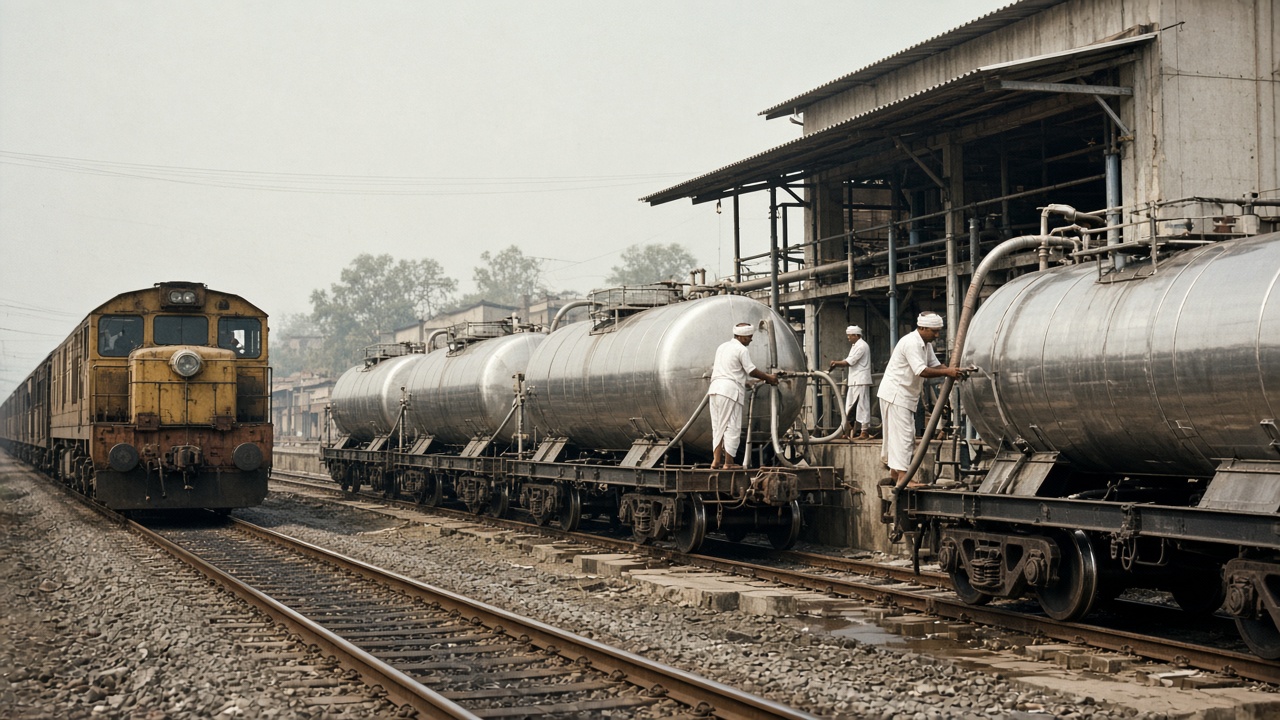
NDDB used donated dairy commodities from Europe to fund a nationwide network of cooperatives. Milk from rural “milksheds” was chilled, processed, and sent by road and rail tankers to cities, creating a national milk grid.
Rail milk tankers carried milk hundreds of kilometres to big cities (artistic illustration).
1970: Operation Flood Phase I begins, linking 18 milksheds to the four metros — Delhi, Bombay, Calcutta, and Madras.
1973–1976: The Gujarat Cooperative Milk Marketing Federation is formed to market Amul (1973); Mother Dairy opens in Delhi (1974); farmers fund the film Manthan with ₹2 each (1976).
1981–1985: Phase II expands to about 136 milksheds and nearly 300 towns, funded partly by the World Bank.
1985–1996: Phase III builds tens of thousands of village societies, veterinary care, and cattle feed plants; milk output roughly triples over the programme.
Technology
National milk grid: Villages linked to cities.
Rail and road tankers: Bulk transport.
Artificial insemination: Better breeds.
Features
Food aid to self-reliance: Gifts funded growth.
Women’s income: Daily cash in hand.
State brands: Nandini, Aavin, Verka, and more.
🏆 Number One1997 – 2013
World’s Largest Milk Producer
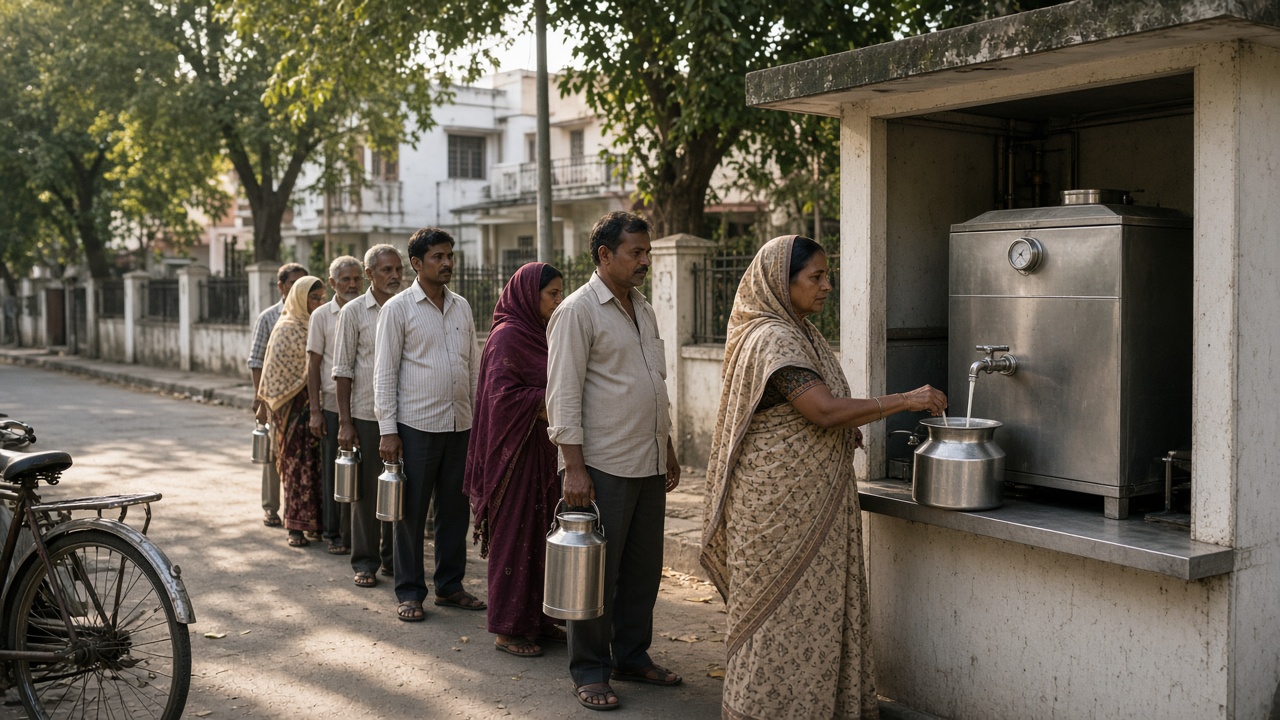
India overtook the United States in milk production. Private dairies joined cooperatives in the market, packaged milk and dairy products spread, and a new national dairy plan focused on productivity.
Bulk milk booths gave city families fresh cooperative milk every day (artistic illustration).
1998: India becomes the world’s largest milk producer, overtaking the United States.
2000s: Milk and Milk Products Order rules are relaxed; private dairies grow alongside cooperatives; the National Project for Cattle and Buffalo Breeding begins (2000).
2006–2011: Kurien steps down from GCMMF (2006); FSSAI surveys highlight milk adulteration (2011).
2012: The National Dairy Plan Phase I begins with World Bank support; Verghese Kurien dies on 9 September.
Technology
Bulk milk coolers: Chilling in villages.
Automatic collection units: Instant fat readings.
UHT and tetra packs: Long shelf life.
Features
Value-added products: Cheese, ice cream, paneer.
Private players: More competition.
Quality focus: Adulteration checks.
🧬 Modern Dairy2014 – Present
Indigenous Breeds, Digital Dairy & White Revolution 2.0
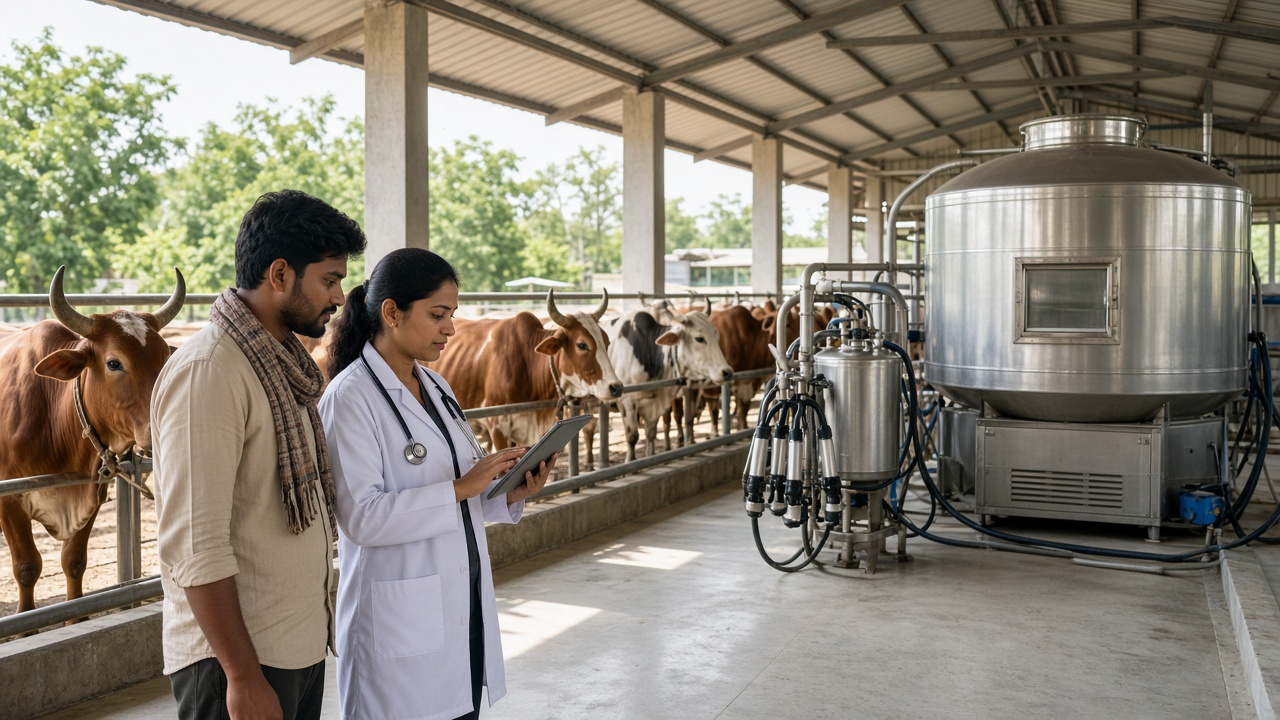
New missions focus on native cattle breeds, better genetics, animal health, and digital tools. Milk production keeps climbing, and a new push aims to bring more villages into dairy cooperatives.
Digital records, vets, and milking machines are modernising Indian dairying (artistic illustration).
2014: The Rashtriya Gokul Mission is launched to conserve and improve native breeds; National Milk Day is first celebrated on 26 November, Kurien’s birthday.
2019–2020: Kisan Credit Cards are extended to dairy farmers (2019); the e-Gopala app and the Animal Husbandry Infrastructure Development Fund are launched (2020).
2021–2022: A Ministry of Cooperation is created (2021); lumpy skin disease hits cattle in several states (2022).
2024–present: White Revolution 2.0 aims to expand cooperative milk collection; milk output reaches about 239 million tonnes (2023–24).
Technology
Sex-sorted semen: More female calves.
IVF and embryo transfer: Faster breed improvement.
Apps and tags: Digital animal records.
Features
Native breeds: Gir, Sahiwal, Red Sindhi.
Animal health: Vaccination drives.
Global brands: Indian dairies go abroad.
Famous Indian Dairy Breeds
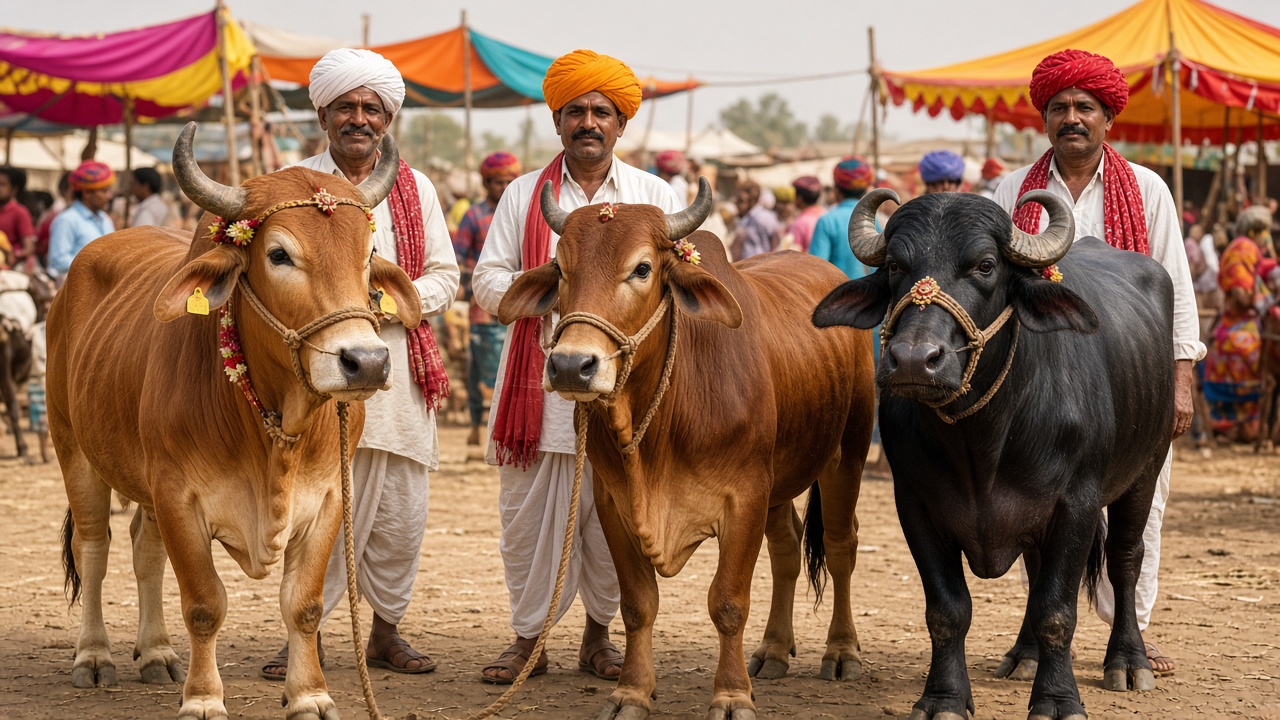
Native cows and Murrah buffaloes are prized at cattle fairs (artistic illustration).
Breed
Animal
Home region
Gir
Cow
Saurashtra, Gujarat
Sahiwal
Cow
Punjab and Haryana (originally Punjab, Pakistan)
Red Sindhi
Cow
Originally Sindh; reared across India
Tharparkar
Cow
Western Rajasthan
Rathi
Cow
Bikaner region, Rajasthan
Kankrej
Cow (dual purpose)
North Gujarat and Rajasthan
Murrah
Buffalo
Haryana
Jaffarabadi
Buffalo
Saurashtra, Gujarat
Mehsana
Buffalo
North Gujarat
Surti
Buffalo
South Gujarat
The Three Phases of Operation Flood
Phase
Years
What it achieved
Phase I
1970–1980
Linked 18 milksheds to Delhi, Bombay, Calcutta, and Madras; funded by sale of donated European milk powder and butter oil
Phase II
1981–1985
Expanded to about 136 milksheds and nearly 300 towns; World Bank support
Phase III
1985–1996
Strengthened tens of thousands of village cooperatives with vet care, feed, and research
The Anand Pattern and State Milk Brands
Level
Who
What it does
Village
Dairy cooperative society
Collects milk twice a day, tests fat, pays farmers
District
Milk union
Processes milk, makes cattle feed, gives vet services
State
Milk federation
Markets milk and products under a common brand
State
Cooperative brand
Gujarat
Amul
Karnataka
Nandini
Tamil Nadu
Aavin
Kerala
Milma
Punjab
Verka
Rajasthan
Saras
Bihar
Sudha
Andhra Pradesh and Telangana
Vijaya
Delhi (NDDB)
Mother Dairy
India’s Milk Production Over Time
Year
Milk (approx. million tonnes)
What was happening
1950–51
~17
Shortages in cities
1960–61
~20
Amul model grows
1970–71
~22
Operation Flood begins
1980–81
~32
Phase II starts
1990–91
~54
Phase III in progress
2000–01
~81
World’s largest producer
2010–11
~122
National Dairy Plan prepared
2020–21
~210
Rashtriya Gokul Mission
2023–24
~239
White Revolution 2.0
White Revolution & Milk Timeline Summary
Year / Era
Milestone
Indus Valley
Humped zebu cattle on seals
Vedic period
Cattle as wealth; ghee in rituals
1889
First military dairy farm, Allahabad
1923
Imperial dairy institute in Bangalore
1946
Kaira District Cooperative Milk Producers’ Union
1949
Verghese Kurien arrives in Anand
1955
Buffalo milk powder; Amul brand; NDRI moves to Karnal
1959
Delhi Milk Scheme
1965
National Dairy Development Board
1966
Amul girl mascot
1970
Operation Flood begins
1973
GCMMF formed to market Amul
1974
Mother Dairy, Delhi
1976
Farmer-funded film Manthan
1996
Operation Flood ends
1998
India becomes the largest milk producer
2012
National Dairy Plan; Kurien dies
2014
Rashtriya Gokul Mission; first National Milk Day
2020
e-Gopala app; dairy infrastructure fund
2021
Ministry of Cooperation
2024
White Revolution 2.0
Test Your Knowledge
20 quick questions from the White Revolution and milk timeline. Click each question to reveal the answer.
Answer: Milk.
Answer: Dr Verghese Kurien.
Answer: The Milkman of India.
Answer: Anand, in Gujarat’s Kaira (now Kheda) district.
Answer: 14 December 1946.
Answer: Sardar Vallabhbhai Patel.
Answer: Tribhuvandas Patel.
Answer: Anand Milk Union Limited.
Answer: Making milk powder from buffalo milk.
Answer: 1965.
Answer: Lal Bahadur Shastri.
Answer: 1970.
Answer: Three.
Answer: Village society, district union, and state federation.
Answer:Manthan, directed by Shyam Benegal.
Answer: 1998.
Answer: 26 November, Kurien’s birthday.
Answer: Murrah.
Answer: The Rashtriya Gokul Mission.
Answer: Nandini.
Classroom activity
Students Tasks
Use these prompts for discussion or projects on dairying and the White Revolution in India.
Click any panel to expand and explore the visual mood.
India’s milk story in pictures — ancient butter churning, Kaira farmers, cooperative dairies, milk trains, city milk booths, village collection centres, native breeds, and modern farms.
Cattle Culture
Ancient India
Kaira Farmers
1946 cooperative
Cooperative Dairy
Amul era
Milk Trains
Operation Flood
City Milk Booth
Fresh daily
Village Collection
Twice a day
Native Breeds
Gir, Sahiwal, Murrah
Modern Dairy
Digital farms
Explore all agriculture timelines
Jump to any other agriculture timeline on WorldTimelineHub.
Disclaimer: This content is AI-generated for educational purposes and may contain errors or outdated details. For correct and authoritative information, please refer to official and reliable sources such as government publications, manufacturers, museums, and academic references.