Green Revolution & Food Security Timeline of India
In the 1960s India lived “from ship to mouth”, waiting for wheat imports to feed its people. Within a decade, new seeds, fertilisers, irrigation, and guaranteed prices
turned the country into a grain-surplus nation. Food security then became a matter of getting that grain to every hungry family.
This timeline covers colonial famines and famine codes, wartime rationing, PL-480 imports, Borlaug and Swaminathan’s dwarf wheat, the Food Corporation of India, MSP,
the White and Yellow Revolutions, the Public Distribution System, mid-day meals, the right to food, the National Food Security Act, and free grain schemes.
Food security means that every person, at all times, can get enough safe and nutritious food. It has three parts: growing enough food (availability), people being
able to afford it (access), and the body getting the nutrients it needs (nutrition). The Green Revolution solved much of the first part for India; ration shops,
school meals, and food laws tackle the other two.
Big picture
From famine to food surplus in one view
Colonial India suffered terrible famines. Independent India still imported grain until high-yielding wheat and rice, backed by irrigation, fertiliser, procurement,
and minimum support prices, made it self-sufficient. Today India grows over 330 million tonnes of foodgrains and runs one of the world’s largest food programmes.
Related timelines:
irrigation development,
farming tools,
mandis and MSP.
1966
High-yielding varieties programme
~51 MT
Foodgrains in 1950–51
330+ MT
Foodgrains today
~80 crore
People get free grain
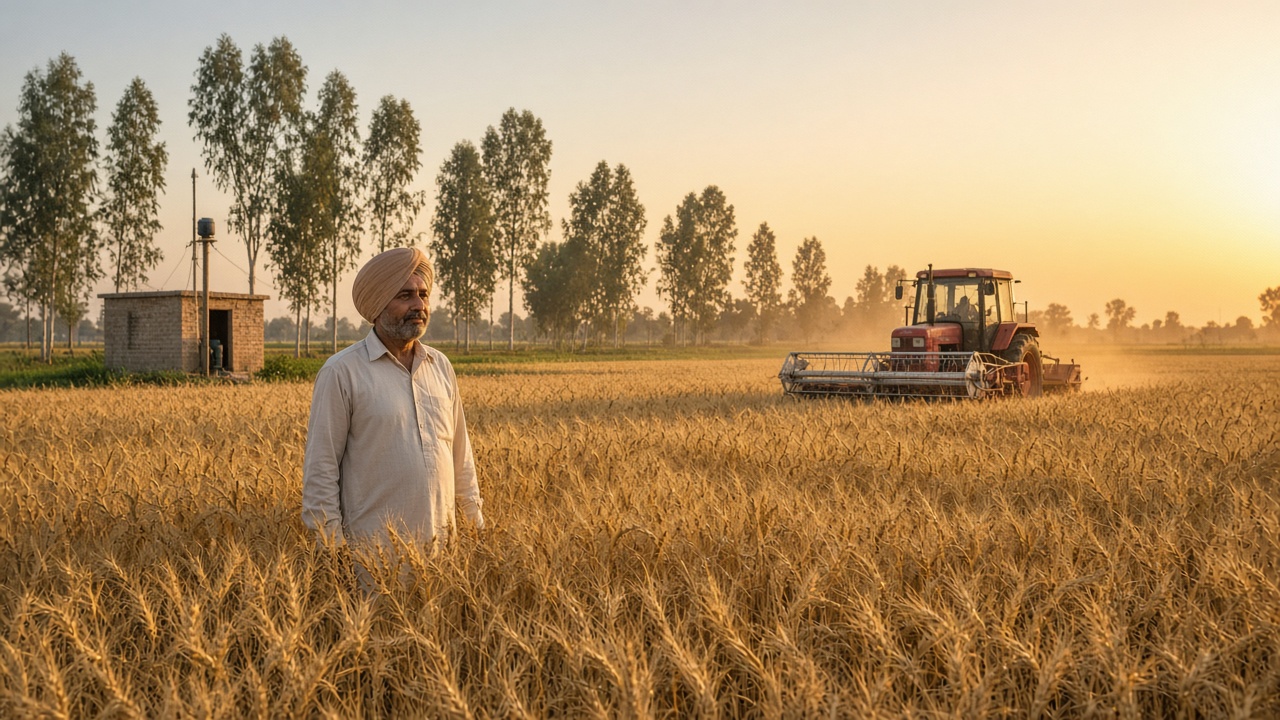
Punjab’s wheat fields became the symbol of the Green Revolution (artistic illustration).
⚠️ Famines1770 – 1946
Famines, Famine Codes & Rationing
Under colonial rule, repeated droughts combined with poor policy caused devastating famines. Famine commissions led to relief codes, and the Second World War brought the first food rationing in Indian cities.
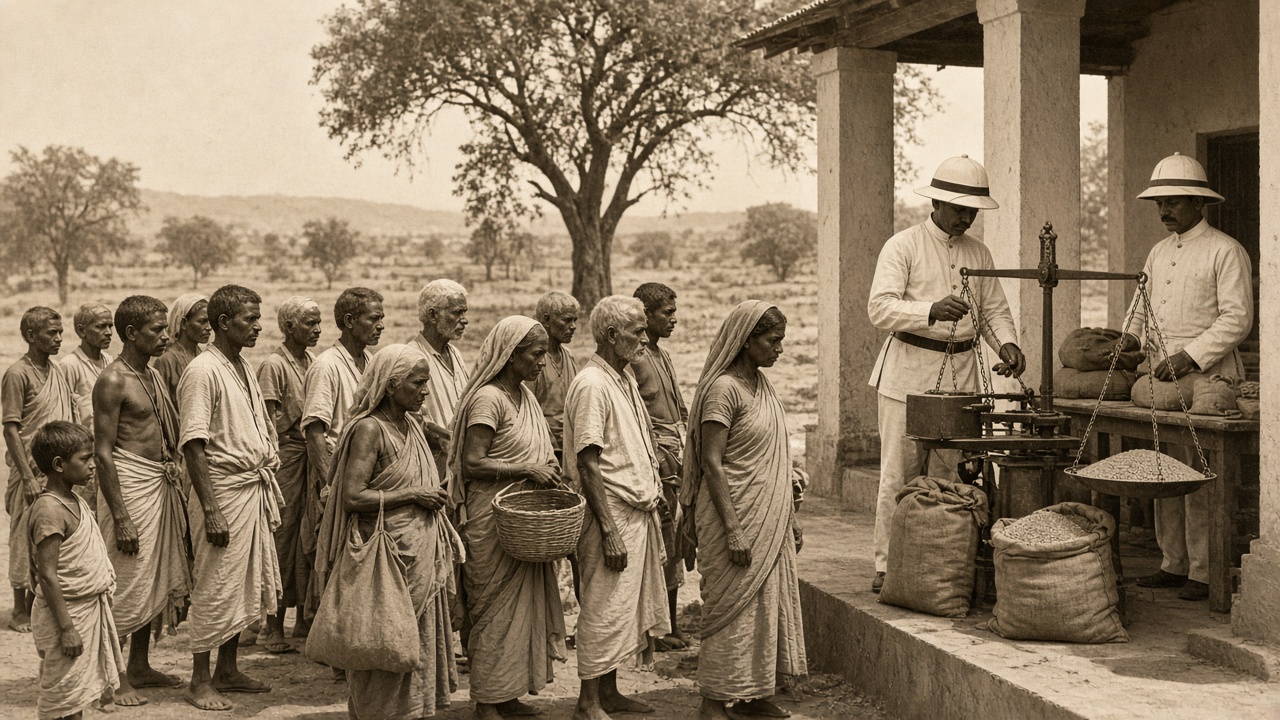
Famine relief depots handed out grain under the famine codes (artistic illustration).
1770: The Great Bengal Famine strikes soon after the East India Company takes control of revenue in Bengal.
1876–1883: The Great Famine of 1876–78 hits southern and western India; the Famine Commission (1880) leads to the first Famine Codes (1883).
1896–1901: Two major famines affect large parts of India; a new Famine Commission improves relief rules.
1939–1946: Wartime rationing begins in Bombay; the Bengal Famine of 1943 kills millions; the Grow More Food campaign and the Foodgrains Policy Committee (1943) follow.
Responses
Famine Codes: Rules for relief works.
Rationing: Fixed grain quotas in cities.
Grow More Food: Push to raise output.
Features
Monsoon risk: Droughts ruined harvests.
Grain exports: Continued during shortages.
Low yields: Little irrigation or fertiliser.
🚢 Imports1947 – 1964
Food Shortages & Ship-to-Mouth Imports
After independence and Partition, India struggled to feed a fast-growing population. Irrigation and community development helped, but the country relied on wheat shipped from the United States under the PL-480 programme.
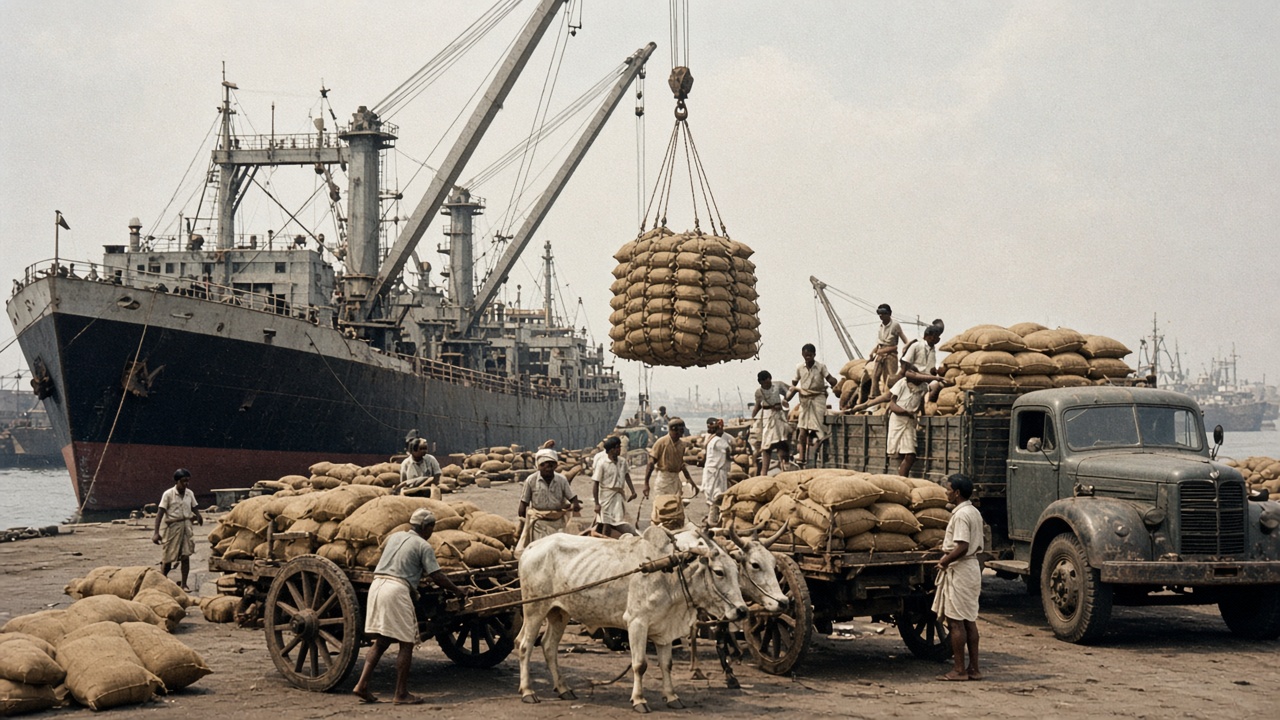
Grain ships from abroad kept ration shops supplied in the 1950s and 1960s (artistic illustration).
1947–1952: Partition moves rich wheat and rice lands to Pakistan; the First Five-Year Plan (1951) puts agriculture first; the Community Development Programme begins (1952).
1956: India signs the PL-480 agreement with the United States for concessional wheat imports.
1959–1961: A Ford Foundation team warns of a food crisis; the Intensive Agricultural District Programme starts in selected districts; the first agricultural university opens at Pantnagar (1960).
1963–1964: Norman Borlaug visits India; scientists including M. S. Swaminathan test Mexican dwarf wheat in Indian fields.
Responses
PL-480 wheat: Imports paid in rupees.
IADP: Intensive farming in chosen districts.
Dwarf wheat trials: Testing new seeds.
Features
Import dependence: Millions of tonnes a year.
Tall varieties: Fell over with fertiliser.
Big dams: Irrigation slowly expanded.
🌾 Green Revolution1965 – 1979
The Green Revolution Begins
After two severe droughts, India imported tonnes of high-yielding Mexican wheat seed and launched a package of seeds, fertiliser, irrigation, credit, and guaranteed prices. Wheat harvests jumped, and imports soon ended.
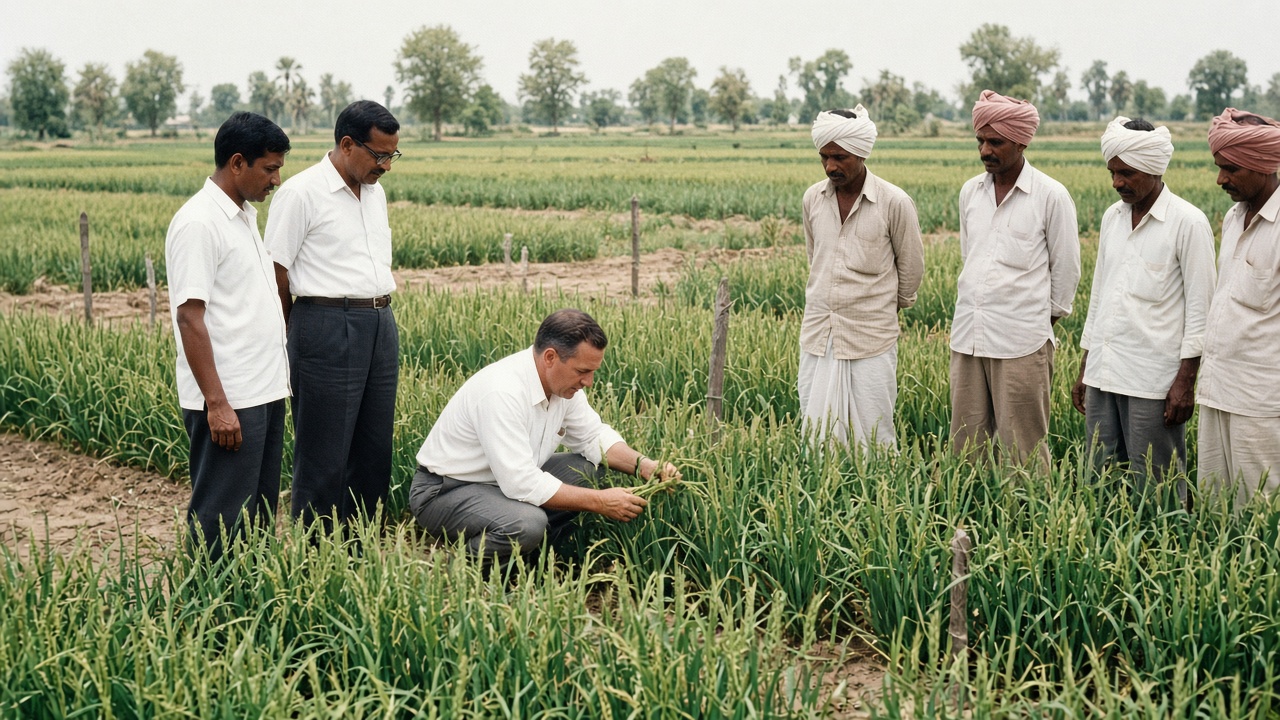
Scientists and farmers tested short, high-yielding wheat in Indian fields (artistic illustration).
1965: Lal Bahadur Shastri gives the slogan “Jai Jawan Jai Kisan”; the Food Corporation of India and the Agricultural Prices Commission are set up.
1966: After the 1965–66 droughts, India imports about 18,000 tonnes of Mexican wheat seed; the High-Yielding Varieties Programme begins; IR8 “miracle rice” arrives.
1968: A record wheat harvest is celebrated with a “Wheat Revolution” stamp; William Gaud of USAID coins the term “Green Revolution”.
1970–1977: Norman Borlaug wins the Nobel Peace Prize (1970); PL-480 imports end (1971); Operation Flood starts the White Revolution (1970); the Food for Work Programme begins (1977).
Package
HYV seeds: Kalyan Sona, Sonalika, IR8.
Inputs: Fertiliser, tube wells, pesticides.
MSP and FCI: Assured price and purchase.
Features
Wheat first: Punjab, Haryana, western UP.
Buffer stocks: Grain saved for bad years.
Leaders: C. Subramaniam and M. S. Swaminathan.
🌈 New Revolutions1980 – 1999
Spreading Gains, New Revolutions & Targeted PDS
High-yielding rice spread to more states, milk and oilseed production soared, and the ration system was reformed to reach the poor. At the same time, the costs of intensive farming — falling water tables and tired soils — began to show.
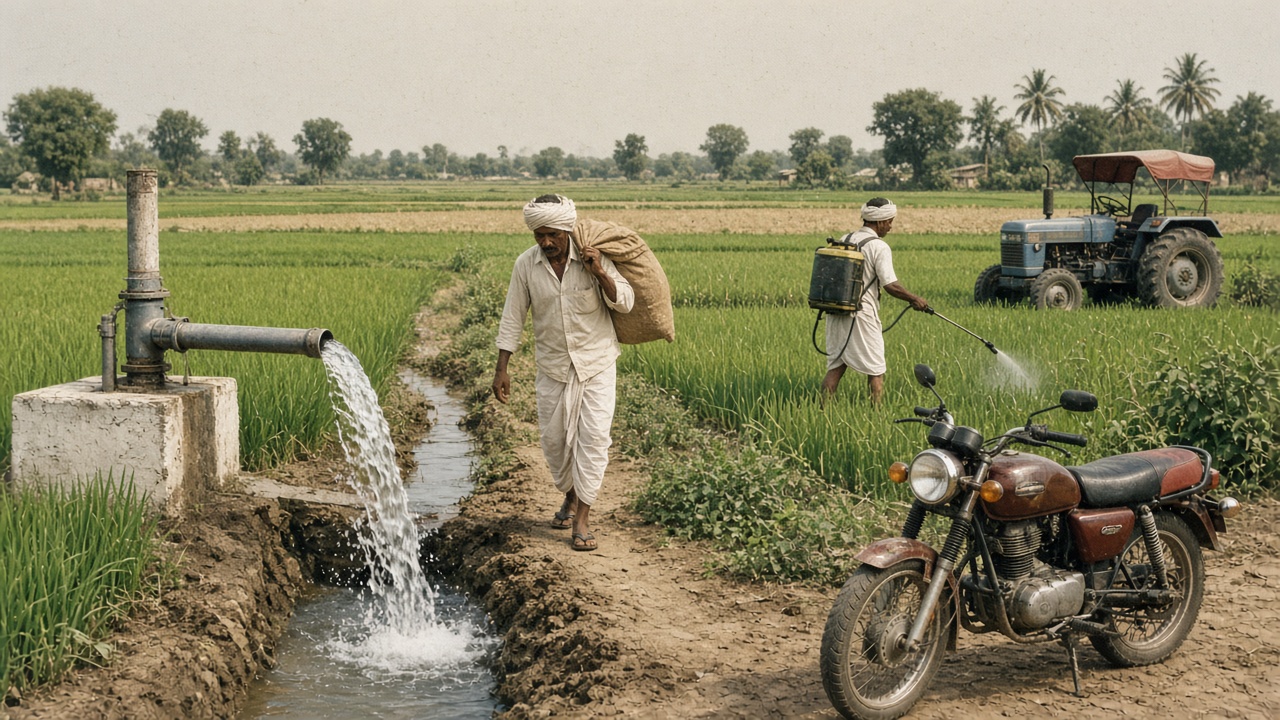
Tube wells, fertiliser, and sprayers spread the Green Revolution to rice lands (artistic illustration).
1980s: High-yielding rice spreads across Andhra Pradesh, Tamil Nadu, and parts of eastern India; tube wells multiply.
1986: The Technology Mission on Oilseeds launches the Yellow Revolution to cut edible oil imports.
1992–1997: The Revamped Public Distribution System reaches remote areas (1992); the Targeted Public Distribution System focuses subsidies on the poor (1997).
1995–1998: A national mid-day meal programme starts in schools (1995); India becomes the world’s largest milk producer (late 1990s).
Programmes
Oilseeds Mission: Yellow Revolution.
Operation Flood: White Revolution.
Targeted PDS: BPL and APL ration cards.
Features
Surplus grain: Big FCI stocks.
Water stress: Groundwater falling in Punjab.
Crop imbalance: Less pulses and millets.
⚖️ Right to Food2000 – 2012
Right to Food, Mid-Day Meals & Food Security Mission
Even with full granaries, many people still went hungry. A landmark court case pushed the government to treat food as a right, cooked school meals became universal, and new missions aimed to raise output of rice, wheat, and pulses.
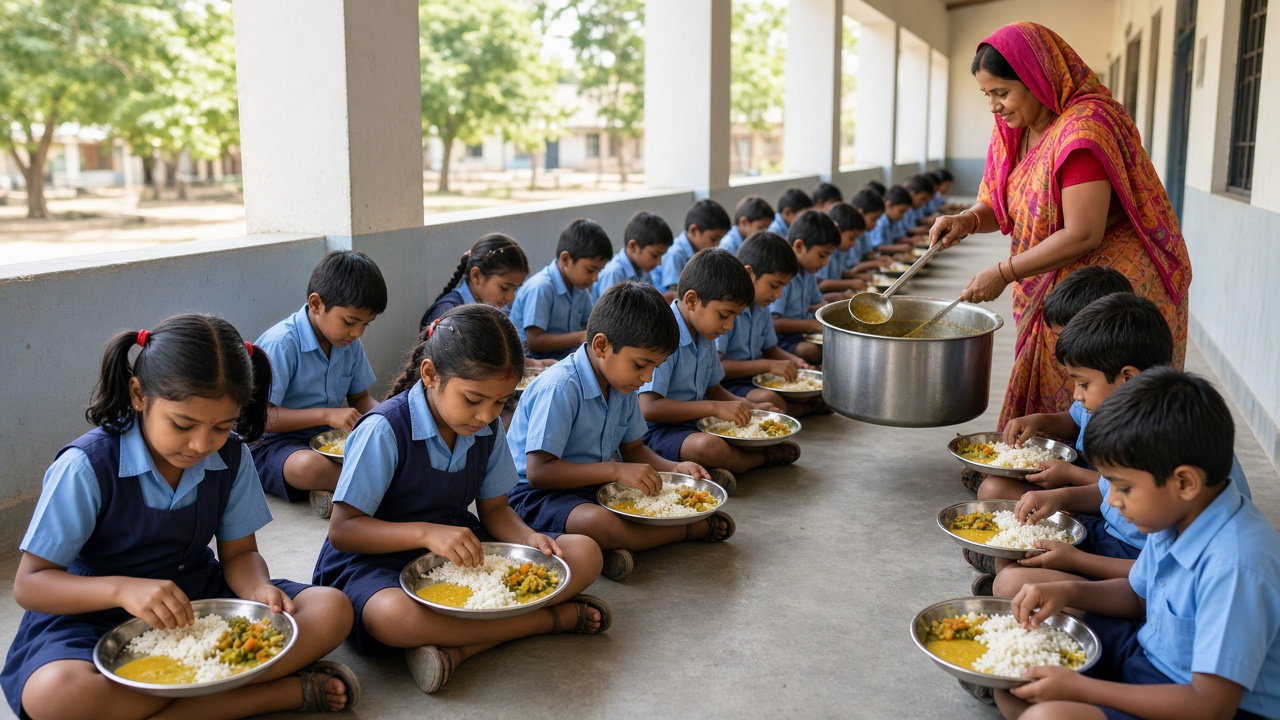
Hot cooked school meals feed crores of children every day (artistic illustration).
2000: Antyodaya Anna Yojana gives the poorest families 35 kg of grain a month at very low prices.
2001: In the PUCL right-to-food case, the Supreme Court orders cooked mid-day meals in all government primary schools.
2004–2006: The National Commission on Farmers, chaired by M. S. Swaminathan, recommends ways to raise farm incomes and nutrition.
2007–2011: The National Food Security Mission and Rashtriya Krishi Vikas Yojana begin (2007); “Bringing Green Revolution to Eastern India” starts (2010–11).
Programmes
AAY: Grain for the poorest.
Mid-day meals: Hot food at school.
NFSM: Raise rice, wheat, pulses output.
Features
Rights approach: Food as an entitlement.
Eastern focus: Bihar, Odisha, Assam, and more.
Nutrition: Beyond just calories.
🍚 Free Grain2013 – Present
National Food Security Act & Free Grain
A national law made subsidised grain a legal right for about two-thirds of Indians. Digital ration cards, biometric shops, and portability followed, and after the pandemic grain became free for around 80 crore people.
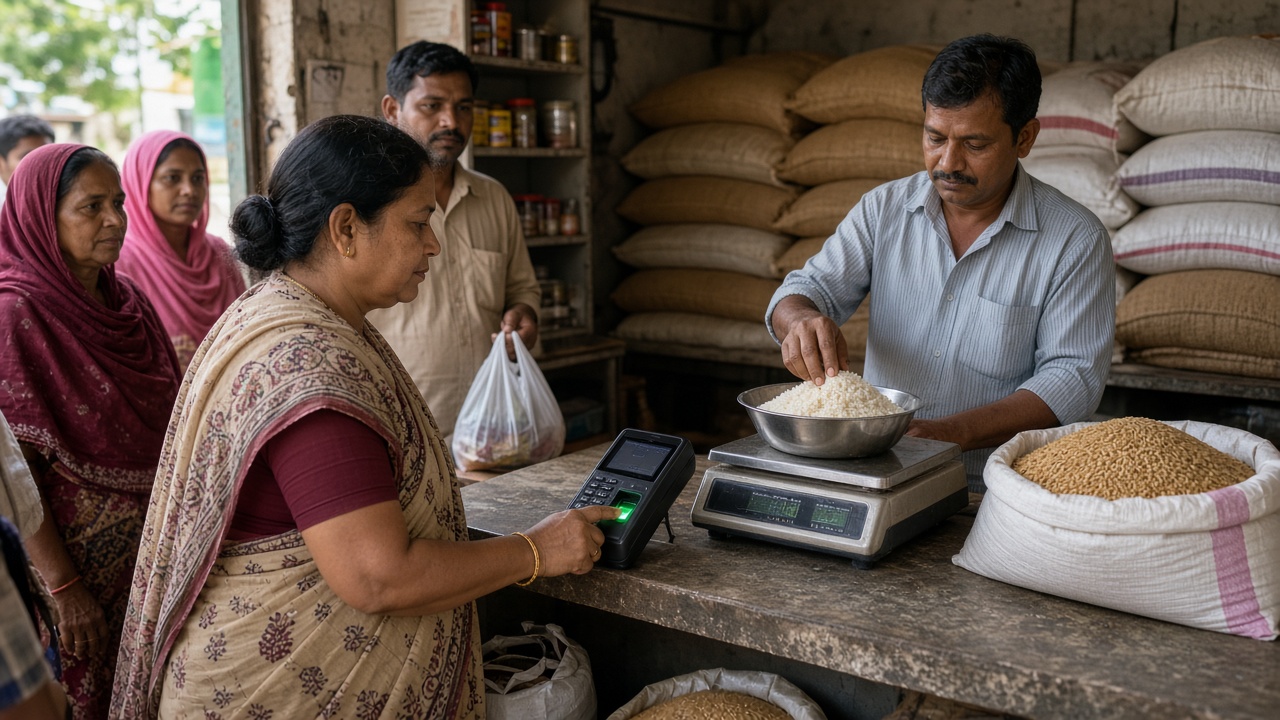
Biometric ration shops let families collect grain anywhere in India (artistic illustration).
2013: The National Food Security Act gives up to 75% of rural and 50% of urban people a right to 5 kg of subsidised grain per person each month.
2015–2019: Soil Health Cards are issued (2015); ration shops adopt biometric point-of-sale machines; One Nation One Ration Card begins (2019).
2020–2023: PM Garib Kalyan Anna Yojana gives free grain during COVID-19 (2020); NFSA grain becomes free from January 2023; India leads the International Year of Millets (2023).
2024–present: Free grain is extended for five years; fortified rice reaches all schemes; M. S. Swaminathan is awarded the Bharat Ratna (2024); foodgrain output tops 330 million tonnes.
Programmes
NFSA: Legal right to grain.
ONORC: Ration anywhere in India.
PMGKAY: Free grain for 80 crore.
Features
Digital ration: Aadhaar-linked cards.
Millets return: Shree Anna for nutrition.
Climate risk: Heatwaves threaten wheat.
India’s Foodgrain Production Over Time
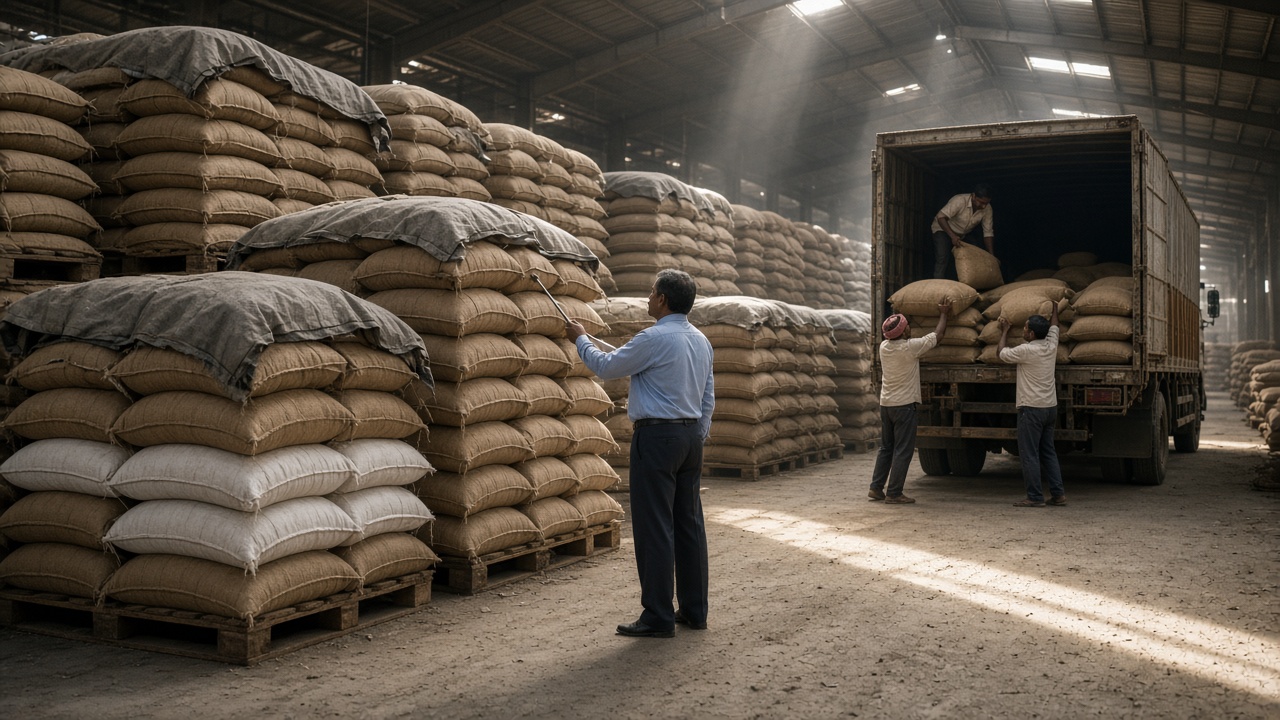
Government godowns hold buffer stocks for ration shops and emergencies (artistic illustration).
Year
Foodgrains (approx. million tonnes)
What was happening
1950–51
~51
Shortages after Partition
1960–61
~82
PL-480 imports
1970–71
~108
Green Revolution in wheat
1980–81
~130
Rice gains spread
1990–91
~176
Self-sufficiency and surplus
2000–01
~197
Large FCI stocks
2010–11
~245
Food Security Mission
2020–21
~311
Free grain during COVID-19
2023–24
~332
Record harvests
The Green Revolution Package
Ingredient
What it did
Side effect
High-yielding seeds
Short plants that hold heavy grain without falling over
Loss of traditional varieties
Chemical fertilisers
Fed crops for much higher yields
Soil health decline when overused
Irrigation and tube wells
Reliable water for two crops a year
Falling groundwater levels
Pesticides
Protected crops from pests
Health and environmental harm
Credit
Loans to buy inputs
Farmer debt
MSP and procurement
Assured price and buyer
Bias towards wheat and rice
Research and extension
New varieties and farmer training
Uneven reach across regions
Farm machinery
Faster sowing, threshing, and harvest
Stubble burning with combines
India’s Colourful Farm Revolutions
Revolution
Product
Key push
Green Revolution
Wheat and rice
High-yielding varieties, from 1966
White Revolution
Milk
Operation Flood, from 1970
Blue Revolution
Fish
Fish farming schemes, from the 1980s
Yellow Revolution
Oilseeds
Technology Mission on Oilseeds, 1986
Golden Revolution
Fruits, vegetables, and honey
Horticulture missions, 1990s–2000s
Silver Revolution
Eggs and poultry
Commercial poultry farming
Major Food Security Schemes
Scheme
Started
What it gives
Public Distribution System
1940s, expanded in the 1960s
Subsidised grain through ration shops
Integrated Child Development Services
1975
Food and care for young children and mothers at anganwadis
Mid-day meals (now PM POSHAN)
1995; renamed 2021
Hot cooked meals in schools
Targeted PDS
1997
Larger subsidy for poor families
Antyodaya Anna Yojana
2000
35 kg grain per month for the poorest families
National Food Security Act
2013
Legal right to 5 kg grain per person each month
One Nation One Ration Card
2019
Ration from any shop in India
PM Garib Kalyan Anna Yojana
2020
Free foodgrains
Green Revolution & Food Security Timeline Summary
Year / Era
Milestone
1770
Great Bengal Famine
1880–1883
Famine Commission and Famine Codes
1943
Bengal Famine; Grow More Food campaign
1952
Community Development Programme
1956
PL-480 wheat agreement with the USA
1960
First agricultural university at Pantnagar
1963
Norman Borlaug visits India
1965
“Jai Jawan Jai Kisan”; FCI and Agricultural Prices Commission
Click any panel to expand and explore the visual mood.
The Green Revolution and food security in pictures — famine relief, grain ships, seed trials, tube wells, golden wheat, grain godowns, school meals, and ration shops.
Famine Relief
Colonial era
Ship to Mouth
PL-480 imports
Dwarf Wheat Trials
1960s
Golden Wheat
Punjab
Water & Fertiliser
1980s
Buffer Stocks
Grain godowns
Mid-Day Meal
School food
Ration Shop
One Nation One Card
Explore all agriculture timelines
Jump to any other agriculture timeline on WorldTimelineHub.
Disclaimer: This content is AI-generated for educational purposes and may contain errors or outdated details. For correct and authoritative information, please refer to official and reliable sources such as government publications, manufacturers, museums, and academic references.