Agricultural Education & Research Timeline of India
Behind every high-yielding seed, soil test, and farm advisory in India stands a network of research institutes, agricultural universities, and district farm
science centres. This network grew from a few colonial model farms into one of the largest agricultural research and education systems in the world.
This timeline covers early farm societies and model farms, the Pusa Institute and the first agricultural colleges, ICAR, land-grant style state agricultural
universities, Green Revolution research, Krishi Vigyan Kendras, gene banks, central agricultural universities, degree reforms, and today’s digital and climate-smart research.
Farming changes with new pests, new markets, and a changing climate. Research institutes breed better seeds and find new methods, universities train the
scientists and extension workers of tomorrow, and farm science centres carry that knowledge to villages. Together they helped India move from famine and food
imports to becoming one of the world’s largest producers of rice, wheat, milk, fruits, and vegetables.
Big picture
Farm science in one view
Colonial model farms and a handful of colleges gave way to ICAR and national research institutes. After independence, state agricultural universities joined
teaching, research, and extension, and Krishi Vigyan Kendras brought science to every district. Today the system focuses on quality education, genetic
resources, digital tools, and climate-resilient crops. Related timelines:
farming tools,
irrigation development,
higher education in India.
1929
ICAR founded
100+
ICAR research institutes
~75
Agricultural universities
700+
Krishi Vigyan Kendras
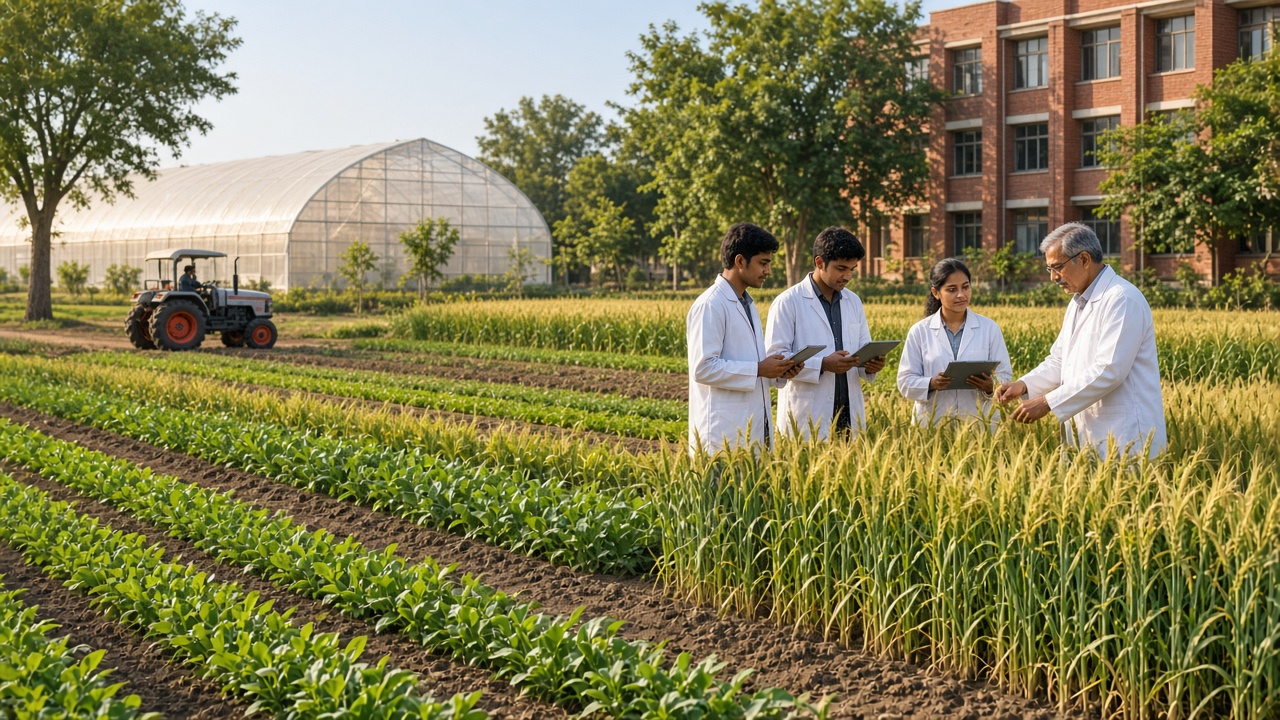
Agricultural universities combine classrooms, labs, and experimental farms (artistic illustration).
🌱 Beginnings1820 – 1904
Farm Societies, Model Farms & First Schools
Learned societies, experimental farms, and a few agricultural schools were the first attempts at farm science in India. Repeated famines pushed the government to create agricultural departments and ask experts how Indian farming could be improved.
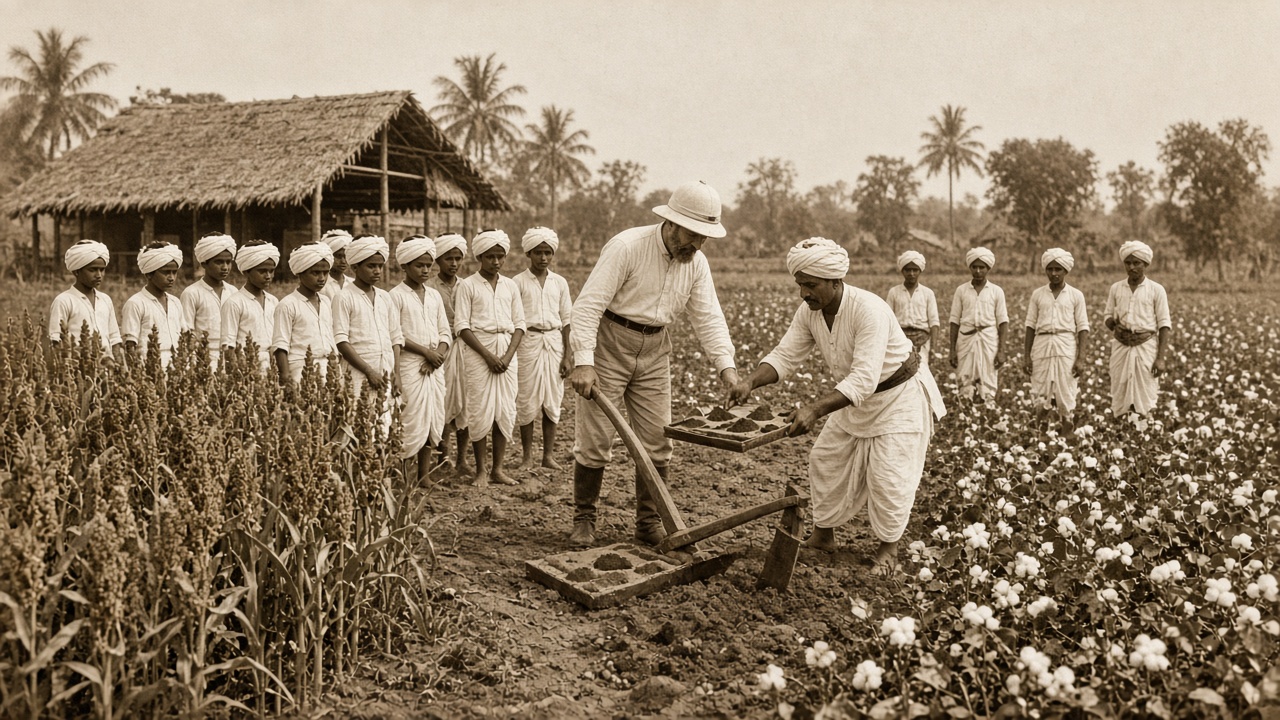
Early farm schools taught students on experimental fields (artistic illustration).
1820: William Carey founds the Agricultural and Horticultural Society of India in Calcutta to promote better farming and new crops.
1865–1876: An experimental farm opens at Saidapet near Madras (1865), and an agricultural school begins there (1876).
1871–1880: A Department of Revenue and Agriculture is created (1871); the Famine Commission (1880) urges agricultural departments in every province.
1889–1893: The Imperial Bacteriological Laboratory opens in Pune (1889), later the Indian Veterinary Research Institute; J. A. Voelcker’s report on improving Indian agriculture is published (1893).
Institutions
Farm societies: Shared seeds and ideas.
Experimental farms: Tested crops and ploughs.
Veterinary lab: Fought cattle diseases.
Features
Famine pressure: Need for better farming.
Few students: Small classes, limited reach.
Cash crops: Focus on cotton, indigo, and tea.
🏛️ Pusa & ICAR1905 – 1946
Pusa Institute, Agricultural Colleges & ICAR
A national research institute opened at Pusa, and agricultural colleges started in several provinces. Specialised institutes for sugarcane, dairy, and rice followed, and the Imperial Council of Agricultural Research was set up to coordinate research across India.
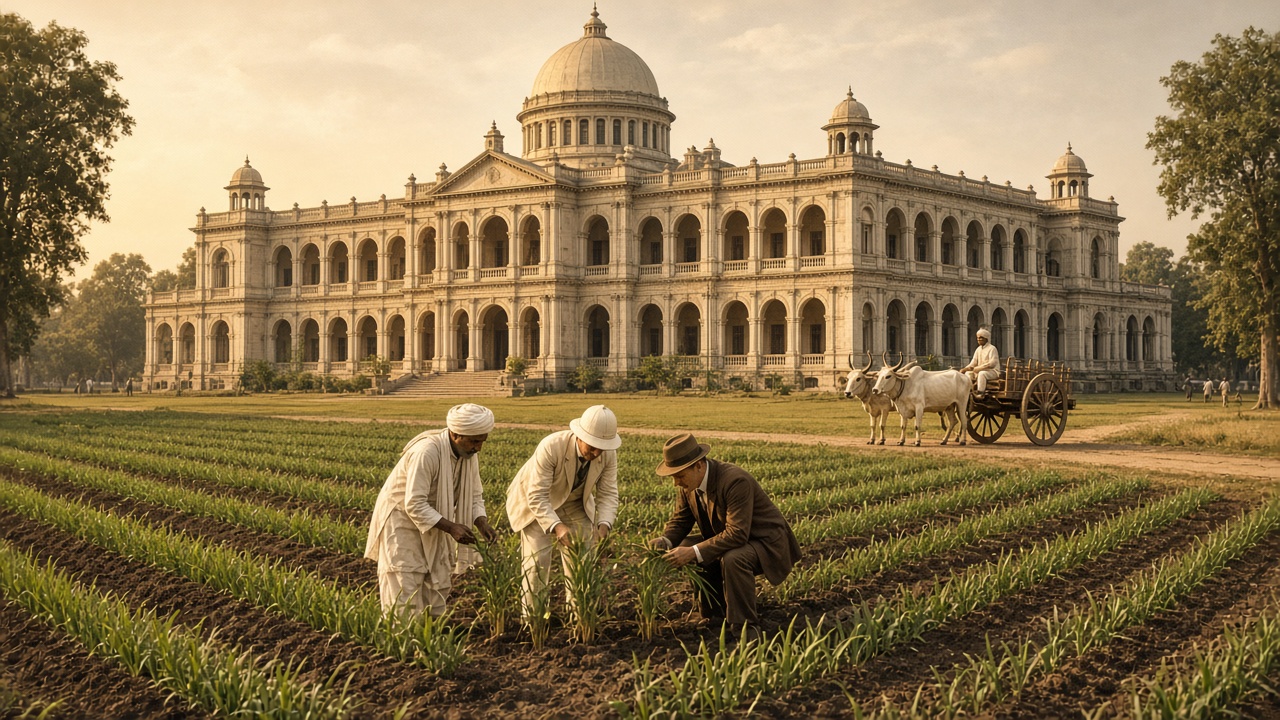
The Pusa Institute in Bihar was India’s first major agricultural research centre (artistic illustration).
1905–1908: The Agricultural Research Institute opens at Pusa, Bihar (1905); agricultural colleges start at Pune, Kanpur, Nagpur, Coimbatore, Sabour, and Lyallpur.
1910–1923: The Allahabad Agricultural Institute is founded (1910); the Sugarcane Breeding Institute opens at Coimbatore (1912); the Imperial Dairy Institute starts in Bangalore (1923).
1926–1929: The Royal Commission on Agriculture reports (1928); the Imperial Council of Agricultural Research, now ICAR, is set up (1929).
1936–1946: After the 1934 earthquake, the Pusa Institute moves to New Delhi (1936); the Central Rice Research Institute opens at Cuttack (1946).
Institutions
Pusa Institute: National crop research.
Provincial colleges: Degrees in agriculture.
Crop institutes: Sugarcane, rice, and dairy.
Features
Plant breeding: Improved wheat and sugarcane.
Coordination: ICAR links research nationally.
Indian scientists: A new generation trained.
🎓 Universities1947 – 1965
Land-Grant Style Agricultural Universities
Independent India decided to build rural universities that would teach, research, and serve farmers together, inspired by the land-grant universities of the United States. The first state agricultural university opened at Pantnagar, and many states soon followed.
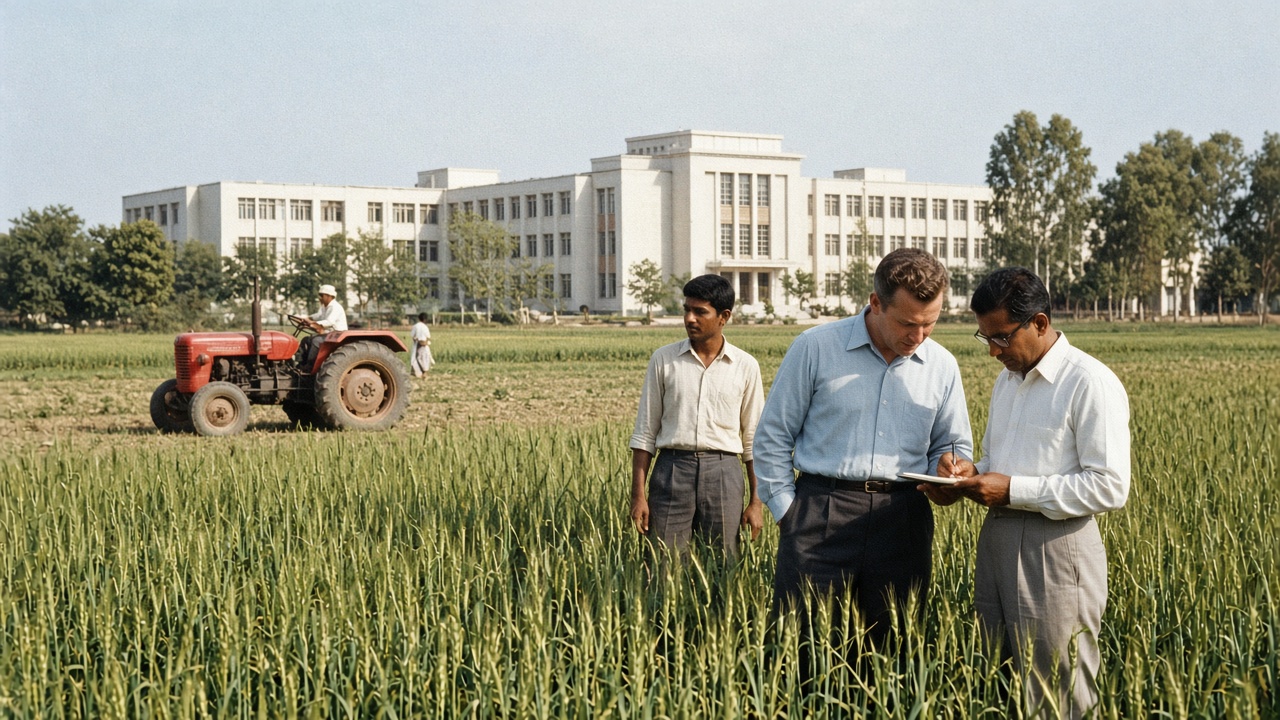
Indian and visiting American faculty helped set up the first agricultural universities (artistic illustration).
1948–1949: The University Education Commission, led by S. Radhakrishnan, recommends rural universities.
1949–1958: The Central Potato Research Institute is founded (1949); the dairy institute moves to Karnal as NDRI (1955); IARI becomes a deemed university (1958).
1960: The Uttar Pradesh Agricultural University at Pantnagar, now G. B. Pant University, becomes India’s first state agricultural university.
1962–1965: Punjab Agricultural University and Orissa University of Agriculture and Technology open (1962); universities follow in Karnataka, Andhra Pradesh, and other states; dwarf wheat trials begin at IARI.
Institutions
State agricultural universities: One per state.
IARI deemed university: Postgraduate teaching.
Commodity institutes: Potato, dairy, and more.
Features
Three-in-one: Teaching, research, extension.
Campus farms: Research on real fields.
Foreign help: US universities as partners.
🌾 Green Revolution1966 – 1990
Green Revolution Research & Krishi Vigyan Kendras
ICAR was reorganised to take charge of national institutes, and scientists at IARI and the agricultural universities adapted high-yielding wheat and rice. New bodies recruited and trained scientists, and Krishi Vigyan Kendras carried research to farmers’ fields.
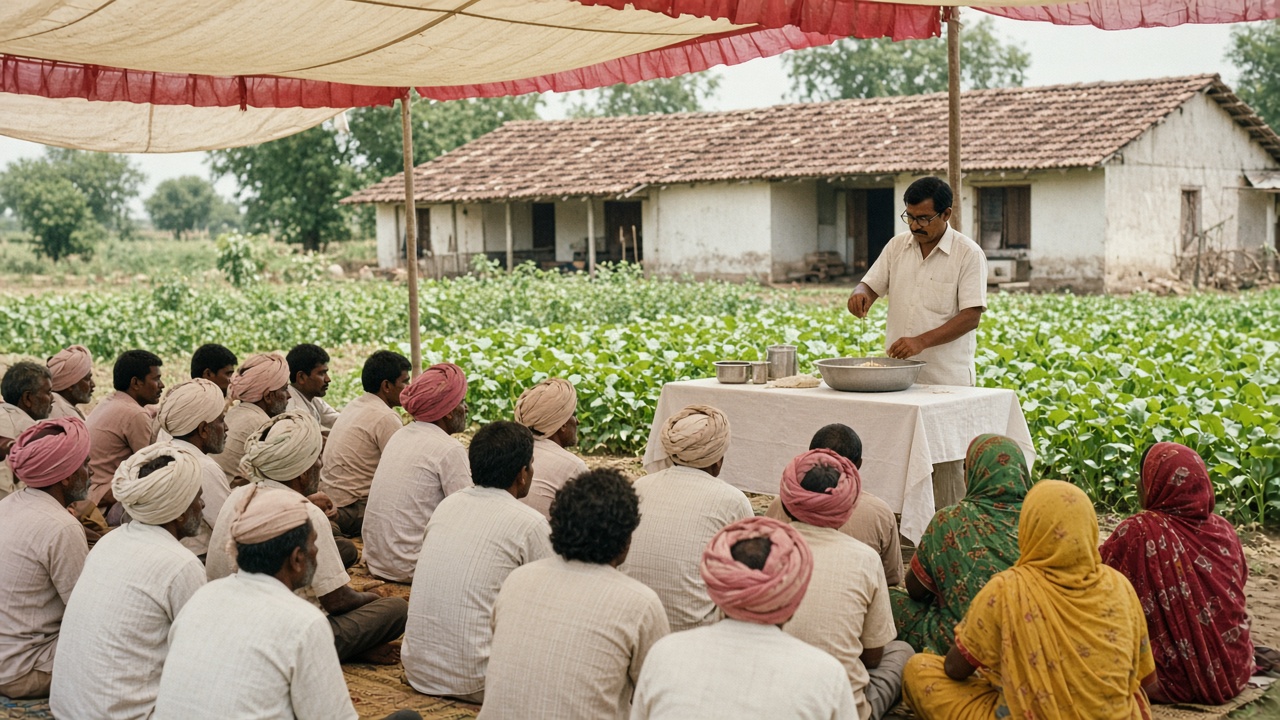
Krishi Vigyan Kendras train farmers with hands-on demonstrations (artistic illustration).
1966–1972: ICAR is reorganised and takes over central research institutes; ICRISAT, an international crops research institute, opens near Hyderabad (1972).
1973–1975: The Department of Agricultural Research and Education is created and the Agricultural Scientists Recruitment Board is set up (1973); the Agricultural Research Service begins (1975).
1974–1976: The first Krishi Vigyan Kendra opens in Puducherry (1974); the National Academy of Agricultural Research Management and the National Bureau of Plant Genetic Resources are set up (1976).
1979: The Lab to Land programme links scientists with small farmers; the National Agricultural Research Project strengthens zonal research stations.
Institutions
DARE and ICAR: National research leadership.
Krishi Vigyan Kendras: District farm science centres.
Zonal research stations: Research for each climate zone.
Features
High-yielding seeds: Wheat and rice varieties.
Learning by doing: Demonstrations on farms.
Merit hiring: Scientists chosen by exam.
🧬 Gene Banks1991 – 2013
Central Universities, Gene Banks & Extension Reform
A central agricultural university opened for the North-East, and a national gene bank began storing seeds of India’s crop diversity. World Bank-supported projects modernised research, and new extension systems and call centres improved how advice reached farmers.
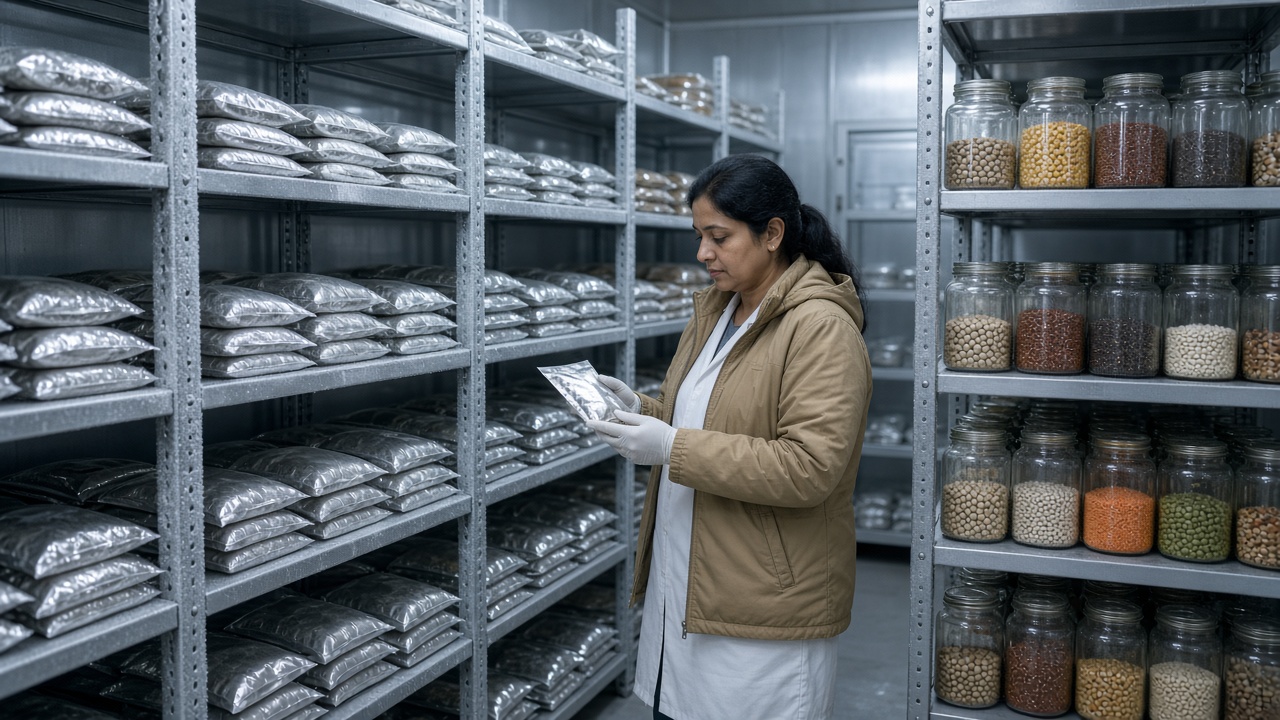
Gene banks store seeds at low temperatures to protect crop diversity (artistic illustration).
1992–1996: The Central Agricultural University Act is passed (1992) and the university starts in Imphal (1993); the National Gene Bank is set up at NBPGR, New Delhi (1996).
1996–1998: ICAR begins accrediting agricultural universities (1996); the National Agricultural Technology Project starts (1998).
2004–2006: Kisan Call Centres open (2004); the Agricultural Technology Management Agency reforms district extension (2005); the National Agricultural Innovation Project begins (2006).
2007–2013: The Fifth Deans Committee revises degree courses (2007); mobile advisory services like mKisan send messages to farmers (2013).
Institutions
National Gene Bank: Long-term seed storage.
Accreditation: Quality checks for universities.
Kisan Call Centres: Toll-free advice for farmers.
Features
North-East focus: Central university at Imphal.
Innovation projects: Research with industry.
Phone advice: SMS and call centres.
🛰️ Smart Research2014 – Present
Professional Degrees, NAHEP & Climate-Smart Research
New central agricultural universities opened, agriculture degrees were recognised as professional courses, and students gained hands-on rural and industry experience. Research now focuses on climate-resilient varieties, biotechnology, drones, and digital farming.
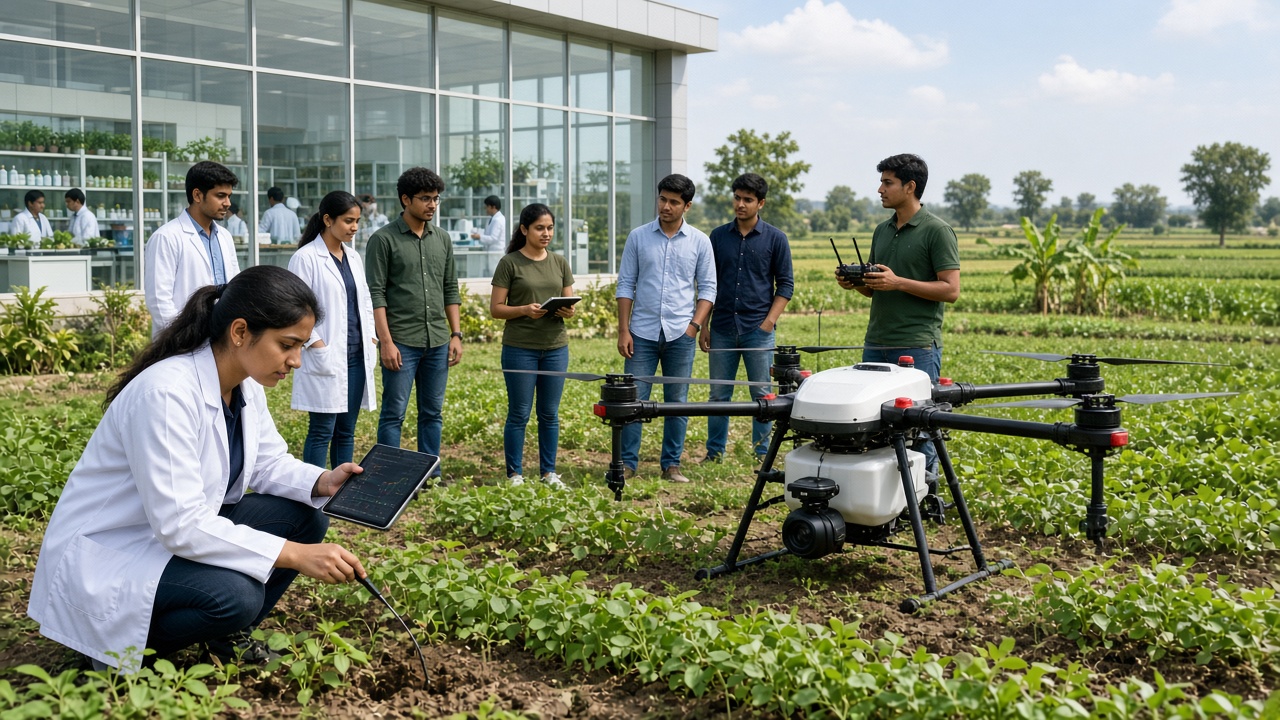
Today’s agriculture students learn drones, sensors, and biotechnology alongside field skills (artistic illustration).
2014–2016: Rani Lakshmi Bai Central Agricultural University opens in Jhansi (2014); Dr. Rajendra Prasad Central Agricultural University is formed at Pusa (2016); Student READY begins.
2016–2017: The Sixth Deans Committee recommends treating agriculture degrees as professional courses; the National Agricultural Higher Education Project begins with World Bank support (2017).
2020: The National Education Policy calls for integrating agricultural education with other disciplines and linking universities to local needs.
2024–present: 109 high-yielding, climate-resilient crop varieties are released together (2024); scientists reach villages through mass farmer outreach campaigns.
Institutions
Central agricultural universities: Three across India.
Student READY: Rural and industry training.
NAHEP: Better teaching and digital tools.
Features
Professional status: Agriculture as a professional degree.
Climate focus: Heat- and drought-tolerant crops.
Agri-startups: Incubators on campuses.
India’s Agricultural Research & Education Network
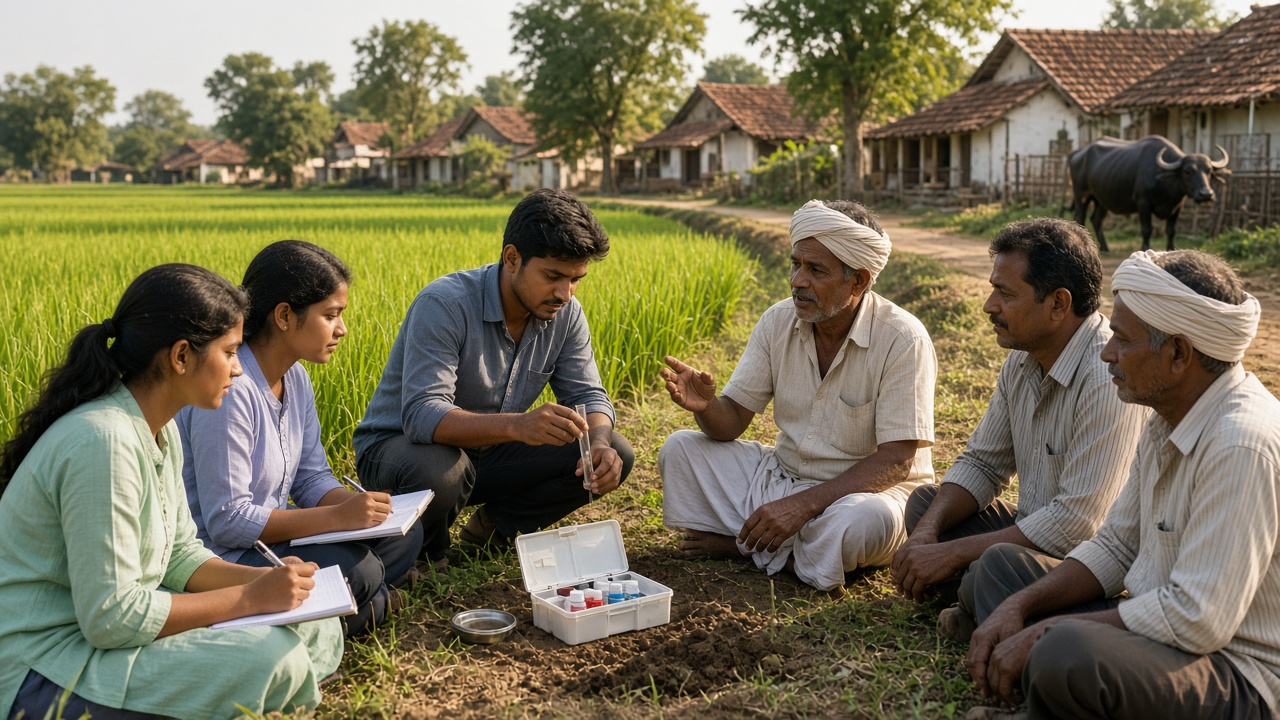
Final-year students live and work with farmers during rural work experience (artistic illustration).
Part of the network
Approx. number
Role
ICAR institutes, bureaus, and centres
100+
National research on crops, animals, fish, soil, and engineering
State agricultural universities
60+
Teaching, research, and extension in each state
Central agricultural universities
3
Union-funded universities in Imphal, Jhansi, and Pusa
ICAR deemed universities
4
Postgraduate teaching at IARI, IVRI, NDRI, and CIFE
Krishi Vigyan Kendras
700+
District-level testing, training, and advice
All-India coordinated research projects
Dozens
Multi-location trials across climate zones
Kisan Call Centres
Nationwide
Toll-free phone advice in local languages
Landmark Agricultural Universities
University
Year
Place
Indian Agricultural Research Institute (deemed university)
1958
New Delhi
G. B. Pant University of Agriculture and Technology
1960
Pantnagar, Uttarakhand
Punjab Agricultural University
1962
Ludhiana, Punjab
Orissa University of Agriculture and Technology
1962
Bhubaneswar, Odisha
University of Agricultural Sciences
1964
Bengaluru, Karnataka
Andhra Pradesh Agricultural University
1964
Hyderabad
Haryana Agricultural University
1970
Hisar, Haryana
Tamil Nadu Agricultural University
1971
Coimbatore, Tamil Nadu
Kerala Agricultural University
1971
Thrissur, Kerala
Central Agricultural University
1993
Imphal, Manipur
Rani Lakshmi Bai Central Agricultural University
2014
Jhansi, Uttar Pradesh
Dr. Rajendra Prasad Central Agricultural University
2016
Pusa, Bihar
Agricultural Degrees You Can Study
Degree
Usual duration
What students learn
B.Sc. (Hons.) Agriculture
4 years
Crops, soils, plant protection, economics, and extension
B.Tech. Agricultural Engineering
4 years
Farm machines, irrigation, and food processing
B.Sc. (Hons.) Horticulture
4 years
Fruits, vegetables, flowers, and spices
B.V.Sc. & A.H.
5½ years
Animal health and livestock production
B.F.Sc. (Fisheries)
4 years
Fish farming, processing, and aquatic resources
B.Sc. (Hons.) Forestry
4 years
Trees, agroforestry, and conservation
B.Tech. Food Technology / Dairy Technology
4 years
Processing, quality, and food safety
M.Sc. and Ph.D.
2 + 3 years (approx.)
Specialised research in any farm science
Agricultural Education & Research Timeline Summary
Year
Milestone
1820
Agricultural and Horticultural Society of India
1865–76
Saidapet experimental farm and school
1889
Imperial Bacteriological Laboratory (now IVRI)
1905
Pusa Agricultural Research Institute
1905–08
Six provincial agricultural colleges
1912
Sugarcane Breeding Institute, Coimbatore
1929
Imperial (now Indian) Council of Agricultural Research
1936
Pusa Institute moves to New Delhi
1946
Central Rice Research Institute, Cuttack
1958
IARI becomes a deemed university
1960
First state agricultural university at Pantnagar
1973
DARE and Agricultural Scientists Recruitment Board
1974
First Krishi Vigyan Kendra, Puducherry
1976
NAARM and NBPGR
1979
Lab to Land; National Agricultural Research Project
1993
Central Agricultural University, Imphal
1996
National Gene Bank; university accreditation
2004
Kisan Call Centres
2014
Rani Lakshmi Bai Central Agricultural University
2016
Dr. Rajendra Prasad Central Agricultural University
2017
National Agricultural Higher Education Project
2020
National Education Policy
2024
109 climate-resilient varieties released
Test Your Knowledge
20 quick questions from the agricultural education and research timeline. Click each question to reveal the answer.
Answer: William Carey.
Answer: Saidapet.
Answer: The Imperial Bacteriological Laboratory.
Answer: Bihar.
Answer: Its buildings were damaged in the 1934 Bihar earthquake.
Answer: Coimbatore.
Answer: The Royal Commission on Agriculture (1926–28).
Answer: 1929.
Answer: Cuttack, Odisha.
Answer: The Uttar Pradesh Agricultural University at Pantnagar (1960), now G. B. Pant University.
Answer: The United States.
Answer: Teaching, research, and extension.
Answer: Karnal, Haryana.
Answer: Department of Agricultural Research and Education.
Answer: Puducherry.
Answer: The National Bureau of Plant Genetic Resources (NBPGR).
Answer: Imphal, Manipur.
Answer: Kisan Call Centres.
Answer: Rural Entrepreneurship Awareness Development Yojana.
Answer: 109.
Classroom activity
Students Tasks
Use these prompts for discussion or projects on agricultural education and research in India.
Timeline understandingCareer awarenessScience & societyRural development
Find the agricultural university and Krishi Vigyan Kendra nearest to your home and list what they offer.
Draw a flowchart showing how a new seed variety moves from a research lab to a farmer’s field.
Mark ten major ICAR institutes and agricultural universities on a map of India.
Interview a farmer about whether they have attended KVK training or called a Kisan Call Centre.
Compare four agriculture-related degrees and the careers each one can lead to.
Explain why a gene bank is important for food security and climate change.
Research one famous Indian agricultural scientist and present their contribution.
Debate: “Every agriculture student should spend six months living in a village.”
Design a poster inviting young people to study agriculture, highlighting modern careers like drones and biotech.
Plan a small school garden experiment comparing two methods, and record the results like a scientist.
Continue exploring
Farm research shapes the tools, water systems, and seeds farmers use. Explore more agriculture and education timelines next.
Click any panel to expand and explore the visual mood.
Agricultural education and research in pictures — early farm schools, the Pusa Institute, new universities, KVK training, gene banks, rural work experience, and modern students.
Farm School
Saidapet 1876
Pusa Institute
1905
First Universities
Pantnagar 1960
KVK Training
From 1974
Gene Bank
NBPGR 1996
Village Learning
Student READY
Smart Farming
Drones & sensors
Campus Today
Teach · Research · Extend
Explore all agriculture timelines
Jump to any other agriculture timeline on WorldTimelineHub.
Disclaimer: This content is AI-generated for educational purposes and may contain errors or outdated details. For correct and authoritative information, please refer to official and reliable sources such as government publications, manufacturers, museums, and academic references.