India’s farmers have tilled the same soil for about 9,000 years. They began with stone sickles and wooden ploughs, learned to forge iron, lifted water with
Persian wheels, and sowed seeds in rows with bamboo drills. Today tractors, power threshers, drip lines, solar pumps, and drones work alongside the bullock plough.
This timeline covers Neolithic sickles and querns, the Harappan plough, iron ploughshares, Vedic and Arthashastra farming, water wheels and leather-bucket lifts,
traditional seed drills, colonial improved ploughs and research farms, tractors, pumpsets, threshers and combines of the Green Revolution, and modern precision tools.
Every grain of rice or wheat passes through a chain of tools — to break the soil, sow the seed, bring water, remove weeds, cut the crop, and separate grain from straw.
Better tools let farmers grow more food with less effort and feed a growing population. In India, many ancient tools such as the sickle, khurpi, and winnowing basket
are still used today, side by side with tractors, harvesters, and drones.
Big picture
India’s farming tools in one view
Farming tools moved from stone and wood, to iron forged by village blacksmiths, to animal-powered water wheels and seed drills, to factory-made iron ploughs and
sugarcane mills, to tractors and pumpsets that powered the Green Revolution, and finally to precision machines, solar pumps, and drones. Related timelines:
power grid,
village roads,
farm credit and banking.
c. 2800 BCE
Ploughed field at Kalibangan
8 lakh+
Tractors sold in India each year
15,000
Drones planned for women’s groups
~45%
Of India’s workers in farming
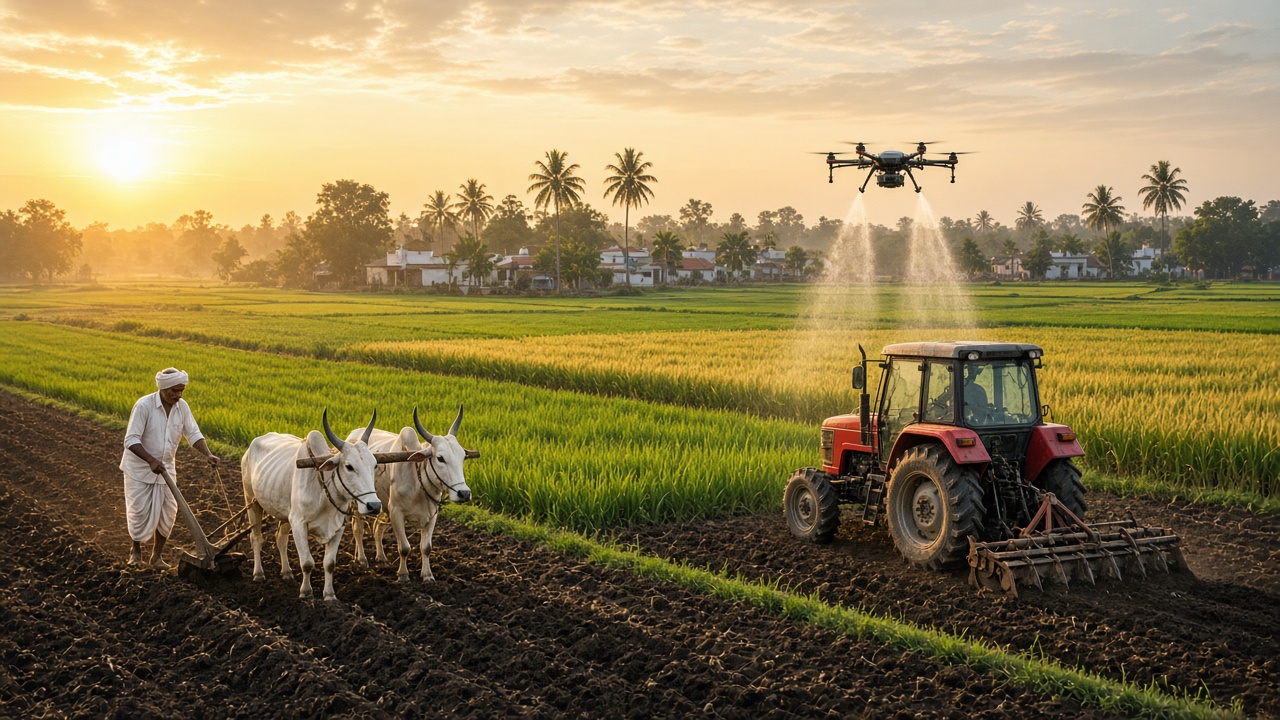
The bullock plough, the tractor, and the drone now work in the same villages (artistic illustration).
🪨 Stone & Woodc. 7000 – 1500 BCE
Stone Tools & Harappan Ploughs
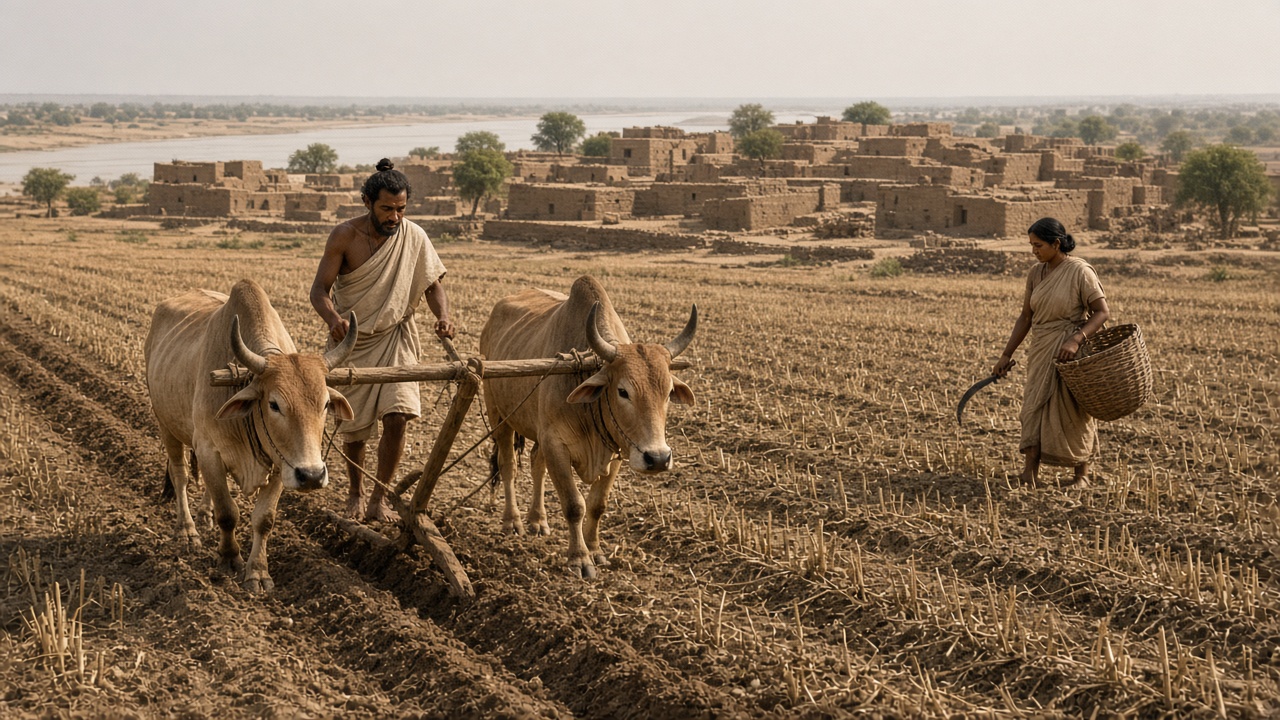
The first farmers of the subcontinent harvested wheat and barley with stone-bladed sickles and ground grain on stone querns. Harappan farmers used wooden ploughs pulled by oxen and stored grain in large granaries.
Harappan farmers ploughed their fields with wooden ploughs and oxen (artistic illustration).
c. 7000 BCE: Farmers at Mehrgarh grow wheat and barley and harvest them with sickles made of flint blades set in wooden handles.
c. 5000–3000 BCE: Stone axes, digging sticks weighted with ring stones, and saddle querns for grinding grain are used in farming villages.
c. 2800 BCE: A field at Kalibangan, Rajasthan, is ploughed in a criss-cross pattern — among the earliest ploughed fields found in the world.
c. 2600–1900 BCE: Harappan cities build large granaries; a terracotta plough model from Banawali shows the shape of their ploughs.
Tools
Flint sickles: Sharp stone blades for reaping.
Wooden plough: Scratched furrows in the soil.
Querns and mortars: Stones for grinding grain.
Features
Animal power: Oxen pull the plough.
Mixed crops: Wheat, barley, pulses, and cotton.
Grain storage: Granaries and clay jars.
⚒️ Iron Agec. 1500 BCE – 600 CE
Iron Ploughshares & Vedic Farming
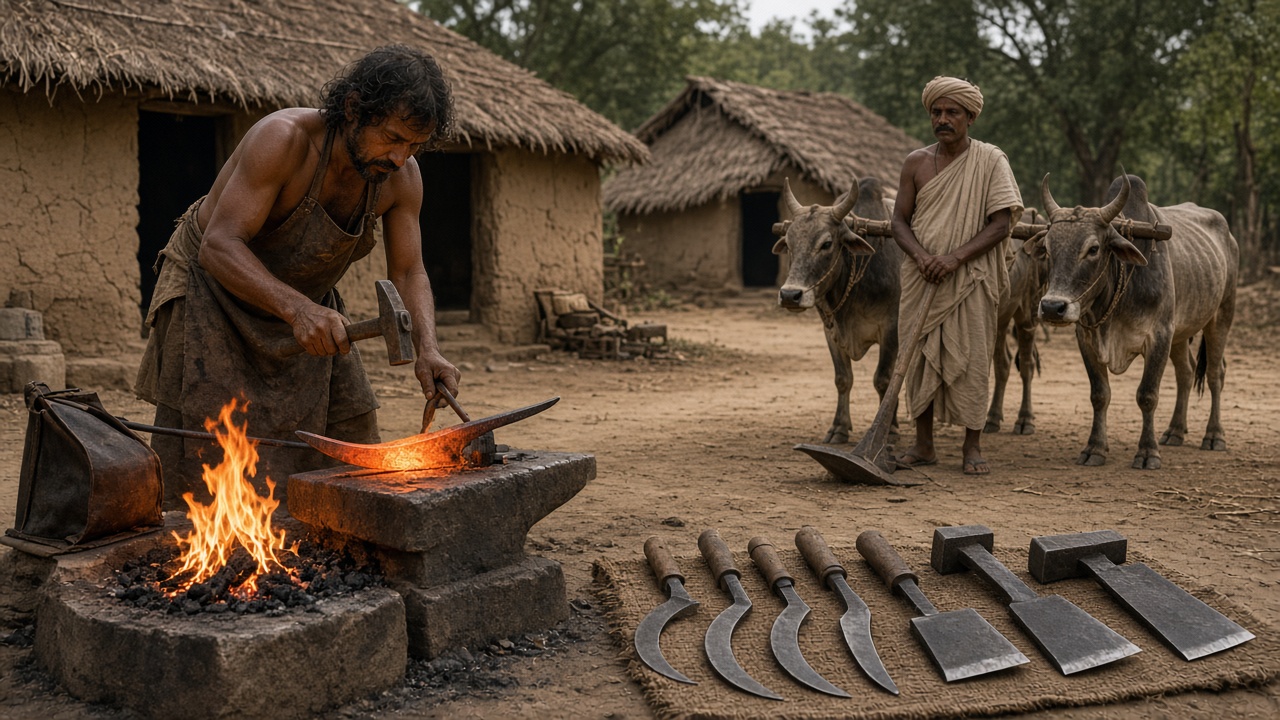
Iron changed Indian farming. Village blacksmiths forged ploughshares, sickles, hoes, and axes that cut deeper and lasted longer, helping farmers clear forests and plough the heavy soils of the Gangetic plains.
Village blacksmiths forged and repaired iron ploughshares, sickles, and hoes (artistic illustration).
c. 1500–1000 BCE: The Rigveda mentions the plough (langala), the furrow (sita), and teams of oxen.
c. 1000–600 BCE: Iron tools spread across north India; iron ploughshares and axes help clear forests in the Ganga valley.
c. 300 BCE onward: The Arthashastra describes state farms, seed treatment, and measuring rainfall to plan sowing.
Early centuries CE: Texts describe the araghatta, a wheel with pots for lifting water from wells for irrigation.
Tools
Iron ploughshare: Deeper, stronger tilling.
Iron sickle and axe: Faster harvest and land clearing.
Rain gauge: Early rainfall measurement.
Features
Rice in the Ganga plains: Wet-rice farming expands.
Village crafts: Blacksmiths and carpenters serve farmers.
Food surplus: Supports towns and kingdoms.
💧 Water Wheels600 – 1757
Water Wheels, Seed Drills & Village Tools
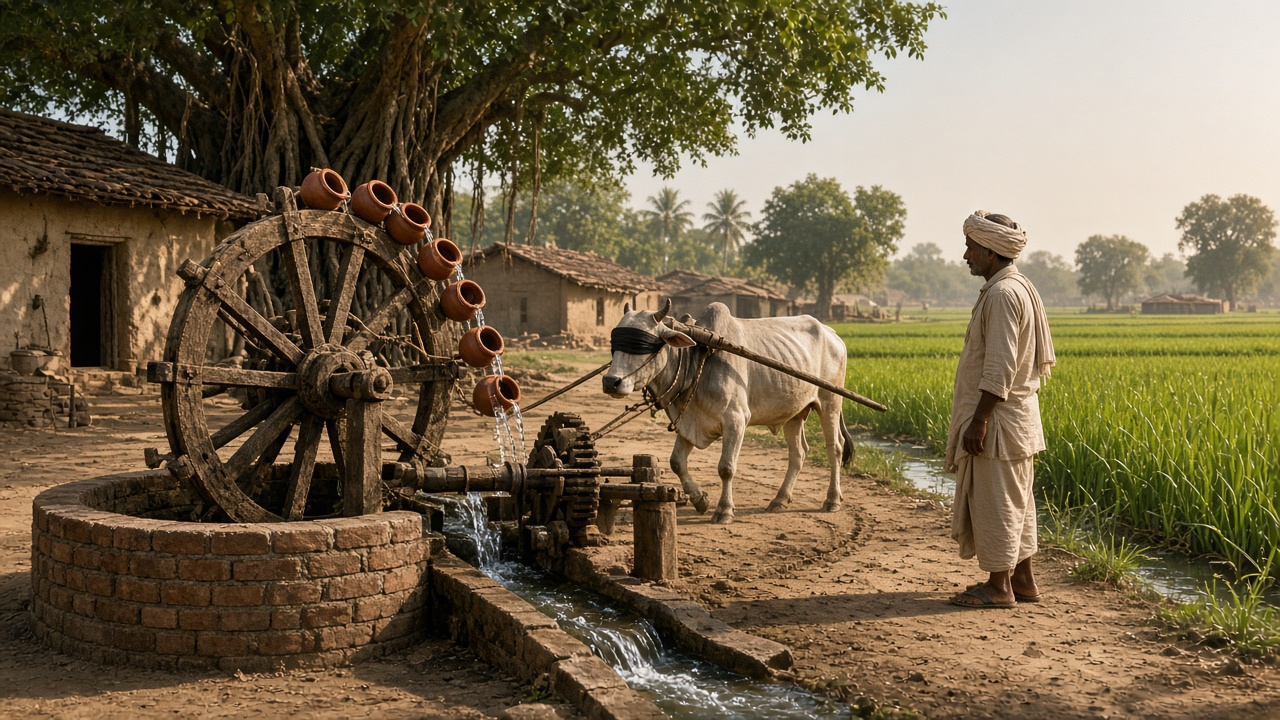
Farmers used animal power to lift water and process crops. The geared Persian wheel spread across north India, leather-bucket lifts drew water from deep wells, and bullock-drawn seed drills sowed seeds neatly in rows.
The Persian wheel used bullock power and a chain of pots to lift water for crops (artistic illustration).
Early medieval period: The farming text Krishi-Parashara describes the parts of the plough, weather signs, and crop care.
13th–16th centuries: The geared Persian wheel (rahat) spreads in north India; Babur describes these wheels in his memoirs.
Mughal era: The charsa or mot, a large leather bucket pulled by bullocks, lifts water from deep wells; wooden kolhu presses crush sugarcane and oilseeds.
1790s: British observers describe Indian bullock-drawn seed drills with bamboo tubes that sow several rows at once.
Tools
Persian wheel: Geared, animal-driven water lift.
Seed drill: Bamboo tubes for row sowing.
Dhenki: Foot-operated rice pounder.
Features
Well irrigation: Two crops a year in many areas.
Bullock threshing: Animals tread grain from stalks.
Winnowing: Baskets separate grain from chaff in the wind.
🏛️ Research Farms1757 – 1946
Colonial Improved Implements & Research Farms
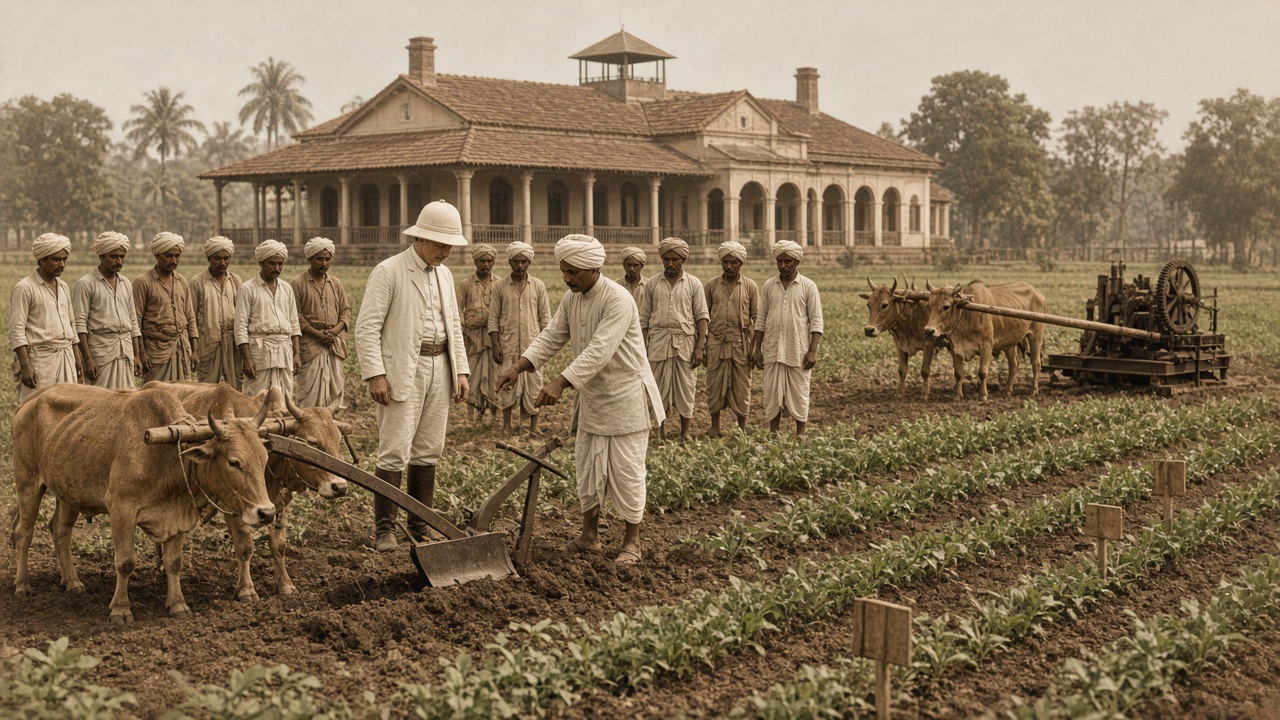
Agricultural departments, research institutes, and demonstration farms introduced iron mouldboard ploughs, iron sugarcane mills, and new crop varieties. Most farmers, however, could not afford new tools and kept using traditional implements.
Demonstration farms showed farmers iron ploughs and new crop varieties (artistic illustration).
1870s–1880s: A Department of Revenue and Agriculture is set up (1871); iron roller sugarcane mills such as the Behea mill replace wooden presses in many areas.
1905–1910: The Imperial Agricultural Research Institute opens at Pusa, Bihar (1905); the Allahabad Agricultural Institute is founded (1910); the light iron Meston plough is promoted.
1926–1929: The Royal Commission on Agriculture studies Indian farming (1926–28); the Imperial Council of Agricultural Research, now ICAR, is set up (1929).
1936–1947: The Pusa institute moves to New Delhi after the 1934 earthquake; a Central Tractor Organisation is set up (1947) to reclaim weed-infested land with tractors.
Tools
Mouldboard plough: Turns the soil over.
Iron cane mill: Crushes more juice from sugarcane.
Chaff cutter: Cuts fodder for cattle.
Features
Scientific research: Crop trials and soil studies.
Canal irrigation: Large canals in Punjab and the south.
Slow adoption: Poverty kept old tools in use.
🚜 Green Revolution1947 – 1990
Tractors, Pumpsets & the Green Revolution
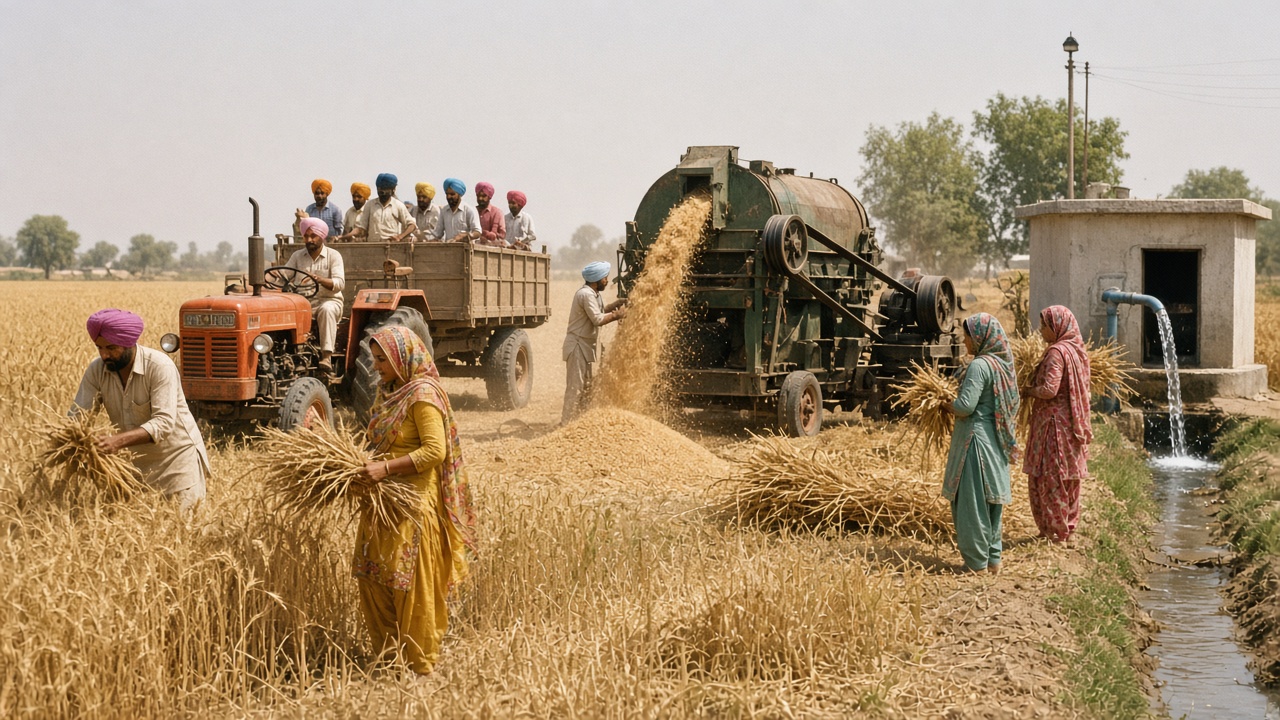
India began making its own tractors, and high-yielding seeds launched the Green Revolution. Tube wells with diesel and electric pumpsets, power threshers, sprayers, and combine harvesters transformed farming in Punjab, Haryana, and western Uttar Pradesh.
Tractors, power threshers, and tube wells changed the wheat harvest in Punjab (artistic illustration).
Early 1960s: Indian factories begin making tractors; state agro-industries corporations supply implements to farmers.
1965–1968: High-yielding wheat and rice varieties arrive; the Green Revolution begins, with tube wells and pumpsets spreading fast.
1970s: Power threshers and combine harvesters spread in Punjab; the first Krishi Vigyan Kendra opens in Puducherry (1974); the Central Institute of Agricultural Engineering is set up in Bhopal (1976).
1980s: The Dangerous Machines (Regulation) Act, 1983 targets thresher accidents; sprinklers and electric pumpsets reach more villages.
Tools
Tractor: Pulls ploughs, harrows, and trolleys.
Pumpset and tube well: Groundwater irrigation.
Power thresher: Separates grain in hours, not weeks.
Features
Food security: India becomes self-sufficient in grain.
Faster work: Tilling and harvest take less time.
New problems: Falling water tables and machine accidents.
🛰️ Smart Farming1991 – Present
Precision Farming, Solar Pumps & Drones
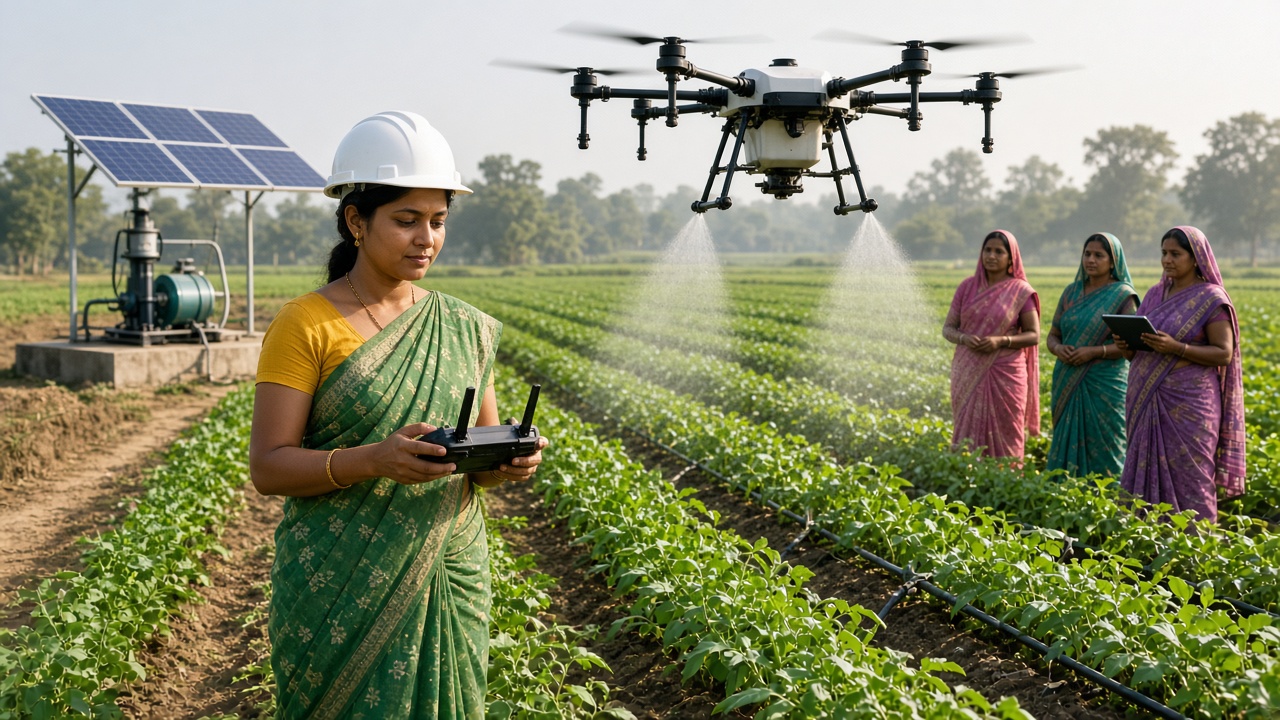
Farmers now use tools that save water, seed, fuel, and labour. Drip and sprinkler systems, zero-till drills, laser levellers, rotavators, custom hiring centres, solar pumps, and drones are spreading, supported by government schemes.
Women’s self-help groups now fly drones to spray crops for farmers (artistic illustration).
1990s–2000s: Drip and sprinkler irrigation spread with subsidies; zero-till seed drills and laser land levellers are adopted in the Indo-Gangetic plains.
2005–2015: The Happy Seeder sows wheat without burning rice straw; the Sub-Mission on Agricultural Mechanisation supports custom hiring centres (2014); Soil Health Cards and PM Krishi Sinchayee Yojana’s “Per Drop More Crop” begin (2015).
2018–2021: Crop residue management machines are subsidised to reduce stubble burning (2018); PM-KUSUM supports solar irrigation pumps (2019); drone rules are eased for farm use (2021).
2022–present: 100 Kisan drones are flagged off together (2022); Namo Drone Didi plans 15,000 drones for women’s self-help groups (2023); farm apps and sensors guide sowing and spraying.
Tools
Drip and sprinkler: Water only where plants need it.
Zero-till drill and Happy Seeder: Sow without ploughing or burning.
Drones: Fast, precise spraying of crops.
Features
Hire, don’t buy: Machines rented by the hour.
Clean energy: Solar pumps replace diesel.
Women in tech: Drone pilots from self-help groups.
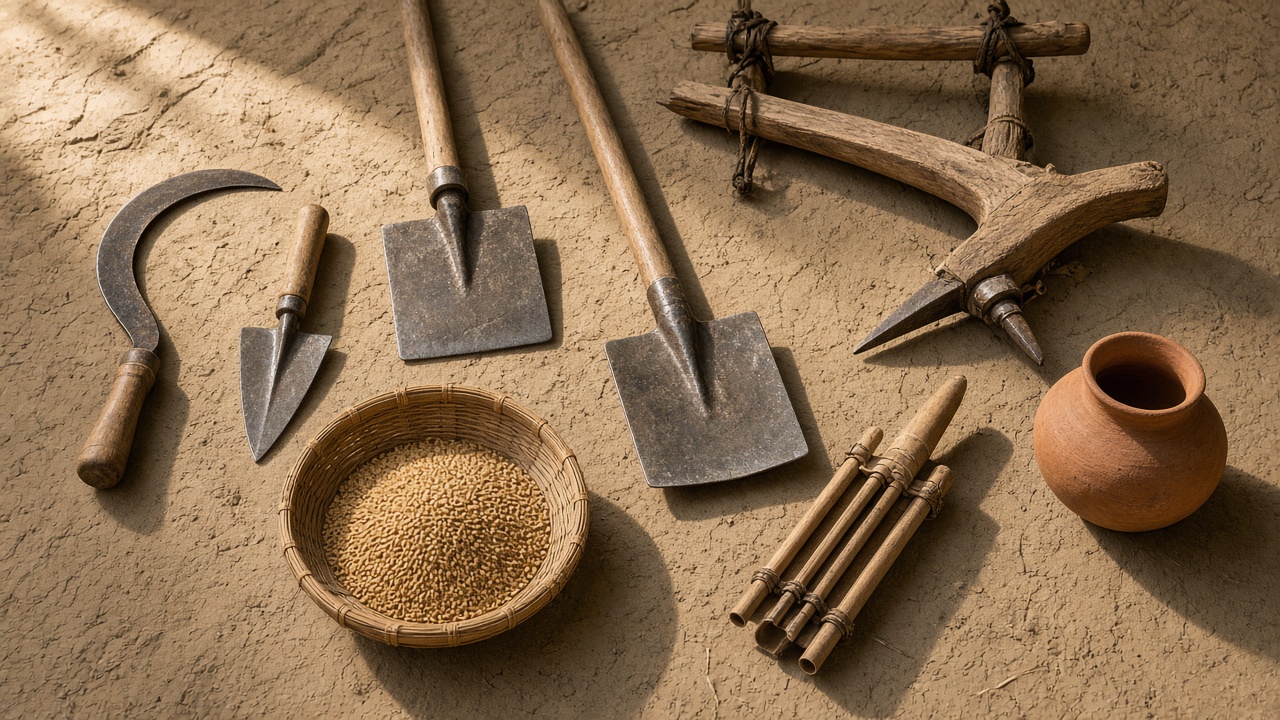
Traditional Farming Tools Still Used Today
Sickles, khurpis, spades, winnowing baskets, and wooden ploughs are still common on small farms (artistic illustration).
Click any panel to expand and explore the visual mood.
India’s farming tools in pictures — Harappan ploughs, village blacksmiths, Persian wheels, colonial demonstration farms, Green Revolution harvests, hand tools, and drones.
Harappan Plough
c. 2800 BCE
Iron Tools
c. 1000 BCE
Persian Wheel
Medieval era
Hand Tools
Still in use
Research Farms
Pusa 1905
Green Revolution
From 1965
Old Meets New
Bullock to tractor
Farm Drones
Drone Didi 2023
Explore all agriculture timelines
Jump to any other agriculture timeline on WorldTimelineHub.
Disclaimer: This content is AI-generated for educational purposes and may contain errors or outdated details. For correct and authoritative information, please refer to official and reliable sources such as government publications, manufacturers, museums, and academic references.