Every Indian kitchen needs oil — mustard in the north and east, groundnut in the west, coconut in Kerala, and sesame in Tamil Nadu. For thousands of years it came from
village ghanis. As demand grew, India turned to mills, factories, a national oilseeds mission, and finally huge imports of palm and soybean oil.
This timeline covers Harappan sesame, the Teli oil pressers and bullock ghanis, colonial groundnut exports, Vanaspati, oilseed research, the 1986 Technology Mission on
Oilseeds, NDDB’s Dhara, the opening of imports, palm oil, food safety rules, GM mustard, and the National Mission on Edible Oils.
Cooking oil gives energy and helps the body absorb vitamins, and India is one of the world’s biggest consumers. Oilseeds are grown mostly by small farmers on
rain-fed land, so yields are low and harvests swing with the monsoon. When local production falls short, India must spend large amounts of foreign exchange on
imports, which is why self-reliance in edible oils has been a national goal for decades.
Big picture
Oilseeds and edible oils in one view
India pressed its own oil for millennia and even exported groundnuts in colonial times. After independence, demand outran supply and imports soared. The 1986
Technology Mission on Oilseeds nearly made India self-sufficient, but after imports were opened in the 1990s, cheap palm oil took over. New missions now aim to
grow more at home. Related timelines:
Green Revolution,
mandis and MSP,
farming tools.
1986
Technology Mission on Oilseeds
~97%
Self-sufficiency, early 1990s
~15 MT
Edible oil imported yearly
55–60%
Needs met by imports
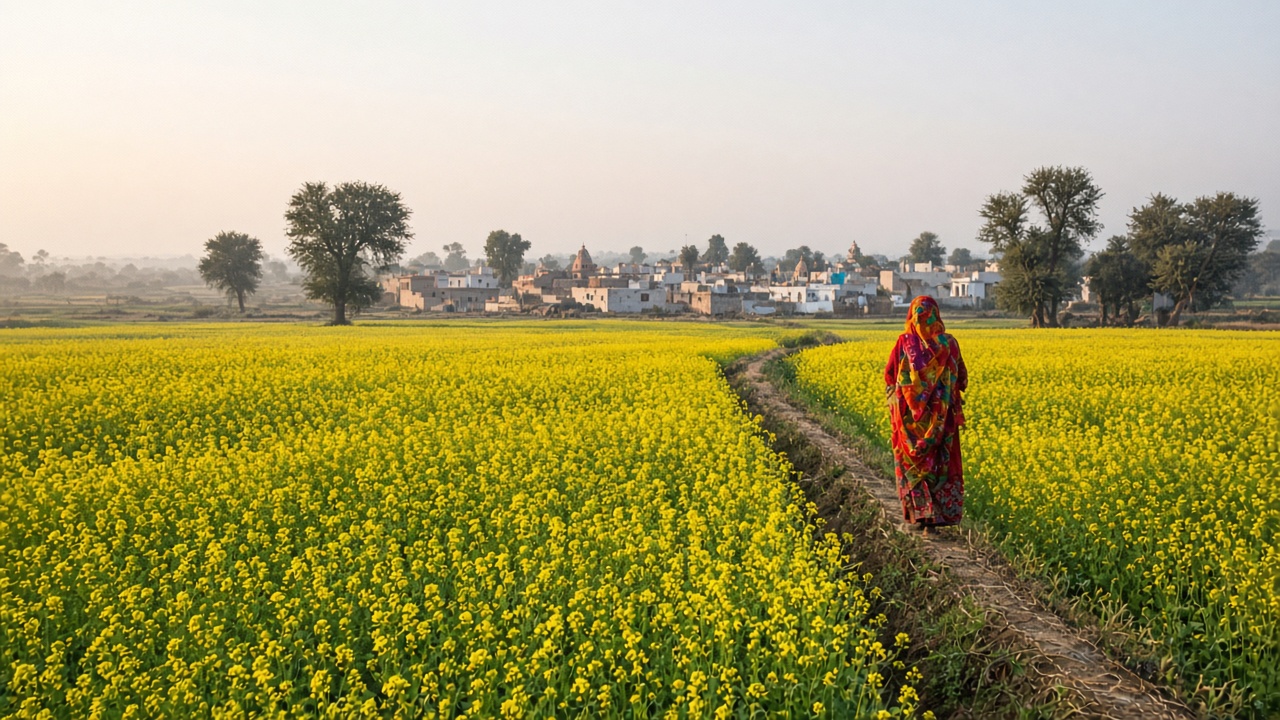
Blooming mustard fields gave the Yellow Revolution its name (artistic illustration).
🫙 GhaniAncient – 1850
Sesame, Mustard & the Village Ghani
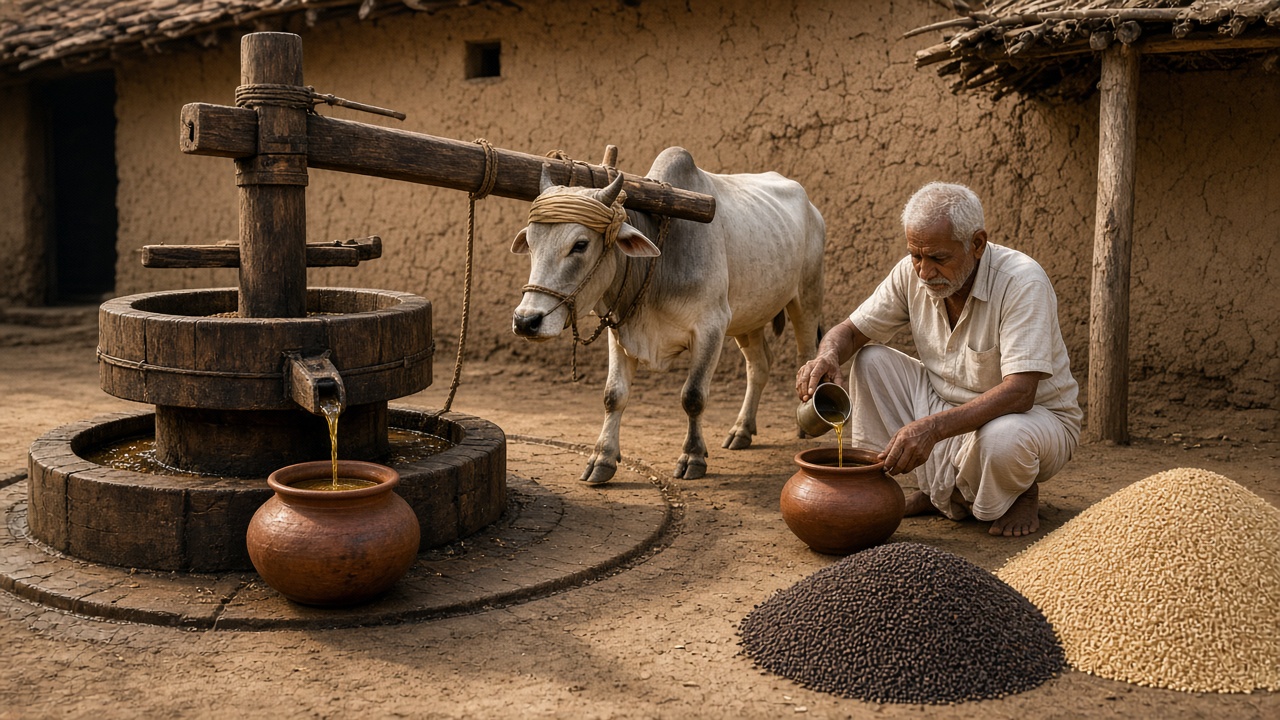
India is one of the oldest homes of oilseed farming. Sesame, mustard, and coconut were pressed in bullock-driven ghanis by oil-pressing communities, and oil was used for cooking, lamps, medicine, and rituals.
A bullock-driven ghani slowly crushes seeds to release oil (artistic illustration).
Harappan era: Sesame seeds found at Harappan sites show it was among the earliest oilseeds grown in India; the Sanskrit word for oil, taila, comes from tila (sesame).
Ancient and classical periods: Texts mention oil pressing and taxes on oil; mustard spreads across the northern plains and coconut oil is used along the coasts.
Medieval period: Teli communities run wooden and stone ghanis in almost every village and town; castor and sesame oil light homes and temples.
16th–18th centuries: Portuguese traders bring groundnut from the Americas; it slowly spreads in southern and western India.
Technology
Ghani / kolhu: Wooden or stone press.
Bullock power: Animal walks in circles.
Oil cake: Leftover feed for cattle.
Features
Local oils: Each region its own oil.
Many uses: Food, lamps, massage, medicine.
Craft skill: Passed down in families.
🚂 Groundnut Boom1850 – 1946
Groundnut Exports, Oil Mills & Vanaspati
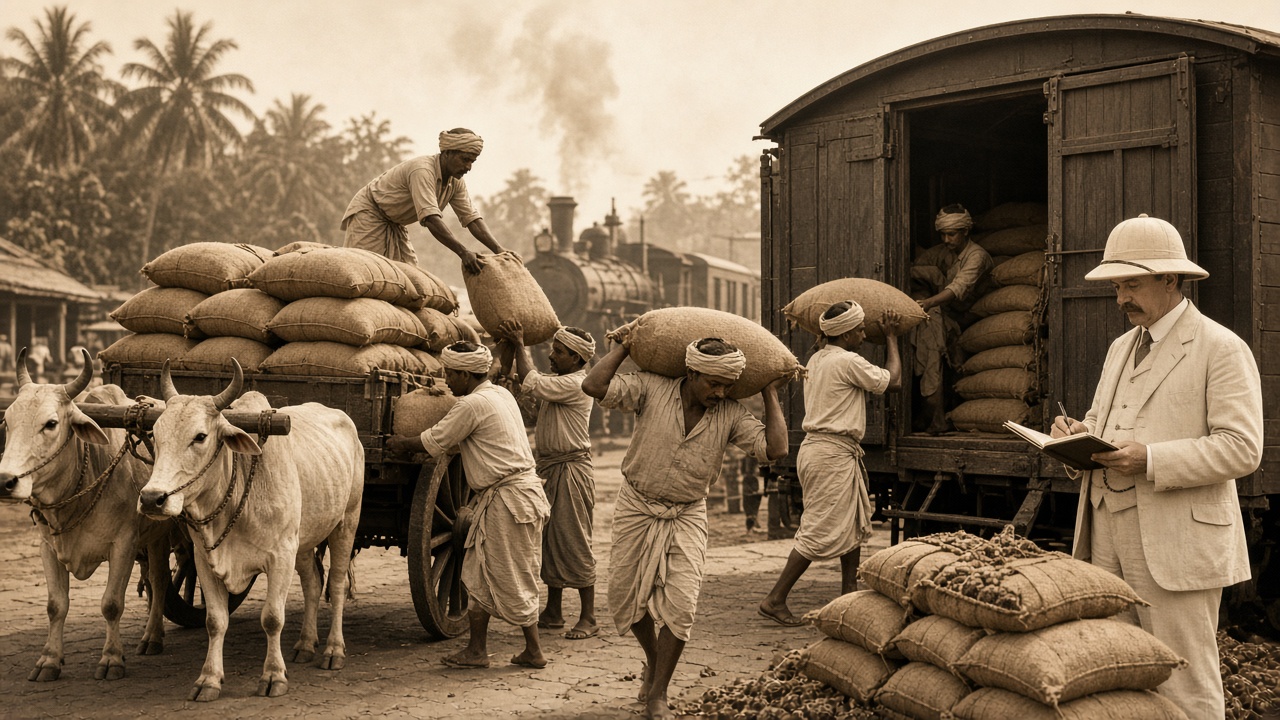
Railways and world demand turned groundnut, linseed, and castor into export crops. Mechanical oil mills replaced some ghanis, and hydrogenated Vanaspati arrived as a cheap substitute for ghee.
Groundnuts travelled by rail to ports for export in colonial times (artistic illustration).
Late 19th century: Groundnut farming expands in the Madras Presidency and the Bombay Deccan; oilseeds are shipped to Europe for soap, lubricants, and food.
Early 20th century: Steam-powered oil mills and expellers open in port and market towns; the Tata Oil Mills Company is founded in Kerala (1917).
1937: Dalda Vanaspati, a hydrogenated vegetable fat, is launched and soon becomes a household name.
1940s: Wartime shortages lead to controls on oils and oilseeds; India is still a net exporter of oilseeds.
Technology
Expellers: Machine screw presses.
Hydrogenation: Oil turned into solid fat.
Railways: Seeds to ports quickly.
Features
Export crops: Groundnut, linseed, castor.
Ghee substitute: Cheaper Vanaspati.
Decline of ghanis: Mills took over.
📉 Shortages1947 – 1985
Shortages, Research & Rising Imports
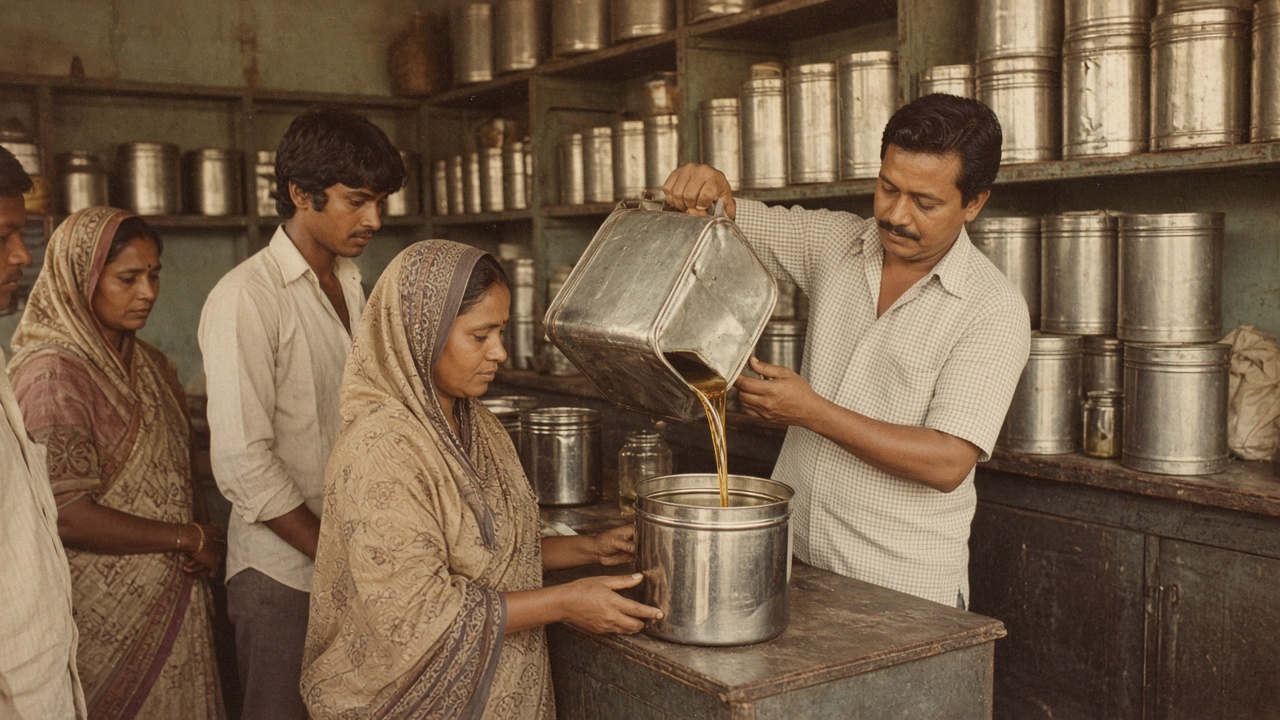
The Green Revolution raised wheat and rice, but oilseeds stayed on poor, rain-fed land. Population and incomes grew, oil prices rose, and by the mid-1980s India had become one of the world’s biggest edible oil importers.
Loose oil was sold from big tins, and prices often climbed in the 1970s and 1980s (artistic illustration).
1947–1950s: An Indian Central Oilseeds Committee supports research; oilseed output is only about 5 million tonnes in 1950–51.
1967: The All India Coordinated Research Project on Oilseeds begins breeding better varieties.
1970s: Soybean is introduced on a large scale in Madhya Pradesh; oil shortages push prices up and imports begin to climb.
1979–1985: The National Dairy Development Board starts an oilseeds project to build growers’ cooperatives on the Anand pattern; imports reach record levels.
Technology
Solvent extraction: More oil from seed cake.
New varieties: From research stations.
Refining: Clear, odourless oils.
Features
Rain-fed crops: Low and risky yields.
Import bill: Big foreign exchange drain.
Cooperatives: Farmers organise.
🌼 Yellow Revolution1986 – 1993
Technology Mission on Oilseeds: The Yellow Revolution
A national mission brought together better seeds, farm practices, processing, price support, and import control. Oilseed production roughly doubled within a decade, and India came close to self-sufficiency in edible oils.
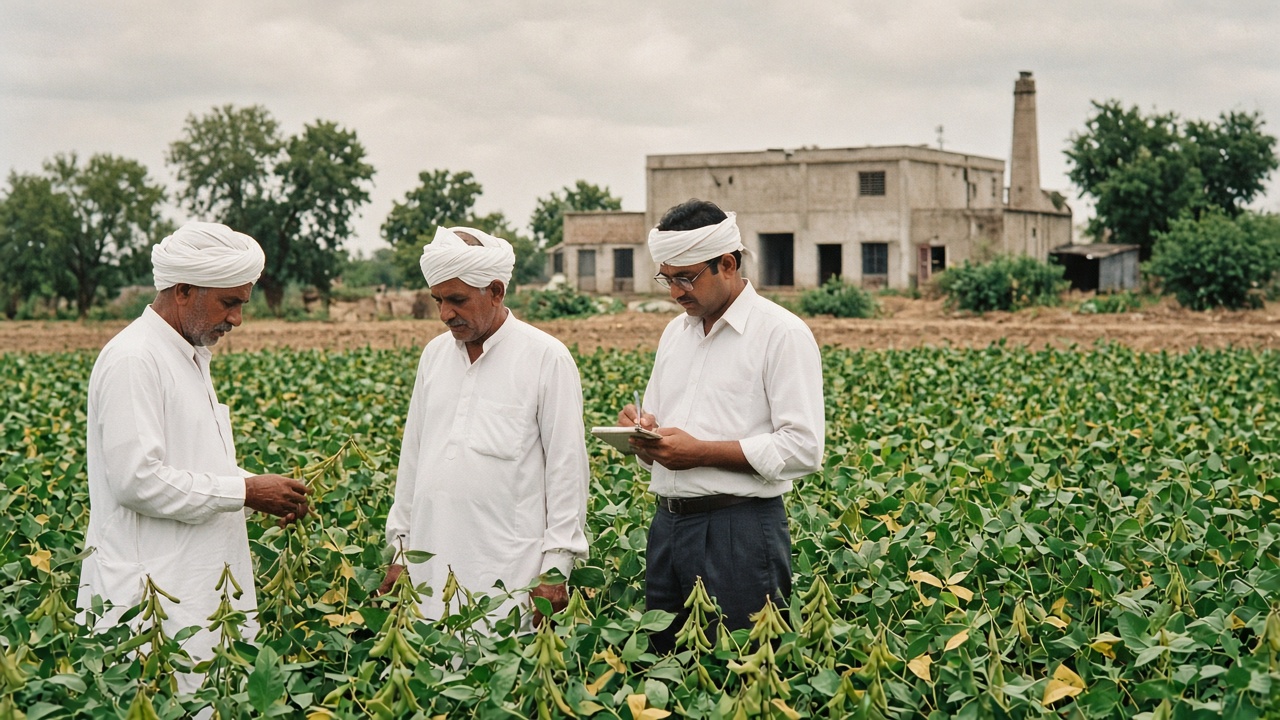
Soybean in central India became one of the biggest success stories of the mission (artistic illustration).
1986: Prime Minister Rajiv Gandhi launches the Technology Mission on Oilseeds, one of several technology missions guided by Sam Pitroda.
1988: NDDB launches the Dhara brand of packed edible oil and steps into the market to steady prices.
1990–1992: Pulses are added to the mission (1990) and an Oil Palm Development Programme begins (1991–92).
Early 1990s: Oilseed output rises from about 11 million tonnes (1985–86) to over 20 million tonnes, and India meets about 97% of its edible oil needs at home.
Import control: Imports canalised through state agencies.
New regions: Soybean in MP, sunflower in Karnataka.
🚢 Imports1994 – 2013
Open Imports, Palm Oil & Food Safety
After economic reforms, edible oil imports were opened up and duties cut. Cheap palm oil from South-East Asia flooded in, domestic oilseed growth stalled, and India became dependent on imports again, while food safety rules grew stricter.
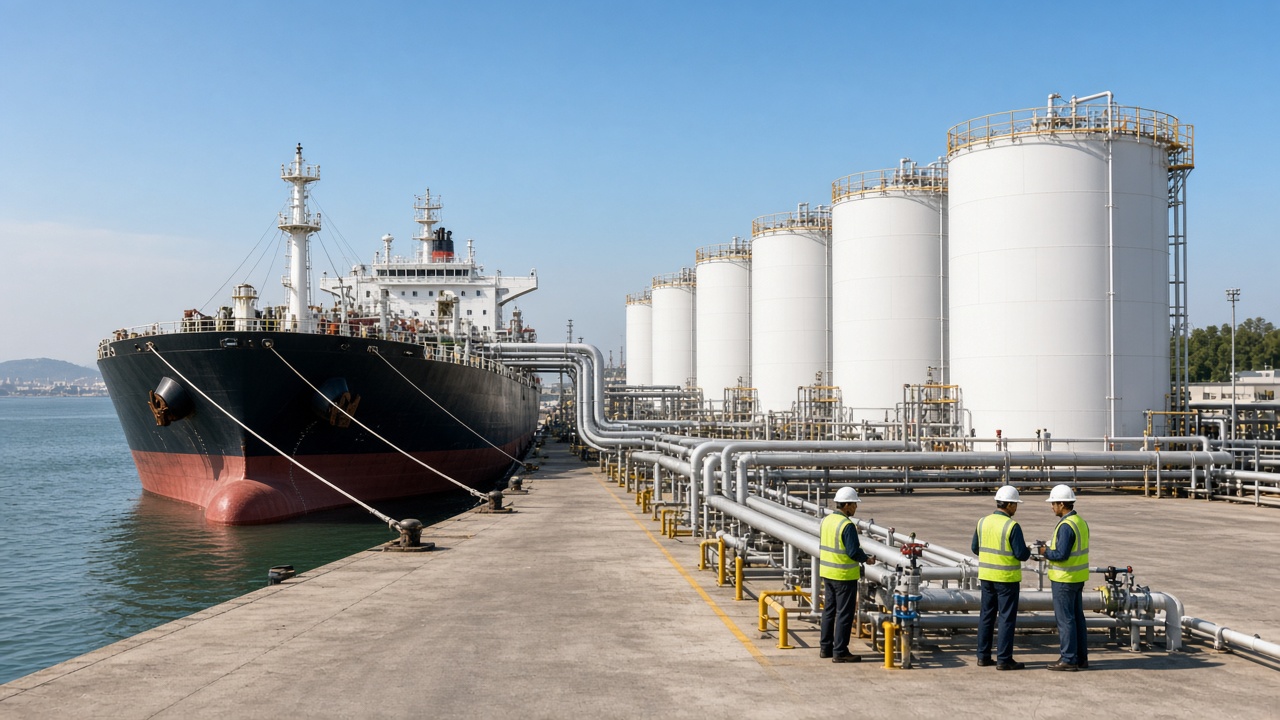
Tanker ships unload palm and soybean oil into port storage tanks (artistic illustration).
1994–1995: Most edible oils are placed under the Open General Licence, letting private traders import freely; import duties are gradually lowered.
1998: A dropsy outbreak caused by mustard oil adulterated with argemone oil leads to a crackdown and a temporary ban on loose mustard oil.
2004–2008: The Integrated Scheme of Oilseeds, Pulses, Oil Palm and Maize begins (2004); the Food Safety and Standards Act is passed (2006) and FSSAI is set up (2008).
2010s: India becomes the world’s largest importer of edible oils, with palm oil the biggest share.
Technology
Port refineries: Big coastal plants.
Blended oils: Mixes of two oils.
Packaging: Pouches and bottles.
Features
Cheap oil: Good for consumers.
Farmer squeeze: Low prices for oilseeds.
Quality rules: Adulteration checks.
🌴 NMEO2014 – Present
Oil Palm Mission, GM Mustard & NMEO
With imports meeting more than half of demand, India launched new missions to expand oil palm and raise yields of traditional oilseeds, while also setting health limits on trans fats and debating GM mustard.
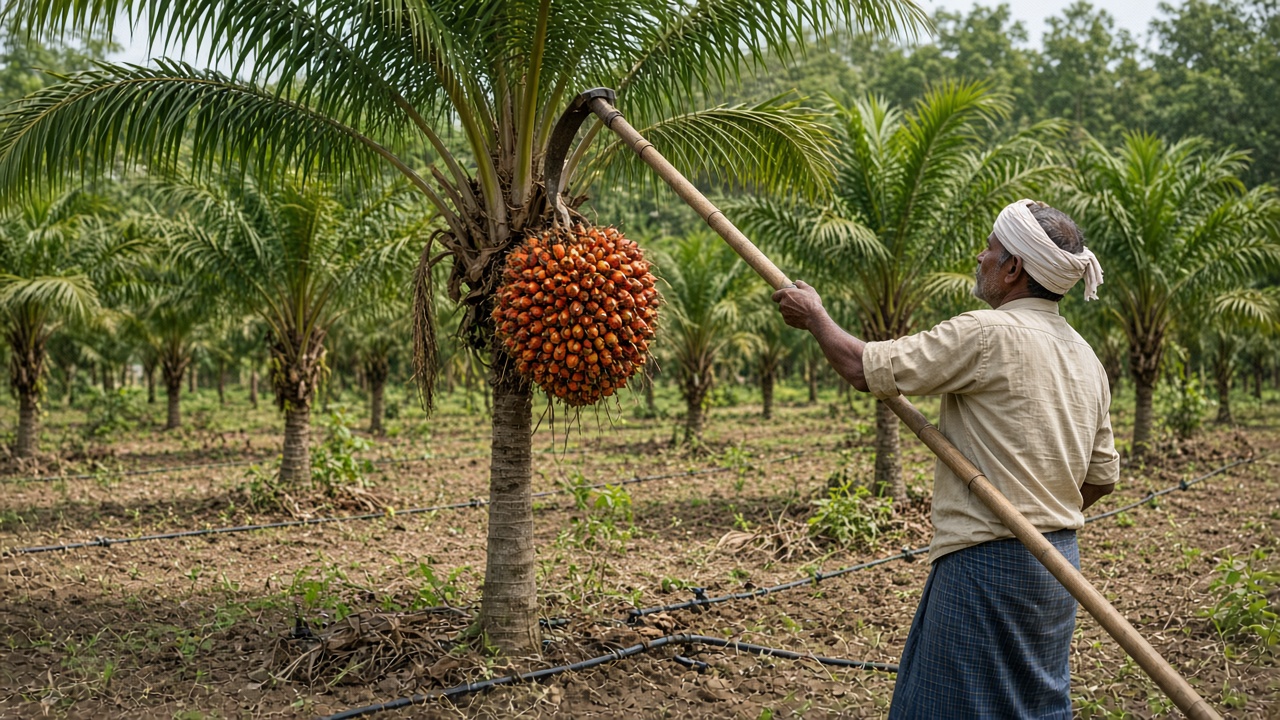
Oil palm plantations are being expanded to cut imports (artistic illustration).
2014–2018: The National Mission on Oilseeds and Oil Palm begins (2014); it is later merged into the National Food Security Mission.
2021–2022: The National Mission on Edible Oils – Oil Palm is launched (2021); FSSAI limits trans fats in oils and fats to 2% (2022); GM mustard DMH-11 is cleared for environmental release (2022).
2024: The National Mission on Edible Oils – Oilseeds is approved to boost mustard, groundnut, soybean, sunflower, and sesame; import duties on crude edible oils are raised to support farmers.
Present: Cold-pressed “kachi ghani” oils make a comeback, and India still imports around 15 million tonnes of edible oil a year.
Technology
Oil palm: Highest oil per hectare.
GM and hybrid mustard: Higher yields.
Seed hubs: Quality seed for farmers.
Features
North-East focus: New oil palm areas.
Health rules: Trans fat limits.
Self-reliance goal: Atmanirbhar in oils.
India’s Nine Major Oilseeds
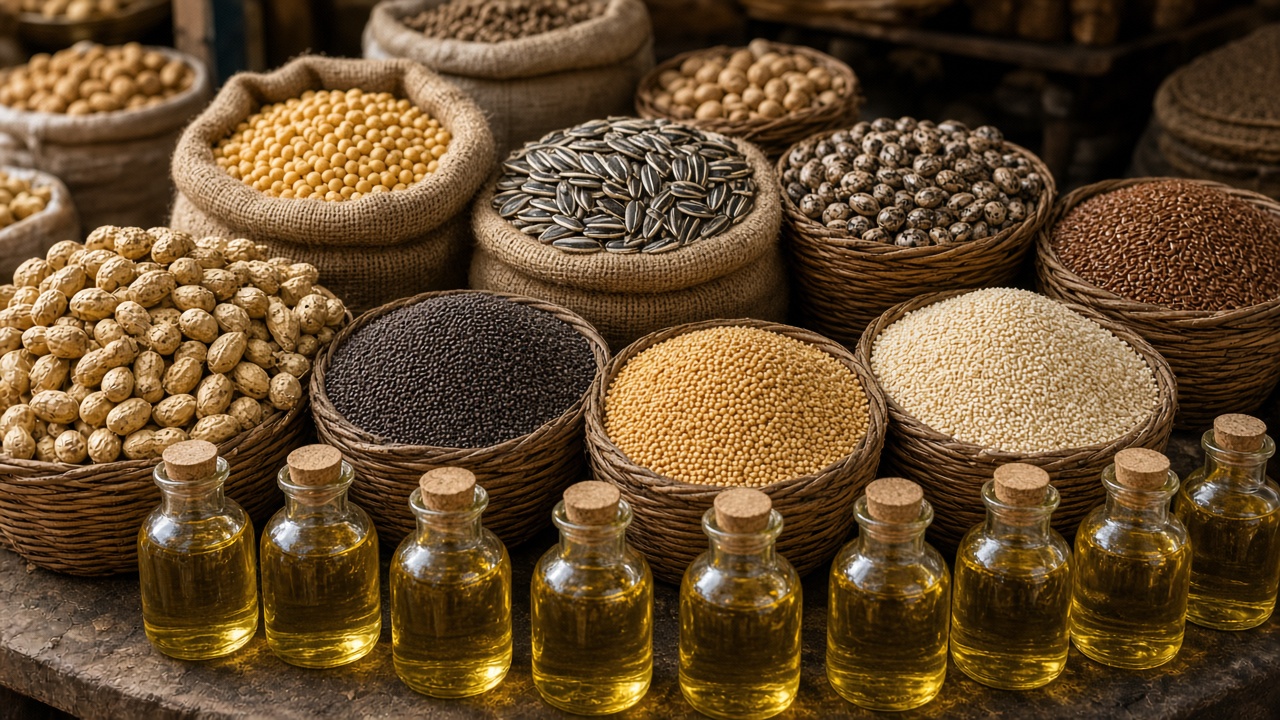
Groundnut, mustard, sesame, soybean, sunflower, and other oilseeds at a market (artistic illustration).
Oilseed
Main states
Season
Soybean
Madhya Pradesh, Maharashtra, Rajasthan
Kharif
Rapeseed-mustard
Rajasthan, Madhya Pradesh, Haryana, Uttar Pradesh
Rabi
Groundnut
Gujarat, Rajasthan, Tamil Nadu, Andhra Pradesh
Kharif and summer
Sesame (til)
Gujarat, West Bengal, Rajasthan, Madhya Pradesh
Kharif and summer
Sunflower
Karnataka, Odisha, Maharashtra
Rabi and kharif
Safflower
Maharashtra, Karnataka
Rabi
Niger
Odisha, Madhya Pradesh, Chhattisgarh
Kharif
Castor (industrial)
Gujarat, Rajasthan
Kharif
Linseed (mostly industrial)
Madhya Pradesh, Uttar Pradesh, Chhattisgarh
Rabi
Which Oil Does Each Region Cook With?
Oil
Traditional region
Typical use
Mustard oil
Punjab, UP, Bihar, Bengal, Odisha, Assam
Curries, fish, pickles
Groundnut oil
Gujarat, Maharashtra, parts of the south
Frying, snacks
Coconut oil
Kerala and coastal Karnataka
Everyday cooking, hair care
Sesame (gingelly) oil
Tamil Nadu, Andhra Pradesh
Tempering, pickles
Soybean oil
Across India
Refined cooking oil
Sunflower oil
Cities across India
Light refined oil
Rice bran oil
Growing in popularity
Frying, blends
Palm oil
Mostly imported
Processed foods, snacks, blends
Where India’s Imported Oil Comes From
Oil
Main sources
Share of imports
Palm oil
Indonesia, Malaysia, Thailand
Largest share (about half or more)
Soybean oil
Argentina, Brazil
Second largest
Sunflower oil
Russia, Ukraine, Argentina
Third largest
Others
Canola, olive, and specialty oils
Small share
Yellow Revolution & Edible Oils Timeline Summary
Year / Era
Milestone
Harappan era
Sesame grown in the Indus Valley
Medieval period
Village ghanis run by oil-pressing communities
16th century
Groundnut arrives with Portuguese traders
Late 19th century
Groundnut export boom
1917
Tata Oil Mills Company founded
1937
Dalda Vanaspati launched
1950–51
Oilseed output about 5 million tonnes
1967
All India Coordinated Research Project on Oilseeds
1970s
Soybean spreads in Madhya Pradesh
1979
NDDB oilseeds cooperative project
1986
Technology Mission on Oilseeds — Yellow Revolution
1988
Dhara edible oil brand by NDDB
1991–92
Oil Palm Development Programme
Early 1990s
Near self-sufficiency in edible oils
1994
Edible oil imports opened up
1998
Mustard oil dropsy outbreak
2004
ISOPOM scheme
2006
Food Safety and Standards Act
2014
National Mission on Oilseeds and Oil Palm
2021
National Mission on Edible Oils – Oil Palm
2022
Trans fat limit of 2%; GM mustard cleared for release
2024
National Mission on Edible Oils – Oilseeds
Test Your Knowledge
20 quick questions from the Yellow Revolution and edible oils timeline. Click each question to reveal the answer.
Answer: Oilseeds (for edible oils).
Answer: After the yellow flowers of mustard and sunflower.
Answer: 1986.
Answer: Sam Pitroda.
Answer: Rajiv Gandhi.
Answer: Tila — sesame.
Answer: A traditional wooden or stone oil press, usually turned by a bullock.
Answer: Portuguese traders, from the Americas, around the 16th century.
Answer: Hydrogenated vegetable oil made to resemble ghee.
Answer: Dalda.
Answer: Dhara.
Answer: Madhya Pradesh.
Answer: Rajasthan.
Answer: Coconut oil.
Answer: About 97%.
Answer: Palm oil.
Answer: Indonesia and Malaysia.
Answer: Mustard oil adulterated with argemone oil.
Answer: DMH-11 (Dhara Mustard Hybrid-11).
Answer: National Mission on Edible Oils.
Classroom activity
Students Tasks
Use these prompts for discussion or projects on oilseeds and edible oils in India.
Click any panel to expand and explore the visual mood.
Edible oils in pictures — bullock ghanis, groundnut trains, oil shops, soybean fields, mustard blooms, oilseed markets, port tanks, and oil palm plantations.
Village Ghani
Bullock oil press
Groundnut Trains
Colonial exports
Loose Oil
1970s shop
Soybean Boom
Madhya Pradesh
Mustard Bloom
Yellow Revolution
Nine Oilseeds
Seeds to oil
Oil Imports
Port tanks
Oil Palm
NMEO mission
Explore all agriculture timelines
Jump to any other agriculture timeline on WorldTimelineHub.
Disclaimer: This content is AI-generated for educational purposes and may contain errors or outdated details. For correct and authoritative information, please refer to official and reliable sources such as government publications, manufacturers, museums, and academic references.