Growing a crop is only half the story — a farmer must also sell it at a fair price. For centuries Indian farmers sold at village haats and to travelling traders.
Over time came regulated markets, government procurement at minimum support prices, farmers’ markets, warehouses, commodity exchanges, and now online mandis.
This timeline covers haats and medieval grain markets, Alauddin Khalji’s price controls, Banjara grain trade, colonial cotton markets, the first regulated market,
AGMARK, APMC Acts, MSP and the Food Corporation of India, dairy cooperatives, farmers’ markets, market reforms, warehouse receipts, e-NAM, and farmer producer organisations.
Ancient → PresentHaat → Mandi → e-NAMSell · Store · Grade · Price
Why Agricultural Marketing Matters
Farmers need to sell quickly after harvest, but prices often fall when everyone sells at once. Without fair weighing, open bidding, storage, and price
information, a farmer can lose much of the value of a good crop to middlemen. Good marketing systems help farmers earn more, keep food prices steady for
consumers, and reduce waste between the field and the plate.
Big picture
Mandis and markets in one view
Village haats and royal grain markets gave way to colonial cotton markets and the first regulated mandis. After independence, APMC laws, minimum support prices,
and public procurement shaped how crops were sold. Farmers’ markets, warehouses, and exchanges came next, and today online mandis and farmer producer
organisations are changing the game again. Related timelines:
agricultural research,
rural roads,
farm credit and banking.
1886
First regulated market, Karanja
~7,000
Regulated market yards
~22,000
Rural haats
1,400+
Mandis on e-NAM
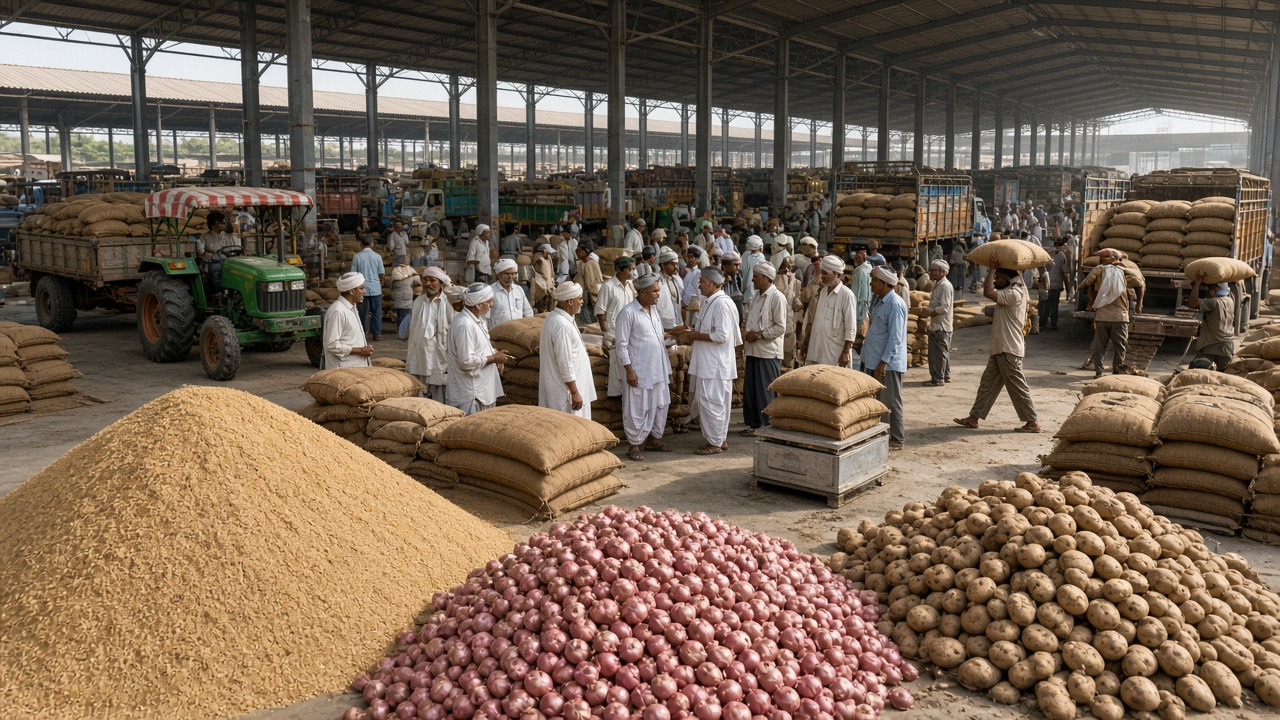
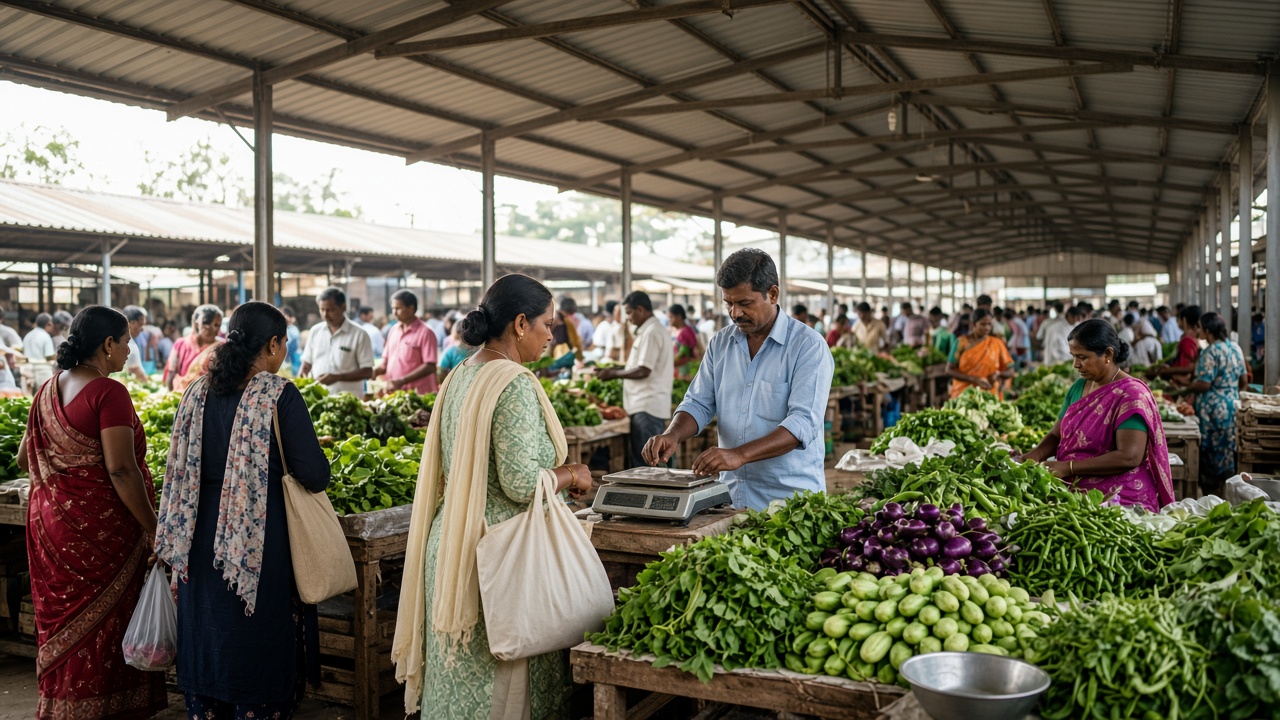
In a mandi, farmers’ produce is auctioned to traders, weighed, and sent onward (artistic illustration).
🧺 HaatsAncient – 1757
Haats, Grain Markets & Banjara Trade
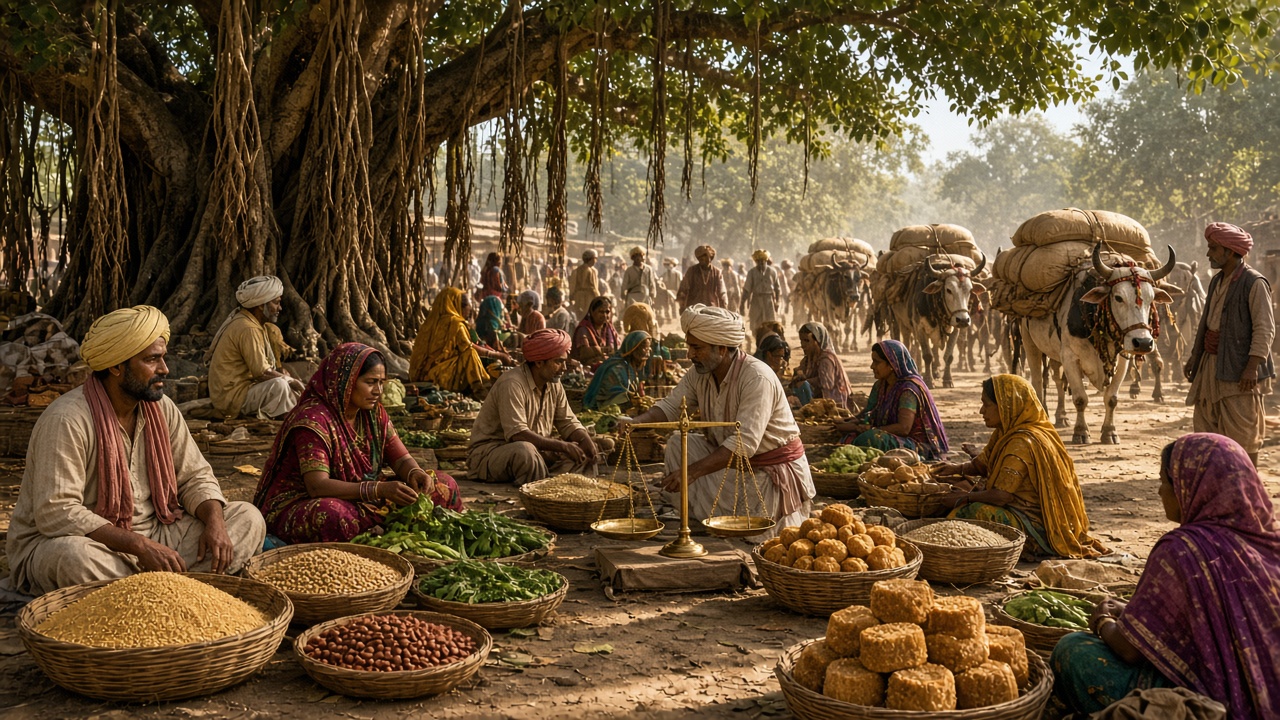
Farmers sold at weekly village haats and to traders in market towns. Kings sometimes controlled grain prices, and wandering Banjara traders carried grain across the subcontinent on caravans of pack bullocks.
Weekly haats and Banjara caravans moved grain between villages and towns (artistic illustration).
Ancient period: Periodic markets serve villages; the Arthashastra describes a superintendent of trade (panyadhyaksha) who watches prices and weights.
Early 14th century: Alauddin Khalji fixes grain prices in Delhi, sets up a supervised grain market under the Shahna-i-Mandi, and keeps state granaries.
Mughal era: Grain markets called ganj and market towns (qasbas) grow along trade routes; Banjara caravans carry grain over long distances.
17th–18th centuries: Moneylenders and traders advance loans to farmers against crops, often buying at low prices after harvest.
Markets
Haat: Weekly village market.
Ganj: Grain market in a town.
State granaries: Grain stored to control prices.
Features
Barter and coins: Both used in trade.
Local weights: Measures varied by region.
Debt ties: Farmers sold to their lenders.
🏛️ Regulated Markets1757 – 1946
Cash Crops, Regulated Markets & AGMARK
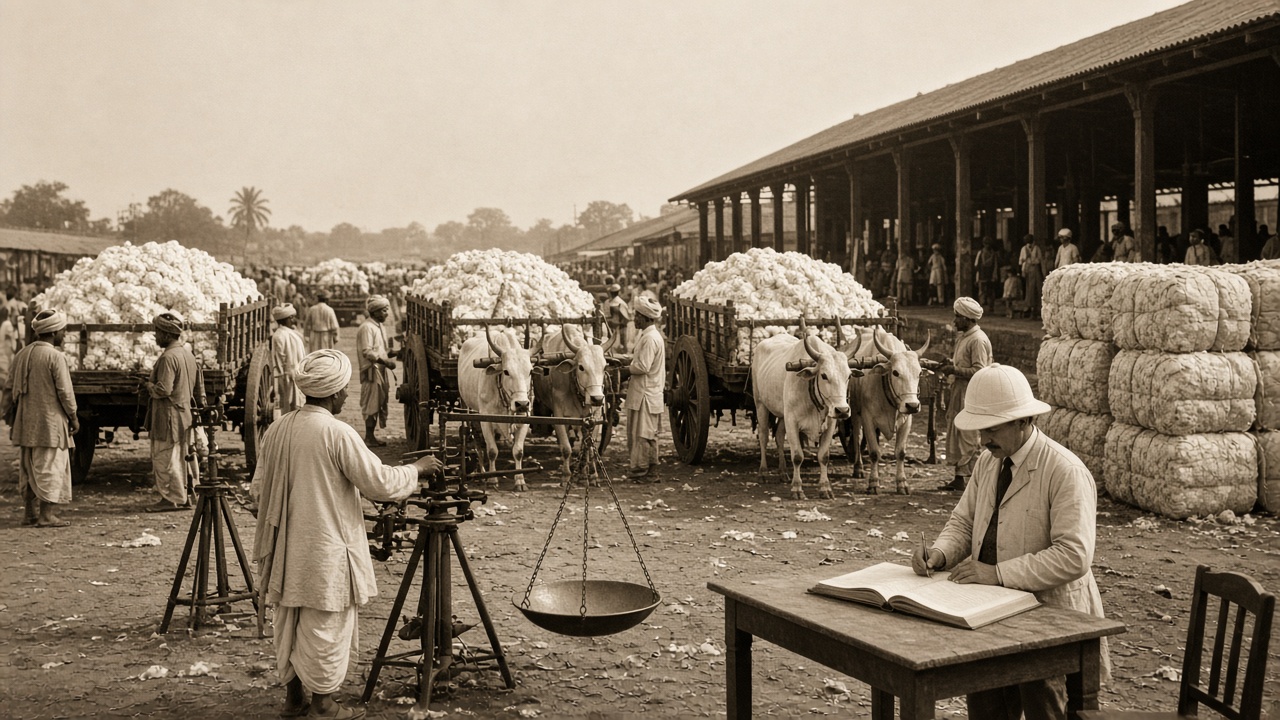
Railways and export demand turned cotton, jute, indigo, and wheat into cash crops. To stop cheating of cotton growers, the first regulated markets were set up with fixed rules for weighing, fees, and payment, and grading laws followed.
Cotton markets in Berar were among the first to be regulated (artistic illustration).
1850s–1870s: Railways link farming regions to ports; cotton demand soars during the American Civil War (1861–65).
1886–1897: The first regulated market opens at Karanja in Berar under the Hyderabad Residency Orders (1886); the Berar Cotton and Grain Market Law follows (1897).
1927–1928: The Bombay Cotton Markets Act is passed (1927); the Royal Commission on Agriculture recommends regulated markets across India (1928).
1935–1937: The Directorate of Marketing and Inspection is set up (1935); the Agricultural Produce (Grading and Marking) Act creates the AGMARK label (1937).
Markets
Regulated market: Rules for fees and weighing.
Market committee: Growers and traders on board.
AGMARK: Quality grading mark.
Features
Export focus: Cotton, jute, and wheat.
Fair weighing: Licensed weighmen.
Few markets: Most farmers still sold locally.
⚖️ APMC & MSP1947 – 1970
APMC Acts, MSP & Public Procurement
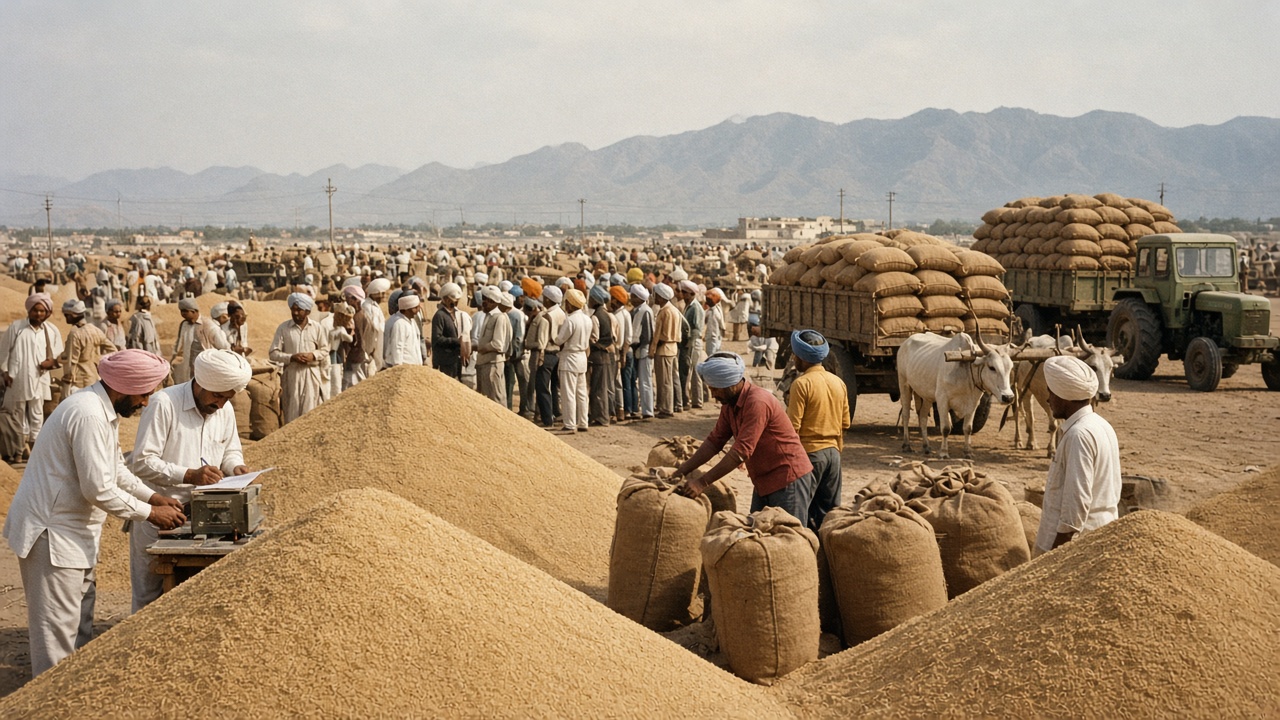
States passed Agricultural Produce Market Committee (APMC) Acts, creating a network of regulated mandis. With the Green Revolution, the government began announcing minimum support prices and buying grain through the Food Corporation of India.
Government procurement at minimum support prices began in the Green Revolution mandis (artistic illustration).
1953–1958: The Forward Markets Commission is set up (1953); the Essential Commodities Act is passed (1955); the Central Warehousing Corporation (1957) and NAFED (1958) are formed.
1960s: States pass APMC Acts based on a model law, bringing more mandis under market committees.
1965: The Agricultural Prices Commission and the Food Corporation of India are set up to support prices and buy grain.
1966–1970: Minimum support prices for wheat begin with the Green Revolution; Operation Flood starts building dairy cooperative markets (1970).
Markets
APMC mandi: Regulated wholesale market.
MSP procurement: Government buys at a set price.
Dairy cooperatives: Village milk collection.
Features
Price floor: Assured price for key crops.
Food stocks: Grain for the ration system.
Commission agents: Arhtiyas link farmers and buyers.
🥬 Direct Selling1971 – 1999
Big Mandis, Cooperatives & Farmers’ Markets
Cities built giant wholesale markets for fruits and vegetables. At the same time, states experimented with farmers’ markets where growers sold directly to consumers, cutting out middlemen and getting better prices.
Farmers’ markets let growers sell directly to shoppers (artistic illustration).
1977: Azadpur Mandi opens in Delhi and grows into one of Asia’s largest fruit and vegetable markets.
1985–1988: The Agricultural Prices Commission becomes the Commission for Agricultural Costs and Prices (1985); Punjab starts Apni Mandi farmers’ markets (1987); Safal fruit and vegetable outlets begin in Delhi (1988).
1994: The Small Farmers’ Agribusiness Consortium is set up to link small farmers with agribusiness.
1999: Andhra Pradesh launches Rythu Bazaars and Tamil Nadu launches Uzhavar Sandhais for direct farmer-to-consumer sales.
Markets
Terminal markets: Giant city wholesale mandis.
Farmers’ markets: No middlemen.
Cooperative outlets: Milk and vegetable booths.
Features
Better prices: Farmers keep more of the rupee.
Fresh for cities: Daily supply chains.
Perishables: Fruits and vegetables grow in value.
📈 Reforms2000 – 2015
Market Reforms, Exchanges & Warehouse Receipts
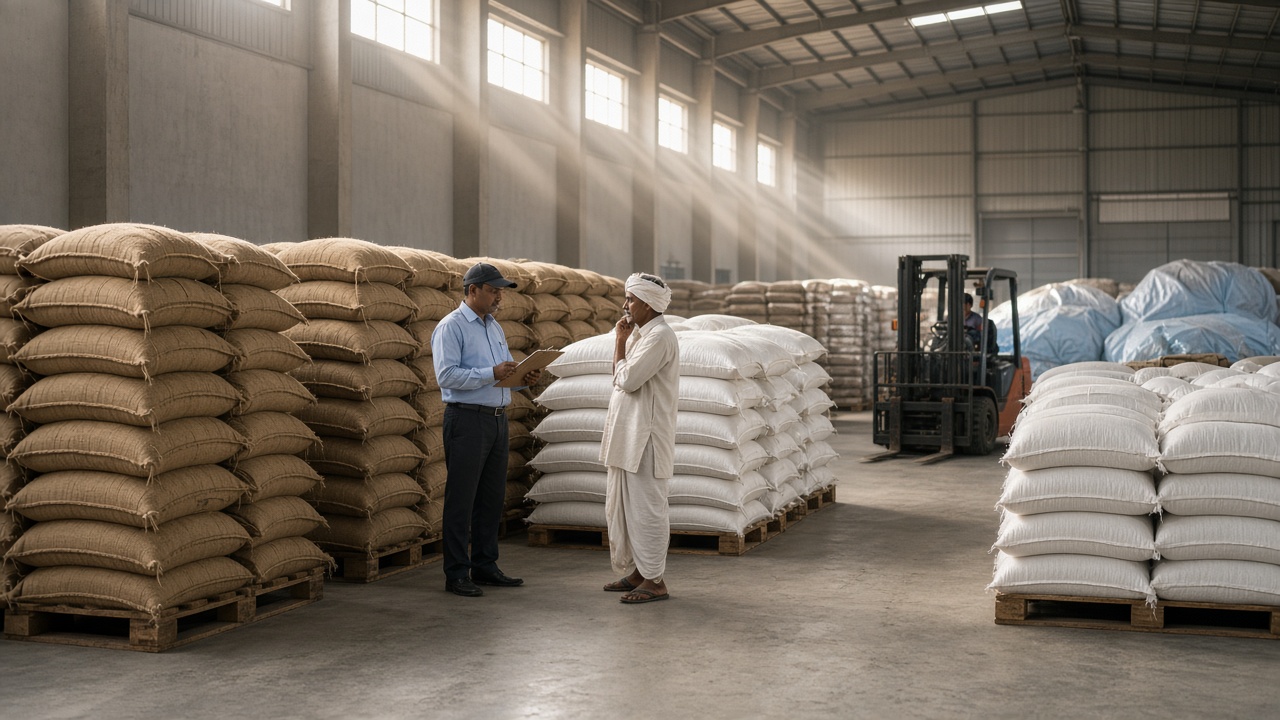
A model law encouraged private markets and contract farming, internet kiosks and a national portal shared mandi prices, commodity exchanges opened, and warehouse receipts let farmers store crops and borrow against them instead of selling in distress.
Farmers can store grain in registered warehouses and borrow against the receipt (artistic illustration).
2000–2001: The AGMARKNET portal starts publishing mandi prices online (2000); ITC’s e-Choupal internet kiosks reach villages (2000); the Gramin Bhandaran Yojana funds rural godowns (2001).
2003: A Model APMC Act allows private markets, direct buying, and contract farming; national commodity exchanges NCDEX and MCX begin trading.
2006–2010: Bihar repeals its APMC Act (2006); the Warehousing (Development and Regulation) Act is passed (2007) and its regulatory authority starts work (2010).
2014–2015: Several states delist fruits and vegetables from APMC rules; the Forward Markets Commission merges with SEBI (2015).
Markets
Price portal: Mandi rates online.
Commodity exchanges: Futures trading in crops.
Warehouse receipts: Store now, sell later.
Features
More choice: Private and direct buyers.
Less distress selling: Loans against stored grain.
Information: Farmers compare prices.
📱 e-NAM2016 – Present
e-NAM, FPOs & Digital Marketing
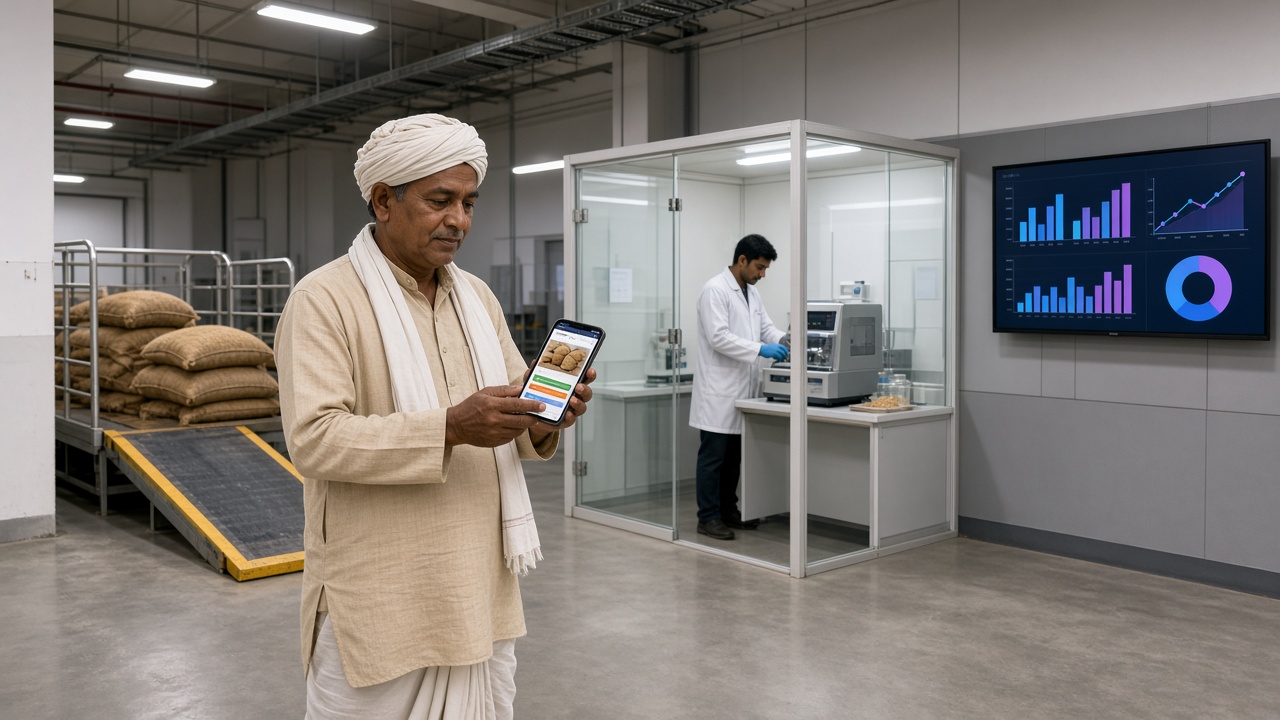
Mandis went online through e-NAM, farmer producer organisations helped small farmers sell together, and new schemes built rural markets, cold chains, and storage. Debates over farm laws showed how important mandis and MSP are to farmers.
On e-NAM, produce is tested, weighed, and sold through online bids (artistic illustration).
2016–2017: e-NAM is launched with 21 mandis on 14 April 2016; a Model Agricultural Produce and Livestock Marketing Act is released (2017).
2018: Operation Greens for tomato, onion, and potato, PM-AASHA for price support, and a plan to upgrade rural haats into Gramin Agricultural Markets are announced.
2020–2021: Three farm laws are passed (2020) and repealed after farmer protests (2021); schemes for 10,000 FPOs, an Agriculture Infrastructure Fund, and Kisan Rail begin (2020).
2024–present: A draft National Policy Framework on Agricultural Marketing is released (2024); more than 1,400 mandis are linked to e-NAM.
Markets
e-NAM: Online bidding across mandis.
FPOs: Farmers sell together as companies.
Assaying labs: Quality tested before sale.
Features
Transparent prices: Bids visible online.
Collective power: Better deals for small farmers.
Cold chains: Less waste of perishables.
Where Indian Farmers Sell Their Crops
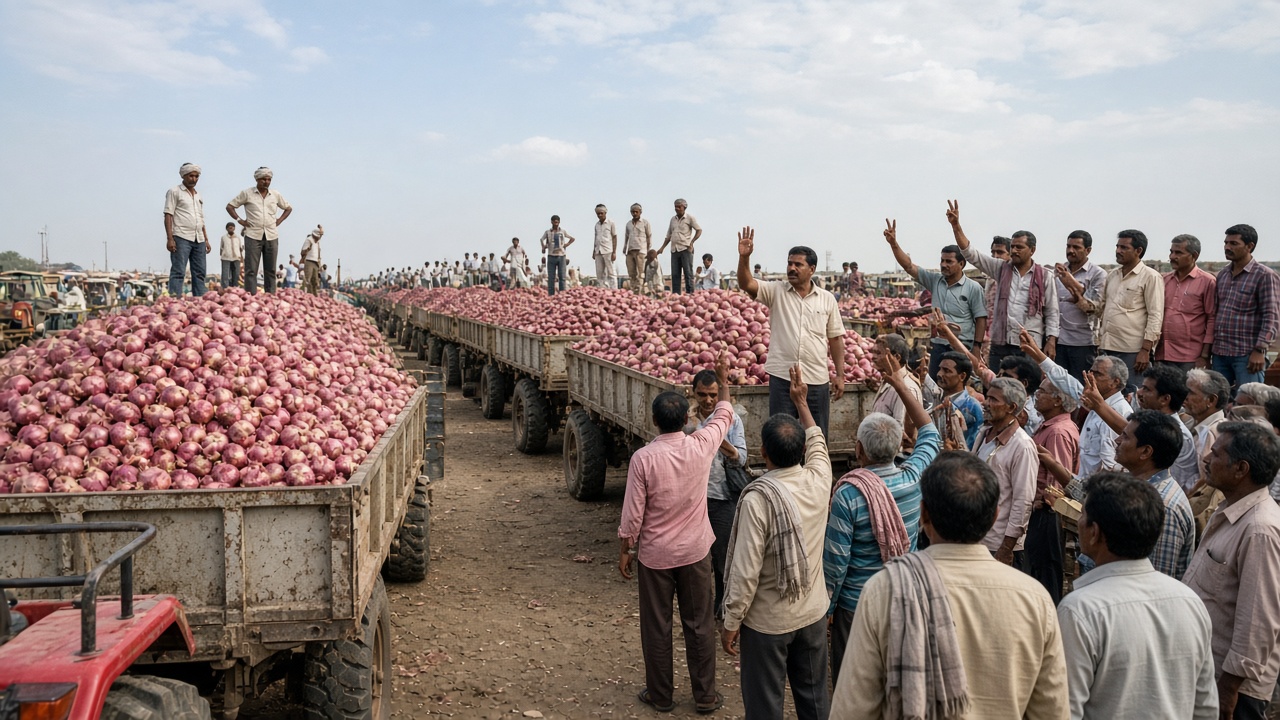
At big onion markets, traders bid on produce while it is still on the farmers’ trolleys (artistic illustration).
Market type
How it works
Best for
Village haat
Weekly open market in or near the village
Small quantities, local sales
APMC principal yard
Regulated mandi with licensed traders and auctions
Grain, oilseeds, cotton, and more
Sub-market yard
Smaller branch of a mandi closer to villages
Nearby farmers
Farmers’ market
Farmers sell directly to consumers
Vegetables and fruits
Government procurement centre
Crops bought at minimum support price
Wheat, paddy, and some pulses
Private market / direct buyer
Companies buy directly from farmers
Contract crops and processing
FPO collection centre
Farmers pool produce and sell as a group
Small and marginal farmers
e-NAM
Online bidding linked to mandis
Wider choice of buyers
Dairy cooperative
Milk collected daily at village centres
Milk producers
Famous Mandis of India
Mandi
Place
Known for
Karanja market
Washim district, Maharashtra
India’s first regulated market (cotton, 1886)
Azadpur Mandi
Delhi
One of Asia’s largest fruit and vegetable markets
Lasalgaon APMC
Nashik district, Maharashtra
Onions
Unjha APMC
Mehsana district, Gujarat
Cumin and other seed spices
Khanna Mandi
Ludhiana district, Punjab
Wheat and paddy
Guntur Mirchi Yard
Guntur, Andhra Pradesh
Red chillies
Vashi APMC
Navi Mumbai, Maharashtra
Fruits, vegetables, grains, and spices
Koyambedu Market
Chennai, Tamil Nadu
Fruits, vegetables, and flowers
From Field to Plate: The Marketing Chain
Stage
Who is involved
What happens
Harvest and cleaning
Farmer
Crop is cut, dried, cleaned, and packed
Assembly
Village trader or FPO
Small lots are collected into bigger loads
Transport
Tractor, truck, or Kisan Rail
Produce reaches the mandi or buyer
Grading and testing
Market staff or assaying lab
Quality is checked; AGMARK grades applied where needed
Auction and weighing
Commission agent, traders, weighman
Open or online bidding, then weighing
Payment
Buyer, agent, or bank transfer
Farmer receives money, minus fees
Storage and processing
Warehouses, cold stores, mills
Crops stored or turned into products
Retail
Shops, supermarkets, ration shops, apps
Food reaches consumers
Agricultural Marketing Timeline Summary
Year / Era
Milestone
Ancient period
Haats and the Arthashastra’s trade superintendent
Early 14th century
Alauddin Khalji’s grain price controls
Mughal era
Ganj grain markets and Banjara caravans
1886
First regulated market at Karanja, Berar
1927
Bombay Cotton Markets Act
1935
Directorate of Marketing and Inspection
1937
AGMARK grading law
1955
Essential Commodities Act
1958
NAFED formed
1960s
State APMC Acts
1965
Agricultural Prices Commission; Food Corporation of India
1970
Operation Flood
1977
Azadpur Mandi, Delhi
1987
Apni Mandi farmers’ markets, Punjab
1999
Rythu Bazaars and Uzhavar Sandhais
2000
AGMARKNET price portal
2003
Model APMC Act; NCDEX and MCX
2007
Warehousing (Development and Regulation) Act
2016
e-NAM launched
2018
Operation Greens; PM-AASHA
2020
10,000 FPOs scheme; Agriculture Infrastructure Fund
2021
Farm laws repealed
2024
Draft National Policy Framework on Agricultural Marketing
Test Your Knowledge
20 quick questions from the agricultural marketing timeline. Click each question to reveal the answer.
Answer: A periodic, usually weekly, village market.
Answer: Alauddin Khalji.
Answer: Shahna-i-Mandi.
Answer: The Banjaras.
Answer: Karanja, in the Berar region.
Answer: Cotton.
Answer: The Agricultural Produce (Grading and Marking) Act.
Answer: Agricultural Produce Market Committee.
Answer: The Agricultural Prices Commission and the Food Corporation of India.
Answer: Minimum Support Price.
Answer: The Commission for Agricultural Costs and Prices (CACP).
Answer: Azadpur Mandi.
Answer: Rythu Bazaars (Andhra Pradesh) and Uzhavar Sandhais (Tamil Nadu).
Answer: Lasalgaon.
Answer: AGMARKNET.
Answer: Bihar.
Answer: The farmer can store grain and take a loan against the receipt instead of selling at a low price.
Answer: 14 April 2016.
Answer: Tomato, onion, and potato (TOP).
Answer: Farmer Producer Organisation.
Classroom activity
Students Tasks
Use these prompts for discussion or projects on agricultural marketing and mandis in India.
Timeline understandingEconomicsData skillsRural life
Visit a local mandi or vegetable market and describe how produce is sold, weighed, and paid for.
Track the price of onions or tomatoes on the AGMARKNET or e-NAM website for two weeks and draw a graph.
Compare the price a farmer gets for a kilogram of vegetables with the price you pay in a shop, and explain the difference.
Draw a flowchart showing the journey of wheat from a farmer’s field to your kitchen.
Explain what minimum support price is and why farmers value it.
Role-play a mandi auction with a farmer, commission agent, traders, and a weighman.
Research one farmer producer organisation and how it helps its members sell better.
Debate: “Farmers should be free to sell anywhere, not only in regulated mandis.”
List ways to reduce the waste of fruits and vegetables between the farm and the market.
Design a simple app screen that would help a farmer find the best mandi price nearby.
Continue exploring
Selling crops depends on good roads, banking, and farm research. Explore more agriculture, economy, and government timelines next.
Click any panel to expand and explore the visual mood.
Agricultural marketing in pictures — village haats, colonial cotton markets, Green Revolution mandis, farmers’ markets, warehouses, onion auctions, and online mandis.
Village Haat
Weekly markets
Cotton Market
Karanja 1886
Grain Mandi
MSP era
Farmers’ Market
Rythu Bazaar 1999
Warehouse
Store & borrow
Onion Auction
Lasalgaon
e-NAM
From 2016
Mandi Today
Auction to truck
Explore all agriculture timelines
Jump to any other agriculture timeline on WorldTimelineHub.
Disclaimer: This content is AI-generated for educational purposes and may contain errors or outdated details. For correct and authoritative information, please refer to official and reliable sources such as government publications, manufacturers, museums, and academic references.