A tractor does much more than plough. In Indian villages it levels fields so water spreads evenly, shapes bunds and furrows that guide water, runs pumps, hauls
water tankers, digs farm ponds, carries silt out of old tanks, and lays drip lines and mulch. This timeline follows how tractors took over irrigation work once done
by bullocks and human hands.
It covers bullock-drawn levellers, tractor land reclamation after 1947, belt-driven pumps in the Green Revolution, command area land shaping, laser land levelling,
raised-bed planting, farm ponds and tank desilting, custom hiring centres, solar pumps, and modern drip and mulch laying machines.
Good irrigation is not only about finding water — the field must be ready to use it. An uneven field wastes water in low spots and leaves high spots dry. Bunds,
ridges, and channels decide where water goes. Wells and ponds need digging and cleaning, and pumps need power. Tractors do all these jobs faster than bullocks,
which is why they became the workhorse of irrigated farming in India.
Big picture
Tractors and water in one view
Tractors first cleared and levelled new land for canals, then powered pumps and shaped fields during the Green Revolution. Laser levellers and raised-bed
planters later helped save water, and today tractors dig farm ponds, desilt tanks, and lay drip lines while solar pumps take over the pumping. Related timelines:
irrigation methods,
farming tools,
rural electrification.
8 lakh+
Tractors sold in India each year
~20–25%
Water saved by laser levelling
540 rpm
Standard PTO speed for pumps
31–50 HP
Most common tractor size
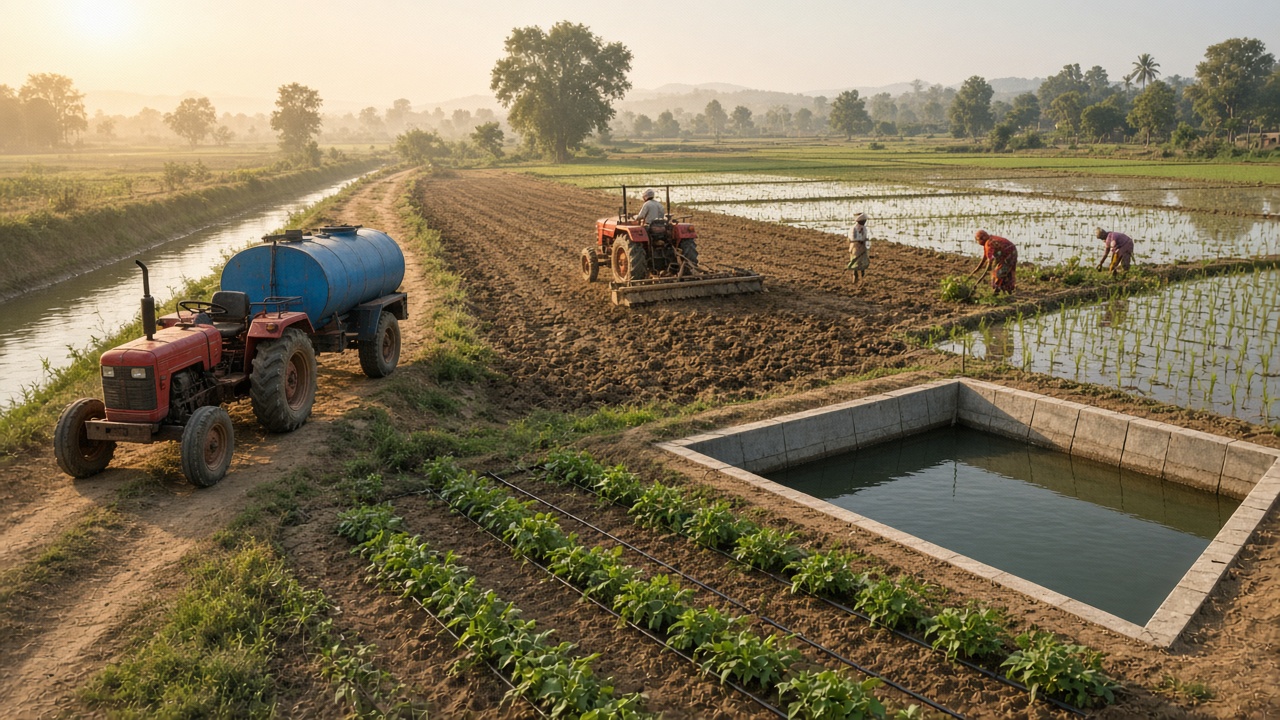
Tractors haul water, level fields, and prepare land for ponds and drip lines (artistic illustration).
🐂 Bullock PowerBefore 1947
Before Tractors: Bullock Levellers & Hand-Dug Channels
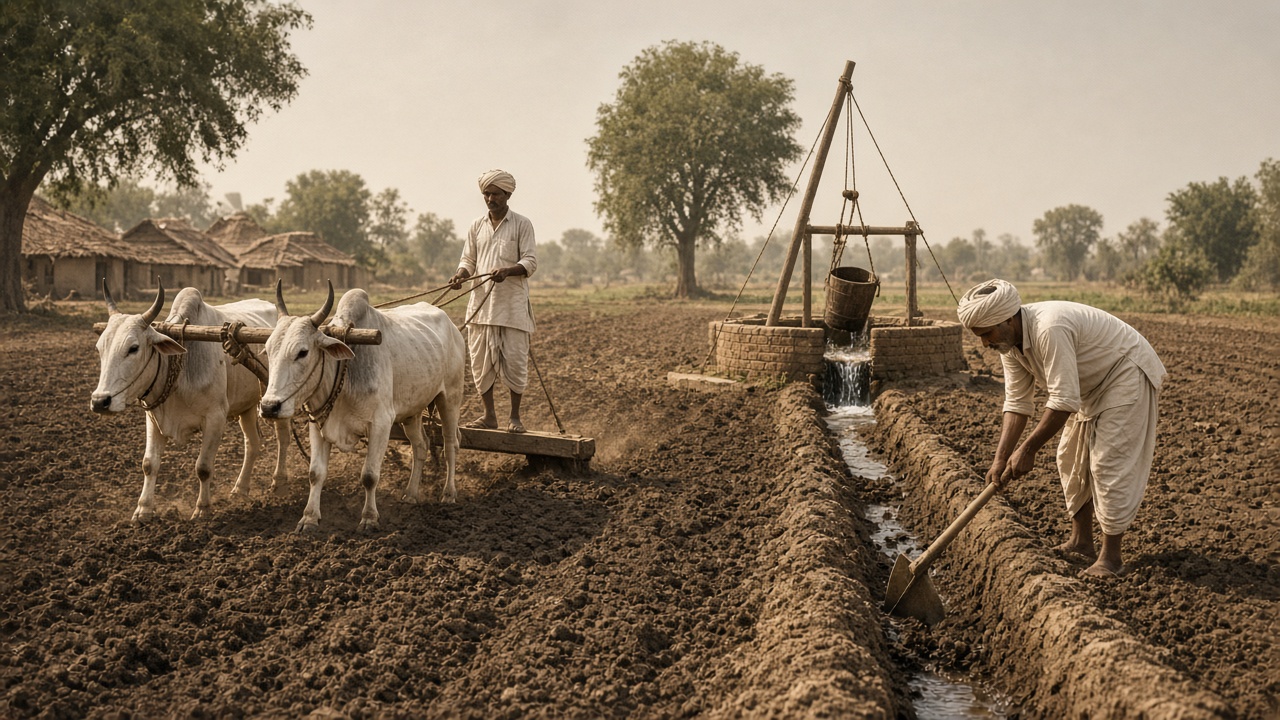
For centuries, bullocks and people did all irrigation work. Bullocks pulled plank levellers to smooth fields and lifted water from wells, while farmers shaped bunds and channels with spades. Only a handful of imported tractors worked on large estates and government farms.
Bullock-drawn plank levellers and hand-dug channels prepared fields for irrigation (artistic illustration).
Traditional practice: A heavy wooden plank (pata, patela, or maind) pulled by bullocks smooths ploughed soil so water can flow evenly.
Traditional practice: Farmers raise earthen bunds (mend) and dig field channels (nali) with spades to divide fields into small basins.
Early 20th century: A few imported tractors appear on large estates, mission farms, and government farms, but cost and fuel keep them rare.
1943: The Grow More Food campaign pushes to bring more land under crops, creating interest in machines for clearing and levelling land.
Tools
Plank leveller: Bullock-drawn soil smoother.
Wooden scraper: Moves soil from high to low spots.
Spade and hoe: Bunds and channels by hand.
Features
Slow work: Levelling took many days.
Uneven fields: Much water was wasted.
Animal lifts: Bullocks also raised well water.
🚜 Reclamation1947 – 1964
Land Reclamation & the First Indian Tractors
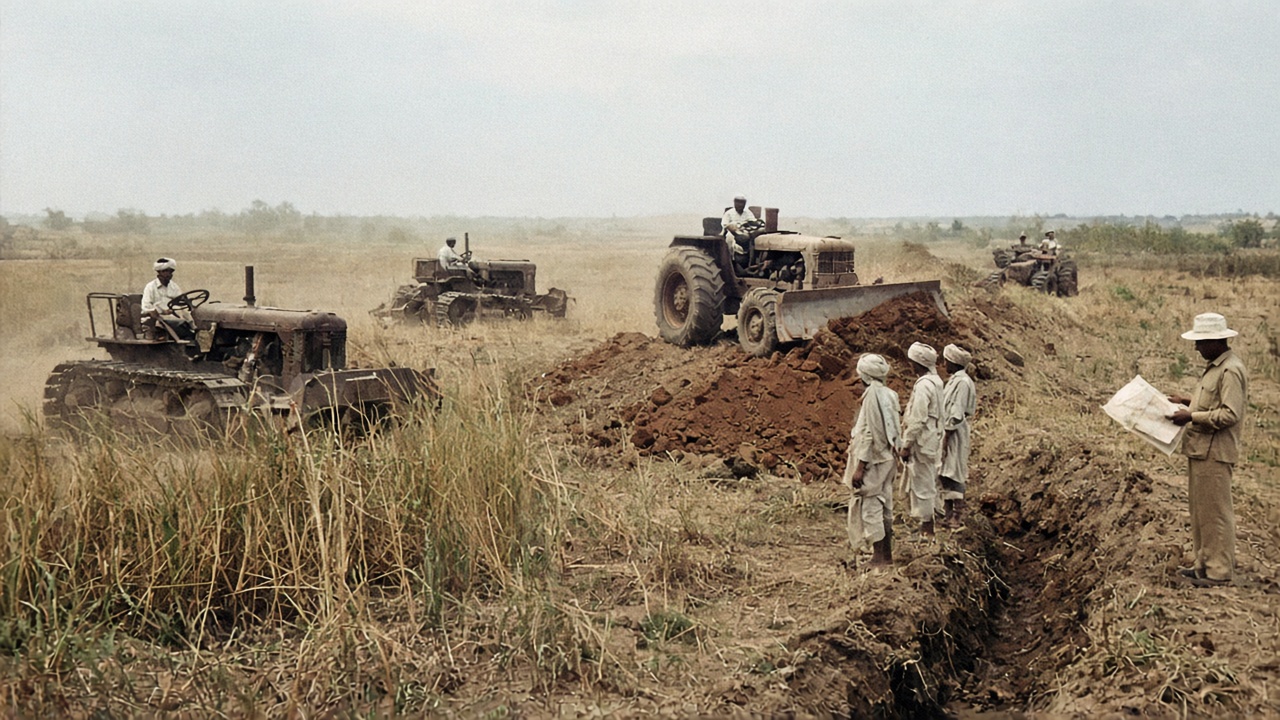
After independence, the government used fleets of tractors to clear weed-choked and forest land, level it, and prepare it for new farms and canal commands. By the early 1960s, Indian factories had begun making tractors.
Tractor fleets cleared and levelled land and built bunds for new irrigated farms (artistic illustration).
1947: The Central Tractor Organisation is set up to reclaim land infested with deep-rooted kans grass using heavy tractors.
1950s: Tractors clear and level land in central India and the Terai of Uttar Pradesh for new farms, many later served by canals and tube wells.
1950s–1960s: Soil conservation programmes under the Five-Year Plans use tractors and bulldozers to build contour bunds that hold rainwater.
Early 1960s: Indian factories begin making tractors, making them easier to buy and repair.
Tools
Crawler tractors: Heavy clearing and deep ploughing.
Dozer blades: Push soil for bunds and levelling.
Disc ploughs: Break hard, weedy ground.
Features
State-run fleets: Government tractor units.
New land: More area ready for irrigation.
Water holding: Contour bunds slow runoff.
🌾 Green Revolution1965 – 1990
Green Revolution: Belt Pumps, Channels & Levelling
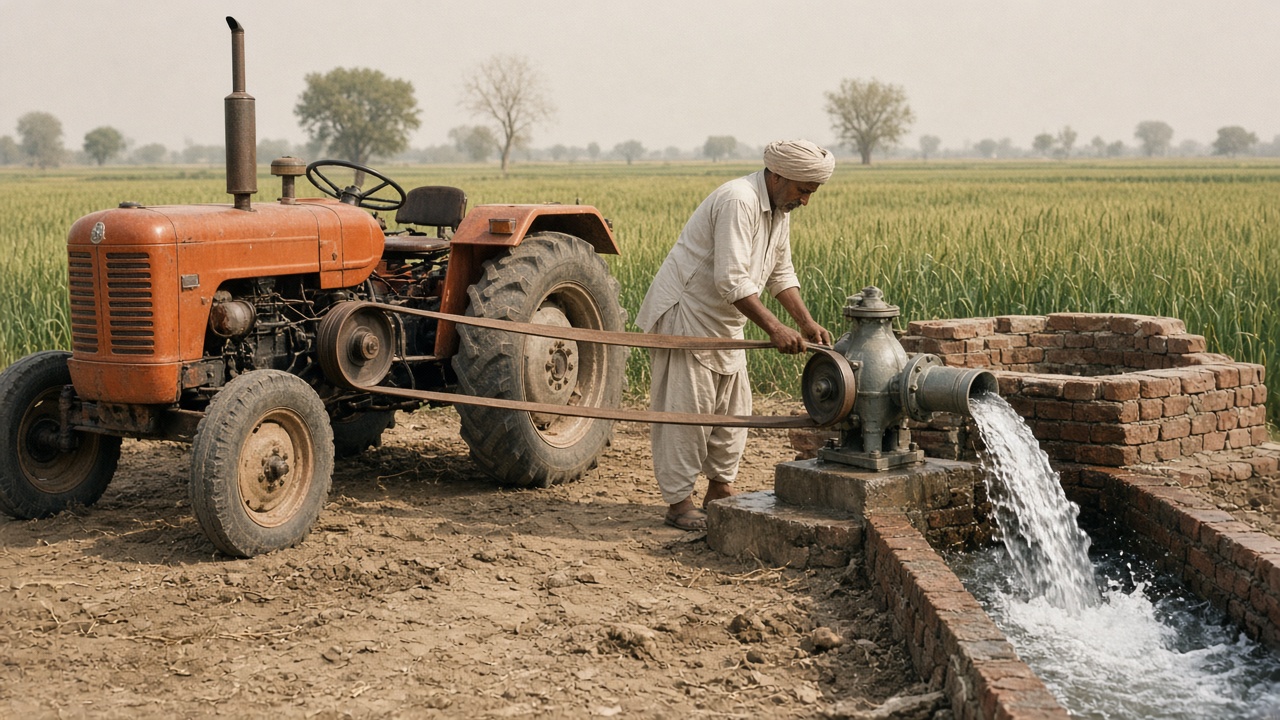
As tube wells spread, tractors became a mobile power source. A belt from the tractor’s pulley could drive a water pump or thresher. Tractors also pulled ridgers, bund formers, and scrapers to shape fields for canal and tube well water.
A flat belt from the tractor’s pulley could drive a pump where there was no electricity (artistic illustration).
Mid-1960s: The Green Revolution begins; tube wells and pumpsets spread in Punjab, Haryana, and western Uttar Pradesh along with tractors.
1960s–1970s: Where villages lack electricity, farmers run centrifugal pumps from the tractor’s belt pulley; tractor trolleys carry pipes, engines, and diesel.
1974: The Command Area Development Programme starts; tractors and scrapers help level land and build field channels so canal water reaches every field.
1980s–1990: Tractor-drawn ridgers and bund formers spread; the National Watershed Development Project for Rainfed Areas begins (1990–91).
Tools
Belt pulley pump: Tractor engine drives a well pump.
Ridger and bund former: Shapes furrows and bunds.
Tractor scraper: Levels land for canal water.
Features
Mobile power: One tractor, many jobs.
On-farm development: Field channels and levelling.
Double cropping: Wheat after rice on irrigated land.
📡 Laser Levelling1991 – 2008
Laser Levelling & Water-Saving Sowing
As water tables fell, tractors began pulling machines designed to save water. Laser land levellers made fields almost perfectly flat, and raised-bed planters and zero-till drills cut the water needed for rice–wheat farming.
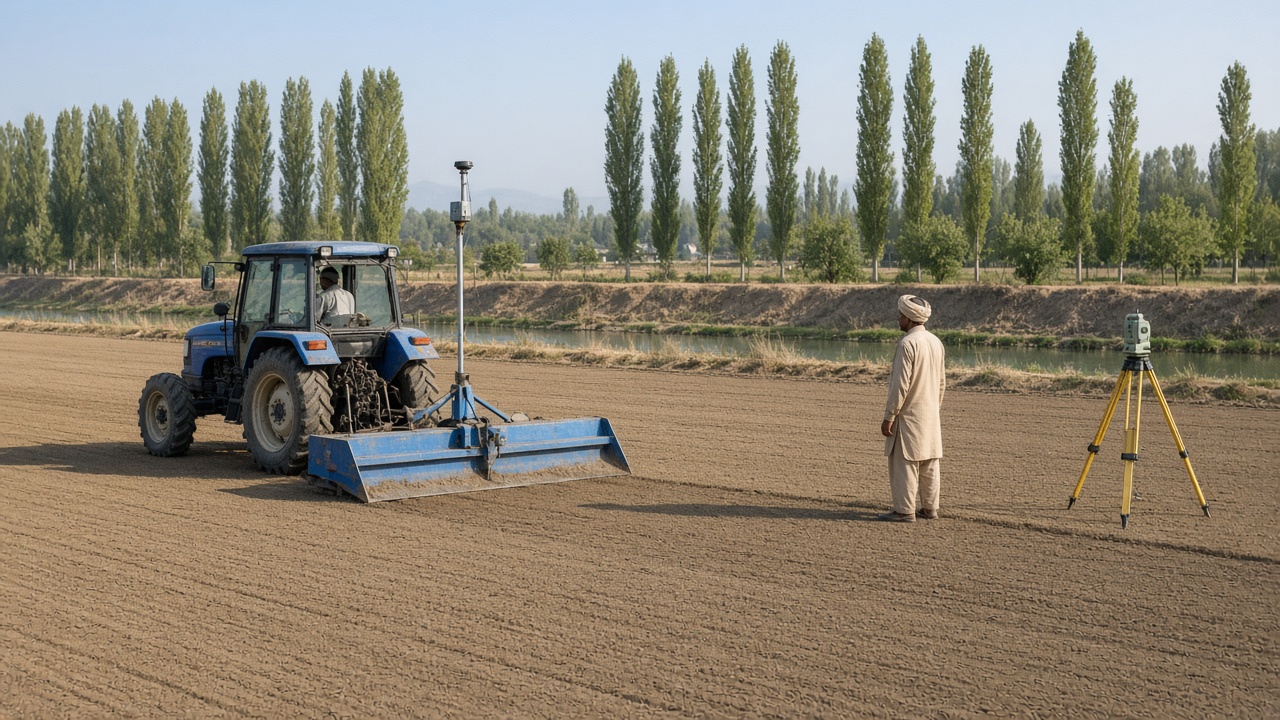
A laser beam guides the leveller bucket so the field becomes almost perfectly flat (artistic illustration).
1990s: Tractor numbers rise quickly; farmers without tractors hire neighbours’ tractors for levelling, ridging, and hauling water.
Early 2000s: Laser land levellers are introduced in Punjab, Haryana, and western Uttar Pradesh with support from the Rice–Wheat Consortium.
2000s: Tractor-drawn raised-bed planters and zero-till drills spread; water flows only in furrows, saving water and reducing waterlogging.
2006–2007: A national micro-irrigation scheme begins (2006) and the Rashtriya Krishi Vikas Yojana (2007) helps states fund farm machines.
Tools
Laser land leveller: Laser-guided levelling bucket.
Raised-bed planter: Beds for crops, furrows for water.
Zero-till drill: Sows without ploughing.
Features
Even watering: No dry or flooded patches.
Less pumping: Saves diesel and electricity.
Higher yields: Better germination on flat fields.
🪣 Ponds & Silt2009 – 2018
Farm Ponds, Tank Desilting & Custom Hiring
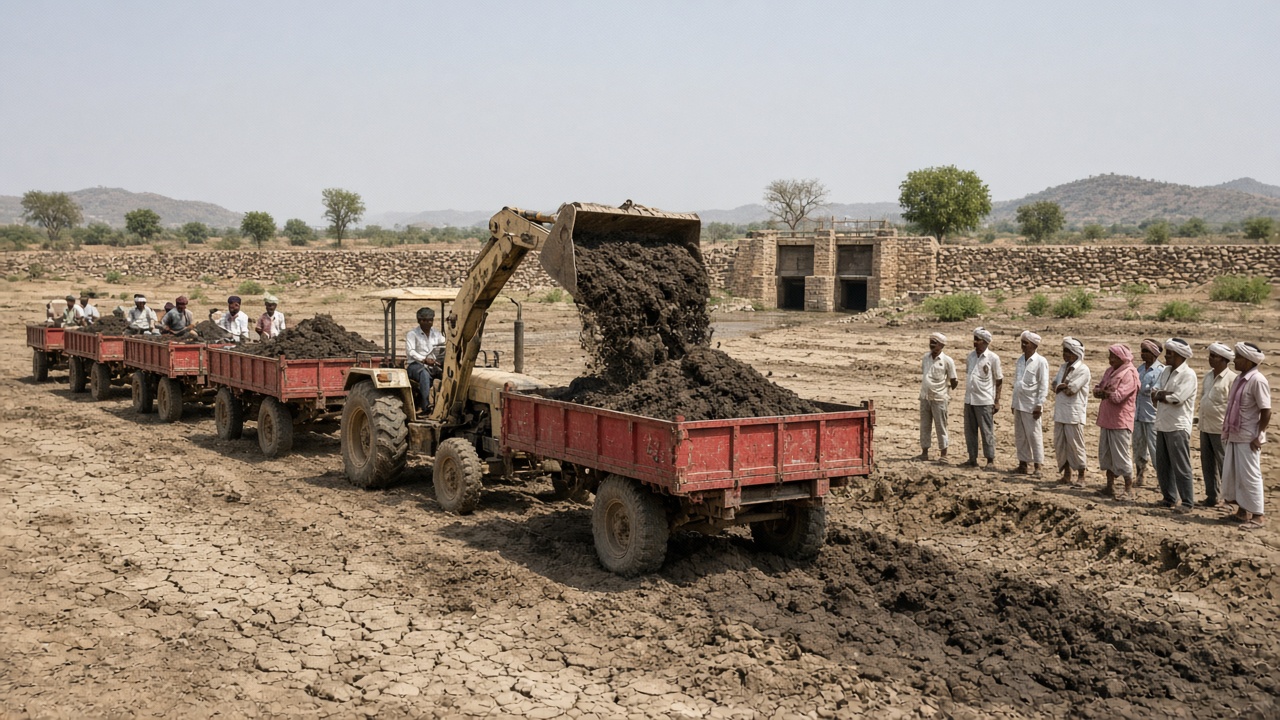
State water campaigns used tractors and excavators to dig farm ponds, deepen streams, and desilt old tanks. Farmers carried the rich silt to their fields in tractor trolleys, and custom hiring centres let small farmers rent machines.
Farmers haul fertile tank silt to their fields in tractor trolleys (artistic illustration).
2009: Punjab’s Preservation of Subsoil Water Act delays paddy transplanting to save groundwater; laser levelling is promoted with subsidies.
2014: The Sub-Mission on Agricultural Mechanisation supports custom hiring centres; Maharashtra launches Jalyukt Shivar to deepen streams and build water structures.
2016–2018: In drought years, tractor water tankers supply villages and orchards; Tamil Nadu revives tanks through the Kudimaramathu scheme (2017).
Tools
Backhoe loader: Digs ponds and loads silt.
Tipping trolley: Carries silt and soil.
Water tanker: Brings water in dry spells.
Features
Rainwater storage: Ponds refill every monsoon.
Soil boost: Tank silt enriches fields.
Rent a machine: Pay per hour or acre.
☀️ Smart Water2019 – Present
Solar Pumps, Drip Laying & Water Missions
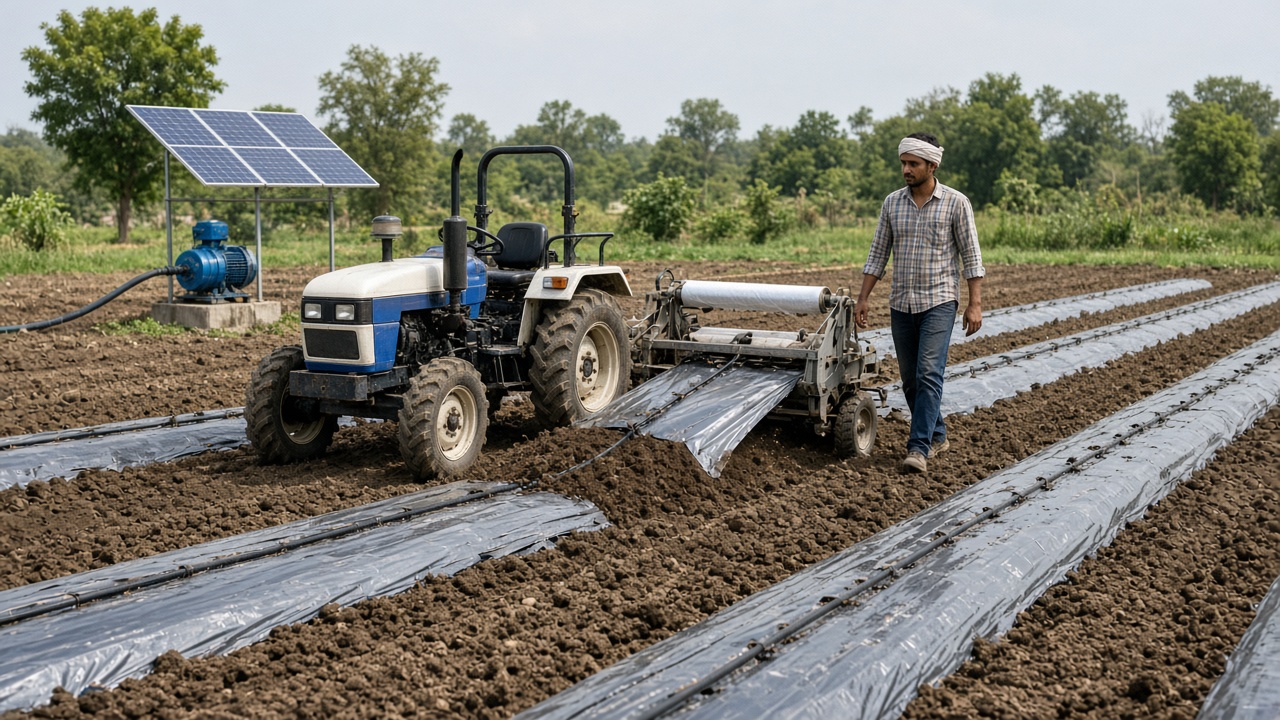
Solar pumps are taking over much of the pumping once done by diesel engines and tractors. Tractors now do precise land work — shaping raised beds, laying drip lines and plastic mulch in one pass, winding up drip pipes after harvest, and digging ponds under water missions.
One tractor pass can shape a bed, lay a drip line, and cover it with mulch film (artistic illustration).
2019: PM-KUSUM supports solar irrigation pumps, reducing the use of diesel engines and tractor-driven pumps; the Ministry of Jal Shakti is formed.
2021: India’s first CNG-converted tractor is launched; Jal Shakti Abhiyan “Catch the Rain” uses machines to build and repair water structures.
2022: Mission Amrit Sarovar begins digging and reviving ponds in every district, with tractors and excavators doing much of the earthwork.
2020s: Tractor-drawn mulch layers, drip lateral layers and winders, and GPS-guided levelling spread through custom hiring centres.
Tools
Mulch and drip layer: Bed, pipe, and film in one pass.
Drip lateral winder: Rolls up pipes for reuse.
PTO pump: Backup pumping from the tractor shaft.
Features
Clean pumping: Solar replaces diesel.
Precision land work: Beds and drip laid accurately.
Cleaner tractors: CNG and electric models tested.
Tractor Implements Used for Irrigation
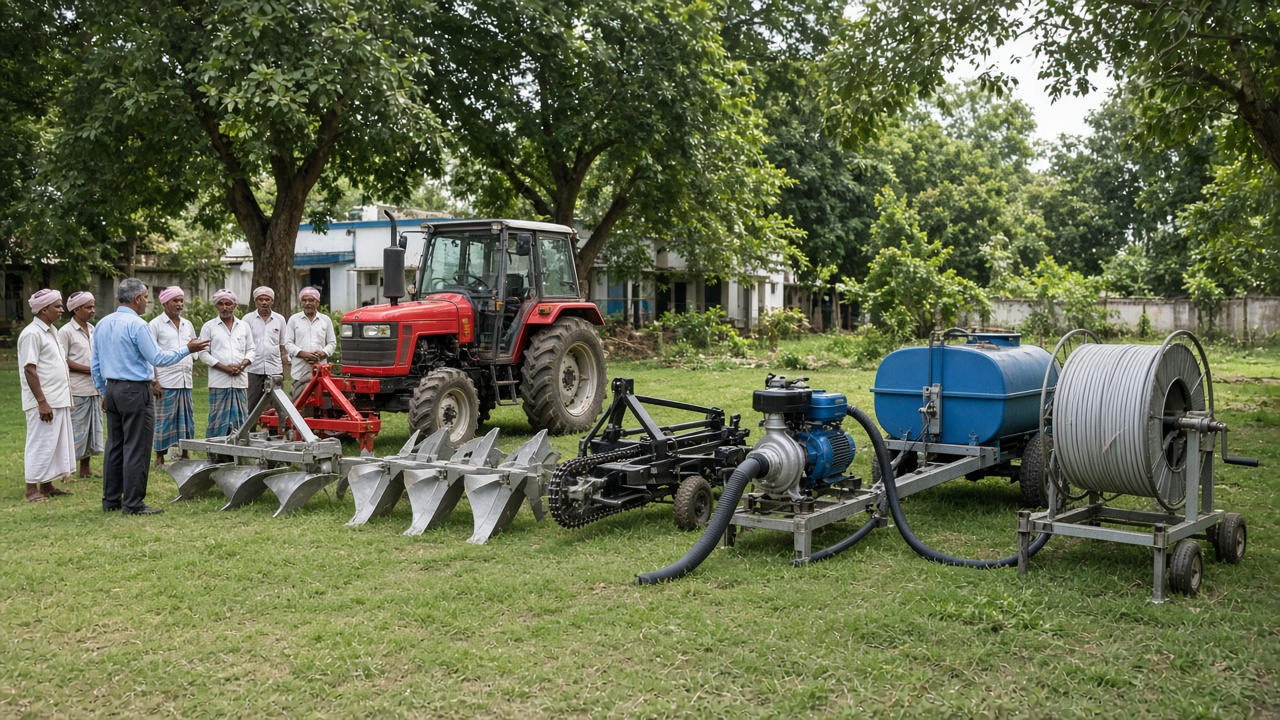
Ridgers, bund formers, trenchers, pumps, tankers, and drip reels all work with a tractor (artistic illustration).
Implement
Irrigation job
Benefit
Laser land leveller
Makes fields flat
Even watering, less water used
Scraper / land plane
Moves soil from high to low spots
Rough levelling of new land
Bund former
Raises earthen bunds around basins
Holds water in paddy and wheat fields
Ridger / furrower
Makes ridges and furrows
Water flows only between rows
Raised-bed planter
Shapes beds and sows seed
Furrow irrigation, less waterlogging
Trencher
Digs narrow trenches
Laying pipelines and drains
Backhoe loader
Digs ponds and desilts tanks
More rainwater storage
PTO water pump
Pumps from wells, ponds, and canals
Portable pumping without electricity
Water tanker trolley
Carries water to fields and orchards
Saves young plants in dry spells
Mulch and drip layer
Lays drip pipe and plastic film
Very high water efficiency
Subsoiler
Breaks hard layers deep in the soil
Rain soaks in better
A Year of Tractor Irrigation Work
Time
Tractor job
Why it matters for water
Summer (before monsoon)
Desilting tanks, digging farm ponds, subsoiling
More room to store and soak up rain
Before kharif sowing
Laser levelling and bund forming
Paddy fields hold water evenly
Kharif sowing
Puddling and ridging
Less seepage; furrows guide water
Monsoon breaks
Running PTO pumps from ponds
Life-saving irrigation in dry spells
Before rabi sowing
Raised beds, mulch and drip laying
Water only where roots need it
Rabi season
Hauling pipes and water tankers
Water for wheat, vegetables, and orchards
After harvest
Winding drip pipes, cleaning channels
Pipes reused; channels ready for next crop
Key Programmes & Schemes
Programme / scheme
Year
Link to tractors and water
Central Tractor Organisation
1947
Tractors reclaim land for farming
Command Area Development Programme
1974
Land levelling and field channels in canal areas
National Watershed Development Project for Rainfed Areas
1990–91
Bunds and water harvesting in dry areas
Rashtriya Krishi Vikas Yojana
2007
State funding for farm machines
Punjab Preservation of Subsoil Water Act
2009
Saving groundwater in paddy season
Sub-Mission on Agricultural Mechanisation
2014
Custom hiring centres and machine subsidies
PM Krishi Sinchayee Yojana
2015
Irrigation and micro-irrigation
Mission Kakatiya (Telangana)
2015
Tank desilting; silt carried in trolleys
PM-KUSUM
2019
Solar pumps replace diesel pumping
Mission Amrit Sarovar
2022
Ponds dug and revived in every district
Tractors in Irrigation Timeline Summary
Year / Era
Milestone
Before 1947
Bullock plank levellers and hand-dug channels
1943
Grow More Food campaign
1947
Central Tractor Organisation
1950s
Tractor land reclamation and contour bunding
Early 1960s
Indian tractor manufacturing begins
Mid-1960s
Green Revolution; tube wells and belt-driven pumps
1974
Command Area Development Programme
1990–91
National Watershed Development Project for Rainfed Areas
Early 2000s
Laser land levellers introduced
2000s
Raised-bed planters and zero-till drills spread
2007
Rashtriya Krishi Vikas Yojana
2009
Punjab Preservation of Subsoil Water Act
2014
Custom hiring centres; Jalyukt Shivar
2015
PM Krishi Sinchayee Yojana; Mission Kakatiya
2016
Farm pond and water self-reliance campaigns
2019
PM-KUSUM solar pumps
2021
First CNG-converted tractor
2022
Mission Amrit Sarovar
Test Your Knowledge
20 quick questions from the tractors in irrigation timeline. Click each question to reveal the answer.
Answer: Bullocks.
Answer: So water spreads evenly without flooding low spots or leaving high spots dry.
Answer: The Central Tractor Organisation.
Answer: Kans grass.
Answer: Slow down rainwater runoff so it soaks into the soil.
Answer: With a flat belt from the tractor’s belt pulley to the pump.
Answer: Power take-off.
Answer: 540 rpm.
Answer: The Command Area Development Programme.
Answer: A ridger (furrower).
Answer: A laser beam from a transmitter, picked up by a receiver on the leveller.
Answer: About 20–25%.
Answer: The rice–wheat areas of Punjab, Haryana, and western Uttar Pradesh.
Answer: Water flows only in the furrows between beds instead of flooding the whole field.
Answer: The Punjab Preservation of Subsoil Water Act.
Answer: A centre that rents out tractors and farm machines by the hour or acre.
Answer: They carried it to their fields in tractor trolleys to enrich the soil.
Answer: PM-KUSUM (2019).
Answer: Shape the bed, lay the drip pipe, and cover it with plastic mulch.
Answer: Mission Amrit Sarovar.
Classroom activity
Students Tasks
Use these prompts for discussion or projects on how tractors help irrigation in India.
Timeline understandingFarm machineryWater conservationRural life
Draw a tractor and label its belt pulley, PTO shaft, and three-point hitch, and explain what each one is used for.
Make a tray model with sand to show how water spreads on a level field compared with an uneven one.
Interview a farmer or tractor owner about the irrigation jobs they use the tractor for in each season.
List five tractor implements from this page and match each one to the irrigation job it does.
Compare the cost of renting a laser leveller from a custom hiring centre with the value of water and diesel it saves.
Explain why solar pumps are replacing diesel engines and tractor-driven pumps on many farms.
Find out how a farm pond is dug and how it stores rainwater, and draw a labelled diagram.
Debate: “Every village should have a custom hiring centre instead of every farmer buying a tractor.”
Make a safety poster on using tractors near canals, ponds, and PTO shafts.
Design a future tractor attachment that saves water — describe how it works and who would use it.
Continue exploring
Tractors work hand in hand with irrigation systems, other farm tools, and rural electricity. Explore more timelines next.
Click any panel to expand and explore the visual mood.
Tractors and irrigation in pictures — bullock levellers, land reclamation, belt-driven pumps, laser levelling, tank desilting, drip and mulch laying, and irrigation implements.
Bullock Leveller
Before tractors
Land Reclamation
From 1947
Belt Pump
Green Revolution
Laser Leveller
Early 2000s
Tank Desilting
Mission Kakatiya
Implements
Ridger to pump
Drip Laying
One-pass machines
Farm at Work
Tanker, leveller & pond
Explore all agriculture timelines
Jump to any other agriculture timeline on WorldTimelineHub.
Disclaimer: This content is AI-generated for educational purposes and may contain errors or outdated details. For correct and authoritative information, please refer to official and reliable sources such as government publications, manufacturers, museums, and academic references.