Beverages Timeline of India: Milk & Lassi → Chai & Coffee → Cool Drinks → Wine → Energy Drinks
For centuries Indians drank milk, lassi, buttermilk, and fruit sherbets. Tea gardens and coffee houses spread in colonial times, the doodhwala and Amul brought milk to towns in the 1950s, chai stalls
and desi colas such as Thums Up ruled the 1970s and 1980s, cafés and Indian wine grew after liberalisation, and in the 2020s energy drinks, cold brew, and chai cafés fill city fridges and streets.
This timeline covers milk, curd, lassi and chaas, sherbets, toddy and feni, Assam and Darjeeling tea, coffee and filter coffee, goli soda and Rooh Afza, Amul and Operation Flood, colas, Frooti and
Tetra Paks, bottled water, café chains, Nashik wine, energy drinks and caffeine rules, and the healthy-drinks trend.
Milk & Lassi → Assam Chai1977 Thums Up → 1996 Cafés2020s Energy Drinks & Cold Brew
Why the Beverages Story Matters
What we drink says a lot about who we are. A glass of lassi on a Punjab farm, a steel tumbler of filter coffee in Chennai, a kulhad of chai on a railway platform, and a chilled cola at a wedding each
carry a story of farming, trade, colonial history, advertising, and technology. The journey from churning buttermilk at home to picking an energy drink from a glowing fridge shows how India’s tastes, health, and economy changed.
Big picture
India’s beverages journey in one view
Milk, curd, lassi, buttermilk, sherbets, and toddy were India’s traditional drinks. The British turned Assam and Darjeeling into tea gardens and campaigned to make Indians tea drinkers, the dairy
cooperative movement brought milk to cities after independence, Indian colas thrived when Coca-Cola left in 1977, cafés and wineries grew after 1991, and energy drinks and chai cafés arrived in the 2010s. Related timelines:
White Revolution,
Golden Revolution,
railways.
1823
Wild Assam tea identified
1946
Amul dairy cooperative founded
1977
Thums Up launched as Coca-Cola exits
1996
First Café Coffee Day in Bengaluru
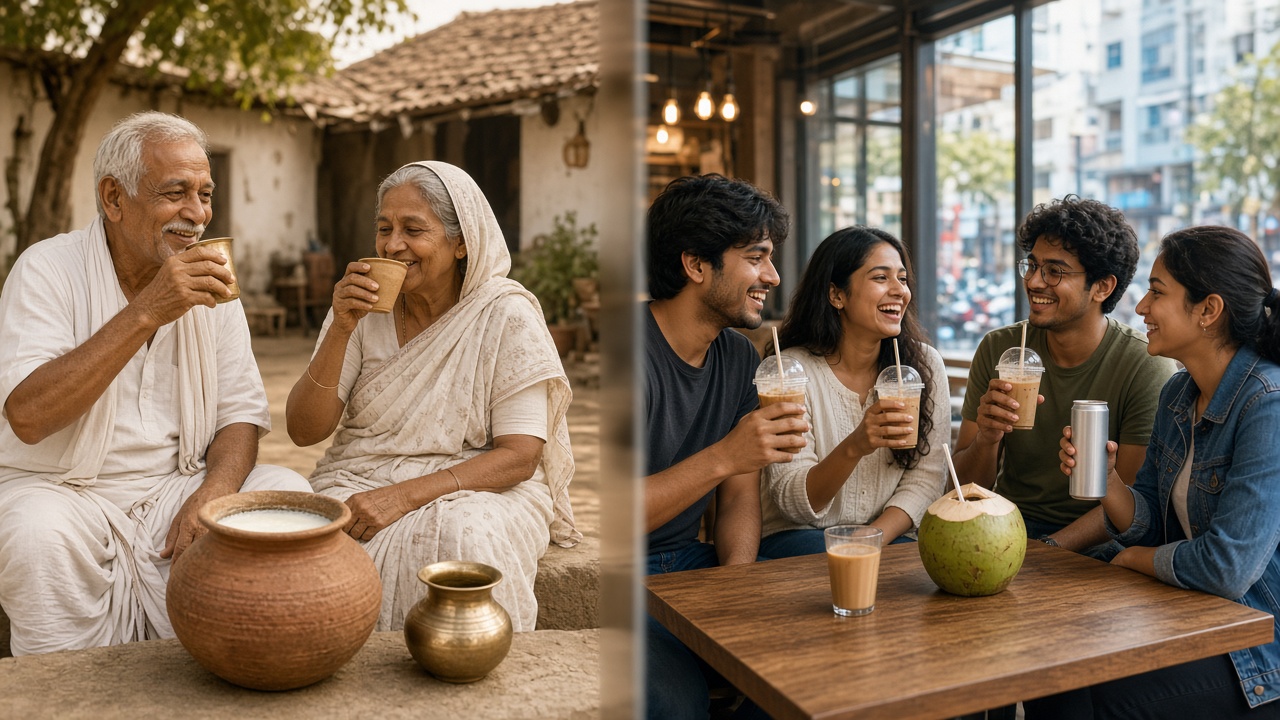
From lassi in the courtyard to cold coffee and canned drinks in the café (artistic illustration).
Indian Beverages Then vs Now at a Glance
Feature
Then
Now
Morning drink
Milk, kanji, or buttermilk
Chai, coffee, or green tea
Milk source
Home cow or the doodhwala
Pouches, Tetra Paks, and apps
Summer cooler
Lassi, nimbu pani, and sherbet
Colas, juices, and iced coffee
Fizzy drinks
Goli soda in marble bottles
Colas and energy drinks in cans
Coffee
Filter coffee at home in the South
Cafés, cold brew, and instant coffee everywhere
Serving
Brass tumblers, kulhads, and lotas
Plastic bottles, cans, and paper cups
Where people drank
Home, village well, and tea stall
Cafés, malls, gyms, and offices
Cooling
Clay matka and ice from the market
Fridges and chilled display coolers
Health worry
Contaminated water and milk
Too much sugar and caffeine
Adult drinks
Toddy, feni, and local brews
Beer and Indian wine from Nashik and Karnataka
🥛 AncientAncient – 1822
Milk, Lassi, Sherbet & Toddy
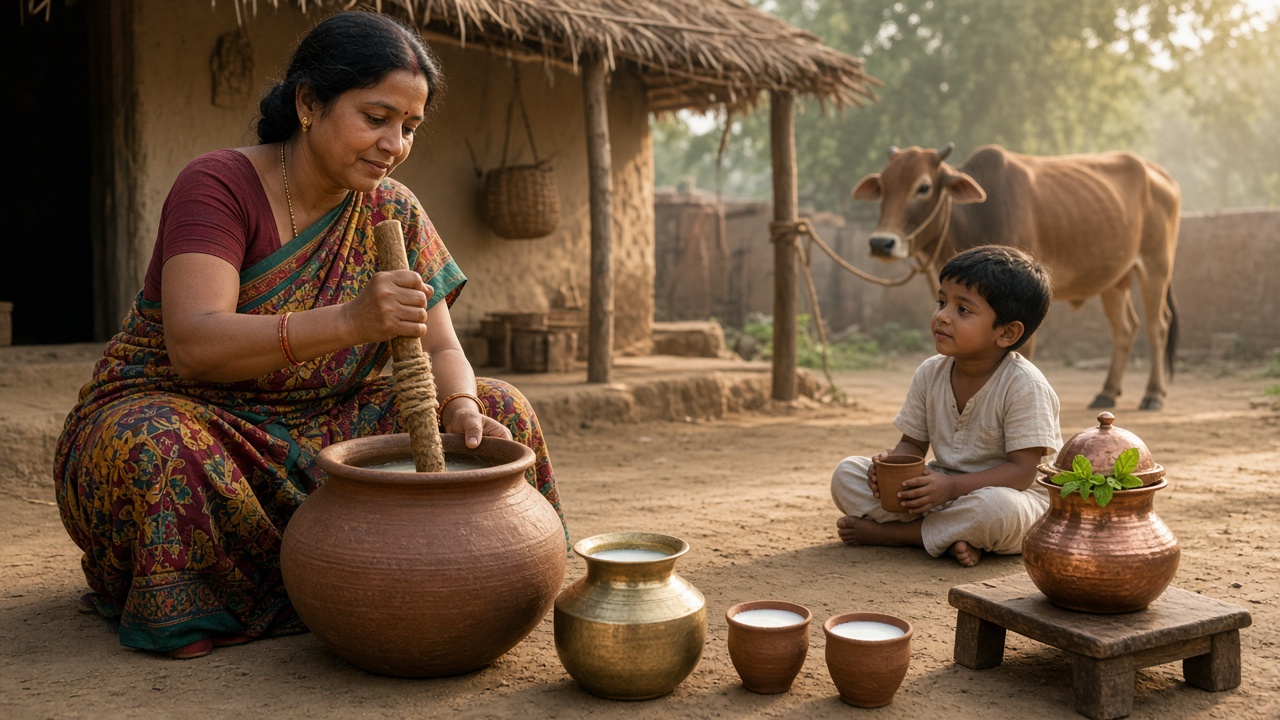
For thousands of years Indian families drank fresh milk from their own cows, churned curd into butter and buttermilk, and cooled off with lassi, panakam, and fruit sherbets. Coastal villages tapped palms for toddy, royal kitchens chilled sherbets with mountain ice, and coffee arrived in the hills of Karnataka.
Churning curd with a wooden mathani to make butter and buttermilk (artistic illustration).
c. 1500–1000 BCE: The Rigveda praises milk, curd, and ghee, and describes the ritual drink soma; cattle are a measure of wealth.
c. 300 BCE–200 CE: The Arthashastra names a superintendent to regulate liquor such as sura, and Ayurvedic texts such as the Charaka Samhita praise takra (buttermilk) for digestion.
1500s: Mughal emperors enjoy fruit sherbets cooled with ice brought from the hills, and the Portuguese bring the cashew to Goa, later distilled into feni.
1600s: Legend says the Sufi saint Baba Budan brings seven coffee beans from Yemen and plants them in the Chikmagalur hills of Karnataka.
Technology
Wooden churner: Curd to butter and chaas.
Clay matka: Natural water cooling.
Palm tapping: Fresh neera and toddy.
Features
Home-made: From the family cow.
Seasonal coolers: Aam panna, panakam.
Brass and clay: Lotas and kulhads.
🍃 Tea1823 – 1946
Tea Gardens, Coffee Houses & Soda
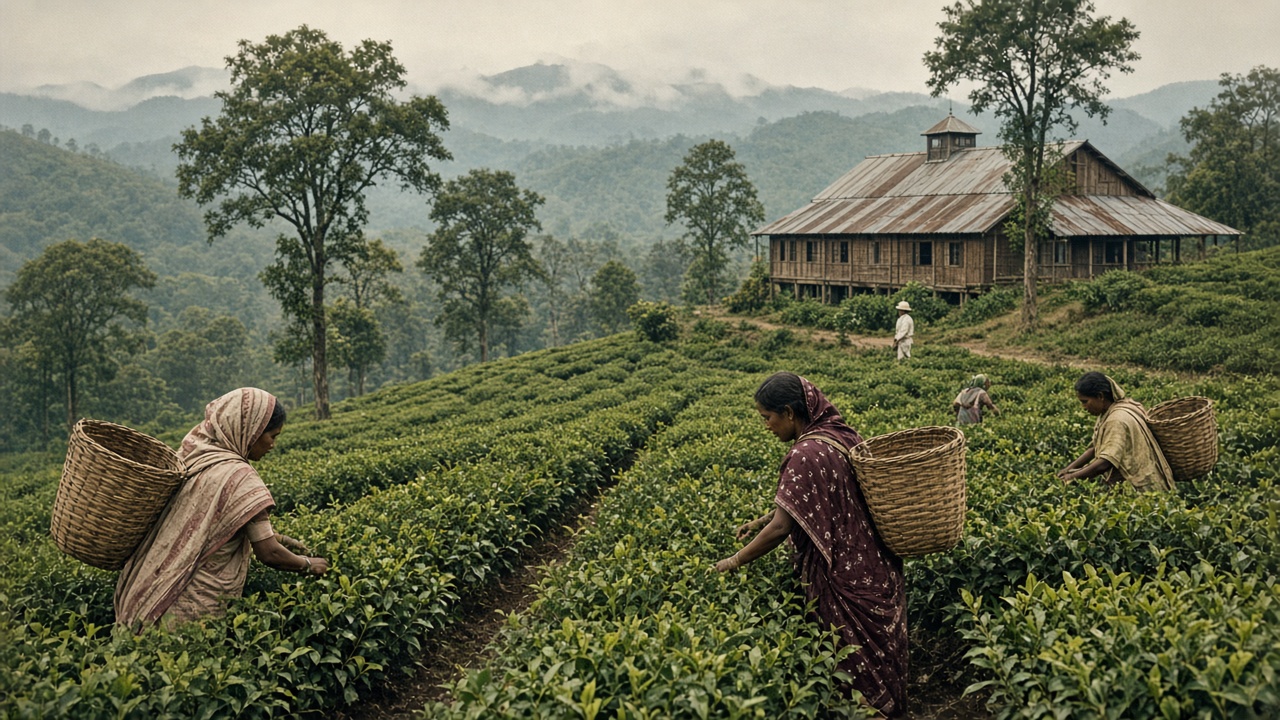
The British turned the hills of Assam, Darjeeling, and the Nilgiris into tea and coffee estates, mostly to export to Britain. Soda water in marble-stoppered goli bottles and bottled sherbets appeared in towns, and from the 1930s tea boards and coffee houses set out to make Indians everyday tea and coffee drinkers.
Tea pluckers with cane baskets in an early 1900s Assam tea garden (artistic illustration).
1823: Robert Bruce, guided by the Assamese nobleman Maniram Dewan to the Singpho chief Bisa Gam, finds tea plants growing wild in Assam.
1839–1841: The first Assam tea is auctioned in London (1839) and tea is planted in Darjeeling (1841); Edward Dyer’s brewery at Kasauli, set up in the 1820s, is one of Asia’s earliest.
1906: Hakeem Hafiz Abdul Majeed creates the rose sherbet Rooh Afza in Old Delhi, while goli soda in marble-stoppered Codd bottles becomes a street favourite.
1930s–1942: The Indian Tea Market Expansion Board hands out tea at railway stations and factories, the first India Coffee House opens in Bombay (1936), and the Coffee Board is set up (1942).
Technology
Tea factories: Withering, rolling, drying.
Codd bottles: Marble-sealed soda.
Coffee roasting: Filter coffee with chicory.
Features
Railway chai: Tea on platforms.
Export crops: Tea and coffee estates.
Sherbet bottles: Rooh Afza in summer.
🚲 Doodhwala1947 – 1969
Doodhwala, Amul & the First Colas
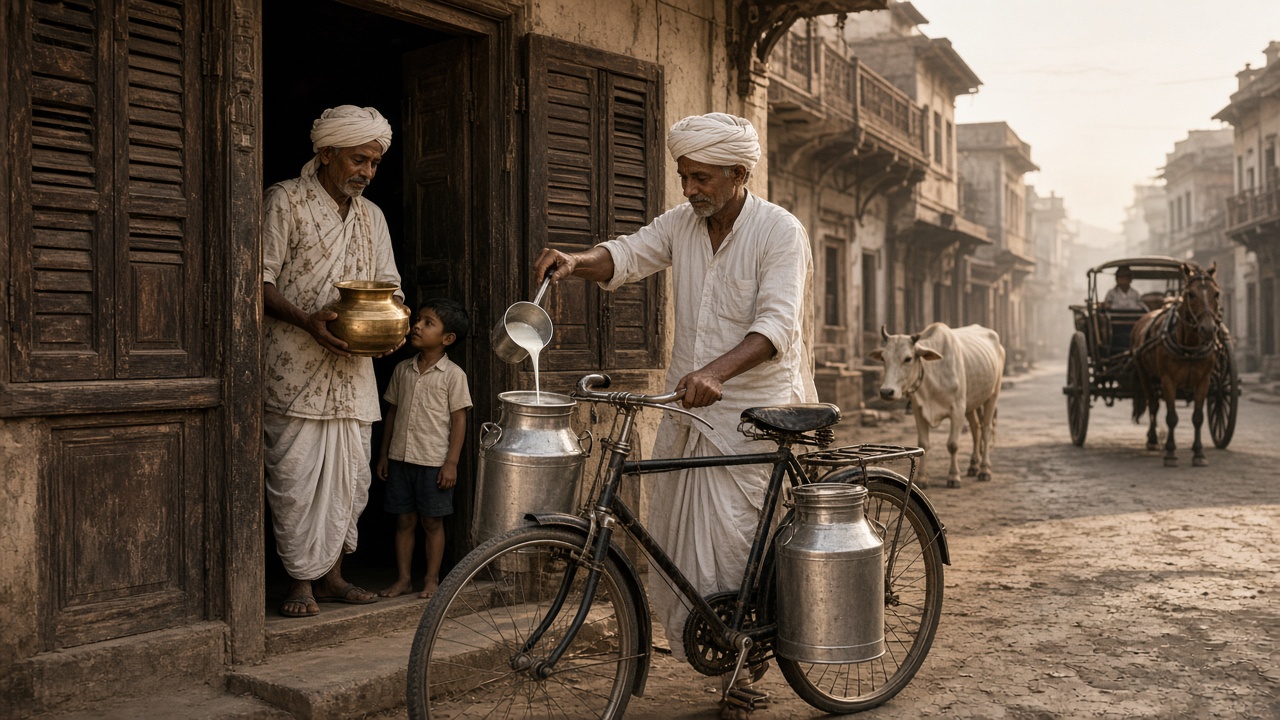
After independence the doodhwala cycled to every door at dawn with milk cans, while dairy cooperatives and milk colonies began supplying pasteurised milk to growing cities. Chai became the national drink at home and on railway platforms, and the first bottled colas and orange sodas appeared at weddings and fairs.
The doodhwala measures milk into a brass pot at the door (artistic illustration).
1946–1955: The Kaira District Cooperative Milk Producers’ Union is formed at Anand in December 1946; with Verghese Kurien it launches the Amul brand in 1955.
1949–1951: Bombay’s Aarey Milk Colony is set up to supply the city with hygienic bottled milk.
1950s: Coca-Cola is bottled in India and Parle launches Gold Spot orange soda; sugarcane juice carts, nimbu pani, and goli soda cool the summers.
1957–1965: Workers’ cooperatives take over the Indian Coffee Houses (from 1957), Bisleri starts bottled water in Bombay, and the National Dairy Development Board is set up at Anand (1965).
Technology
Pasteurisation: Safer city milk.
Glass milk bottles: Sealed with foil caps.
Bottling plants: Colas and sodas.
Features
Doorstep milk: Doodhwala at dawn.
Cooperatives: Farmers own the dairy.
Party drinks: Bottled sodas.
🥤 Cool Drinks1970 – 1990
Chai Stalls, Thums Up & Frooti
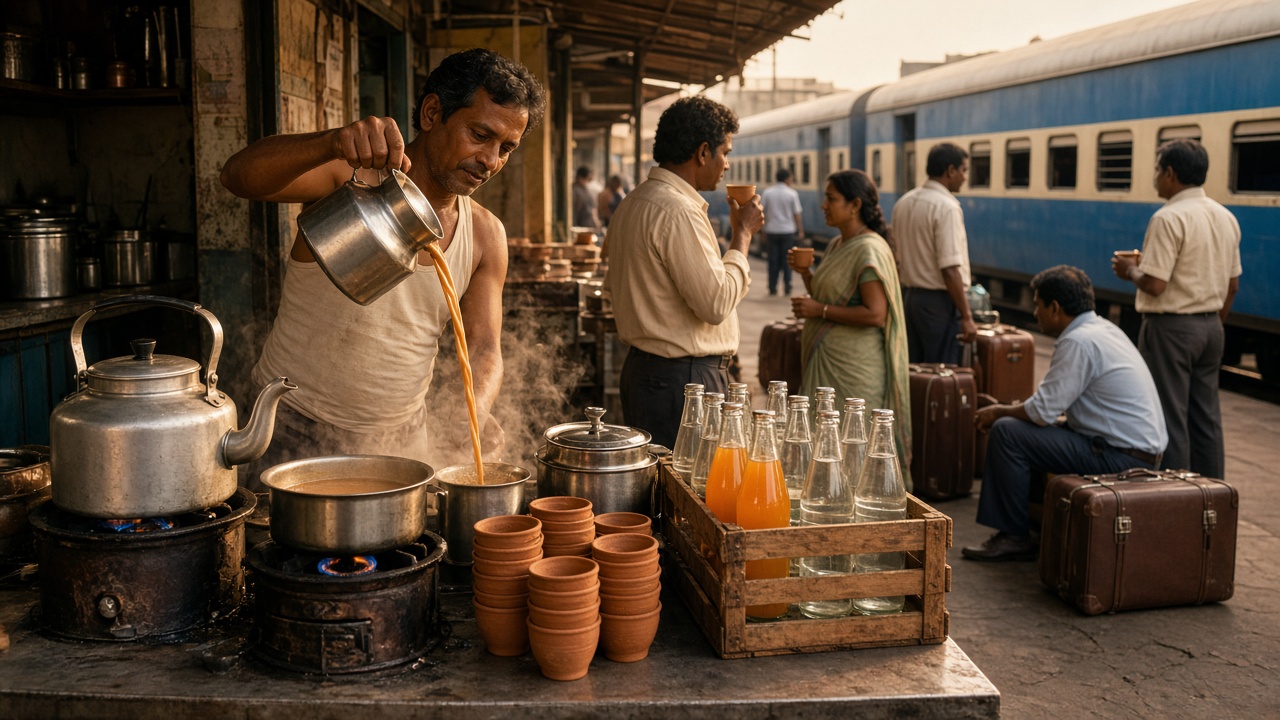
Operation Flood made milk plentiful, and the roadside chai stall with its kulhads and boiling kettle became the meeting place of every town. When Coca-Cola left India in 1977, Indian “cool drinks” such as Thums Up, Limca, and Campa Cola took over, while Frooti in a Tetra Pak and Rasna at home became childhood favourites.
Kulhad chai and a crate of bottled cool drinks on a railway platform (artistic illustration).
1970–1974: Operation Flood begins linking village dairies to city markets, and Mother Dairy opens milk booths in Delhi (1974).
1971–1976: Parle launches the lemon drink Limca (1971) and the mango drink Maaza (1976); Rasna concentrate later becomes a cheap home summer drink.
1977: Coca-Cola leaves India rather than follow new foreign-exchange rules; Parle launches Thums Up, and Campa Cola and the government’s Double Seven fill the gap.
1980s: Frooti (1985) is sold in handy Tetra Pak cartons, and pioneering wineries near Pune and Bengaluru start making Indian grape wine.
Technology
Tetra Pak cartons: No fridge needed.
Returnable bottles: Crates and deposits.
Milk grids: Tankers and chilling centres.
Features
Chai stall culture: Kulhad and gossip.
Desi colas: Indian brands rule.
Mango drinks: Maaza and Frooti.
☕ Café1991 – 2009
Global Colas, Cafés & Indian Wine
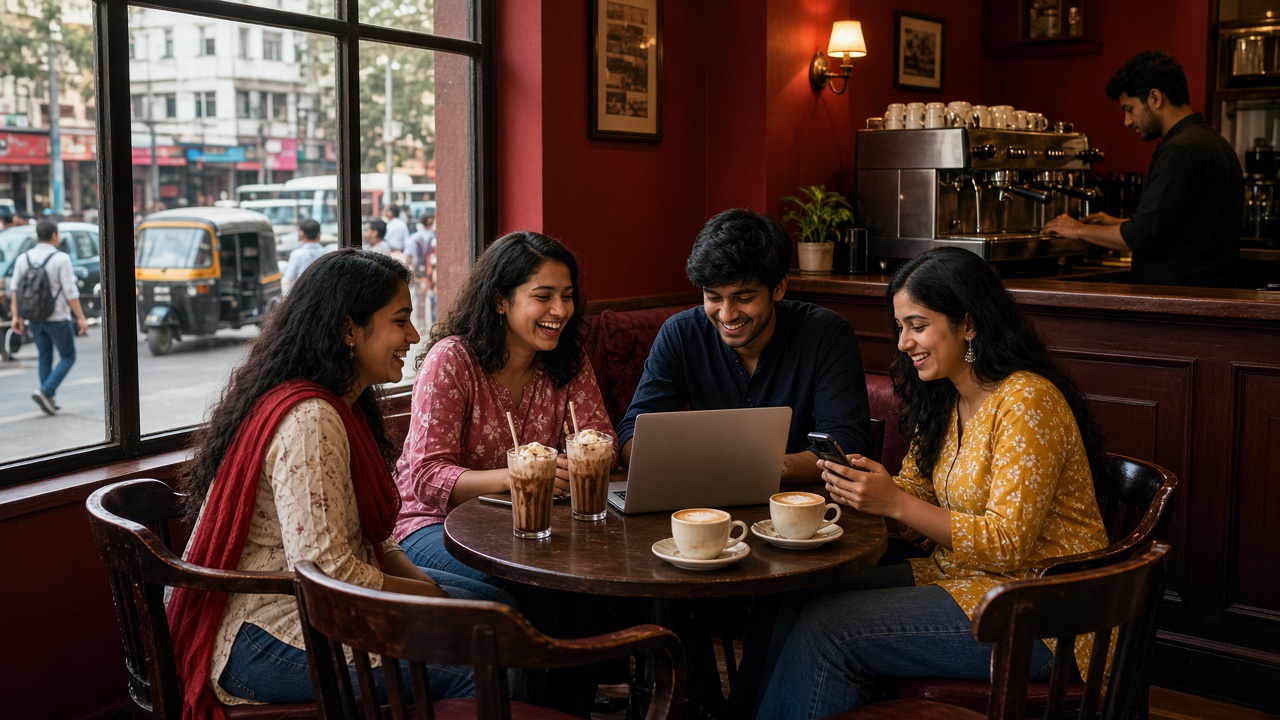
Liberalisation brought Pepsi and Coca-Cola back with film-star advertising, packaged water became a necessity, and café chains made a cold coffee the new hangout for young people. Flavoured milk and packaged lassi filled dairy fridges, and vineyards around Nashik began producing Indian wine for adult drinkers.
Cold coffee and cappuccinos become the new hangout in 2000s cafés (artistic illustration).
1990–1993: Pepsi enters India (first as Lehar Pepsi), and Coca-Cola returns in 1993 and buys Thums Up, Limca, Gold Spot, and Maaza from Parle.
1996–2000: Café Coffee Day opens its first café on Brigade Road, Bengaluru (1996), and Barista follows (2000), turning coffee into a youth hangout drink.
1998–2001: India becomes the world’s largest milk producer (1998); Sula Vineyards releases its first wines in Nashik (2000), and Maharashtra’s 2001 grape policy helps Nashik become the wine capital.
2000s: Packaged water, flavoured milk, and energy drinks spread in cities; a 2003 report on pesticide residues in soft drinks sparks a national debate on drink safety.
Technology
Espresso machines: Cappuccino and latte.
PET bottles: Light and disposable.
Visi-coolers: Chilled drinks in every shop.
Features
Café hangouts: Coffee with friends.
Celebrity ads: Cola wars on TV.
Nashik wine: Indian vineyards grow.
⚡ Energy2010s – Future
Energy Drinks, Chai Cafés & Healthy Sips
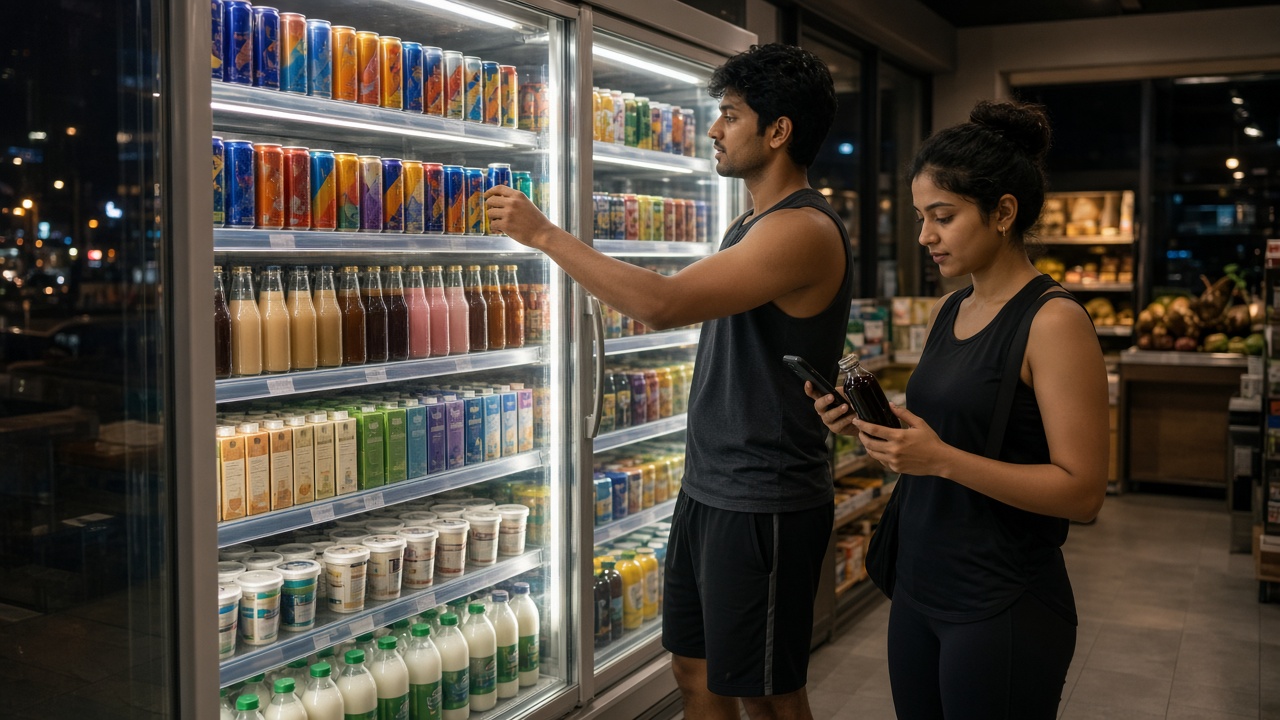
In the 2010s energy drinks moved from gyms and parties to every small-town shop, while chai cafés, global coffee chains, and Indian speciality coffee roasters gave old drinks a new style. Worries about sugar and caffeine brought new rules and taxes, and many people turned back to buttermilk, coconut water, kadha, and plant-based milks.
Energy drinks, cold brew, and plant milks side by side in a 2020s store fridge (artistic illustration).
2010–2012: Chai Point (2010) and Chaayos (2012) open modern chai cafés, and Tata Starbucks opens its first store in Mumbai in October 2012.
Late 2010s: Cheaper energy drinks reach small towns; FSSAI caps caffeine at 300 mg per litre with warning labels, and GST taxes sugary aerated drinks at 28% plus a cess from 2017.
2020–2023: The UN marks the first International Tea Day on 21 May 2020 after India’s proposal, kadha and haldi doodh surge during the pandemic, and Reliance relaunches Campa Cola (2023).
Future: Less sugar, plant-based and millet drinks, probiotic buttermilk, Indian speciality coffee, recyclable packaging, and clearer front-of-pack labels will shape what India drinks.
Technology
Cold brew: Slow-steeped coffee.
Aluminium cans: Recyclable packs.
Vending and apps: Chai on order.
Features
Caffeine labels: Not for children.
Healthy swaps: Coconut water, chaas.
Craft drinks: Speciality chai and coffee.
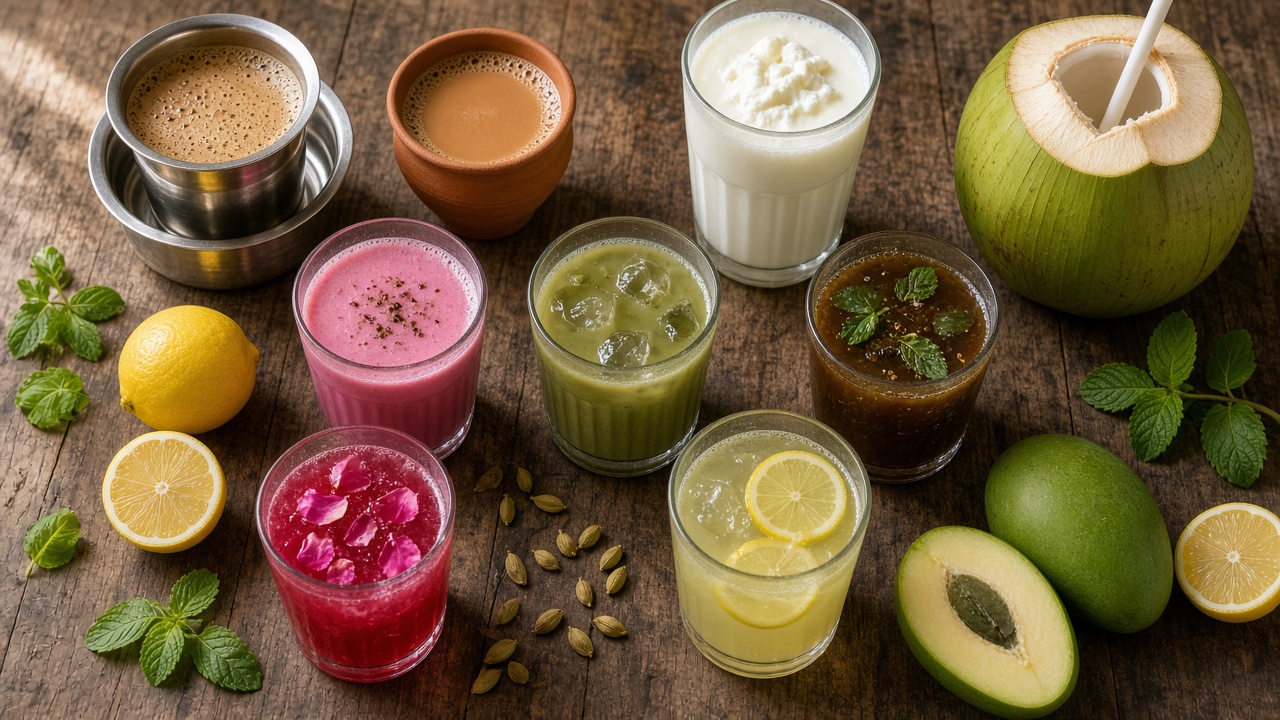
Traditional Drinks from Across India
Filter coffee, chai, lassi, sol kadhi, aam panna, jaljeera, nimbu pani, rose sherbet, and coconut water (artistic illustration).
Drink
Region
Main ingredients
Lassi
Punjab and North India
Curd whisked with sugar or salt
Chaas / majjiga / mor
All over India
Thin curd, cumin, ginger, curry leaves
Filter coffee
Tamil Nadu and Karnataka
Coffee with chicory, milk, and sugar
Masala chai
All over India
Tea, milk, ginger, and cardamom
Kahwa and noon chai
Kashmir
Green tea with saffron and almonds; pink salted tea
Sol kadhi
Konkan and Goa
Kokum and coconut milk
Aam panna
North and West India
Raw mango, mint, and roasted cumin
Sattu sharbat
Bihar and Jharkhand
Roasted gram flour, lemon, and salt
Panakam
Tamil Nadu, Andhra Pradesh, and Karnataka
Jaggery, dry ginger, and cardamom
Thandai
North India, especially at Holi
Milk, nuts, fennel, and rose petals
Famous Indian Drink Brands and Cafés
Name
Started
What it is
Rooh Afza
1906
Rose sherbet from Old Delhi
Indian Coffee House
1936
Coffee houses, cooperative-run from 1957
Amul
1946 (cooperative), 1955 (brand)
Milk, lassi, and dairy drinks
Gold Spot
1950s
Orange soda by Parle
Bisleri
1965
Bottled drinking water
Limca
1971
Lemon-lime soda
Thums Up
1977
Strong Indian cola
Frooti
1985
Mango drink in a Tetra Pak
Café Coffee Day
1996
India’s first big café chain
Sula Vineyards
1999 (first wines 2000)
Winery in Nashik
Chaayos
2012
Chai café chain
How Much Caffeine Is in Your Drink?
Values are rough averages and vary with the brand, strength, and cup size. Caffeinated drinks are not recommended for young children.
Click any panel to expand and explore the visual mood.
India’s beverages journey in pictures — churning buttermilk, plucking Assam tea, the 1950s doodhwala, railway chai and bottled cool drinks, 2000s café cold coffee, regional drinks, 2020s energy drinks, and then versus now.
Lassi & Chaas
Churned at home
Tea Gardens
Two leaves and a bud
Doodhwala
Milk at the door at dawn
Railway Chai
Kulhads and cool drinks
Café Culture
Cold coffee with friends
Regional Drinks
Sol kadhi to filter coffee
Energy Drinks
Cans and cold brew
Then vs Now
Kulhad to café cup
Explore all daily life timelines
Jump to any other daily life timeline on WorldTimelineHub.
Disclaimer: This content is AI-generated for educational purposes and may contain errors or outdated details. For correct and authoritative information, please refer to official and reliable sources such as government publications, manufacturers, museums, and academic references.