In the 1950s a family’s gold was its savings, made to order by the local goldsmith and passed from mother to daughter. Rising gold prices made imitation jewellery popular in the 1980s,
branded hallmarked showrooms arrived in the 2000s, lightweight minimal pieces suited working lives in the 2010s, and in the 2020s lab-grown diamonds and digital gold are changing how India shines.
This timeline covers Harappan beads, Golconda diamonds, temple jewellery, kundan and meenakari, stridhan and heirlooms, the Gold Control Act, one-gram gold and American diamonds, glass and
lac bangles, branded showrooms, BIS hallmarking and HUID, online jewellery, minimal everyday wear, gold bonds and ETFs, lab-grown diamonds from Surat, and digital gold.
India is one of the world’s largest buyers of gold, and jewellery here is much more than decoration — it is savings, security, blessing, and identity. The way Indians buy and wear
jewellery reflects changes in laws, prices, women’s work, trust, and technology, from the family goldsmith and heirloom boxes to hallmarked showrooms, online stores, and lab-grown diamonds.
Big picture
India’s jewellery journey in one view
For thousands of years India crafted gold, gems, and beads, and was the world’s main source of diamonds. After independence gold heirlooms were family wealth, while gold control
laws and rising prices pushed many towards imitation jewellery. Liberalisation brought brands and hallmarking, the 2010s favoured light everyday pieces bought online, and the 2020s
brought mandatory HUID hallmarks, lab-grown diamonds, and digital gold. Related timelines:
banking,
the rupee,
Digital India.
1968
Gold (Control) Act passed
1994
Titan founds Tanishq
2000
BIS gold hallmarking begins
2023
6-digit HUID hallmark mandatory
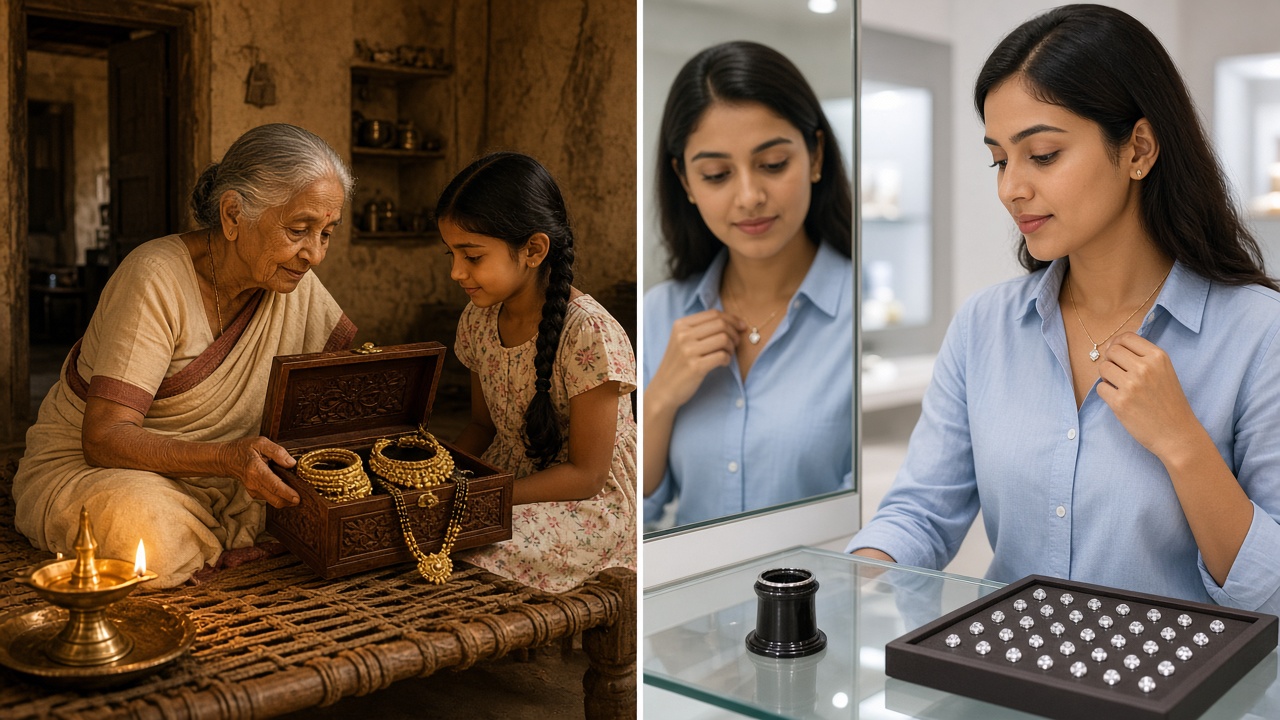
From a grandmother’s heirloom box to a minimal lab-grown diamond pendant (artistic illustration).
Jewellery Then vs Now at a Glance
Feature
Then
Now
Main purpose
Savings, security, and tradition
Style, gifting, and investment
Typical pieces
Heavy bangles, long chains, necklaces
Light chains, studs, pendants, rings
Gold purity
22 carat, trust in the goldsmith
22, 18, and 14 carat with BIS hallmark
Stones
Rubies, emeralds, pearls, polki
Mined and lab-grown diamonds, coloured gems
Who made it
Family sunar (goldsmith)
Factories, brands, and designers
Where bought
Goldsmith’s workshop or bazaar shop
Showrooms, websites, and apps
Proof of purity
Touchstone and trust
HUID code, XRF testing, certificates
When worn
Every day, heavier at weddings
Minimal daily; heavy sets for occasions
Imitation
Glass and lac bangles
One-gram gold, American diamond, fashion jewellery
Gold as investment
Coins and jewellery at home
Gold ETFs, bonds, and digital gold
🛕 HeritageAncient – 1946
Temple Gold & Royal Gems
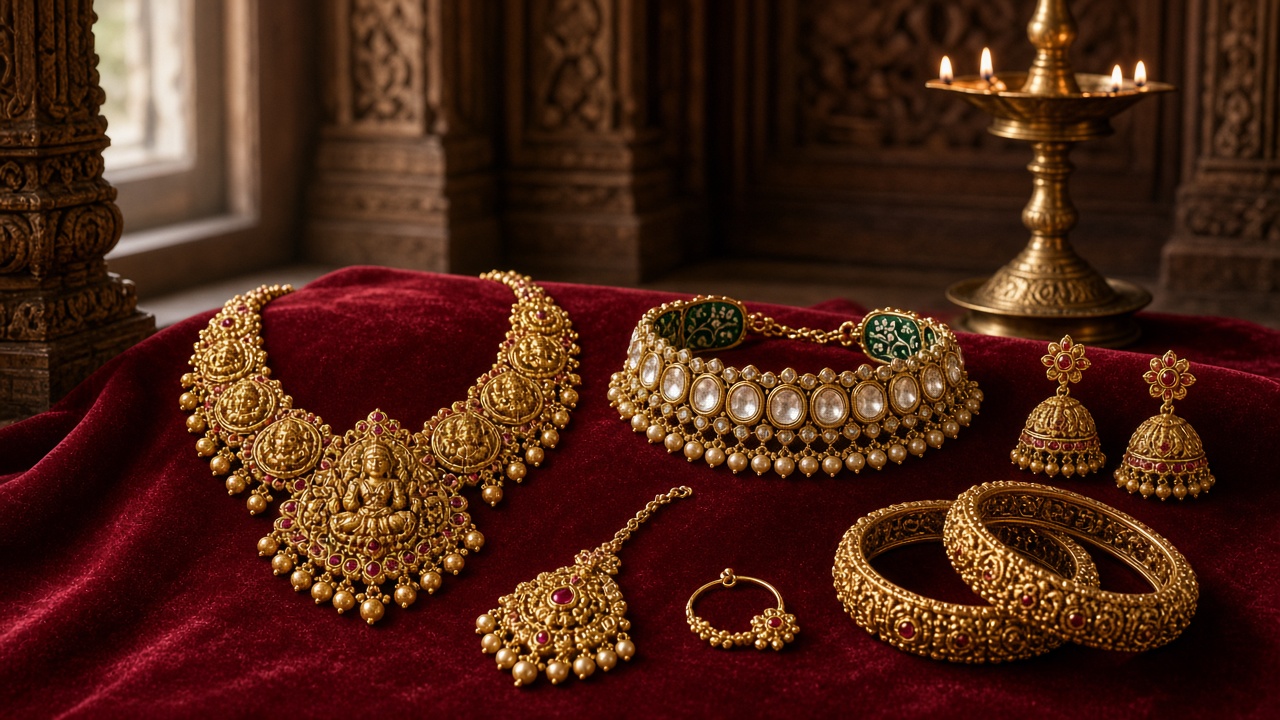
India has one of the oldest jewellery traditions in the world. Harappan craftsmen made gold ornaments and beads, Indian mines supplied the world’s diamonds for centuries, and temples and royal courts gave rise to temple jewellery, kundan, and meenakari.
Temple jewellery, a kundan choker, jhumkas, a nath, and gold bangles (artistic illustration).
Harappan period (c. 2600–1900 BCE): Craftsmen make gold and silver ornaments and fine carnelian beads; bead workshops are found at Lothal, and Harappan beads reach Mesopotamia.
Up to the 1720s: India is the world’s main source of diamonds, from mines in the Golconda region; the Koh-i-Noor is believed to come from the Kollur mine.
Medieval South India: Temple jewellery with images of gods and goddesses adorns temple deities and is later worn by Bharatanatyam dancers and brides.
16th–17th centuries: Kundan, jadau, and meenakari (enamel) work flourish in Mughal and Rajput courts, especially in Rajasthan.
Technology
Bead drilling: Hard carnelian stones.
Kundan setting: Stones set in pure gold foil.
Touchstone: Testing gold purity.
Features
Stridhan: A woman’s own wealth.
Sacred motifs: Temple designs.
Royal craft: Court workshops.
💛 Heirlooms1947 – 1969
Gold Heirlooms
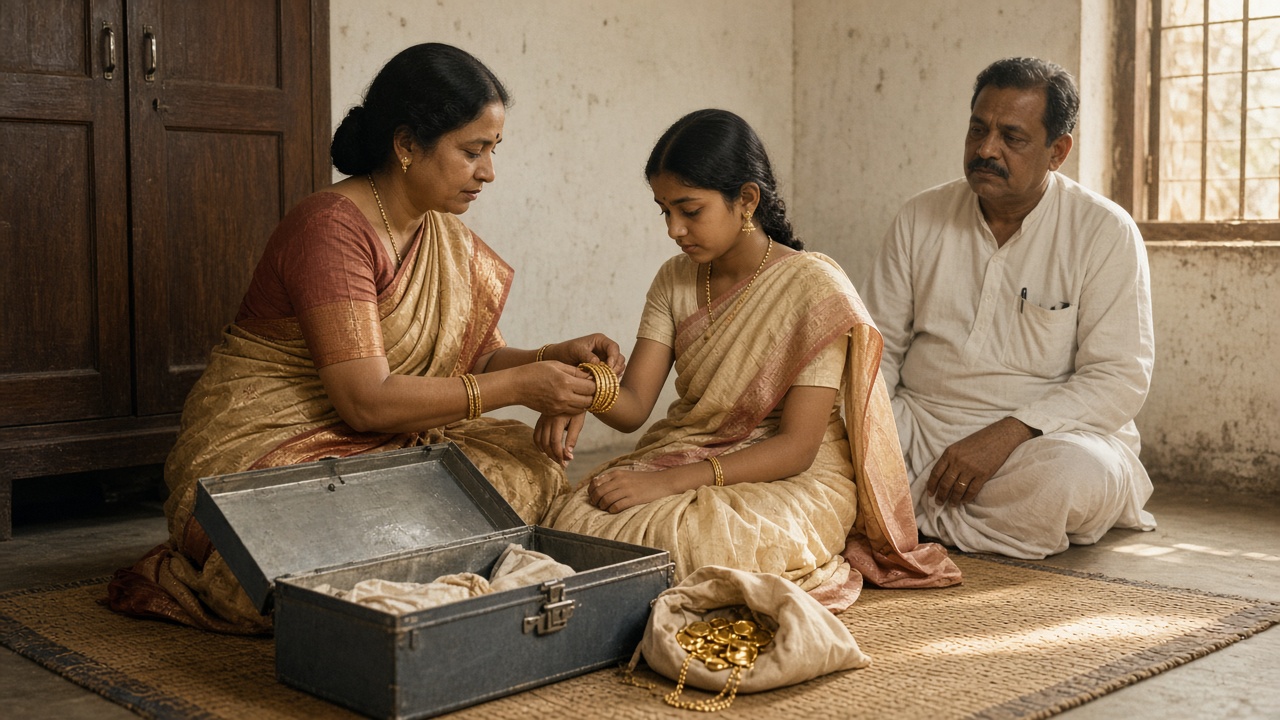
In the 1950s gold was the family bank. Mothers passed bangles, chains, and necklaces to daughters, the family goldsmith made new pieces to order, and gold kept in trunks or pawned in hard times was the safety net for millions of households.
A mother passes heirloom gold bangles to her daughter before a wedding (artistic illustration).
1950s: Married women wear gold bangles, chains, and mangalsutras daily, with silver anklets and toe rings; gold is saved for weddings and passed down as stridhan.
1962: During the war with China, citizens donate gold ornaments to the National Defence Fund, and the government issues gold bonds to collect gold.
1963: Gold Control Rules try to curb gold demand, for a time limiting new jewellery to 14 carat gold; the unpopular rule is relaxed in 1966.
1968: The Gold (Control) Act licenses goldsmiths and dealers and limits how much gold they can hold; many traditional goldsmiths lose their livelihood.
Technology
Hand tools: Blowpipe, hammer, and anvil.
Balance scales: Weighing in tolas.
Touchstone test: Checking purity.
Features
Family bank: Gold as savings.
Made to order: Local sunar.
Passed down: Mother to daughter.
✨ Artificial1970 – 1989
Artificial & Imitation Jewellery
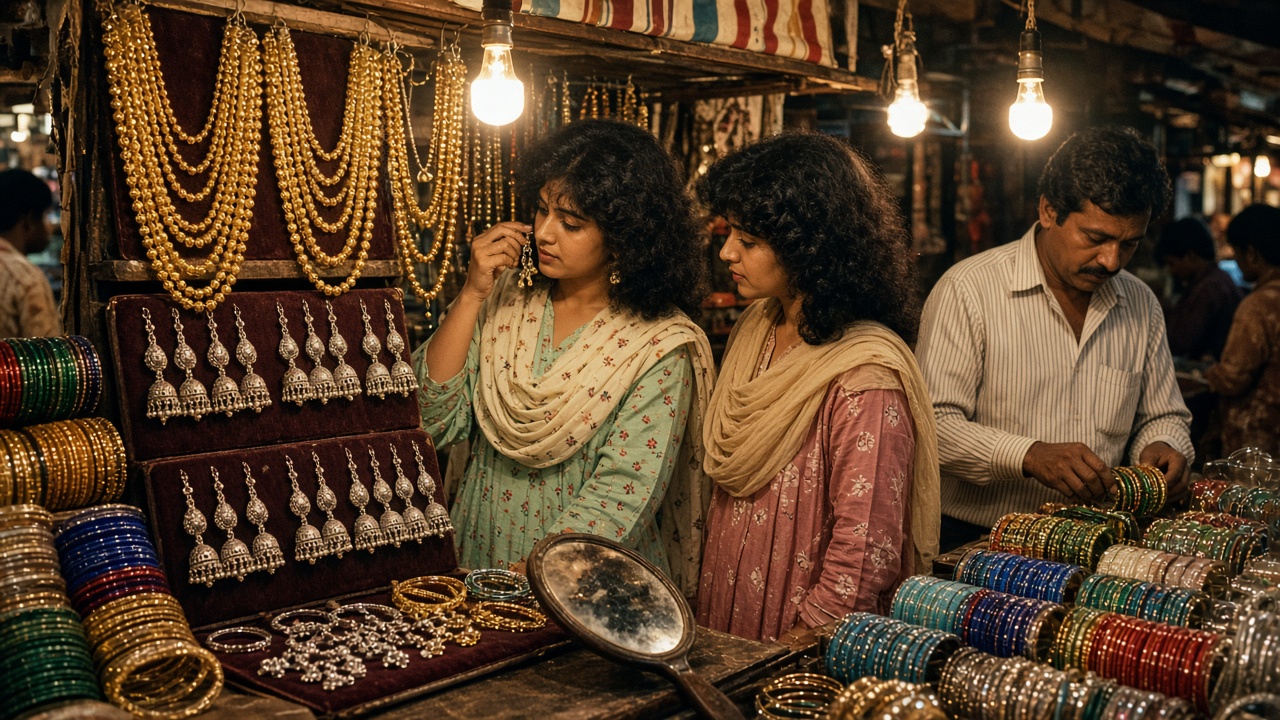
As world gold prices soared in the 1970s, gold-plated “one-gram gold”, American diamonds, and fashion jewellery let women match every outfit without buying gold. Real gold was often kept safe in bank lockers while imitation pieces were worn for travel and daily life.
One-gram gold, oxidised jhumkas, and glass bangles at a market stall (artistic illustration).
1970s: After world gold prices are freed, gold becomes far costlier; import curbs also make gold smuggling a big business.
1970s–1980s: Gold-plated imitation jewellery grows, with Machilipatnam (Andhra Pradesh) famous for one-gram gold and Rajkot (Gujarat) for imitation jewellery.
1980s: “American diamonds” (cubic zirconia) give the sparkle of diamonds at a tiny price; film heroines popularise matching costume jewellery.
1980s: Glass bangles from Firozabad, lac bangles from Hyderabad and Jaipur, and oxidised silver become everyday favourites.
Technology
Electroplating: Gold coat on brass or copper.
Cubic zirconia: Lab-made sparkle.
Machine chains: Mass production.
Features
Affordable: Match every outfit.
Safe to wear: Real gold in lockers.
Film fashion: Costume looks.
🏬 Branded1990 – 2009
Branded Showrooms & Hallmarking
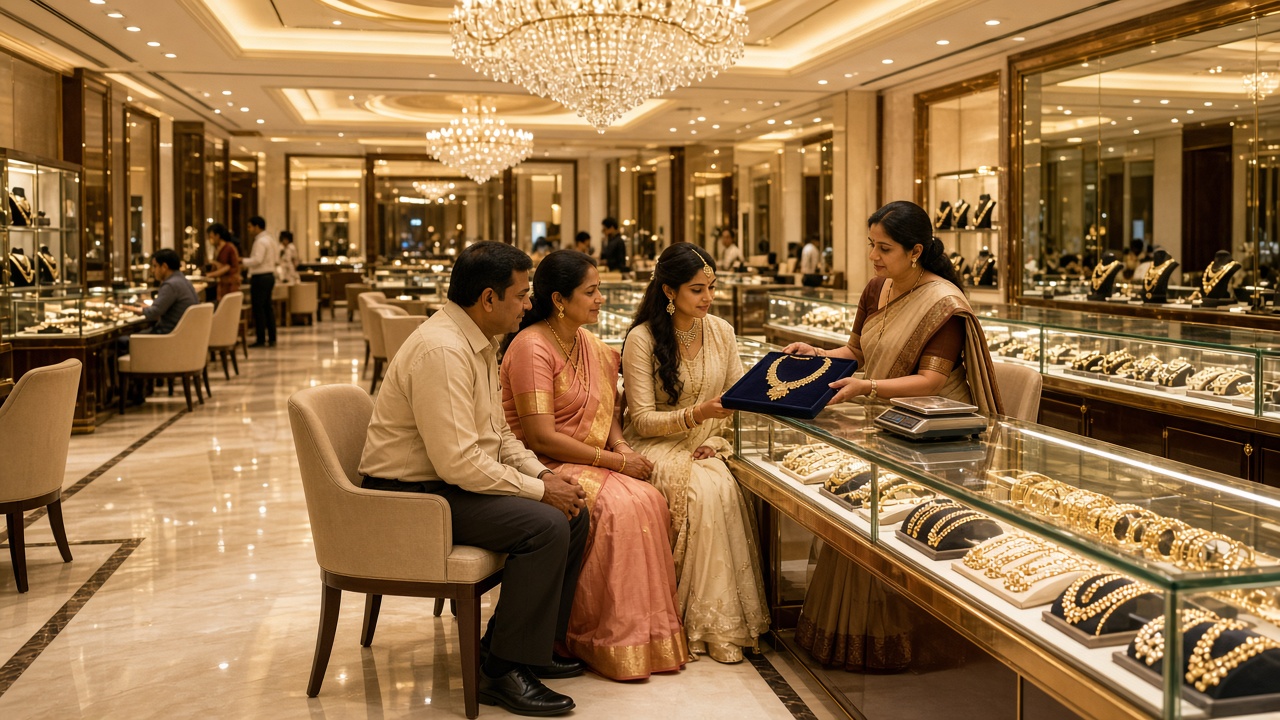
With gold control scrapped and imports eased, jewellery moved from small shops to big, bright showrooms with fixed prices, purity guarantees, and exchange offers. Hallmarking began, diamonds became more common, and festivals like Akshaya Tritiya turned into major gold-buying days.
A family chooses wedding jewellery in a branded showroom (artistic illustration).
1990: The Gold (Control) Act is repealed; through the 1990s gold import rules are eased, cutting smuggling.
1993–1994: Kalyan Jewellers (Thrissur) and Malabar Gold (Kozhikode) start in 1993, and Titan founds Tanishq in 1994 as a national jewellery brand.
2000: The Bureau of Indian Standards (BIS) starts voluntary hallmarking of gold jewellery; silver hallmarking follows in 2005.
2000s: Diamond jewellery spreads to the middle class, big chains expand across states, and in 2007 India’s first gold exchange-traded funds (ETFs) are launched.
Technology
Karatmeters (XRF): Instant purity tests.
Digital scales: Exact weights.
CAD design: Computer-made patterns.
Features
Trust: Hallmarked purity.
Exchange offers: Old gold for new.
Showrooms: Fixed, displayed prices.
💫 Minimal2010 – 2019
Minimal Everyday & Online Jewellery
Working women wanted light pieces they could wear to the office, so thin chains, studs, and small diamond pendants in 18 and 14 carat gold took off. Jewellery was bought online with try-at-home services, and the government offered new ways to own gold without jewellery.
A thin chain, studs, and a slim bracelet — minimal jewellery for work (artistic illustration).
2008–2011: Online jewellers such as CaratLane (2008) and BlueStone (2011) start selling jewellery on the internet, later adding try-at-home services.
2015: The government launches Sovereign Gold Bonds and the Gold Monetisation Scheme to reduce physical gold imports.
2016: Tanishq launches Mia, a lightweight everyday jewellery brand for working women; rose gold and 14 carat pieces become popular.
2010s: Oxidised silver and tribal-style pieces pair with kurtas, and men’s chains, kadas, and studs grow.
Technology
E-commerce: Buy with a click.
Virtual try-on: See it on screen.
Lightweight casting: Hollow and thin designs.
Features
Everyday wear: Office-friendly.
Lower carat: 18K and 14K gold.
Gold without jewellery: Bonds and ETFs.
🔬 Lab-Grown2020s – Future
Lab-Grown Diamonds & Digital Gold
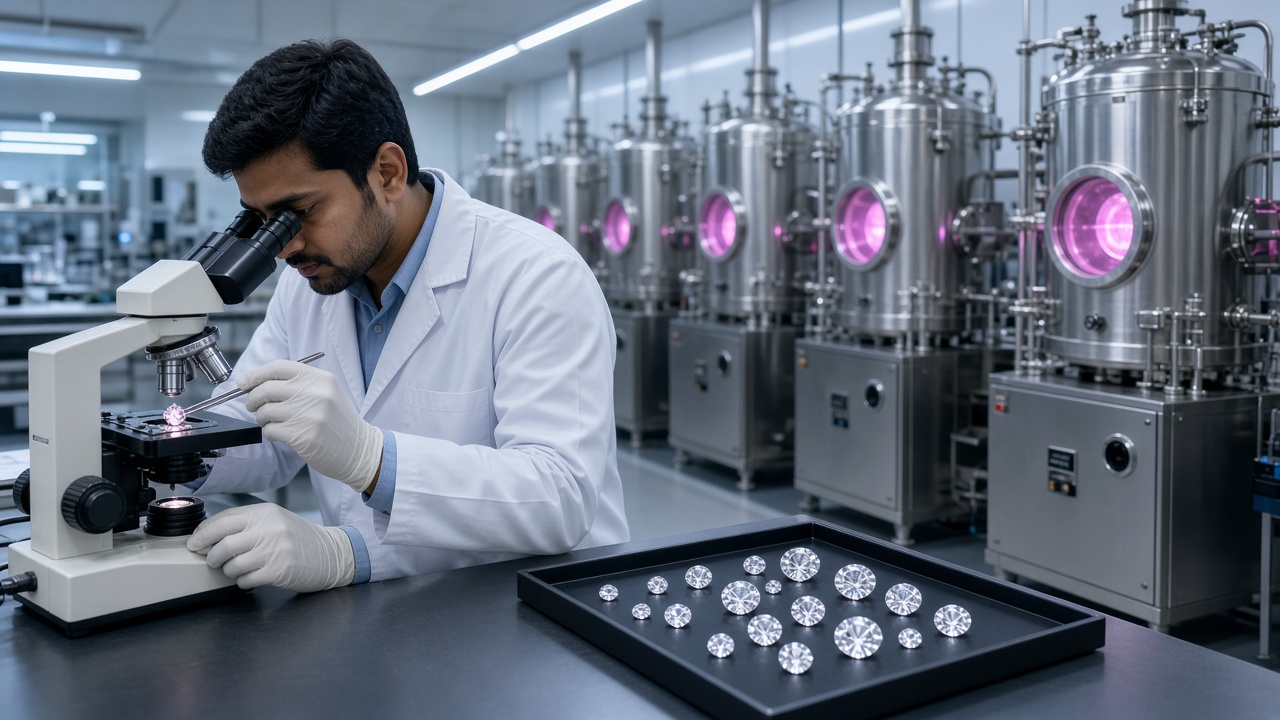
In the 2020s every piece of gold jewellery sold by a jeweller must carry a hallmark with a unique code. Lab-grown diamonds — real diamonds grown in weeks — make diamond jewellery far more affordable, and India, led by Surat, has become a major producer. Gold can now be bought in rupee-sized amounts on phone apps.
CVD reactors grow real diamonds in weeks (artistic illustration).
2021: BIS hallmarking becomes mandatory for gold jewellery from 16 June 2021, starting in 256 districts.
2023: From 1 April, every hallmarked gold piece must carry a 6-digit HUID code that buyers can verify on the BIS Care app.
2023: The Union Budget announces support for lab-grown diamond research at an IIT and cuts customs duty on diamond “seeds”; Surat becomes a major lab-grown hub.
2020s–Future: Digital gold on payment apps, recycled gold, 3D-printed designs, and traceable, certified stones shape the next chapter.
Technology
CVD and HPHT: Growing diamonds.
HUID codes: Verify on an app.
3D printing: Complex designs.
Features
Affordable diamonds: Real, not mined.
Transparent purity: Every piece coded.
Gold in rupees: Digital buying.
Traditional Jewellery Styles of India
Style or piece
Region
What makes it special
Temple jewellery
Tamil Nadu, Kerala
Gold with gods, goddesses, and temple motifs
Kundan
Rajasthan
Stones set in layers of pure gold foil
Meenakari
Jaipur, Rajasthan
Colourful enamel on gold
Polki
Rajasthan, North India
Uncut natural diamonds
Thewa
Pratapgarh, Rajasthan
Gold sheet designs fused on coloured glass
Filigree (tarakasi)
Cuttack, Odisha
Fine silver wire lace work
Kasu mala
South India
Necklace of gold coins
Nath
Maharashtra and North India
Large bridal nose ring
Mangalsutra
Across India
Black-bead and gold necklace of marriage
Glass and lac bangles
Firozabad, Hyderabad, Jaipur
Colourful, affordable, festive
Gold Purity & Hallmark Guide
Grade
Purity mark
Gold content
Common use
24 carat
999
99.9%
Coins and bars (too soft for most jewellery)
22 carat
916
91.6%
Traditional Indian jewellery
18 carat
750
75%
Diamond and gemstone jewellery
14 carat
585
58.5%
Lightweight everyday jewellery
Sterling silver
925
92.5% silver
Silver jewellery and anklets
BIS hallmark
BIS logo + purity + HUID
—
Proof of purity on every piece
Mined Diamond vs Lab-Grown vs American Diamond
Feature
Mined diamond
Lab-grown diamond
American diamond (CZ)
Made of
Carbon
Carbon
Zirconium dioxide
How it forms
Deep in the earth over billions of years
Grown in weeks by CVD or HPHT
Melted and crystallised in a factory
Real diamond?
Yes
Yes
No (a simulant)
Hardness (Mohs)
10
10
About 8–8.5
Price
Highest
Much lower than mined
Very low
How to identify
Lab certificate
Lab testing and certificate
Simple diamond tester
From Sunar to App: How Indians Buy Jewellery
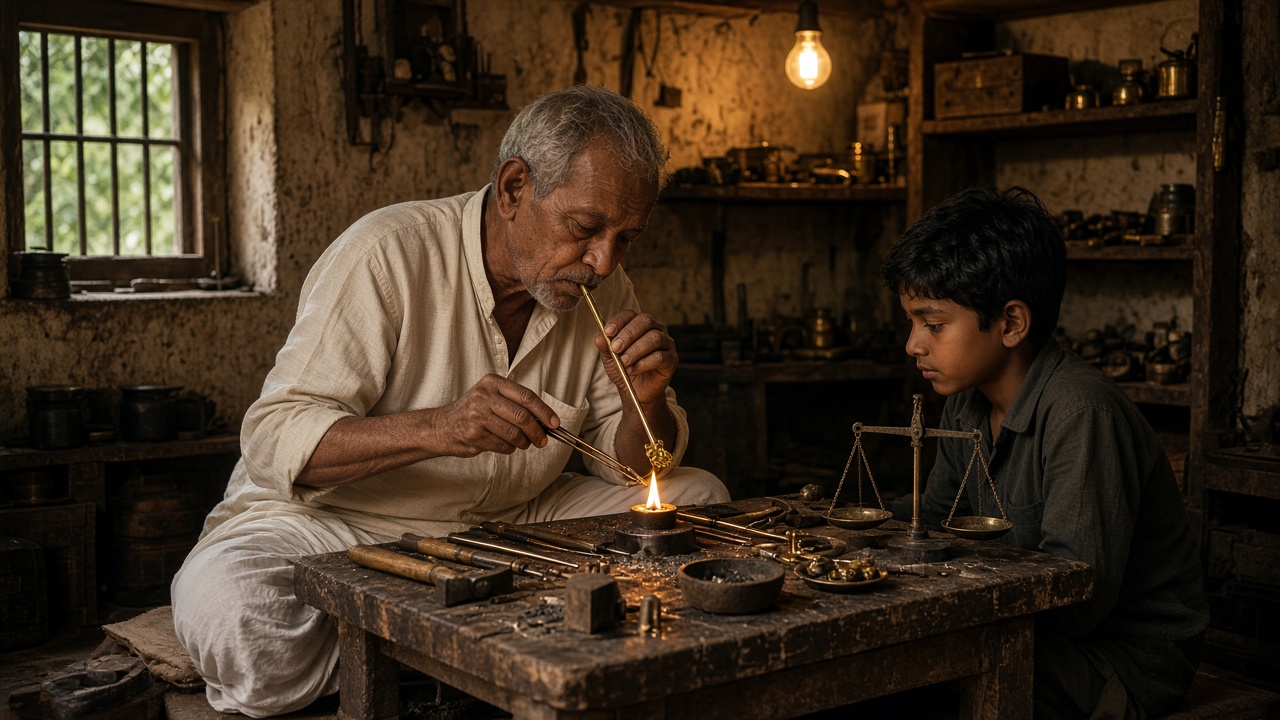
A sunar solders gold with a blowpipe, a skill passed down generations (artistic illustration).
Way to buy
Where
What you get
Common from
Family sunar
Goldsmith’s workshop
Pieces made to order
Centuries old
Bazaar jeweller
Local market shop
Ready pieces, gold on credit
Early 1900s
Imitation stall
Street markets and fairs
One-gram gold, bangles, fashion pieces
1970s–1980s
Branded showroom
City high streets and malls
Fixed prices, hallmarks, exchange
1990s–2000s
Online jeweller
Websites and apps
Try-at-home, certified diamonds
2010s
Gold ETFs and bonds
Stock exchange or bank
Gold investment without jewellery
2007 and 2015
Digital gold
Payment apps
Gold from one rupee, stored in a vault
Late 2010s–2020s
Jewellery Timeline Summary
Year / Era
Milestone
c. 2600–1900 BCE
Harappan gold ornaments and carnelian beads
Up to the 1720s
India, via Golconda, is the world’s main diamond source
Medieval era
South Indian temple jewellery
16th–17th centuries
Kundan and meenakari in Mughal and Rajput courts
1950s
Gold heirlooms as family savings
1962
Gold donated for national defence
1963
Gold Control Rules
1968
Gold (Control) Act
1970s–1980s
One-gram gold and American diamonds
1990
Gold (Control) Act repealed
1993–1994
Kalyan, Malabar Gold, and Tanishq begin
2000
BIS voluntary gold hallmarking
2007
First gold ETFs in India
2008–2011
Online jewellers CaratLane and BlueStone
2015
Sovereign Gold Bonds and Gold Monetisation Scheme
2016
Lightweight everyday brands such as Mia
2021
Mandatory hallmarking begins
2023
6-digit HUID mandatory; lab-grown diamond push
2020s
Lab-grown diamonds and digital gold
Test Your Knowledge
20 quick questions from the jewellery timeline. Click each question to reveal the answer.
Answer: Carnelian.
Answer: Golconda (in present-day Andhra Pradesh and Telangana).
Answer: The Koh-i-Noor.
Answer: Jewellery with stones set in layers of pure gold foil.
Answer: Colourful enamel work on metal, famous in Jaipur.
Answer: A woman’s own wealth, often in the form of jewellery.
Answer: A traditional goldsmith.
Answer: To help the National Defence Fund during the war with China.
Answer: 1968.
Answer: Brass or copper jewellery with a thin gold plating.
Answer: Machilipatnam.
Answer: Cubic zirconia (zirconium dioxide), not carbon.
Answer: Firozabad.
Answer: 1990.
Answer: Titan.
Answer: 22 carat gold, about 91.6% pure.
Answer: The Bureau of Indian Standards (BIS).
Answer: Six (alphanumeric).
Answer: Yes — it is carbon with the same hardness and sparkle as a mined diamond.
Answer: Surat.
Classroom activity
Students Tasks
Use these prompts for discussion or projects on how Indian jewellery and gold buying changed over time.
Timeline understandingCulture and heritageEconomics of goldScience of materials
Ask your grandparents about a family heirloom and the story behind it.
Make a timeline poster: heirlooms (1950s), artificial (1980s), branded (2000s), minimal (2010s), and lab-grown (2020s).
Collect pictures of five traditional jewellery styles and mark their regions on a map of India.
Explain what 24, 22, 18, and 14 carat mean using a simple pie chart for each.
Find out what a BIS hallmark and HUID code look like, and how to check one on the BIS Care app.
Interview a local jeweller or goldsmith about how their work has changed.
Compare a mined diamond, a lab-grown diamond, and an American diamond in a chart.
Discuss why Indian families have long treated gold as savings.
Research the Golconda diamond mines and famous diamonds that came from India.
Debate: “Lab-grown diamonds are better than mined diamonds.”
Continue exploring
Jewellery is tied to banking, money, and digital services in India. Explore these connected timelines next.
Click any panel to expand and explore the visual mood.
India’s jewellery journey in pictures — temple gold and kundan, 1950s heirlooms, 1980s imitation stalls, branded showrooms, minimal everyday pieces, lab-grown diamonds, the traditional goldsmith, and then versus now.
Temple & Kundan
Heritage craft
1950s Heirlooms
Mother to daughter
1980s Artificial
One-gram gold
Branded Showroom
Hallmarked trust
Minimal Jewellery
Office everyday
Lab-Grown Diamonds
Grown in weeks
The Goldsmith
Blowpipe and flame
Then vs Now
Heirlooms to lab-grown
Explore all daily life timelines
Jump to any other daily life timeline on WorldTimelineHub.
Disclaimer: This content is AI-generated for educational purposes and may contain errors or outdated details. For correct and authoritative information, please refer to official and reliable sources such as government publications, manufacturers, museums, and academic references.