Old Kitchens vs Modern Kitchens: Timeline of India
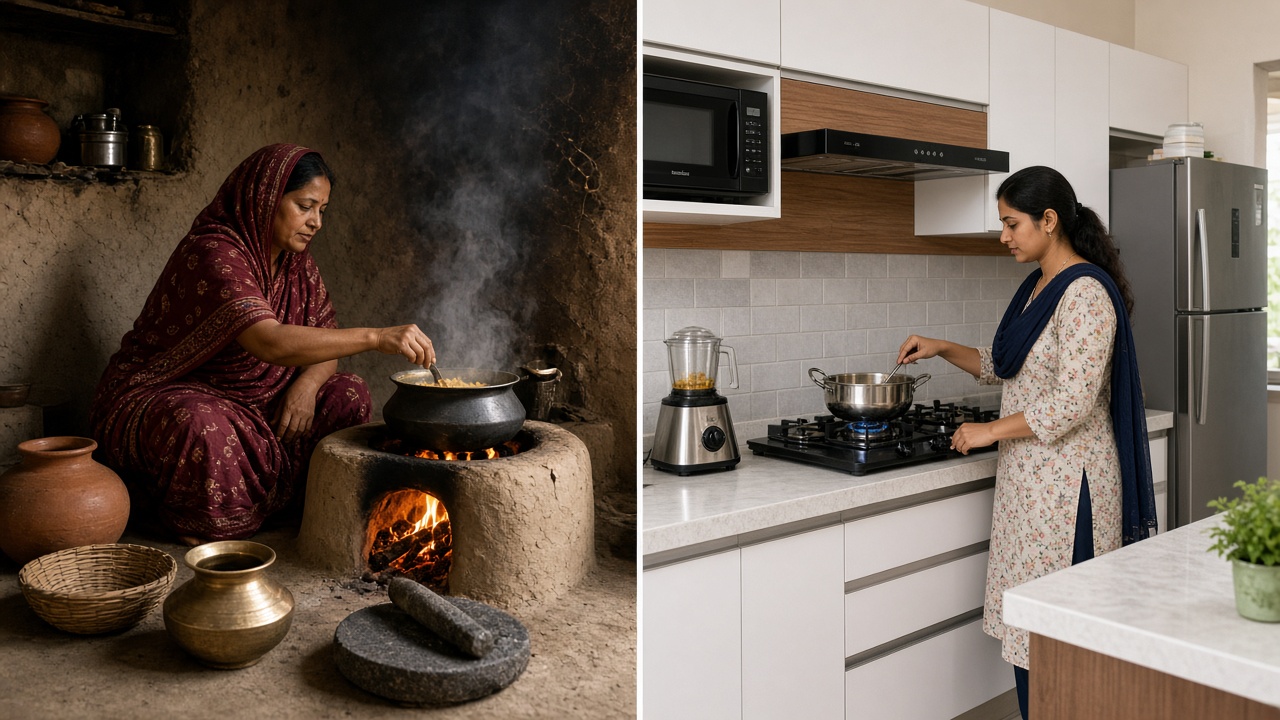
For thousands of years the Indian kitchen was a smoky corner with a mud chulha, stone grinders, and clay and brass pots, where women cooked sitting on the floor. In a few
decades it has become a bright space with gas stoves, pressure cookers, mixer-grinders, refrigerators, chimneys, and apps that deliver groceries in minutes.
This timeline covers Harappan clay ovens and grinding stones, the sacred rasoi, royal and temple kitchens, the Sikh langar, colonial cookhouses and imported ice, Dalda and
kerosene stoves, stainless steel, pressure cookers, LPG and refrigerators, the mixer-grinder, modular kitchens, Ujjwala gas connections, and smart appliances.
The kitchen shows how a society lives. Changes in fuel, tools, and appliances have saved Indian families — mostly women — many hours of grinding, fetching wood, and
tending smoky fires every day. Cleaner fuel has reduced household air pollution, refrigerators and cold chains have cut food waste, and new appliances have changed what
and how India eats. At the same time, many traditional tools and methods are being rediscovered for their taste and health benefits.
Big picture
The Indian kitchen in one view
Wood-fired chulhas, stone grinders, and clay pots served India for thousands of years. Brass, copper, and later aluminium vessels arrived, then stainless steel,
pressure cookers, and LPG after independence. Fridges and mixer-grinders spread from the 1980s, modular kitchens from the late 1990s, and free LPG connections
reached village homes from 2016. Related timelines:
electricity in India,
cooking oils,
milk and dairy.
~49%
Homes cooking with firewood, 2011
~33 crore
LPG connections, 2024
10 crore+
Free Ujjwala connections
~59%
Homes on clean fuel, NFHS-5
From cooking on the floor at a smoky chulha to standing at a gas hob with a chimney (artistic illustration).
Old Kitchen vs Modern Kitchen at a Glance
Feature
Old kitchen
Modern kitchen
Fuel
Wood, cow-dung cakes, crop waste, coal
LPG, piped natural gas, electricity
Stove
Mud chulha, coal angithi, tandoor
Gas stove, glass-top hob, induction cooktop
Cooking position
Sitting on the floor
Standing at a platform or counter
Grinding
Sil-batta, okhli-musal, hand chakki
Mixer-grinder, wet grinder, food processor
Vessels
Clay, brass, copper, bell-metal, iron
Stainless steel, non-stick, aluminium, cast iron
Cooling
Earthen matka, cool corners, pickling and drying
Refrigerator, freezer, bottled water coolers
Water
Carried from wells, ponds, or handpumps
Taps with RO and UV purifiers
Smoke
Smoky room, blackened walls
Chimney or exhaust fan
Storage
Clay jars, jute sacks, brass dabbas
Airtight containers, modular cabinets
Shopping
Weekly haat, local grocer, home-grown
Supermarkets, online and 10-minute delivery
Time spent
Many hours a day, mostly by women
Much less, shared more often within families
🏺 Ancient HearthsAncient – 1200
Hearths, Clay Pots & Grinding Stones
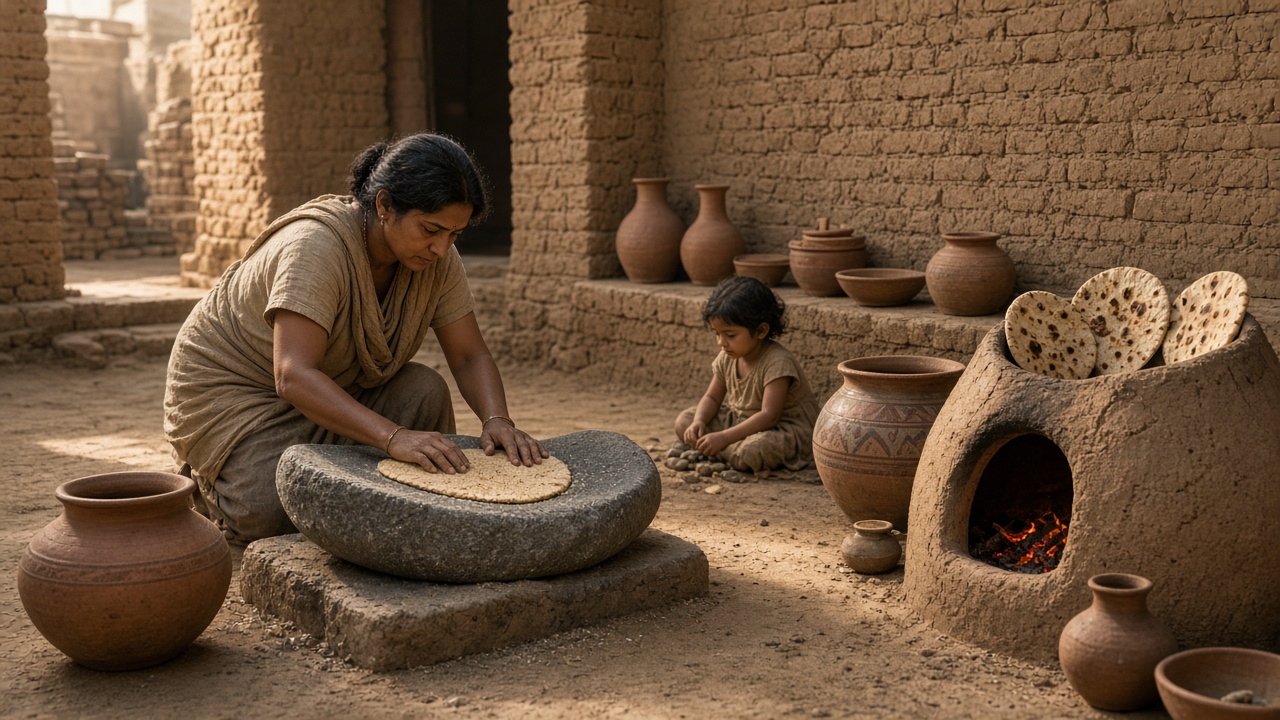
The earliest Indian kitchens were built around a fire. Harappan homes had clay ovens and grinding stones, and later households cooked on mud hearths with clay and copper pots. The kitchen, or rasoi, was often treated as a clean and even sacred space.
Harappan families ground grain on saddle querns and baked in clay ovens (artistic illustration).
c. 2600–1900 BCE: Harappan homes have hearths, tandoor-like clay ovens, saddle querns for grinding grain, and large storage jars for grain and oil.
Vedic period: The household fire (agni) is central to home and ritual; food is cooked in clay pots, and milk, ghee, barley, and rice are staples.
Ancient period: Stone tools such as the sil-batta, okhli-musal (mortar and pestle), and hand chakki become standard; ayurvedic texts link food to health.
Early medieval: Copper and bell-metal (kansa) vessels spread in richer homes; many households keep the rasoi clean and remove footwear before entering.
Technology
Clay ovens: Baking flatbreads.
Stone grinders: Querns and sil-batta.
Earthen pots: Cooking and storage.
Features
Floor cooking: Sitting by the fire.
Sacred space: The clean rasoi.
Hard labour: Daily grinding by hand.
👑 Royal & Temple1200 – 1757
Royal Kitchens, Temple Hearths & Langar
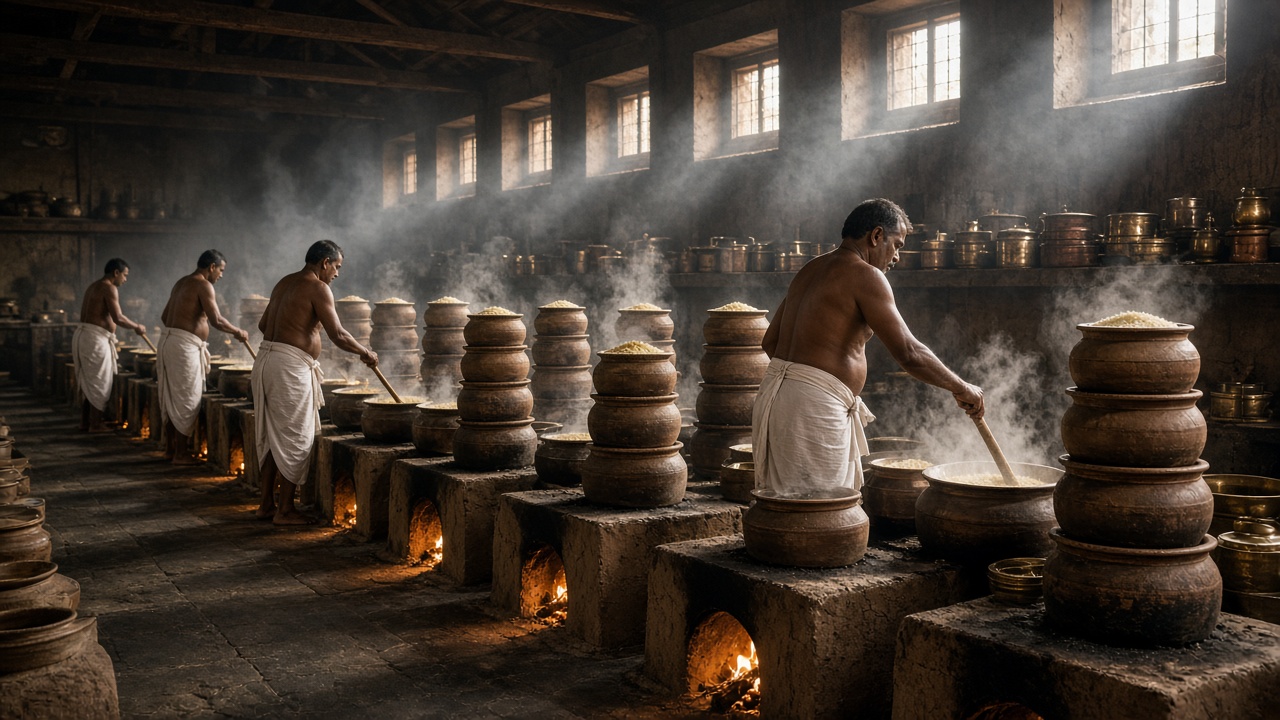
Kings ran huge organised kitchens, temples cooked for thousands of devotees on rows of wood-fired hearths, and the Sikh langar fed everyone together. Brass and copper utensils became prized, and new crops from the Americas changed Indian cooking.
Great temple kitchens still cook in stacked clay pots over wood fires (artistic illustration).
12th century onward: Great temple kitchens, such as the one at Puri’s Jagannath temple, cook for thousands daily in clay pots stacked over wood-fired hearths.
16th century: Guru Nanak starts the langar, a free community kitchen where everyone sits and eats together; the tradition continues in every gurdwara.
16th century: The Portuguese bring chillies, potatoes, and tomatoes; the Ain-i-Akbari describes Emperor Akbar’s well-organised royal kitchen department.
17th–18th centuries: Brass, copper, and bell-metal utensils are common in well-off homes; copper pots are coated with tin (kalai) to make them safe.
Technology
Stacked clay pots: Cooking many dishes at once.
Kalai tinning: Safe copper vessels.
Dum cooking: Sealed pots on slow fire.
Features
Mass cooking: Temples and langars.
Metal utensils: Brass and copper.
New ingredients: Chillies and potatoes.
🧊 Cookhouses1757 – 1946
Cookhouses, Kerosene & Imported Ice
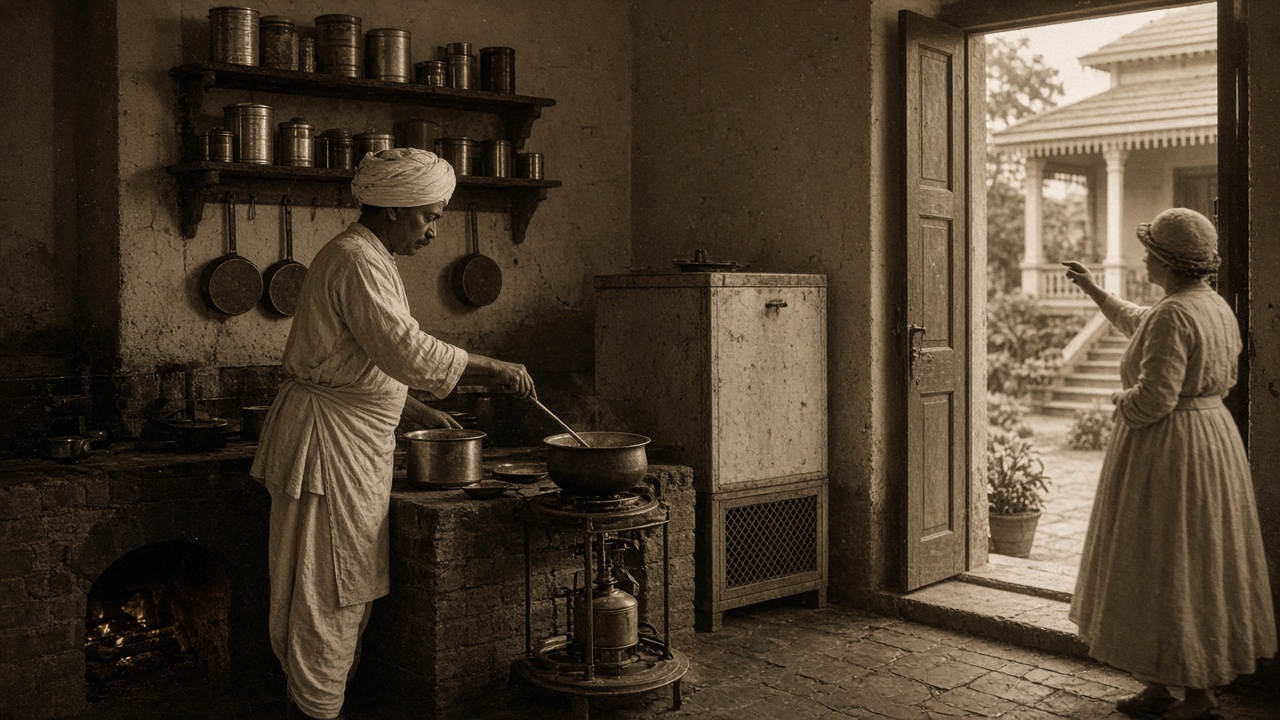
Colonial bungalows had separate cookhouses run by Indian cooks. Ice shipped from America, kerosene stoves, aluminium utensils, tinned foods, and vanaspati ghee slowly entered city kitchens, while village kitchens stayed much the same.
Colonial cookhouses mixed brick hearths with kerosene stoves and ice boxes (artistic illustration).
Late 1700s–1800s: British bungalows keep the cookhouse (bawarchi-khana) separate from the main house; Indian cooks (khansamas) create Anglo-Indian dishes.
1833: The first shipment of natural ice from America reaches Calcutta; ice houses supply the rich until ice factories spread later in the century.
Late 1800s–1920s: Kerosene lamps and pressure stoves reach towns; cheap aluminium utensils begin to replace some brass and clay vessels.
1930s–1940s: Dalda vanaspati (1937), tinned foods, and packaged tea enter city kitchens; most rural homes still cook on chulhas with wood and cow-dung cakes.
Technology
Kerosene stoves: Faster city cooking.
Ice boxes: Early cold storage.
Aluminium vessels: Light and cheap.
Features
Separate cookhouse: In bungalows.
Packaged foods: Tins and vanaspati.
Rural continuity: The chulha stays.
🔥 Gas & Steel1947 – 1990
Pressure Cookers, LPG & Stainless Steel
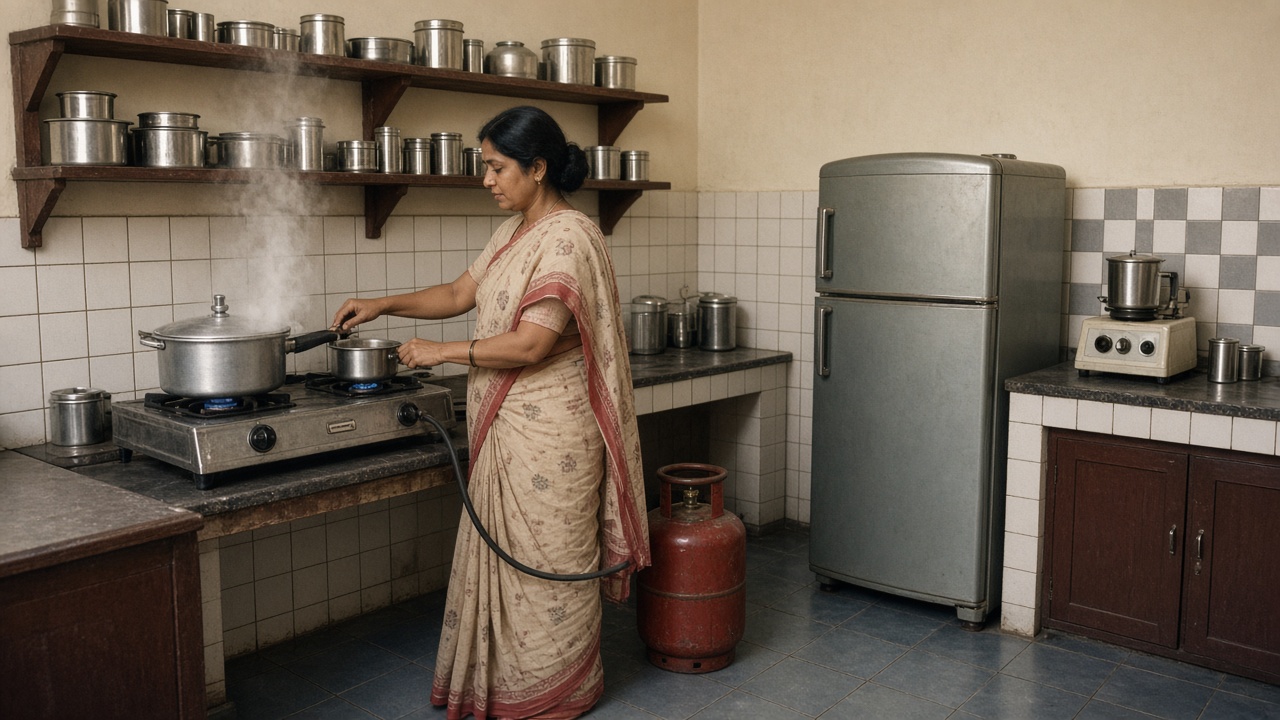
After independence, Indian companies began making pressure cookers, refrigerators, and mixer-grinders, and LPG cylinders arrived in cities. Shining stainless steel replaced brass in most homes, and the middle-class kitchen moved from the floor to a raised platform.
The whistle of the pressure cooker became the sound of the Indian kitchen (artistic illustration).
1958–1959: Godrej makes India’s first indigenous refrigerator (1958); Indian companies such as Hawkins and Prestige begin making pressure cookers in the late 1950s.
1963: Satya Prakash Mathur launches the Sumeet mixer-grinder, built for tough Indian grinding such as idli batter and spice pastes.
1965: Indian Oil launches Indane LPG with the first connections in Calcutta; gas slowly spreads to other cities over the next decades.
1970s–1980s: Stainless steel replaces brass in most homes; standing platforms, tiled walls, and fridges appear in city kitchens.
Technology
Pressure cooker: Faster dal and rice.
LPG stove: Smoke-free flame.
Mixer-grinder: End of the sil-batta.
Features
Steel everywhere: Easy to clean.
Standing platform: New layout.
Long waits: For gas connections.
🏠 Modular1991 – 2014
Microwaves, Chimneys & Modular Kitchens
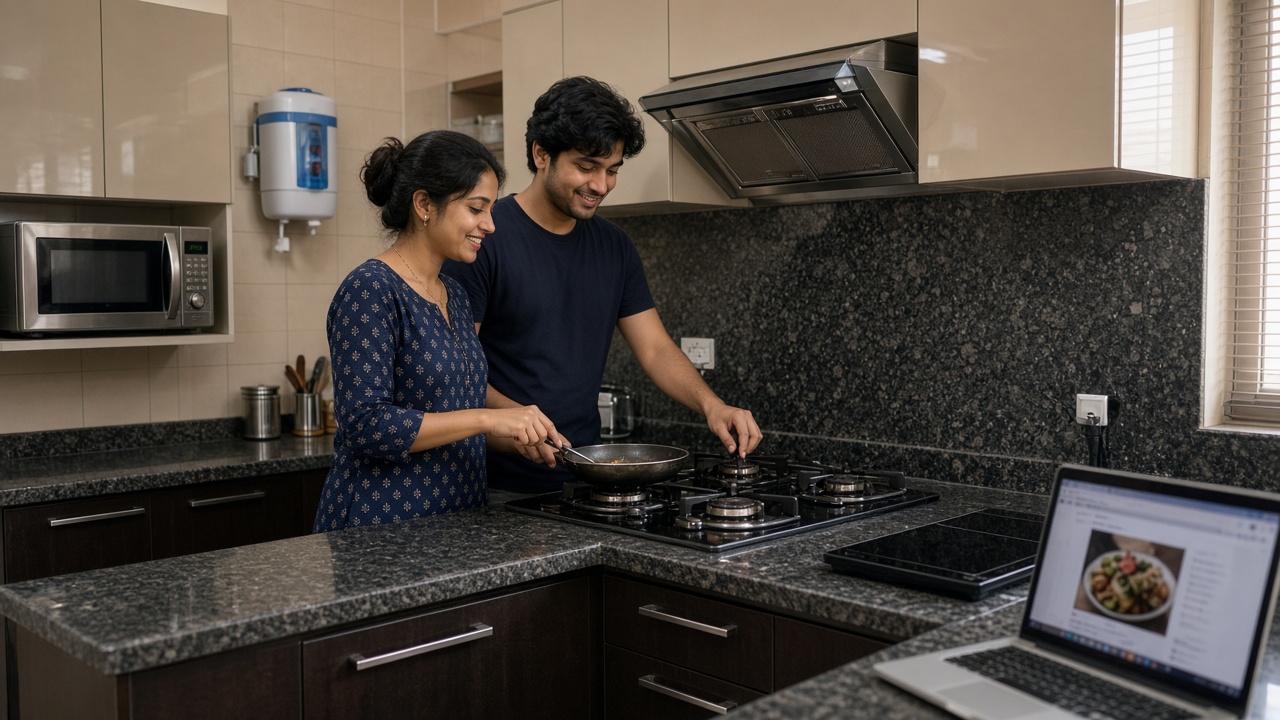
After economic reforms, global brands brought microwave ovens, chimneys, water purifiers, and induction cooktops. Urban apartments got modular kitchens, and online grocery and food delivery apps began to change how families shop and eat.
Modular kitchens with chimneys and built-in appliances spread in Indian cities (artistic illustration).
1990s: Liberalisation brings microwave ovens, frost-free fridges, and global appliance brands; many more city homes get LPG connections.
Late 1990s–2000s: Modular kitchens, electric chimneys, and granite counters become popular in new apartments; RO water purifiers spread.
2000s: Induction cooktops, non-stick cookware, and electric kettles become common; cooking shows and recipe websites inspire new dishes.
2011–2014: Online grocery and food delivery apps appear in big cities; Census 2011 still finds about half of households cooking with firewood.
Technology
Microwave ovens: Reheating and baking.
Electric chimneys: Removing smoke and grease.
RO purifiers: Safe drinking water.
Features
Modular design: Cabinets and counters.
Global brands: More choice.
Urban–rural gap: Villages still on chulhas.
✨ Smart Kitchens2015 – Present
Ujjwala, Smart Appliances & Quick Commerce
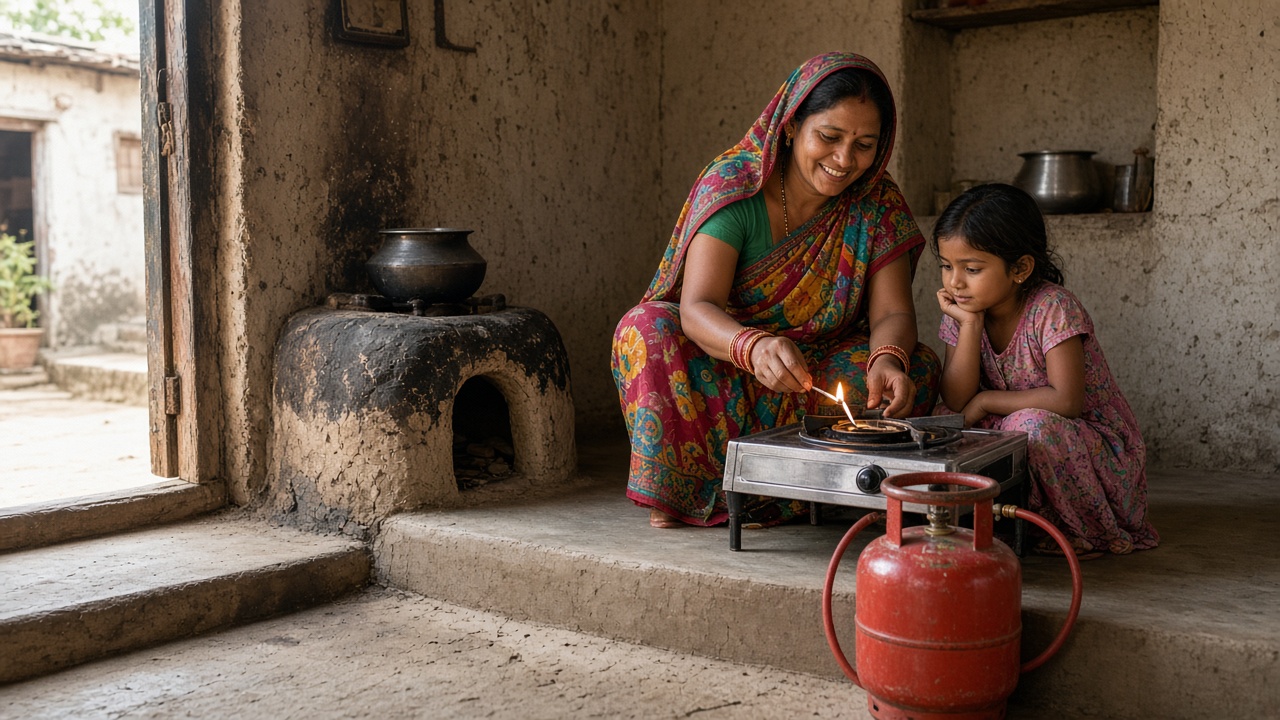
Free LPG connections brought clean cooking gas to crores of village homes. City kitchens added air fryers, smart appliances, and piped gas, while 10-minute delivery apps and cloud kitchens changed shopping and eating. Many families also returned to millets, cast iron, and clay pots.
Ujjwala connections helped village women switch from smoky chulhas to LPG (artistic illustration).
2015: LPG subsidy moves to direct bank transfers (PAHAL), and the “Give It Up” campaign asks better-off families to give up their subsidy.
2016–2019: The Pradhan Mantri Ujjwala Yojana gives free LPG connections to women from poor households; the target of 8 crore is met in 2019.
2020–2022: Ujjwala 2.0 (2021) adds more connections; piped natural gas spreads in cities; Indian Oil unveils the Surya Nutan indoor solar cooktop (2022).
2023–present: The International Year of Millets revives traditional grains; quick-commerce apps deliver groceries in minutes; Ujjwala crosses 10 crore connections.
Technology
Smart appliances: App-controlled cooking.
Piped gas and induction: No cylinders.
Solar cooktops: Clean indoor cooking.
Features
Clean fuel: LPG in villages.
Instant groceries: Quick commerce.
Back to roots: Millets and cast iron.
Traditional Kitchen Tools and Their Modern Replacements
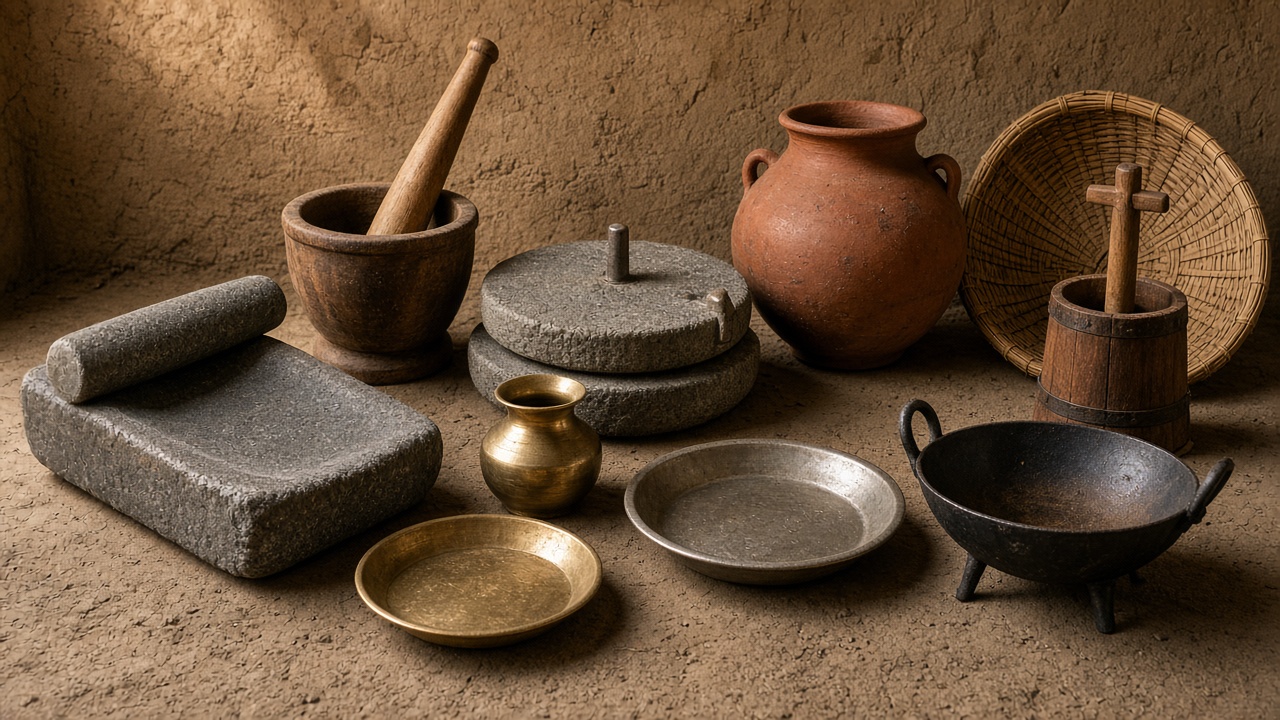
Sil-batta, okhli, chakki, matka, supa, and churn — the tools of the old Indian kitchen (artistic illustration).
Traditional tool
What it did
Modern replacement
Chulha
Mud stove burning wood or dung cakes
Gas stove, induction cooktop
Angithi
Coal brazier for cooking and warmth
Gas hob, room heater
Sil-batta
Grinding spices and chutneys
Mixer-grinder
Okhli-musal
Pounding grain and spices
Food processor, packaged spices
Hand chakki
Milling flour at home
Flour mill, packaged atta
Ammikal and aattukal
South Indian grinding stones for batter
Electric wet grinder
Mathani (churn)
Churning curd into butter and buttermilk
Hand blender, packaged butter
Supa (winnowing basket)
Cleaning grain
Machine-cleaned packaged grain
Matka
Cooling drinking water
Refrigerator, water cooler
Bonti
Bengali floor-mounted cutting blade
Kitchen knife and chopping board
Cooking Fuel in Indian Homes
Year / survey
What it found
1965
First Indane LPG connections in Calcutta
Census 2011
About 49% of households used firewood, 29% LPG, 9% crop residue, 8% cow-dung cakes, and 3% kerosene
2014
About 14 crore LPG connections in India
2016
Pradhan Mantri Ujjwala Yojana begins
2019
8 crore Ujjwala connections given
NFHS-5 (2019–21)
About 59% of households use clean cooking fuel
2024
About 33 crore LPG connections; more than 10 crore under Ujjwala
Figures are rounded. Having an LPG connection does not always mean a family uses gas for all its cooking — refill costs keep some homes partly on firewood.
Traditional Kitchens Across India
Region
Traditional kitchen feature
Punjab
Clay tandoor and the shared village oven (sanjha chulha)
Rajasthan
Outdoor clay chulhas and bajra rotis on iron tawas
Bengal
The bonti blade and clay ovens for fish and rice
Kerala
Wood-fired hearths, bell-metal uruli, and banana-leaf meals
Tamil Nadu
Ammikal and aattukal grinding stones, brass vessels
North-East
Bamboo racks above the hearth for smoking and drying meat and fish
Kashmir
Copper samovar for kahwa and wazwan cooked by professional chefs
Gujarat
Brass and copper dabbas and a strong pickling tradition
Indian Kitchen Timeline Summary
Year / Era
Milestone
c. 2600–1900 BCE
Harappan clay ovens and saddle querns
Vedic period
Household fire at the heart of home
12th century onward
Great temple kitchens with stacked clay pots
16th century
Sikh langar begins; chillies and potatoes arrive
c. 1590s
Ain-i-Akbari describes Akbar’s royal kitchen
1833
First American ice shipment reaches Calcutta
1937
Dalda vanaspati launched
1958
First Indian-made refrigerator by Godrej
Late 1950s
Indian pressure cookers go on sale
1963
Sumeet mixer-grinder launched
1965
Indane LPG launched
1970s–1980s
Stainless steel replaces brass
1990s
Microwaves and global appliance brands
Late 1990s–2000s
Modular kitchens and chimneys
2011
About half of homes still cook with firewood
2015
PAHAL and “Give It Up” LPG reforms
2016
Pradhan Mantri Ujjwala Yojana
2021
Ujjwala 2.0
2022
Surya Nutan indoor solar cooktop unveiled
2023
International Year of Millets
Test Your Knowledge
20 quick questions from the old versus modern kitchens timeline. Click each question to reveal the answer.
Answer: A traditional mud or brick stove that burns wood, crop waste, or cow-dung cakes.
Answer: Grinding grain into flour.
Answer: The flat stone slab (sil) and the stone roller (batta).
Answer: Rasoi.
Answer: Guru Nanak.
Answer: The Ain-i-Akbari.
Answer: To stop food reacting with the copper and make the pots safe to cook in.
Answer: Any two of chillies, potatoes, and tomatoes.
Answer: A separate cookhouse, usually behind the main house.
Answer: 1833.
Answer: Godrej.
Answer: Satya Prakash Mathur, in 1963.
Answer: Indane.
Answer: Stainless steel.
Answer: It sucks out smoke, steam, and grease from cooking.
Answer: About 49%, nearly half.
Answer: Free LPG connections for women from poor households.
Answer: It fills the home with smoke and fine particles that damage the lungs and eyes, especially of women and children.
Answer: An indoor solar cooktop unveiled by Indian Oil in 2022.
Answer: Any one of cast-iron kadais, clay pots, copper water bottles, or millets.
Classroom activity
Students Tasks
Use these prompts for discussion or projects on how Indian kitchens changed over time.
Timeline understandingEveryday technologyHealth and environmentOral history
Interview a grandparent about their childhood kitchen and write down five things that are different today.
Make a two-column chart comparing an old kitchen and a modern kitchen, with drawings.
List every appliance in your kitchen and find out when each one became common in India.
Explain how a pressure cooker cooks food faster.
Make a pie chart of household cooking fuels from the Census 2011 figures on this page.
Discuss how clean cooking fuel improves the health of women and children.
Collect pictures of five traditional kitchen tools and name their modern replacements.
Time how long it takes to grind chutney with a sil-batta and with a mixer, and compare.
Find out what fuel families in your area use for cooking and why.
Debate: “Traditional kitchens were healthier than modern kitchens.”
Continue exploring
Kitchens changed with electricity, cooking oils, milk, and vegetables. Explore these connected India timelines next.
Click any panel to expand and explore the visual mood.
The Indian kitchen in pictures — Harappan ovens, temple hearths, colonial cookhouses, 1970s gas stoves, modular kitchens, village LPG, traditional tools, and then versus now.
Harappan Hearth
Clay ovens and querns
Temple Kitchen
Stacked clay pots
Colonial Cookhouse
Kerosene and ice
1970s Kitchen
LPG and steel
Modular Kitchen
Chimney and microwave
Village LPG
Goodbye smoke
Traditional Tools
Sil-batta and chakki
Then vs Now
Chulha to hob
Explore all daily life timelines
Jump to any other daily life timeline on WorldTimelineHub.
Disclaimer: This content is AI-generated for educational purposes and may contain errors or outdated details. For correct and authoritative information, please refer to official and reliable sources such as government publications, manufacturers, museums, and academic references.