Hairstyle Timeline of India: Oiled Braids → Bob Cut → Salon Styles → Unisex Salons → Home Grooming
In the 1950s almost every Indian girl wore long, oiled hair in neat plaits. Bold women tried bob cuts in the 1970s, city salons brought colour and styling in the 1990s, unisex
salon chains and beard culture boomed in the 2010s, and in the 2020s a haircut can be booked on an app and delivered to your doorstep.
This timeline covers champi and Ayurvedic hair oils, shikakai and reetha, gajras and parandis, village barbers, 1950s braids, Dev Anand’s puff and the Sadhana cut, 1970s bobs and
beauty parlours, shampoo sachets, 1990s hair colour, film and cricket hairstyles, unisex salon chains, beards, lockdown haircuts, and home grooming apps in the 2020s.
Hair has deep meaning in India — in religion, marriage, festivals, and identity. How people wear their hair shows changing ideas about beauty, gender, work, and freedom. The
journey from the village barber and the family champi to beauty parlours, salon chains, and home grooming apps also reflects India’s changing economy, media, and technology.
Big picture
India’s hairstyle journey in one view
For centuries Indians cared for long hair with oils, herbal cleansers, and flowers, while village barbers served men. Films shaped hairstyles from the 1950s, beauty parlours
spread in the 1970s, and liberalisation brought salons, colour, and global brands in the 1990s. Unisex salon chains and men’s grooming grew in the 2000s and 2010s, and the
2020s brought lockdown haircuts and app-booked grooming at home. Related timelines:
television,
mobile phones,
the internet.
1814
Indian “shampooing” reaches Britain
1960
The Sadhana cut craze
2014
At-home services app UrbanClap founded
2020
Lockdown haircuts at home
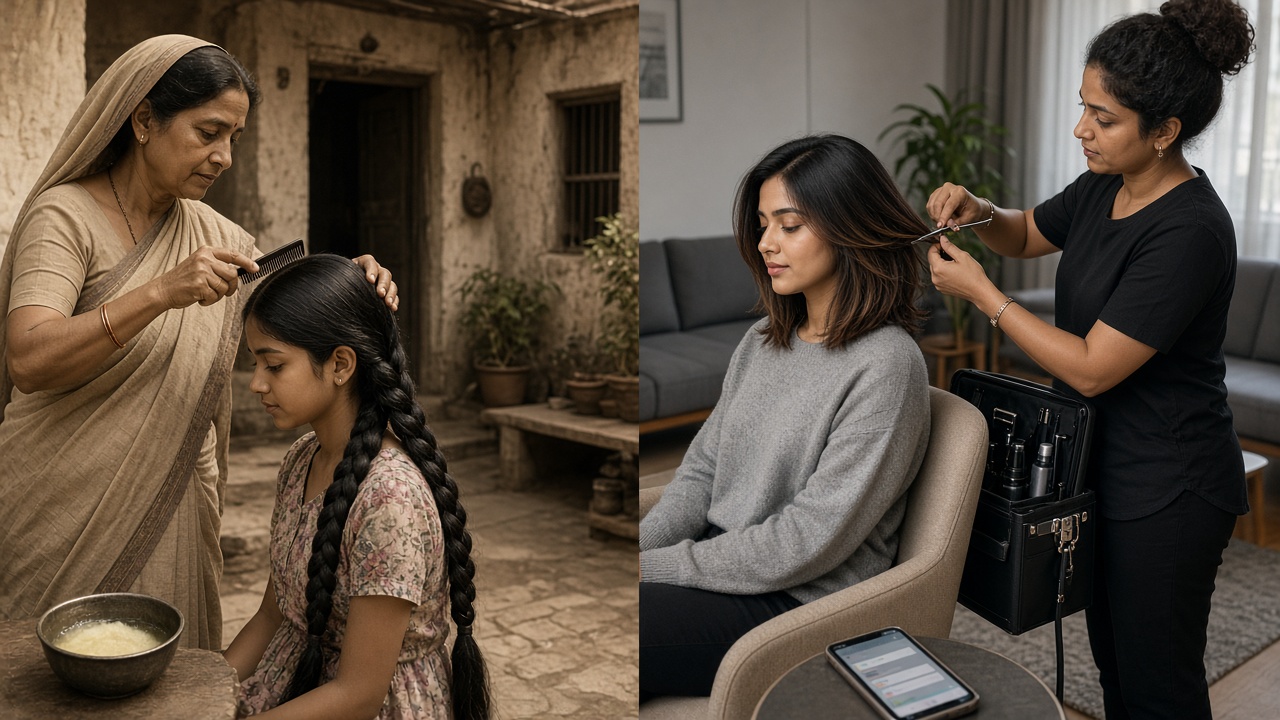
From a mother’s oiled braids to an app-booked stylist at home (artistic illustration).
Hairstyles Then vs Now at a Glance
Feature
Then
Now
Women’s hair
Long, oiled, braided or in a bun
Any length — bobs, layers, curls, colour
Men’s hair
Short, oiled, side-parted
Fades, undercuts, long hair, styled beards
Cleansing
Shikakai, reetha, soap
Shampoos, conditioners, serums
Hair care
Weekly champi with home oils
Salon treatments, masks, and oiling revival
Colour
Henna for grey hair
Salon colour, highlights, home kits
Where men groomed
Village or roadside barber
Barbershops, unisex salons, or at home
Where women groomed
At home with family
Beauty parlours, salons, and home services
Booking
Walk in and wait
Phone call or app
Trend source
Family, community, films
Films, cricket, Instagram, YouTube
Tools
Comb, scissors, razor
Dryers, straighteners, trimmers, curlers
🌼 AdornmentsAncient – 1946
Oils, Buns & Adornments
Long, well-oiled hair was prized in India for thousands of years. Hair was washed with natural cleansers, massaged with herbal oils, and decorated with flowers and ornaments, while barbers served men in every village. Indian head massage even gave the English language the word “shampoo”.
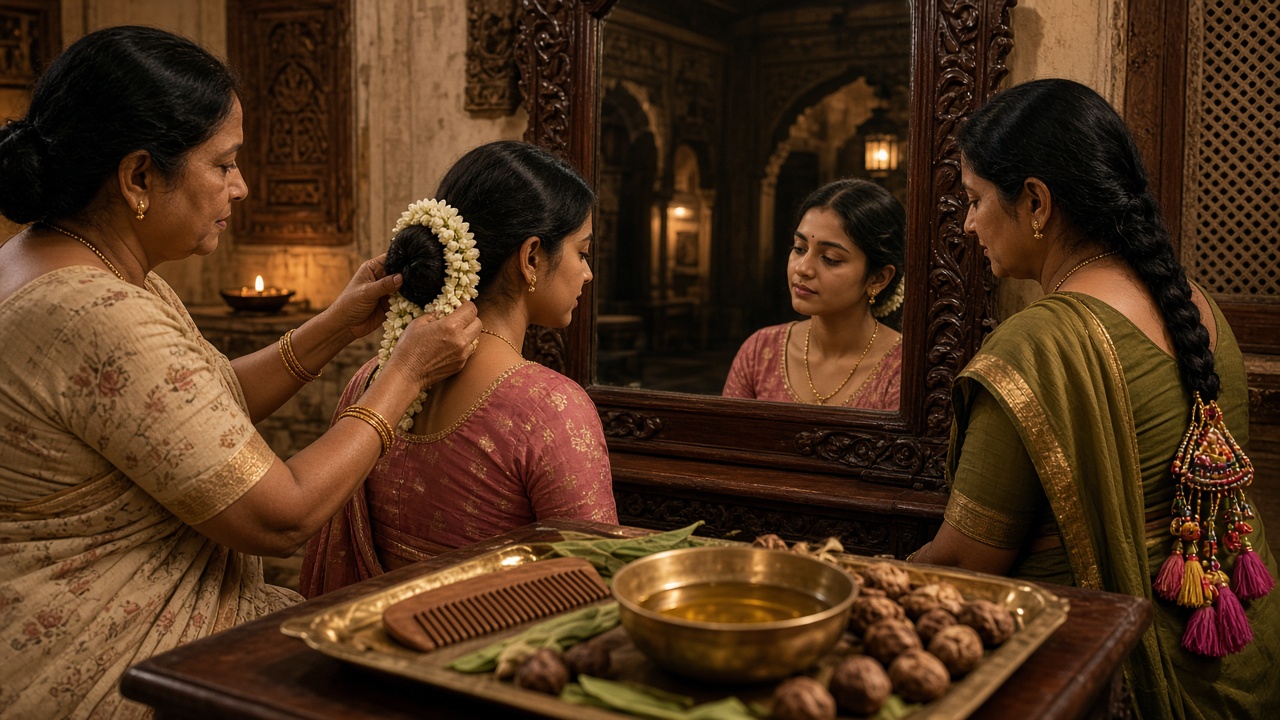
A jasmine gajra, a tasselled parandi, oil, shikakai, and reetha (artistic illustration).
Harappan period (c. 2500 BCE): The bronze “Dancing Girl” from Mohenjo-daro wears her hair in a bun, and combs are found at Harappan sites.
Ancient and classical times: Ayurvedic texts recommend oils such as amla, bhringraj, and coconut; the Ajanta paintings show elaborate buns and braids decorated with jewels and flowers.
1699: Uncut hair (kesh), covered by a turban, becomes one of the articles of faith for the Sikh Khalsa.
1814: Sake Dean Mahomed opens a “shampooing” bath in Brighton, England; the word comes from the Hindi champo, to press or massage.
Technology
Herbal oils: Amla, bhringraj, coconut.
Natural cleansers: Shikakai and reetha.
Combs and razors: Wood, ivory, iron.
Features
Long hair: Beauty and tradition.
Flowers: Gajra and parandi.
Village barbers: Served every home.
🎀 Braids1947 – 1969
Oiled Braids & Film Puffs
In the 1950s long, oiled plaits were the rule for girls and women, and the weekly champi was a family ritual. Men kept short, oiled hair — until film stars began to set trends, from Dev Anand’s puff to the famous Sadhana cut.
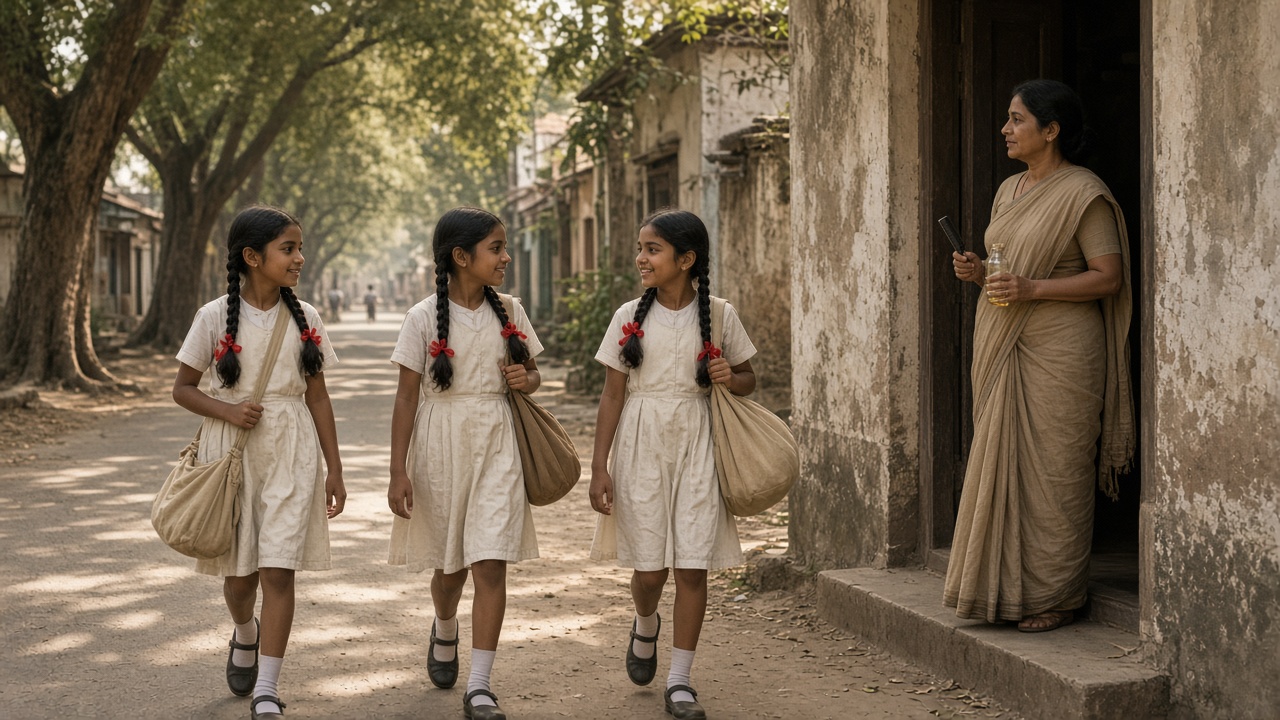
Two oiled plaits with ribbons — the classic 1950s school hairstyle (artistic illustration).
1950s: Most girls and women keep long, oiled hair in one or two plaits or a bun; schoolgirls wear two plaits tied with ribbons, and jasmine or marigold decorates buns.
1950s: Men wear short, oiled, side-parted hair from the local barber; film star Dev Anand’s high puff becomes a much-copied style.
1960: Actress Sadhana’s short fringe in Love in Simla starts the “Sadhana cut” craze among young women.
Late 1960s: Bouffant and beehive hairdos worn by heroines such as Sharmila Tagore and Mumtaz become party styles, using backcombing, hairpins, and hairpieces.
Technology
Bottled hair oils: Household brands.
Ribbons and hairpins: Neat plaits.
Hair cream: Shiny men’s styles.
Features
Long hair norm: For women.
Weekly champi: Family ritual.
Film trends: Puff and fringe.
✂️ Bob Cut1970 – 1989
Bob Cuts & Beauty Parlours
In the 1970s young women in cities cut their hair into bobs and layers, while young men grew theirs long with thick sideburns. Beauty parlours opened in city neighbourhoods, and cheap shampoo sachets took shampoo to small towns and villages in the 1980s.
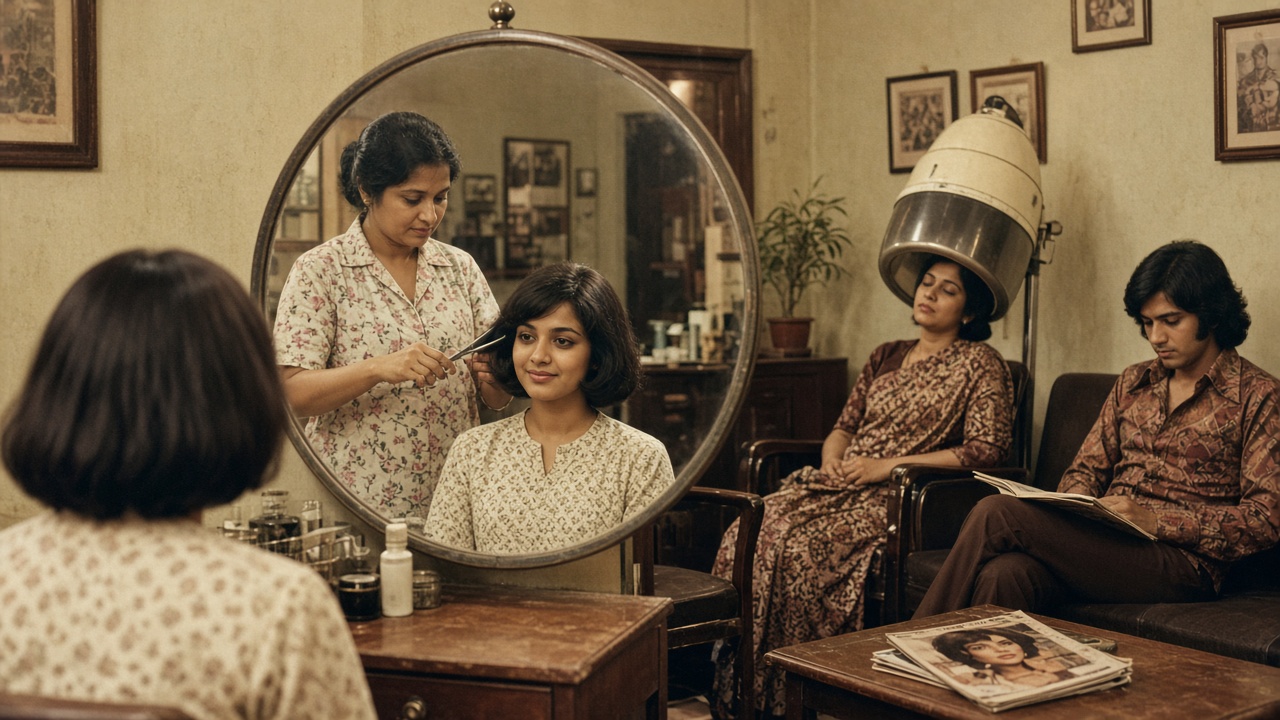
A fresh bob cut in a 1970s beauty parlour (artistic illustration).
1970s: Bob cuts and shorter layered styles appear among college and working women in cities, inspired by western fashion and film heroines.
1970s: Young men wear longer hair covering the ears and long sideburns, a look popularised by stars such as Amitabh Bachchan.
1971: Shahnaz Husain opens a herbal beauty salon in Delhi; women’s beauty parlours offering haircuts, threading, and facials spread in cities.
1980s: Low-priced shampoo sachets, pioneered by brands such as Chik, take shampoo to small towns and villages; perms and feathered, blow-dried hair are in fashion.
Technology
Hooded dryer: Parlour staple.
Perm lotions: Curls that last.
Shampoo sachets: One wash, one rupee.
Features
Short hair: A bold choice for women.
Long hair: For young men.
Beauty parlours: New careers for women.
💇 Salons1990 – 2004
Salon Styles & Hair Colour
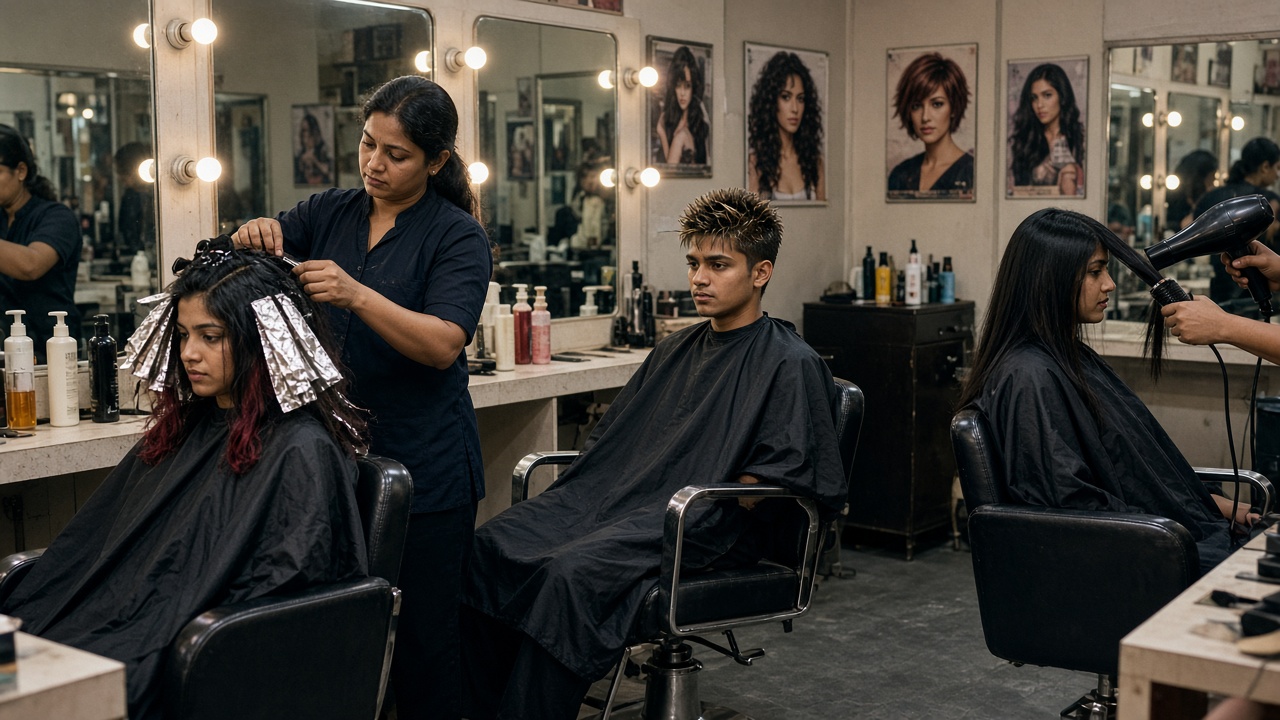
After the 1991 reforms global hair-care and colour brands arrived, and city salons offered colour, highlights, and blow-dry straightening. Satellite TV, films, and cricket made hairstyles national trends almost overnight, and more men began visiting salons instead of only barbers.
Highlights, blow-drying, and gelled spikes in a city salon (artistic illustration).
1990s: After liberalisation, global hair-care and colour brands expand in India; salons offer colour, highlights, blow-drying, and straightening.
1990s: Young men use hair gel for spiky styles and start visiting salons; satellite TV and fashion shows spread new looks quickly.
2001: Aamir Khan’s goatee in Dil Chahta Hai starts a trend of styled facial hair.
2003–2004: Salman Khan’s long, centre-parted hair in Tere Naam (2003) is copied across India, and cricketer M. S. Dhoni’s long hair soon becomes famous too.
Technology
Professional colour: Highlights and shades.
Flat irons: Straight, sleek hair.
Hair gel: Spikes and wet looks.
Features
Colour craze: Burgundy and highlights.
Men in salons: Beyond the barber.
Star trends: Films and cricket.
💈 Unisex2005 – 2019
Unisex Salon Chains & Beard Culture
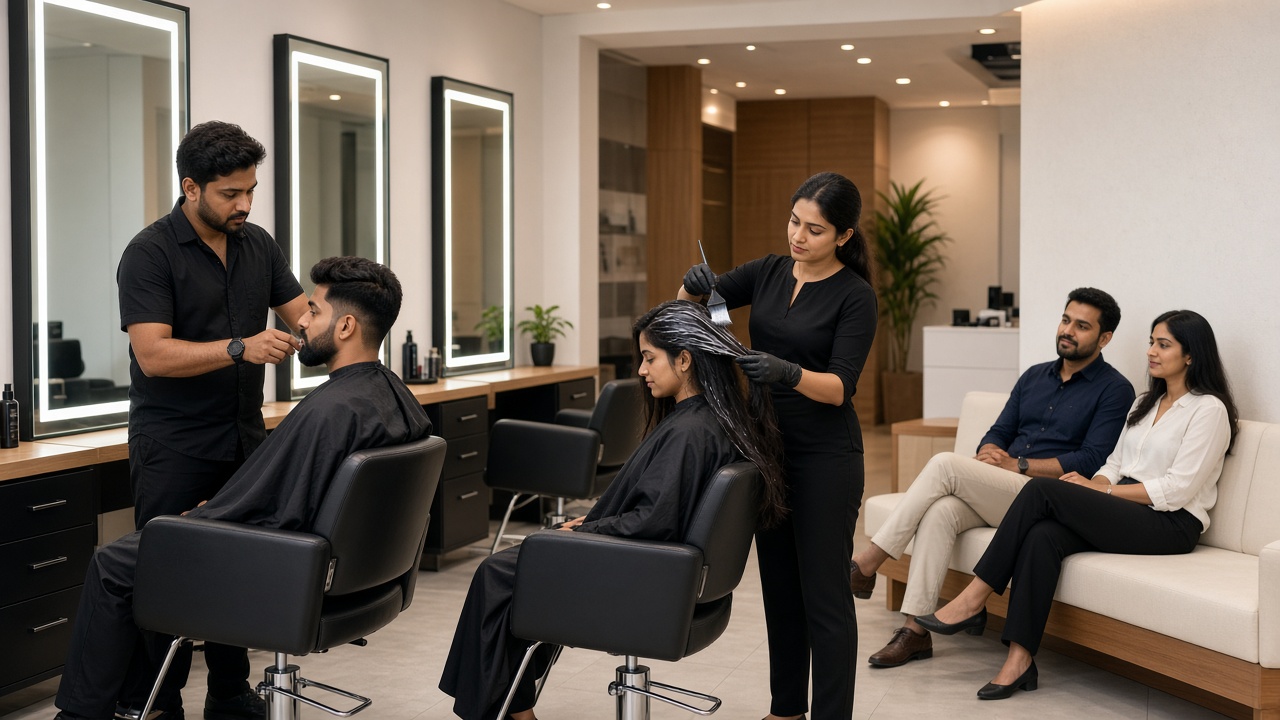
Unisex salon chains where men and women are served side by side spread from big cities to small towns. Men’s grooming boomed — beards, fades, and beard oils — while women chose keratin, smoothening, and colour, often learning styles from YouTube.
Men and women styled side by side in a unisex salon (artistic illustration).
2000s–2010s: Unisex salon chains such as Naturals (founded in Chennai in 2000), Lakmé Salon, and Jawed Habib expand through franchises into smaller towns.
2008: Aamir Khan’s shaved-head look in Ghajini sets a trend among young men.
2010s: Full beards, fades, and undercuts — popularised by cricketers such as Virat Kohli — fuel men’s grooming brands, beard oils, and trimmers.
2014: UrbanClap is founded, offering at-home beauty and grooming services; keratin, smoothening, and rebonding treatments are popular with women.
Technology
Keratin treatments: Smooth, frizz-free hair.
Cordless trimmers: Beards at home.
Online booking: Reserve a slot.
Features
Side by side: Men and women.
Franchise chains: Small towns too.
Beard culture: Grooming boom.
📱 Home Grooming2020s – Future
Home Grooming Apps
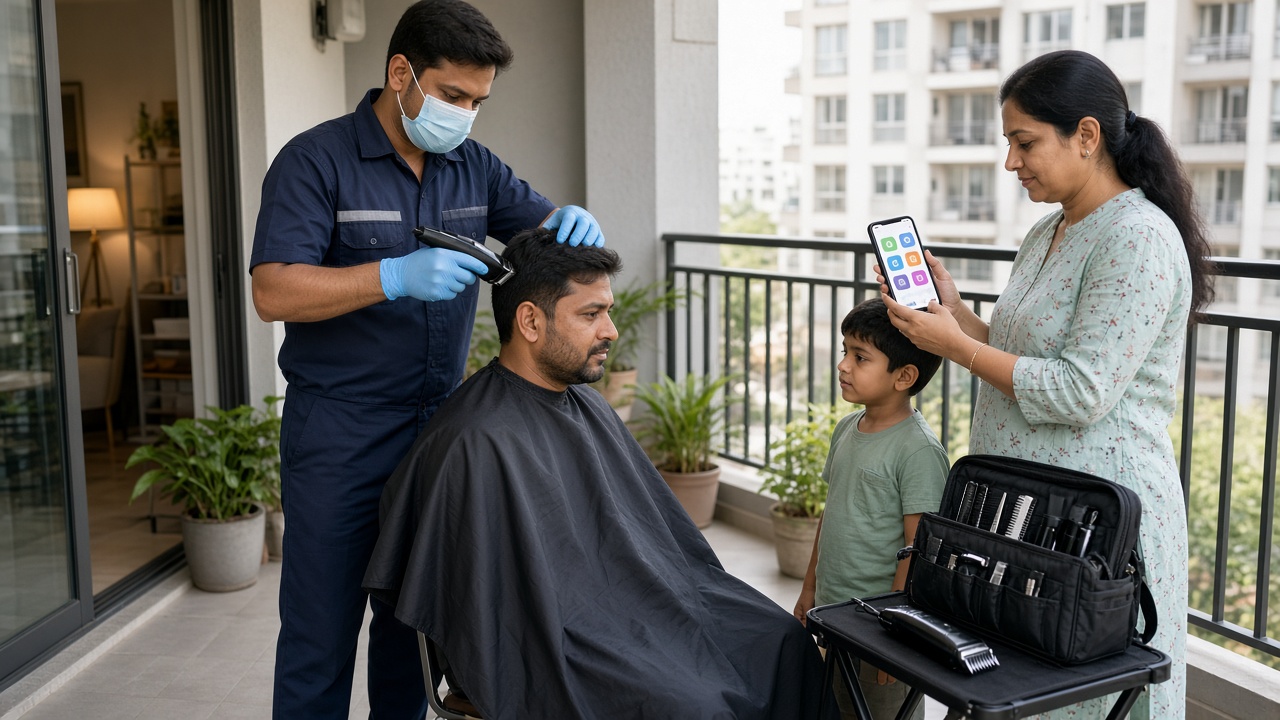
When lockdowns closed salons in 2020, families picked up trimmers and scissors at home. Since then apps have made it normal to book a trained stylist who comes home with a sanitised kit, while natural hair care and traditional oiling have made a comeback.
A haircut booked on an app and delivered at home (artistic illustration).
2020: COVID-19 lockdowns shut salons for weeks; people cut their own and their family’s hair, and sales of trimmers and home hair-colour kits rise. UrbanClap renames itself Urban Company.
2020s: Apps such as Urban Company and YesMadam send trained beauticians and barbers home; salons reopen with masks, gloves, and single-use capes.
2020s: Curly and natural hair care, sulfate-free and Ayurvedic products, and traditional oiling return as trends; hair donation for cancer patients grows.
Future: AI apps that preview a haircut on your photo, scalp-analysis devices, and personalised hair products point to the next chapter.
Technology
Booking apps: Salon at your door.
AI try-on: Preview a style.
Rechargeable trimmers: DIY grooming.
Features
Convenience: No waiting.
Hygiene: Sanitised kits.
Back to roots: Oiling returns.
Traditional Hair Care & Adornments
Practice or item
Region
Purpose
Champi
All India
Head massage with warm oil
Coconut oil
South India, coastal regions
Everyday hair oil
Amla and bhringraj oils
All India
Ayurvedic oils for hair and scalp
Shikakai and reetha
All India
Natural hair cleansers
Henna (mehendi)
All India
Natural colour for grey hair
Gajra
South and West India
Jasmine string for buns and braids
Parandi
Punjab
Colourful tasselled braid extension
Jadai nagam
Tamil Nadu
Bridal braid ornament
Kesh and dastar
Sikh tradition
Uncut hair covered by a turban
Mundan
Many Hindu communities
First head-shaving ceremony of a child
Hairstyles That Became Trends
Style
When
Made popular by
The puff
1950s–1960s
Dev Anand
Sadhana cut (fringe)
1960
Sadhana in Love in Simla
Bouffant
Late 1960s
Sharmila Tagore, Mumtaz
Ear-covering hair and sideburns
1970s
Amitabh Bachchan
Bob cut
1970s
College and working women, film heroines
Goatee
2001
Aamir Khan in Dil Chahta Hai
Long centre parting
2003
Salman Khan in Tere Naam
Long hair
2004–2007
M. S. Dhoni
Shaved head
2008
Aamir Khan in Ghajini
Fade and full beard
2010s
Virat Kohli and other cricketers
From Barber to App: Grooming Services Compared
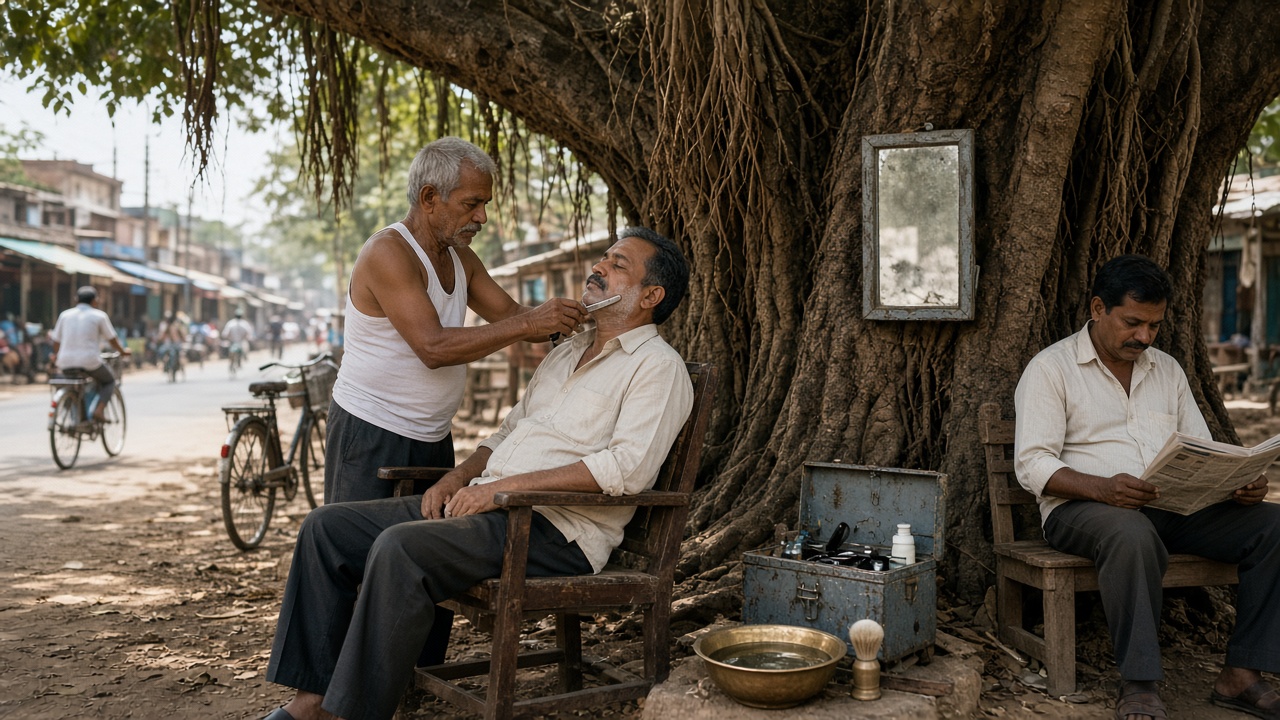
The roadside barber under a tree — still part of Indian street life (artistic illustration).
Service
Where
Typical services
Common from
Village or roadside barber
Under a tree or at home
Haircut, shave, head massage
Centuries old
Barbershop
Small town and city shops
Haircuts, shaves, beard trims
Early 1900s
Beauty parlour
City neighbourhoods
Women’s haircuts, threading, facials
1970s
City salon
Markets and malls
Colour, highlights, styling
1990s
Unisex salon chain
Cities and towns
Everything for men and women
2000s–2010s
At-home app service
Your own home
Haircuts, colour, grooming, beauty
Late 2010s–2020s
DIY grooming
Your own home
Trimming, home colour kits
2020s (lockdowns)
Hairstyle Timeline Summary
Year / Era
Milestone
c. 2500 BCE
Harappan “Dancing Girl” with a bun
Ancient times
Ayurvedic hair oils; shikakai and reetha
Classical era
Elaborate hairstyles in Ajanta paintings
1699
Kesh becomes an article of Sikh faith
1814
“Shampooing” introduced in Britain
1950s
Oiled plaits; Dev Anand’s puff
1960
The Sadhana cut
Late 1960s
Bouffant hairdos
1970s
Bob cuts; long hair for men
1971
Shahnaz Husain’s herbal salon in Delhi
1980s
Shampoo sachets reach villages
1990s
Salon colour and highlights
2000
Naturals salon chain founded
2001–2003
Dil Chahta Hai and Tere Naam trends
2008
Ghajini shaved look
2010s
Unisex salons and beard culture
2014
UrbanClap founded
2020
Lockdown haircuts at home
2020s
Home grooming apps and natural hair care
Test Your Knowledge
20 quick questions from the hairstyle timeline. Click each question to reveal the answer.
Answer: Champo (to press or massage).
Answer: Sake Dean Mahomed.
Answer: Shikakai and reetha (soapnut).
Answer: In a bun.
Answer: A string of flowers, usually jasmine, worn in the hair.
Answer: A colourful tasselled braid extension from Punjab.
Answer: 1699.
Answer: Two oiled plaits tied with ribbons.
Answer: Dev Anand.
Answer:Love in Simla.
Answer: The 1970s.
Answer: They made shampoo cheap enough for families in small towns and villages.
Answer: Henna (mehendi).
Answer:Dil Chahta Hai.
Answer:Tere Naam.
Answer: A salon that serves both men and women.
Answer: Naturals, Lakmé Salon, or Jawed Habib.
Answer: UrbanClap.
Answer: COVID-19 lockdowns closed salons.
Answer: It shows how a new hairstyle would look on your own photo.
Classroom activity
Students Tasks
Use these prompts for discussion or projects on how Indian hairstyles and grooming changed over time.
Timeline understandingCulture and identityMedia influenceOral history
Ask your parents and grandparents how they wore their hair as teenagers and where they got their haircuts.
Make a timeline poster: braids (1950s), bob cut (1970s), salons (1990s), unisex salons (2010s), and home grooming apps (2020s).
Collect old family photos and describe how hairstyles changed from one generation to the next.
Find out how shikakai, reetha, and amla are used in traditional hair care.
Interview a local barber or beautician about how their work has changed.
List three film or sports stars whose hairstyles became trends and explain why.
Discuss how the “shampoo” story shows the exchange of ideas between India and the world.
Compare the cost and convenience of a roadside barber, a salon, and an at-home app service.
Research hair donation and how it helps cancer patients.
Debate: “Home grooming apps are better than going to a salon.”
Continue exploring
Hairstyles changed with television, mobile phones, the internet, and digital services. Explore these connected timelines next.
Click any panel to expand and explore the visual mood.
India’s hairstyle journey in pictures — gajras and parandis, 1950s oiled plaits, a 1970s bob, 1990s salon colour, unisex salons, the roadside barber, home grooming, and then versus now.
Gajra & Parandi
Flowers and tassels
1950s Braids
Oiled plaits
1970s Bob
Beauty parlour era
1990s Salon
Colour and gel
Unisex Salon
Beards and keratin
Roadside Barber
Under the banyan
Home Grooming
Booked on an app
Then vs Now
Braids to apps
Explore all daily life timelines
Jump to any other daily life timeline on WorldTimelineHub.
Disclaimer: This content is AI-generated for educational purposes and may contain errors or outdated details. For correct and authoritative information, please refer to official and reliable sources such as government publications, manufacturers, museums, and academic references.