Wedding Timeline of India: Community Weddings → Banquet Halls → Destination → Court → Live Streaming
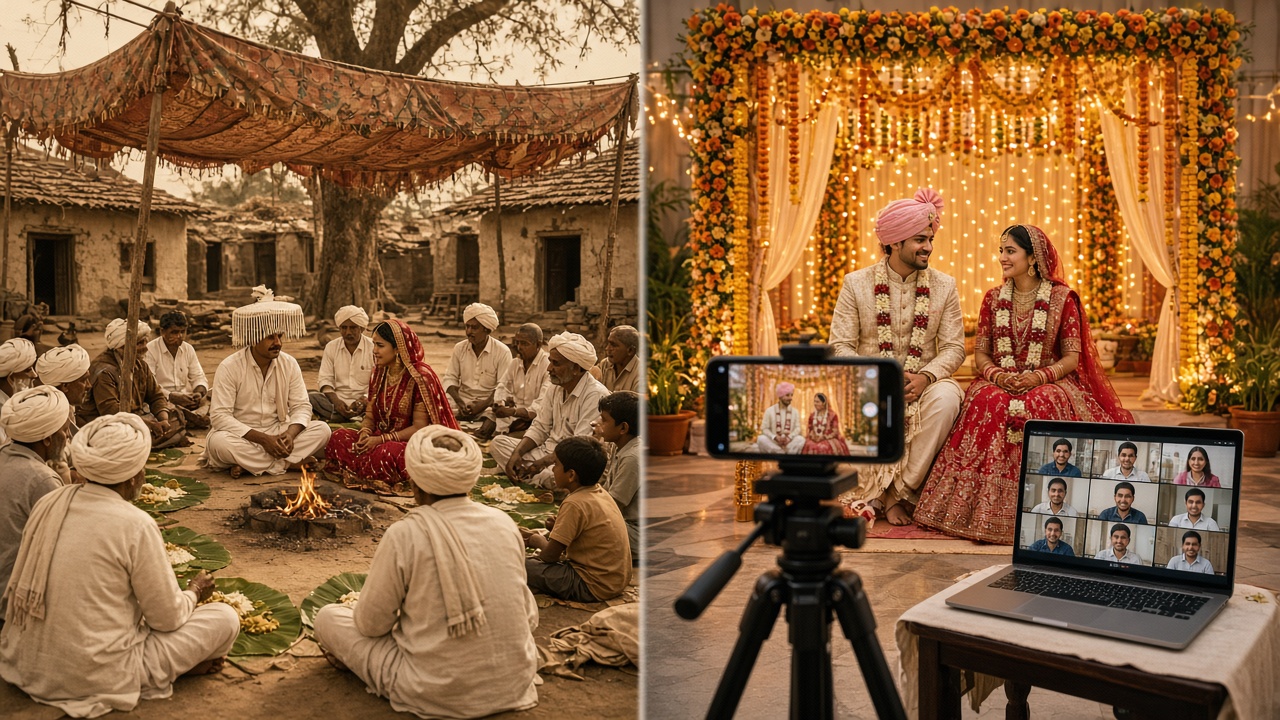
In the 1950s a wedding belonged to the whole village — neighbours cooked together, a shamiana went up in the courtyard, and guests ate in long pangat rows on leaf plates. By the 1980s families hired
banquet halls and caterers, the 2000s brought palace and beach destination weddings, many couples chose simple court marriages, and in the 2020s relatives joined ceremonies through live streams.
This timeline covers the sacred fire and saptapadi, swayamvaras, nikah, Anand Karaj and church weddings, marriage reform laws, community feasts, baraats and brass bands, marriage halls and tent houses,
wedding videos, matrimonial websites, wedding planners, destination weddings, court marriages, registration, and live-streamed and digital weddings.
1950s Community → 1980s Banquets2000s Destination → Court Marriage2020s Live Streaming
Why the Wedding Story Matters
A wedding is one of the biggest events in an Indian family’s life. Where it is held, who is invited, how the food is served, and even how it is recorded reflect changes in family size, cities,
money, law, women’s rights, and technology. The journey from a village pangat under a shamiana to a ceremony watched live by relatives across the world shows how Indian society itself has changed.
Big picture
India’s wedding journey in one view
Ancient Indian weddings centred on the sacred fire, while reform laws from 1856 onwards tackled child marriage and widow remarriage. After independence weddings were community events at home,
banquet halls and caterers took over in the 1970s and 1980s, palace and beach destination weddings grew after liberalisation, simple court marriages and intimate weddings rose in the 2010s, and the 2020 lockdown made live-streamed weddings common. Related timelines:
internet,
mobile phones,
women’s education.
1955
Hindu Marriage Act passed
1978
Marriage age raised to 18 and 21
2006
Supreme Court orders compulsory registration
2020
Lockdown weddings go live online
From a village wedding under the shamiana to a ceremony streamed live to relatives (artistic illustration).
Indian Weddings Then vs Now at a Glance
Feature
Then
Now
Venue
Home courtyard or village ground
Banquet halls, resorts, palaces, or a court
Duration
Several days
One to three days of planned events
Guests
The whole village or mohalla
A chosen list, plus viewers online
Food
Pangat on leaf plates, cooked by halwais
Buffets and live counters by caterers
Lighting
Petromax lanterns and oil lamps
LED, fairy lights, and drone light shows
Music
Shehnai, dhol, and brass band
DJs and choreographed sangeet
Invitations
Printed cards and personal visits
WhatsApp e-invites and wedding websites
Memories
A few black-and-white studio photos
Candid photos, drone shots, and wedding films
Matchmaking
Families, priests, and go-betweens
Matrimonial websites and apps
Registration
Rarely registered
Registered, often online
🔥 Sacred FireAncient – 1946
Sacred Fire, Swayamvara & Reform Laws
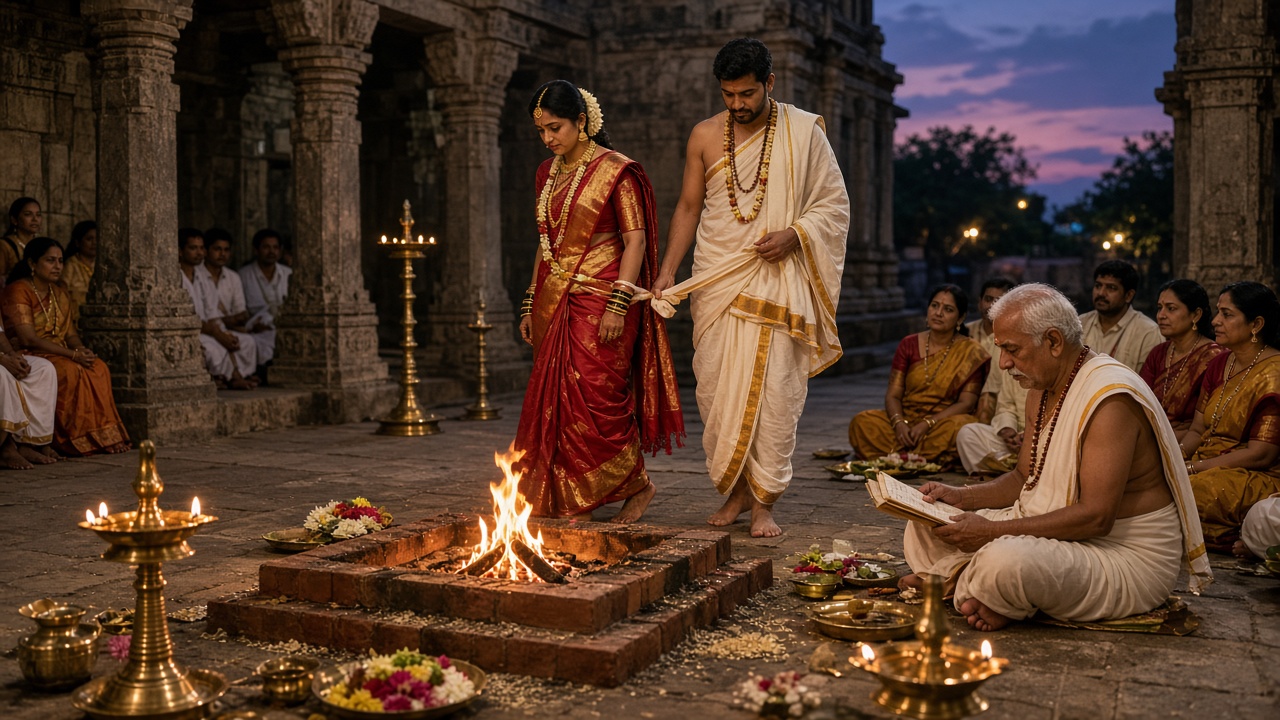
For thousands of years Indian weddings were family and community rituals held at home or at a temple. Hindu weddings centred on the sacred fire and the seven steps, while nikah, Anand Karaj, and church weddings followed their own traditions. From the 19th century reformers and new laws took on child marriage and widow remarriage.
The couple walks around the sacred fire, their garments tied together (artistic illustration).
c. 1500–1000 BCE: A Rigvedic wedding hymn describes the marriage of Surya and rituals around the sacred fire; later Grihya Sutras set out the saptapadi, or seven steps.
Epic age: The Ramayana and Mahabharata describe the swayamvaras of Sita and Draupadi, and the Manusmriti lists eight forms of marriage.
1500s–1800s: Guru Ram Das composes the four laavan of the Sikh Anand Karaj, Muslim weddings are solemnised by nikah with mehr, and child marriage is widespread.
1856–1929: The Hindu Widows’ Remarriage Act (1856) follows Ishwar Chandra Vidyasagar’s campaign, and the Sarda Act (1929) sets minimum marriage ages of 14 for girls and 18 for boys.
Technology
Havan kund: The sacred fire.
Oil lamps: Night ceremonies.
Palm-leaf texts: Horoscopes and rituals.
Features
Saptapadi: Seven vows.
Family-arranged: Elders decide.
Reform: Widow remarriage allowed.
🏘️ Community1947 – 1969
Community Weddings & Pangat Feasts
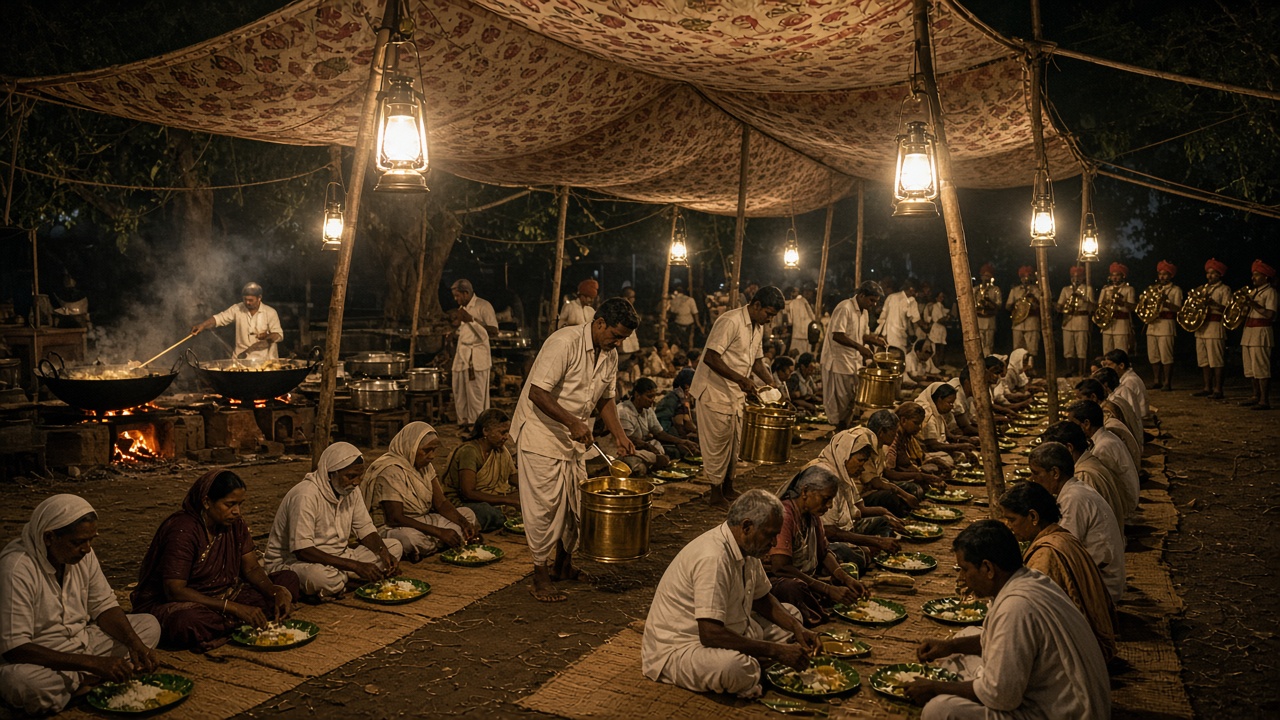
In the 1950s a wedding was a village or neighbourhood event lasting several days. Neighbours lent cots, rooms, and brass utensils, relatives and halwais cooked in huge kadhais, a shamiana went up in the courtyard, and guests sat in long pangat rows on the ground, eating from leaf plates under hissing petromax lanterns.
A pangat feast under the shamiana, lit by petromax lanterns (artistic illustration).
1950s: Weddings are held at home or on village grounds, with the whole community helping to cook, serve, decorate, and host the baraat for several days.
1954–1955: The Special Marriage Act (1954) allows civil marriage between any two people by registration, and the Hindu Marriage Act (1955) makes monogamy compulsory and allows divorce.
1961: The Dowry Prohibition Act makes giving and taking dowry a crime.
1950s–1960s: Baraats arrive on horseback, bullock carts, or by train with brass bands; newspaper matrimonial columns and black-and-white studio portraits become part of weddings.
Technology
Petromax lanterns: Pressure-lamp lighting.
Shamiana tents: Shade for guests.
Studio cameras: Formal portraits.
Features
Whole village helps: Shared work.
Pangat meals: Leaf plates on the floor.
Many days: Long celebrations.
🏛️ Banquets1970 – 1994
Banquet Halls, Caterers & Wedding Videos
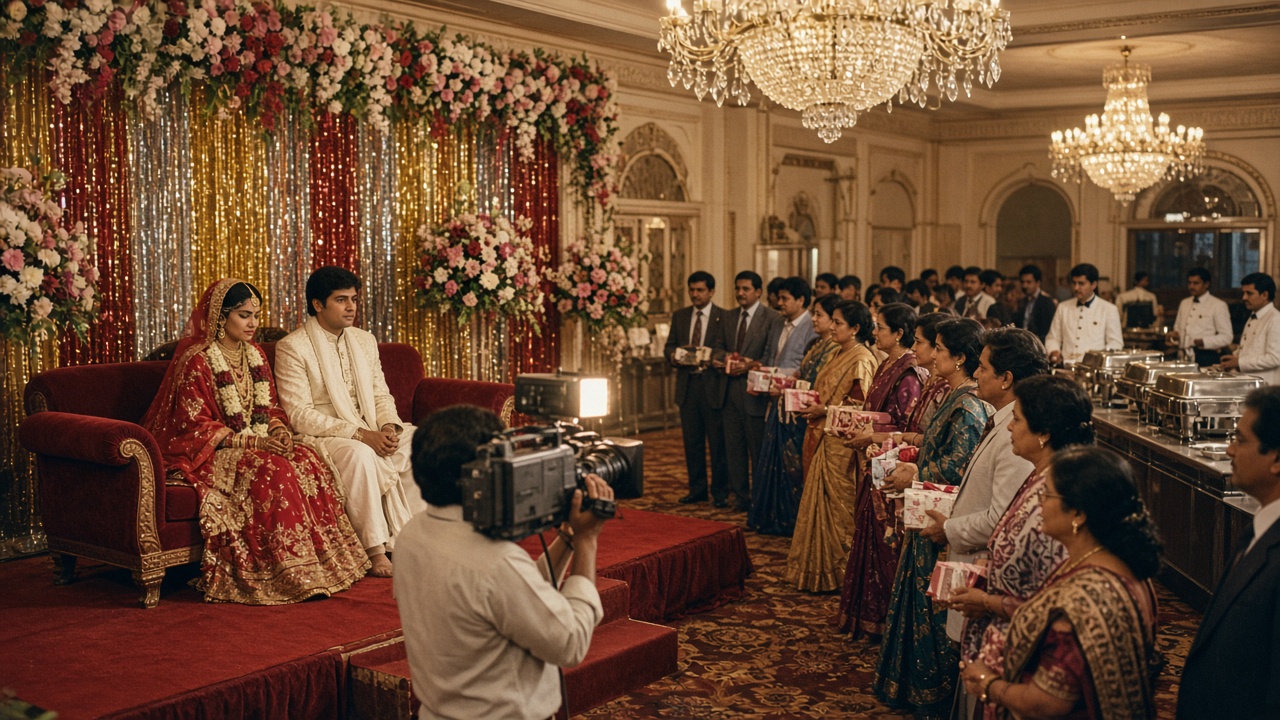
As towns grew crowded and homes shrank, families moved weddings to marriage halls, kalyana mandapams, dharamshalas, and hotel banquet halls. Tent houses and caterers supplied everything, buffets replaced floor seating, the couple greeted guests on a stage at the reception, and a videographer with a bright light recorded it all on VHS.
The stage reception, the gift queue, and the VHS videographer (artistic illustration).
1970s: Tent houses and caterers rent out shamianas, crockery, and cooks, and marriage halls and kalyana mandapams spread through towns.
1978: The minimum age of marriage is raised to 18 for women and 21 for men.
1980s: Buffets, stage receptions, VHS wedding videos, and film songs on loudspeakers become standard; Section 498A (1983) and dowry law amendments target dowry harassment.
1994: The film Hum Aapke Hain Koun..! makes song-filled family weddings a nationwide dream, while community mass weddings help poorer families cut costs.
Technology
VHS cameras: The wedding video.
Serial lights: Electric decorations.
Cassette players: Film songs.
Features
Buffet dinners: Standing meals.
Stage reception: Photos with guests.
Hired venues: Halls and mandapams.
🏰 Destination1995 – 2009
Destination Weddings & Wedding Planners
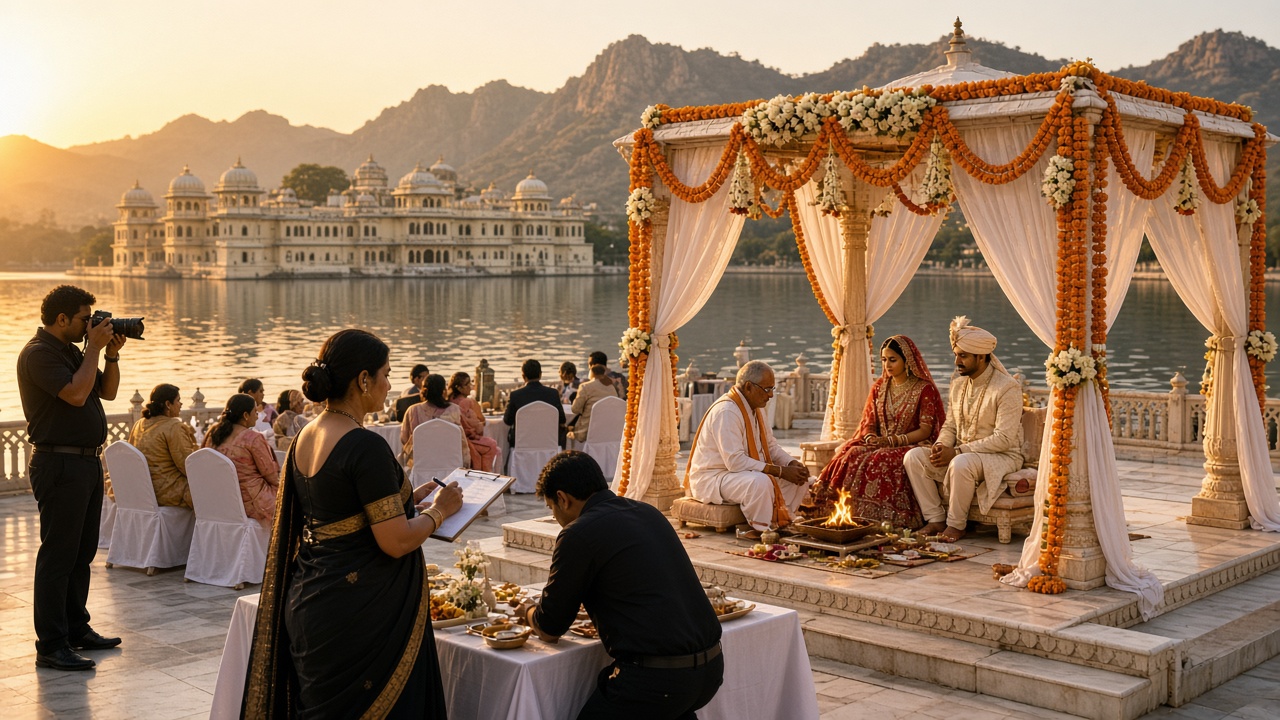
After liberalisation, rising incomes and NRI families made the “big fat Indian wedding” a trend. Palace hotels in Udaipur and Jaipur, Goa beaches, and Kerala backwaters hosted weddings, professional planners managed themed décor and sangeet choreography, and matrimonial websites moved matchmaking online.
A lakeside palace mandap, a wedding planner, and a photographer (artistic illustration).
Late 1990s: Matrimonial websites such as Shaadi.com, BharatMatrimony, and Jeevansathi begin moving matchmaking from newspapers to the internet.
2000s: Palace hotels in Rajasthan, Goa beaches, and Kerala resorts become wedding venues; films such as Monsoon Wedding (2001) celebrate the Indian family wedding.
2006: The Supreme Court directs compulsory registration of marriages, and the Prohibition of Child Marriage Act replaces the Sarda Act.
2000s: Wedding planners, sangeet choreographers, digital cameras, SMS invites, and candid photography change how weddings are organised and remembered.
Technology
Matrimonial websites: Online profiles.
Digital cameras: Hundreds of photos.
Mobile phones: Calls and SMS invites.
Features
Palace venues: Royal settings.
Wedding planners: Professional teams.
Themed events: Mehendi to sangeet.
✍️ Court2010 – 2019
Court Marriages, Hashtags & Intimate Weddings
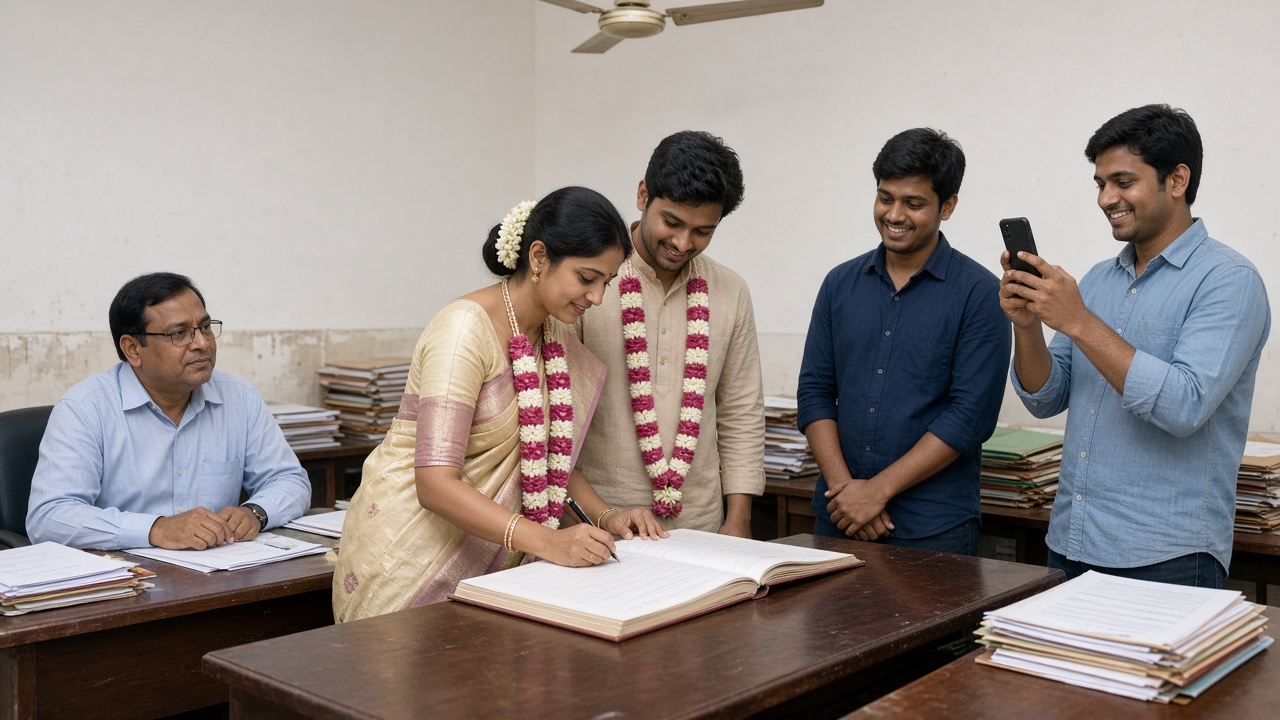
Many couples chose simple court marriages or small registered ceremonies to save money and avoid pressure, while others went bigger with celebrity-style weddings abroad. Pre-wedding shoots, drones, wedding films, hashtags, and WhatsApp invites spread, and Supreme Court judgments strengthened adults’ right to choose their partners.
Signing the marriage register before the registrar and witnesses (artistic illustration).
2010s: More couples marry under the Special Marriage Act, giving 30 days’ notice and signing before a Marriage Officer and three witnesses, often with a small party later.
2017–2018: Celebrity weddings in Italy and Rajasthan’s palaces make headlines, popularising pre-wedding shoots, drone videos, and wedding hashtags.
2017–2019: The Supreme Court strikes down instant triple talaq (2017), upholds an adult’s right to choose a partner in the Shafin Jahan case (2018), and Parliament passes a 2019 law on the issue.
2010s: WhatsApp e-invites, wedding websites, eco-friendly décor, and online registration in several states make weddings more digital.
Technology
Drones: Aerial wedding shots.
WhatsApp invites: Digital cards.
Social media: Wedding hashtags.
Features
Court marriage: Simple and legal.
Intimate weddings: Close family only.
Pre-wedding shoots: Couple films.
📡 Live Streaming2020s – Future
Live-Streamed & Digital Weddings
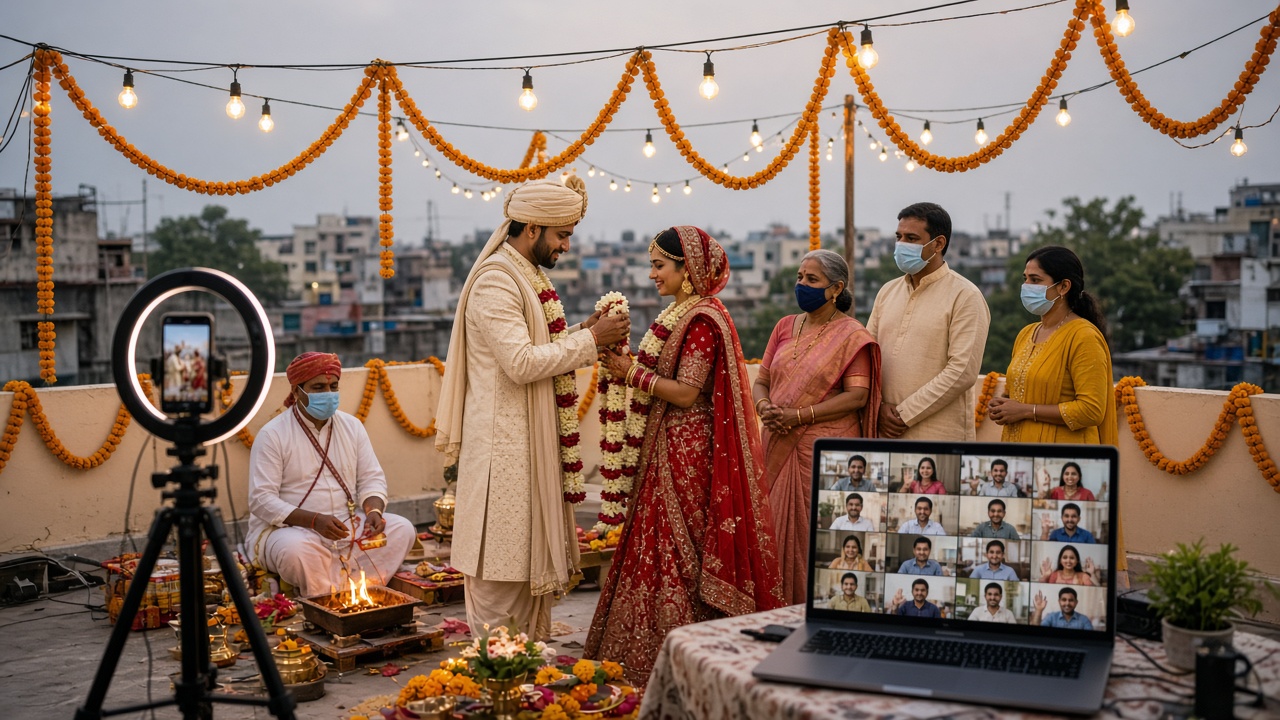
The 2020 lockdown limited guest numbers, so families held small home, rooftop, and temple weddings with a phone on a tripod streaming the ceremony to relatives on video calls, YouTube, and Instagram. E-invites, UPI shagun, online registration, and hybrid guest lists stayed on even after big weddings returned.
A masked rooftop wedding with relatives watching live on a video call (artistic illustration).
2020: Lockdown and unlock rules cap wedding guests, at one stage at 50, so ceremonies are live streamed and gifts are sent by UPI.
2022: A couple in Tamil Nadu hosts one of India’s first metaverse wedding receptions, with guests joining as avatars.
2023: The Supreme Court declines to legalise same-sex marriage, leaving it to Parliament (October), and the Prime Minister urges families to “Wed in India” (November).
2025 and beyond: Uttarakhand’s Uniform Civil Code makes marriage registration compulsory from January 2025; AI planning, virtual guests, and zero-waste weddings are growing trends.
Technology
Live streaming: Guests anywhere.
UPI QR codes: Digital shagun.
Online registration: Marriage certificates.
Features
Hybrid guests: In person and online.
Micro-weddings: Small and personal.
Sustainable: Less waste.
Common Wedding Rituals and Their Meaning
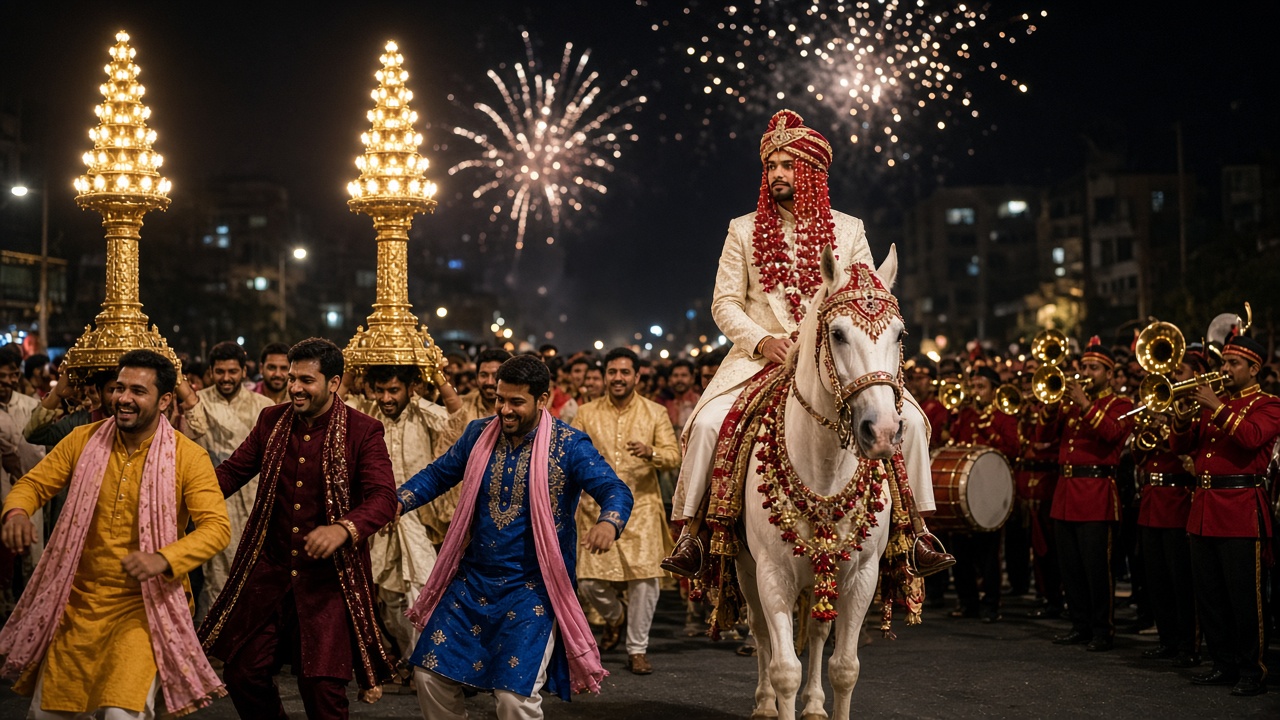
The groom’s baraat arrives with a white mare, a brass band, and dancing relatives (artistic illustration).
Rituals differ by region, religion, and community; these are widely seen in North Indian Hindu weddings.
Ritual
When
Meaning
Roka / sagai
Weeks or months before
Families formally agree to the match
Haldi
A day or two before
Turmeric paste for blessing and glow
Mehendi
A day or two before
Henna designs on the bride’s hands
Sangeet
Evening before
Songs and dances by both families
Baraat
Wedding day
The groom’s procession to the venue
Jaimala / varmala
On arrival
Exchange of flower garlands
Kanyadaan
During the ceremony
Parents give their daughter’s hand
Pheras / saptapadi
During the ceremony
Seven rounds and vows around the fire
Vidaai
After the ceremony
Emotional farewell to the bride
Reception
After the wedding
Party to meet friends and relatives
Wedding Traditions Across India
Tradition
Community / region
Key ritual
Anand Karaj
Sikh, Punjab
Four laavan around the Guru Granth Sahib
Nikah
Muslim, across India
Consent before a qazi, with mehr for the bride
Church wedding
Christian, Kerala, Goa, and the Northeast
Vows and exchange of rings
Tamil wedding
Tamil Nadu
Tying the thali at the morning muhurtham
Bengali wedding
West Bengal
Subho drishti and sindoor daan
Malayali Hindu wedding
Kerala
A short ceremony with thali and garlands
Marathi wedding
Maharashtra
Antarpat cloth and mangalashtak verses
Gujarati wedding
Gujarat
Hast milap, joining of hands
Parsi lagan
Parsi, Mumbai and Gujarat
Ara antar cloth and rice showers
Assamese wedding
Assam
Juroon ceremony and sacred fire
Key Marriage Laws in India
Law
Year
What it did
Hindu Widows’ Remarriage Act
1856
Allowed Hindu widows to remarry
Indian Christian Marriage Act
1872
Rules for Christian weddings
Anand Marriage Act
1909
Recognised the Sikh Anand Karaj
Child Marriage Restraint (Sarda) Act
1929
First minimum marriage ages
Parsi Marriage and Divorce Act
1936
Rules for Parsi marriages
Special Marriage Act
1954
Civil marriage for any two adults
Hindu Marriage Act
1955
Monogamy, valid ceremonies, divorce
Dowry Prohibition Act
1961
Made dowry a crime
Prohibition of Child Marriage Act
2006
Stronger action against child marriage
Muslim Women (Protection of Rights on Marriage) Act
2019
Made instant triple talaq an offence
Wedding Timeline Summary
Year / Era
Milestone
c. 1500–1000 BCE
Rigvedic wedding hymn and sacred fire
Epic age
Swayamvaras of Sita and Draupadi
1500s
Laavan of the Sikh Anand Karaj
1856
Hindu Widows’ Remarriage Act
1872
Indian Christian Marriage Act
1909
Anand Marriage Act
1929
Sarda Act sets minimum ages
1950s
Community weddings and pangat feasts
1954
Special Marriage Act
1955
Hindu Marriage Act
1961
Dowry Prohibition Act
1970s
Marriage halls, tent houses, and caterers
1978
Marriage age raised to 18 and 21
1980s
Buffets and VHS wedding videos
1994
Hum Aapke Hain Koun..!
Late 1990s
Matrimonial websites begin
2000s
Palace and beach destination weddings
2006
Compulsory registration; child marriage law
2010s
Court marriages, drones, and hashtags
2017
Instant triple talaq struck down
2018
Right to choose a partner upheld
2020
Lockdown guest limits; live-streamed weddings
2022
Metaverse wedding reception
2023
Same-sex marriage verdict; “Wed in India”
2025
Uttarakhand UCC compulsory registration
Future
AI planning, virtual guests, zero-waste weddings
Test Your Knowledge
20 quick questions from the wedding timeline. Click each question to reveal the answer.
Answer: Seven steps — the seven rounds and vows around the sacred fire.
Answer: A ceremony in which a princess chose her husband from a gathering of suitors.
Answer: Guru Ram Das.
Answer: Ishwar Chandra Vidyasagar.
Answer: The Sarda Act.
Answer: Guests seated in long rows on the ground to eat a community meal.
Answer: Petromax kerosene pressure lanterns.
Answer: The Special Marriage Act.
Answer: 1955.
Answer: The Dowry Prohibition Act.
Answer: 18 for women and 21 for men.
Answer: A marriage hall, especially in South India.
Answer: VHS video cameras.
Answer:Hum Aapke Hain Koun..!
Answer: Udaipur (Jaipur and Jodhpur are also popular).
Answer: 2006.
Answer: 30 days.
Answer: COVID-19 lockdown rules limited the number of guests.
Answer: A gift of money given to the couple for good luck, now often sent by UPI.
Answer: Uttarakhand.
Classroom activity
Students Tasks
Use these prompts for discussion or projects on how Indian weddings have changed over time.
Timeline understandingCulture and diversityLaw and rightsBudget planning
Interview grandparents about their wedding: where it was held, how many guests came, and what food was served.
Make a timeline poster: community weddings (1950s), banquet halls (1980s), destination weddings (2000s), court marriages (2010s), and live streaming (2020s).
Compare old wedding photos or videos from your family across three generations.
Create a chart of wedding traditions from five different regions or religions of India.
Find out the steps and documents needed to register a marriage in your state.
Discuss why India set minimum marriage ages and why child marriage is harmful.
Plan a budget for a simple wedding of 100 guests and compare it with a wedding of 1,000 guests.
List ways to make a wedding eco-friendly, such as reducing plastic and food waste.
Design a digital wedding invitation and a live-stream plan for relatives who cannot travel.
Debate: “Simple weddings are better than big fat Indian weddings.”
Continue exploring
Indian weddings changed with the internet, mobile phones, Digital India, and women’s education. Explore these connected timelines next.
Click any panel to expand and explore the visual mood.
India’s wedding journey in pictures — the sacred fire, the village pangat feast, the baraat, the 1980s banquet reception, the palace destination wedding, the court marriage, the live-streamed lockdown wedding, and then versus now.
Sacred Fire
Seven steps together
Pangat Feast
The whole village eats
Baraat
Band, mare, and dancing
Banquet Reception
Stage, buffet, and VHS
Destination Wedding
A lakeside palace mandap
Court Marriage
Sign the register
Live-Streamed Wedding
Relatives on the screen
Then vs Now
Shamiana to live stream
Explore all daily life timelines
Jump to any other daily life timeline on WorldTimelineHub.
Disclaimer: This content is AI-generated for educational purposes and may contain errors or outdated details. For correct and authoritative information, please refer to official and reliable sources such as government publications, manufacturers, museums, and academic references.