Home Cleaning Timeline of India: Brooms → Vacuum Cleaners → Robotic Vacuums → Smart Mops
In the 1950s every Indian home began the day with the jhadu — a grass broom for the rooms and a coconut-stick broom for the courtyard — followed by a squatting pocha with a wet cloth. Floor wipers and
phenyl joined in the 1980s, vacuum cleaners arrived with door-to-door demos in the 1990s, robot vacuums and spin mops spread in the 2010s, and in the 2020s smart wet-dry mops clean and wash themselves.
This timeline covers gobar lipai and lime whitewash, phool jhadu and seenk jhadu, pocha and phenyl, red oxide, mosaic, marble and vitrified floors, rubber wipers and cobweb brooms, vacuum cleaners,
microfibre and spin mops, robot vacuum-mops, Swachh Bharat, Diwali safai, and smart floor scrubbers with sensors, apps, and self-cleaning docks.
Sweeping and mopping are the first chores of the day in almost every Indian home. How India cleans its floors reflects changes in building materials, electricity, chemistry, city life, household
help, and ideas about hygiene. The journey from a grass broom and a wet cloth to a robot that maps the house and washes its own mop shows technology slowly taking over one of the oldest household jobs.
Big picture
India’s cleaning journey in one view
For centuries Indians swept with grass and palm brooms, plastered mud floors with cow dung, and whitewashed walls before festivals. After independence pocha and phenyl kept stone and red oxide floors
clean, wipers and plastic brooms arrived with mosaic floors in the 1980s, vacuum cleaners spread in the 1990s, robot vacuums and spin mops followed in the 2010s, and smart mops arrived in the 2020s. Related timelines:
power grid,
Digital India,
artificial intelligence.
1982
Eureka Forbes set up; vacuum demos begin
2014
Swachh Bharat Mission launched
2010s
Robot vacuums enter Indian homes
2020
Lockdown boosts cleaning gadgets
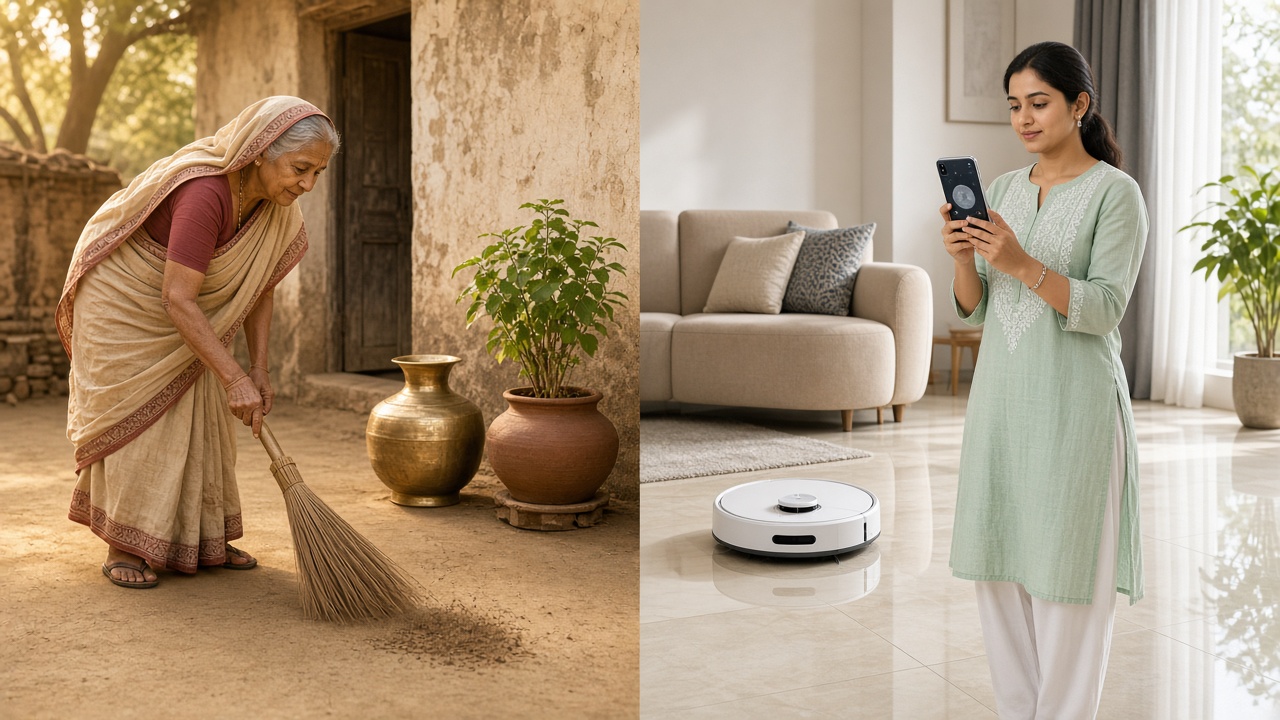
From the grass jhadu to a robot vacuum run from a phone (artistic illustration).
Home Cleaning Then vs Now at a Glance
Feature
Then
Now
Sweeping
Grass and coconut-stick jhadu
Vacuum cleaners and robot vacuums
Mopping
Wet cloth by hand while squatting
Spin mops and smart wet-dry scrubbers
Floors
Mud, stone, and red oxide
Vitrified tiles, marble, and laminate
Disinfectant
Neem, cow dung, and phenyl
Scented floor cleaners and sanitisers
Walls
Lime whitewash before festivals
Washable emulsion paint
Dusting
Cloth and long cobweb broom
Microfibre dusters and handheld vacuums
Dirt collection
Tin dustpan and open heap
Dust bins and self-emptying docks
Time
An hour or more of bending daily
Scheduled robots while you work
Who cleaned
Women of the house and helpers
Family members, helpers, machines, and services
Control
Hands and experience
Sensors, maps, and phone apps
🌾 JhaduAncient – 1946
Jhadu, Gobar Lipai & Whitewash
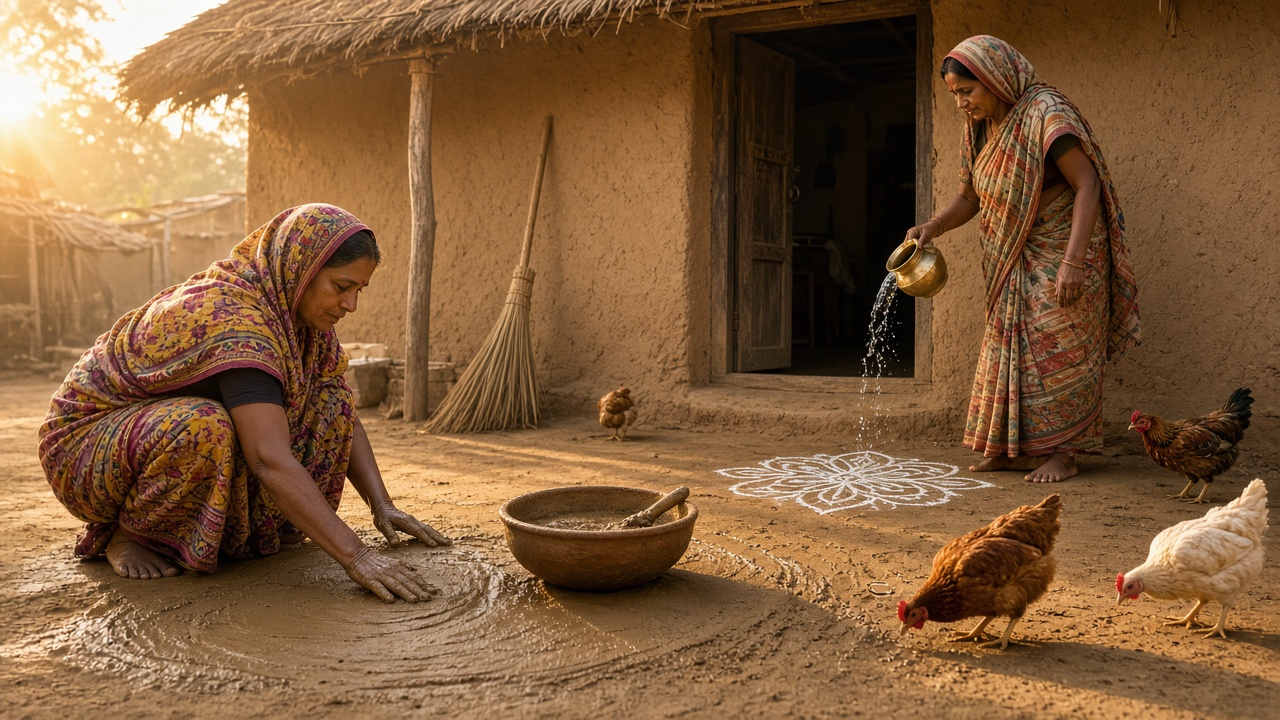
For thousands of years Indian homes were swept with brooms of grass, palm, and coconut leaves, mud floors were plastered with cow dung and clay, and walls were coated with lime. Cleaning was tied to daily ritual — sweeping and sprinkling water at the doorstep before drawing a rangoli or kolam — and to whole-house cleaning before festivals.
Plastering the courtyard with cow dung and mud, and sprinkling water before the kolam (artistic illustration).
c. 2500 BCE: Harappan cities such as Mohenjo-daro have covered drains, bathrooms, and planned streets, showing an early focus on cleanliness.
Ancient times: Brooms of grass, palm, and coconut-leaf ribs sweep homes, and mud floors are plastered with cow dung (gobar lipai) and walls with lime (chuna).
Tradition: Homes are cleaned and whitewashed before Diwali, Pongal, and other festivals, and many families treat the broom with respect and avoid touching it with their feet.
1901–1940s: Bengal Chemicals, founded by Acharya Prafulla Chandra Ray, becomes known for phenyl, and Mahatma Gandhi makes cleaning, including cleaning toilets, part of ashram life.
Technology
Grass brooms: Sweeping fine dust.
Cow-dung plaster: Smooth mud floors.
Lime whitewash: Bright, fresh walls.
Features
Morning ritual: Sweep, sprinkle, rangoli.
Festival cleaning: Whole-house safai.
Local materials: Grass, clay, and lime.
🧹 Brooms1947 – 1979
Brooms, Pocha & Phenyl
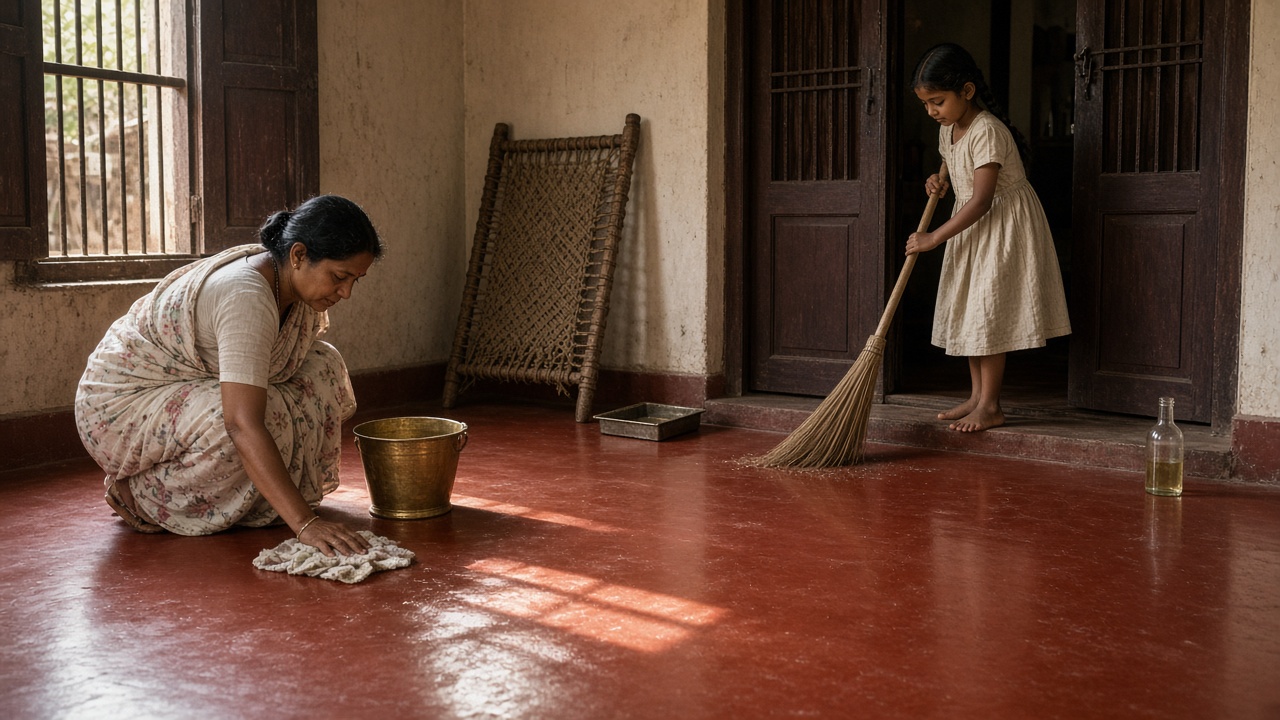
In the 1950s the daily routine was jhadu-pocha: sweeping every room with a soft phool jhadu, the courtyard and bathroom with a stiff seenk jhadu, and then squatting to wipe the floor with a wet cloth. Town homes had red oxide, Kota stone, and later mosaic floors, and a little phenyl in the bucket kept germs and smells away.
Pocha on a red oxide floor while the doorstep is swept with a seenk jhadu (artistic illustration).
1950s: Soft phool jhadu, made largely from broom grass grown in Northeast India, sweeps rooms, while stiff seenk jhadu of coconut-leaf ribs cleans courtyards and bathrooms.
1950s: Floors are wiped by hand with a wet cloth (pocha) while squatting, and red oxide and Kota and Shahabad stone floors are common in town homes.
1950s–1960s: Phenyl disinfects floors, drains, and toilets, naphthalene balls keep insects out of cupboards, and walls get a fresh coat of lime every year.
1960s–1970s: Mosaic (terrazzo) floors spread in city flats, cloth mops on sticks appear, and jhadu-pocha becomes the core daily work of domestic helpers in many homes.
Technology
Phool jhadu: Soft indoor broom.
Seenk jhadu: Stiff outdoor broom.
Phenyl: Floor disinfectant.
Features
Jhadu-pocha: Twice-daily routine.
Hand wiping: Squatting on the floor.
Tin dustpans: Collecting dirt.
💧 Wipers1980 – 1989
Floor Wipers, Plastic Brooms & First Vacuums
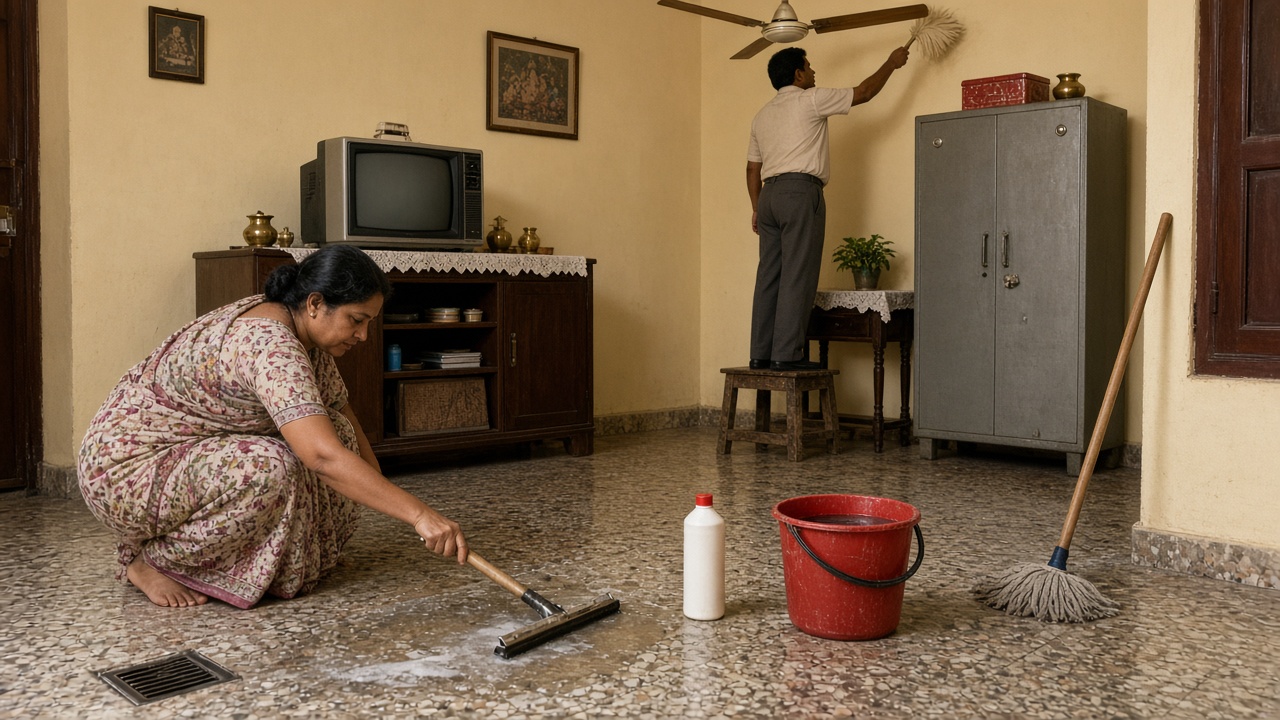
In the 1980s rubber floor wipers pushed water across washable mosaic floors towards the drain, plastic brushes, buckets, and dustpans replaced tin and brass, and long cobweb brooms reached the ceiling fans now found in most town homes. The first vacuum cleaners reached a few homes through door-to-door salesmen.
A rubber wiper on a mosaic floor while the ceiling fan gets dusted (artistic illustration).
1980s: Rubber floor wipers (squeegees) push washing water on mosaic floors and bathrooms towards the drain, and plastic buckets, brushes, and dustpans become everyday items.
1982: Eureka Forbes is set up in India and begins selling vacuum cleaners through door-to-door salesmen who demonstrate them in customers’ homes.
1980s: Ceiling fans, televisions, and more furniture mean more dusting, and long cobweb brooms and feather dusters join the cleaning kit.
1980s–1990s: Bottled toilet cleaners and scented floor cleaners start replacing plain phenyl in city homes, and TV adverts promote “germ-free” floors.
Technology
Rubber wipers: Water to the drain.
Plastic brushes: Scrubbing bathrooms.
Cobweb brooms: Reaching ceilings.
Features
Washable floors: Mosaic and tiles.
Doorstep demos: First vacuums.
Scented cleaners: Beyond phenyl.
🌀 Vacuum1990 – 2009
Vacuum Cleaners & Tiled Floors
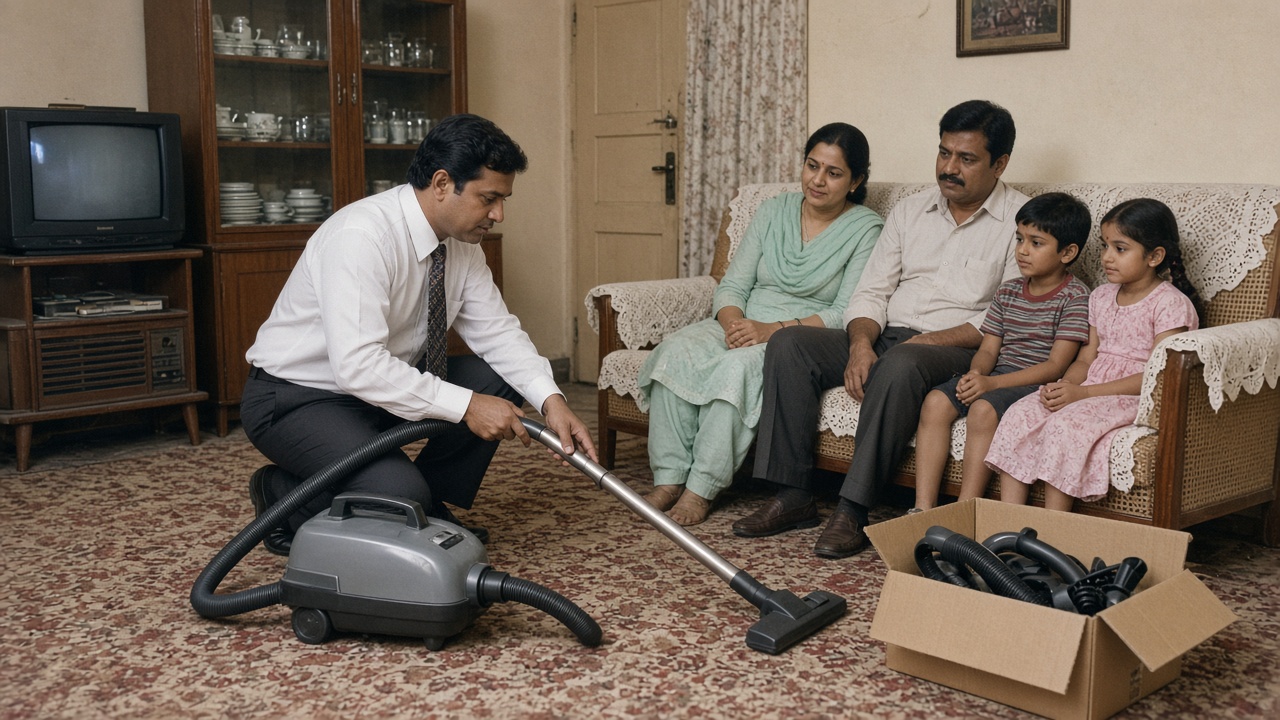
After liberalisation, vacuum cleaners became a status appliance in middle-class city homes, often bought after a salesman’s demonstration in the living room. Carpets, sofas, and curtains needed vacuuming, glossy ceramic and vitrified tiles replaced mosaic, and flat mops and microfibre cloths made floor cleaning faster.
A salesman demonstrates a vacuum cleaner to a curious family (artistic illustration).
1990s: Canister vacuum cleaners spread in middle-class city homes, mostly sold through doorstep demonstrations and later in electronics showrooms.
1990s: Carpets, upholstered sofas, and curtains become common in city homes, and handheld and car vacuums appear.
Late 1990s–2000s: Ceramic and vitrified tiles replace mosaic in new flats, making floors easier to mop, and global appliance brands sell a wider range of vacuums.
2000s: Flat mops with washable heads, microfibre cloths, disinfectant floor cleaners, and scrub sponges fill supermarket shelves.
Technology
Canister vacuums: Suction and hose.
Vitrified tiles: Low-absorption floors.
Microfibre: Traps fine dust.
Features
Attachments: Sofa, curtain, and crevice.
Standing mops: No more squatting.
EMIs: Appliances on instalments.
🤖 Robots2010 – 2019
Robot Vacuums, Spin Mops & Swachh Bharat
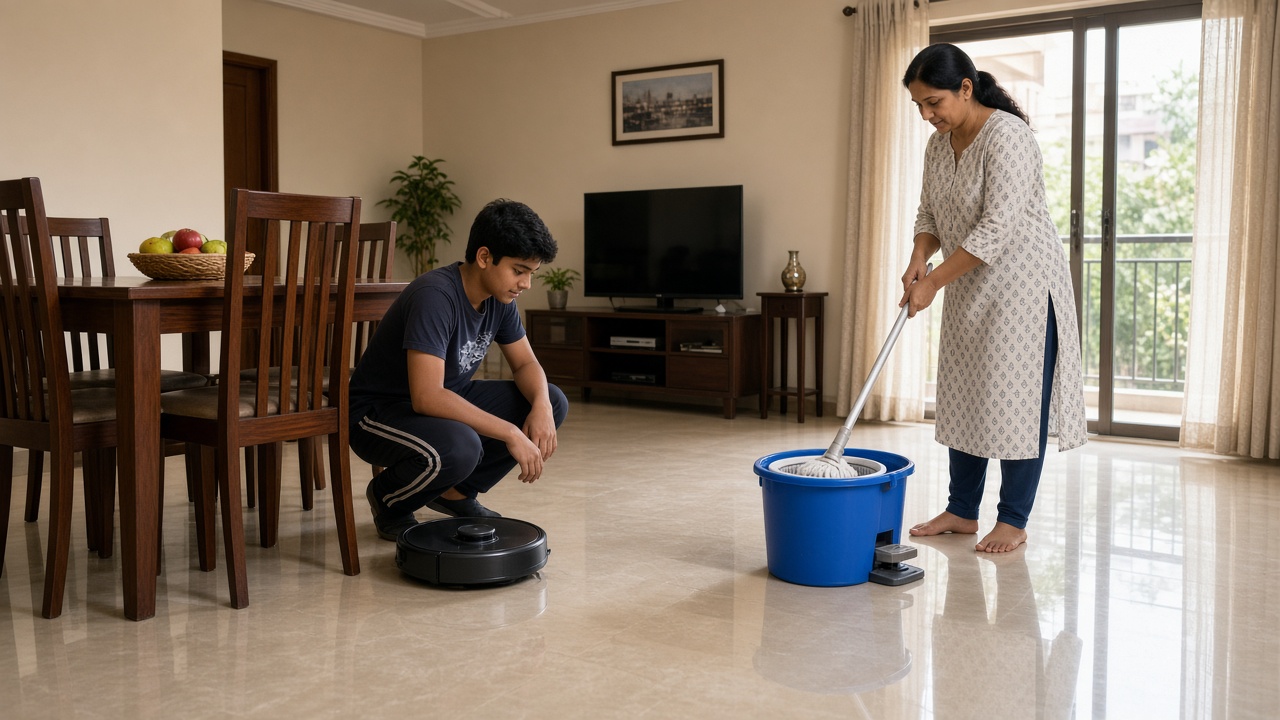
In the 2010s round robot vacuums began gliding across Indian floors, the spin mop with its pedal bucket became a household hit, and online shopping made cleaning gadgets easy to buy. Cleanliness also became a national campaign with the Swachh Bharat Mission, and robots started replacing people in dangerous sewer cleaning.
A robot vacuum at work while the spin mop gets wrung out (artistic illustration).
Early 2010s: Robot vacuum cleaners go on sale in India, with Indian brand Milagrow among the early sellers, and are adapted to mop as well as sweep for India’s hard floors.
2010s: Spin mops with pedal buckets end hand-wringing of mop cloths, and wet-and-dry vacuums and bagless cyclonic vacuums grow in popularity.
2014: The Swachh Bharat Mission is launched on 2 October, and app-based home services such as UrbanClap (now Urban Company) offer deep cleaning of homes.
2013–2018: A 2013 law bans manual scavenging, and in 2018 Kerala start-up Genrobotics introduces the Bandicoot robot to clean manholes.
Technology
Robot vacuums: Autonomous sweeping.
Spin mops: Pedal-powered wringing.
Cyclonic suction: Bagless vacuums.
Features
Scheduled cleaning: Runs on a timer.
Online buying: Gadgets delivered home.
Clean India: National campaign.
✨ Smart2020s – Future
Smart Mops, Wet-Dry Scrubbers & AI Robots
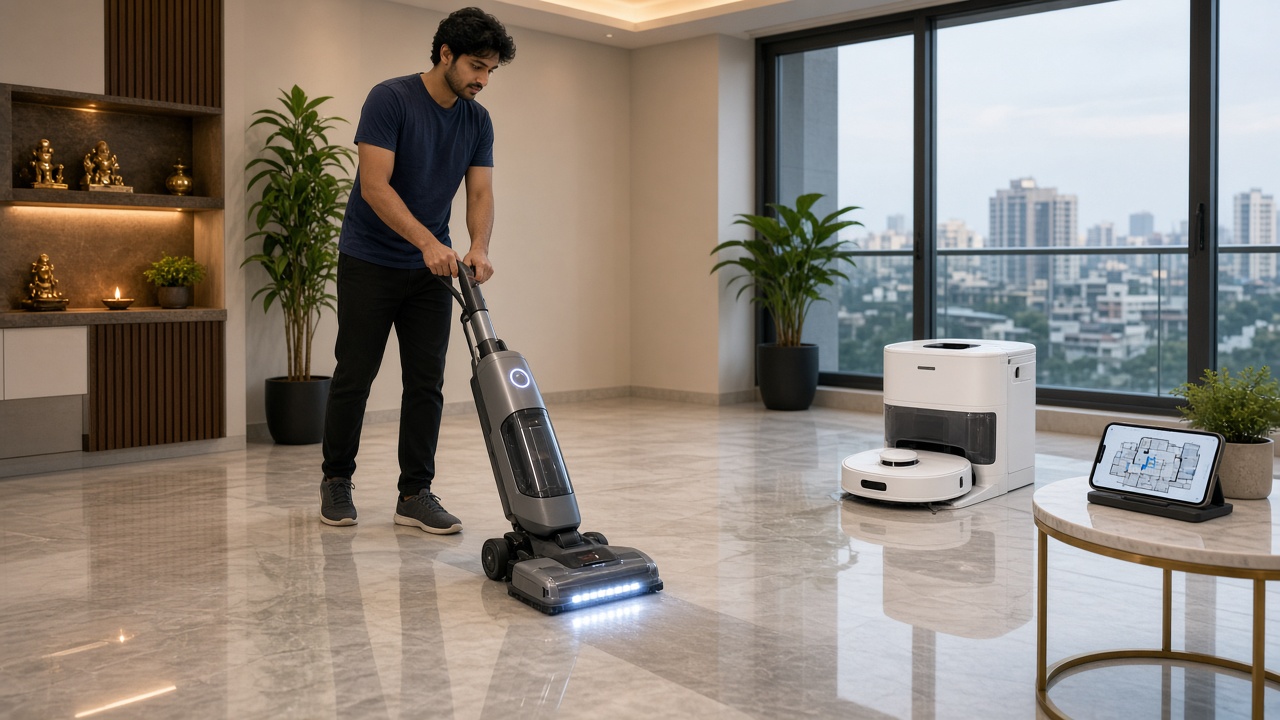
The 2020 lockdown, when many families cleaned without household help for months, pushed cleaning gadgets into the mainstream. Cordless smart mops now vacuum and scrub at once and wash their own rollers, while robot vacuum-mops map the home with lasers, avoid obstacles, and empty and wash themselves at a docking station.
A smart wet-dry scrubber and a robot mop with a self-washing dock (artistic illustration).
2020–2021: During the pandemic lockdowns families clean without household help, and sales of vacuums, robot cleaners, mops, and disinfectants rise sharply.
2020s: Cordless wet-dry smart mops vacuum and scrub in one pass, keep clean and dirty water separate, sense how dirty the floor is, and self-clean their rollers.
2020s: Robot vacuum-mops with LiDAR mapping, app and voice control, obstacle avoidance, and all-in-one docks that empty dust and wash and dry mop pads.
Future: AI cleaning robots that recognise objects, eco-friendly refillable cleaners, water-saving scrubbers, and home robots that also tidy and dust.
Technology
LiDAR mapping: Room-by-room plans.
Dirt sensors: Adjust suction and water.
Self-cleaning docks: Empty and wash.
Features
Vacuum + mop: One pass.
App control: No-go zones and schedules.
Hands-free: No touching dirty water.
From Jhadu to Robots: Cleaning Tools Through Time
Tool
Common from
What it does
Phool jhadu (grass broom)
Traditional
Sweeps fine dust indoors
Seenk jhadu (coconut-stick broom)
Traditional
Sweeps courtyards, bathrooms, and wet dirt
Pocha cloth
Traditional
Wipes floors by hand with water
Phenyl
Early 20th century onwards
Disinfects floors, drains, and toilets
Rubber floor wiper
1970s–1980s
Pushes water towards the drain
Cobweb broom and feather duster
1980s
Reaches fans, ceilings, and shelves
Canister vacuum cleaner
1980s–1990s
Sucks dust from carpets and sofas
Flat and microfibre mop
2000s
Mops standing up; traps fine dust
Spin mop
2010s
Wrings the mop with a pedal or push
Robot vacuum-mop
2010s–2020s
Sweeps and mops on its own
Smart wet-dry scrubber
2020s
Vacuums and washes floors in one pass
Indian Floors and How They Were Cleaned
Floor type
Common from
How it was cleaned
Good to know
Mud with cow-dung plaster
Ancient times–now (villages)
Swept daily, re-plastered every few days
Cool underfoot; needs regular upkeep
Kota and Shahabad stone
Colonial era onwards
Swept and wiped with a wet cloth
Hard-wearing local stone
Red oxide
Early–mid 20th century
Pocha and occasional oiling for shine
Cool, glossy, and now nostalgic
Mosaic (terrazzo)
1960s–1980s
Washed with water and a rubber wiper
Polished chips of marble in cement
Marble
1980s onwards
Mild cleaners; avoid acids
Stains easily with lemon or vinegar
Ceramic and vitrified tiles
Late 1990s onwards
Mops, spin mops, and robots
Low-absorption and easy to clean
Wood and laminate
2010s onwards (few homes)
Vacuum and a barely damp mop
Water can damage the surface
Cleaning Traditions and Cleanliness Drives
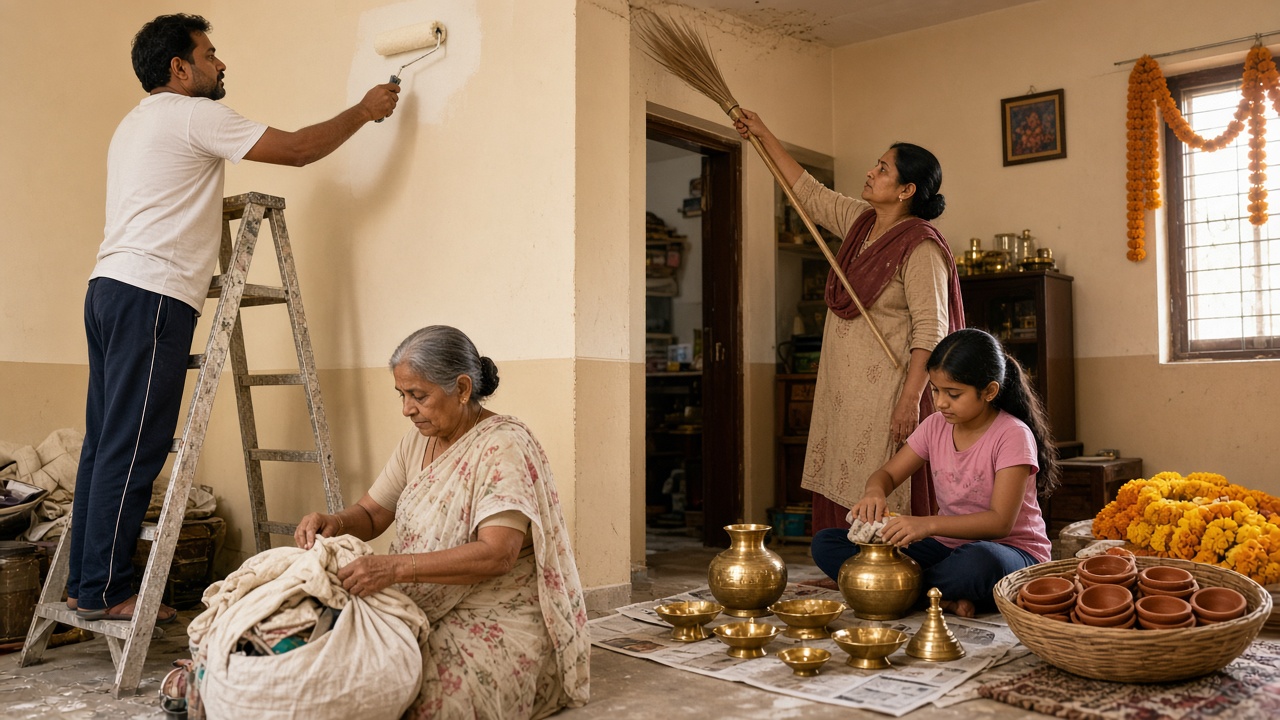
Painting, dusting, sorting, and polishing brass during Diwali safai (artistic illustration).
Occasion
When
What is cleaned
Diwali safai
October–November
Whole house cleaned, painted, and decluttered before Lakshmi Puja
Bhogi
January (Tamil Nadu, Andhra Pradesh, Telangana)
Old items discarded and homes cleaned before Sankranti and Pongal
Ugadi and Gudi Padwa
March–April
Homes cleaned and doorways decorated for the new year
Onam
August–September (Kerala)
Homes and courtyards cleaned for pookalam flower carpets
Chhath
October–November (Bihar and eastern UP)
River ghats and ponds cleaned by communities
Swachh Bharat Mission
From 2 October 2014
Streets, public places, and toilets across India
Swachh Survekshan
Annual, from 2016
Cities ranked on cleanliness
Home Cleaning Timeline Summary
Year / Era
Milestone
c. 2500 BCE
Harappan covered drains and bathrooms
Ancient times
Grass brooms, gobar lipai, and lime whitewash
1901
Bengal Chemicals founded; later known for phenyl
1950s
Jhadu-pocha on red oxide and stone floors
1960s–1970s
Mosaic floors and cloth mops
1980s
Rubber floor wipers and plastic brooms
1982
Eureka Forbes and doorstep vacuum demos
1990s
Vacuum cleaners spread in city homes
Late 1990s–2000s
Vitrified tiles and flat mops
Early 2010s
Robot vacuums go on sale in India
2010s
Spin mops become a household hit
2013
Law bans manual scavenging
2014
Swachh Bharat Mission launched
2016
First Swachh Survekshan city ranking
2018
Bandicoot manhole-cleaning robot
2020–2021
Lockdown boom in cleaning gadgets
2020s
Smart wet-dry mops and self-washing robot docks
Future
AI robots that clean, tidy, and dust
Test Your Knowledge
20 quick questions from the home cleaning timeline. Click each question to reveal the answer.
Answer: Mohenjo-daro.
Answer: Plastering mud floors and walls with a paste of cow dung, mud, and water.
Answer: Lime whitewash for walls.
Answer: Dried broom grass.
Answer: The thin ribs of coconut or palm leaves.
Answer: Wiping the floor with a wet cloth.
Answer: Acharya Prafulla Chandra Ray.
Answer: A cement floor coloured with red iron oxide and polished to a glossy finish.
Answer: Chips of marble set in cement and polished.
Answer: Pushes water across the floor towards the drain.
Answer: 1982.
Answer: By door-to-door salesmen who demonstrated them at home.
Answer: They absorb very little water, so stains stay on the surface.
Answer: They react with marble and leave dull marks and stains.
Answer: A spinner in the bucket whirls the mop head when a pedal or the handle is pressed.
Answer: 2 October 2014, Gandhi Jayanti.
Answer: Cleaning manholes and sewers so that people do not have to enter them.
Answer: An annual survey that ranks Indian cities on cleanliness.
Answer: Map rooms with laser light and plan its cleaning path.
Answer: To keep clean water and dirty water separate so the floor is always washed with clean water.
Classroom activity
Students Tasks
Use these prompts for discussion or projects on how Indians have cleaned their homes over time.
Timeline understandingHygiene and healthTechnology and robotsDignity of labour
Interview a grandparent about how floors were cleaned in their childhood home and what the floor was made of.
Make a timeline poster: brooms (1950s), floor wipers (1980s), vacuum cleaners (1990s), robot vacuums (2010s), and smart mops (2020s).
Compare a phool jhadu and a seenk jhadu: what are they made of, and where is each one used?
Identify the floor types in your home and school, and find out the best way to clean each one.
Time how long it takes to sweep and mop one room by hand, and compare it with a vacuum or robot cleaner if available.
Draw a diagram showing how a robot vacuum uses sensors to avoid stairs and obstacles.
List who does the cleaning in your home and discuss how chores could be shared fairly.
Research the Swachh Bharat Mission and your city’s latest Swachh Survekshan ranking.
Find out why manual scavenging was banned and how robots like Bandicoot help sanitation workers.
Debate: “Robot cleaners will make brooms disappear from Indian homes.”
Continue exploring
Home cleaning changed with electricity, the internet, Digital India, and artificial intelligence. Explore these connected timelines next.
Click any panel to expand and explore the visual mood.
India’s cleaning journey in pictures — gobar lipai, jhadu-pocha on a red oxide floor, the 1980s floor wiper, the doorstep vacuum demo, the robot vacuum and spin mop, the smart wet-dry scrubber, Diwali safai, and then versus now.
Gobar Lipai
Plastering the courtyard
Jhadu & Pocha
Red oxide floors
Floor Wiper
Mosaic and phenyl
Vacuum Demo
Salesman at the door
Robot Vacuum
And the spin mop
Smart Mop
Vacuum and scrub
Diwali Safai
Clean, paint, declutter
Then vs Now
Jhadu to robot
Explore all daily life timelines
Jump to any other daily life timeline on WorldTimelineHub.
Disclaimer: This content is AI-generated for educational purposes and may contain errors or outdated details. For correct and authoritative information, please refer to official and reliable sources such as government publications, manufacturers, museums, and academic references.