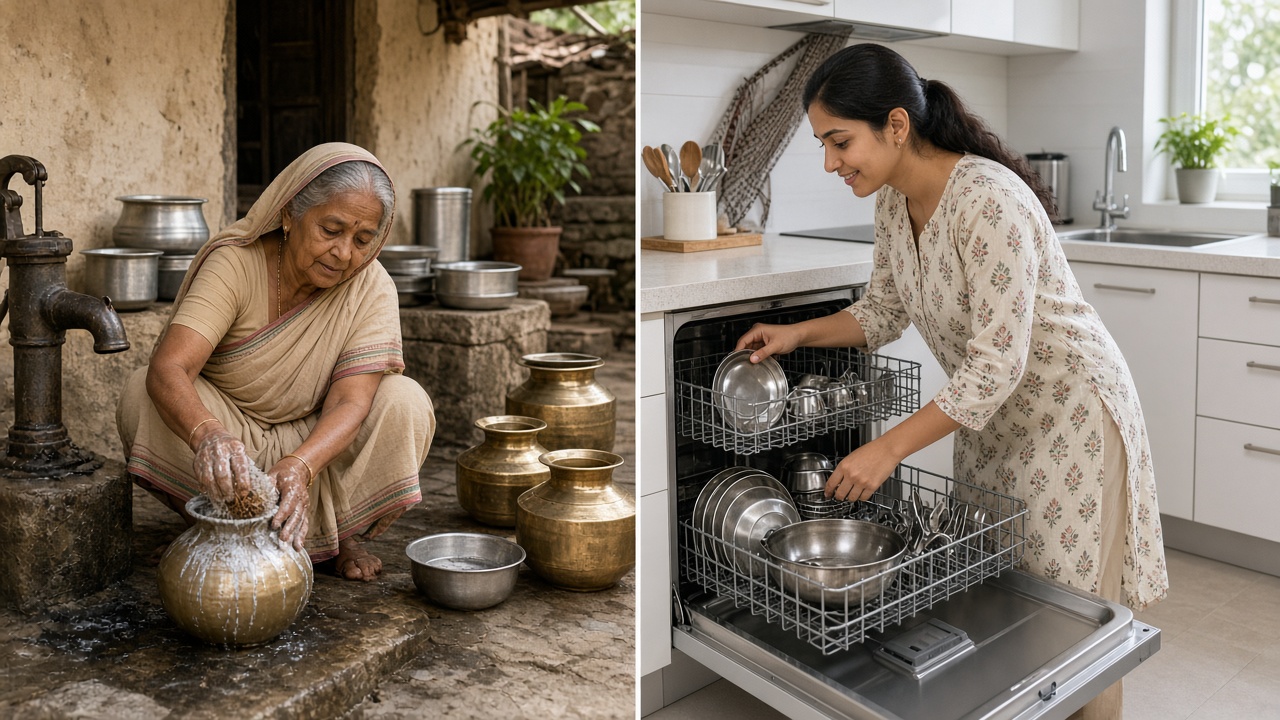
In the 1950s Indian women squatted beside the hand pump or well and scrubbed brass and aluminium vessels with ash from the chulha and a fistful of coconut coir. Stainless steel, scouring powder, and
dishwash bars took over in the 1970s and 1980s, liquid gels and sponges arrived with kitchen sinks in the 1990s, and in the 2020s dishwashers with special cycles for oily kadhais entered Indian kitchens.
This timeline covers ash, sand, clay, tamarind, lemon, and coconut coir, brass, copper, kansa, clay, and aluminium vessels, tin-coating kalaiwalas, stainless steel, steel wool, scouring powder,
dishwash bars, liquid gels, sponge scrubbers, sinks and dish racks, banana leaf and sal-leaf plates, and dishwashers with Indian cycles, tablets, and water softeners.
Indian cooking uses oil, turmeric, masala, and many small bowls, so washing up after every meal is one of the longest daily chores. How India washes its utensils reflects changes in metals,
water supply, kitchen design, chemistry, household help, and who shares the housework. The journey from chulha ash at the hand pump to a dishwasher with a “kadhai cycle” shows everyday technology adapting to Indian food.
Big picture
India’s dish washing journey in one view
For centuries Indians scoured brass, copper, and clay vessels with sand, ash, tamarind, and coconut coir, and ate feasts on leaf plates that needed no washing. After independence ash remained the everyday
cleaner, stainless steel and dishwash bars took over in the 1970s and 1980s, liquid gels and sinks came in the 1990s, modular kitchens in the 2010s, and dishwashers in the 2020s. Related timelines:
power grid,
women’s education,
Digital India.
1950s
Chulha ash and coir at the hand pump
1970s
Steel thalis and dishwash bars spread
1990s
Liquid gels and kitchen sinks
2020
Lockdown dishwasher boom
From ash and coir at the hand pump to a dishwasher loaded with steel utensils (artistic illustration).
Dish Washing Then vs Now at a Glance
Feature
Then
Now
Where
Hand pump, well, or floor-level washing corner
Kitchen sink or dishwasher
Posture
Squatting on the ground
Standing at the counter
Cleaner
Ash, sand, clay, and tamarind
Bars, liquid gels, and tablets
Scrubber
Coconut coir and straw
Sponge pads, steel wool, and brushes
Utensils
Brass, copper, clay, and aluminium
Stainless steel, non-stick, and glass
Water
Drawn from a well or pump
Tap water, often heated in a dishwasher
Drying
Upside down in the sun
Dish racks and dishwasher dry cycles
Feasts
Banana leaves and sal-leaf plates
Steel plates, caterers, and disposables
Who washed
Women of the house and helpers
Family members, helpers, and machines
Control
Elbow grease and experience
Programmes, sensors, and apps
🥥 CoirAncient – 1946
Sand, Tamarind & Coconut Coir
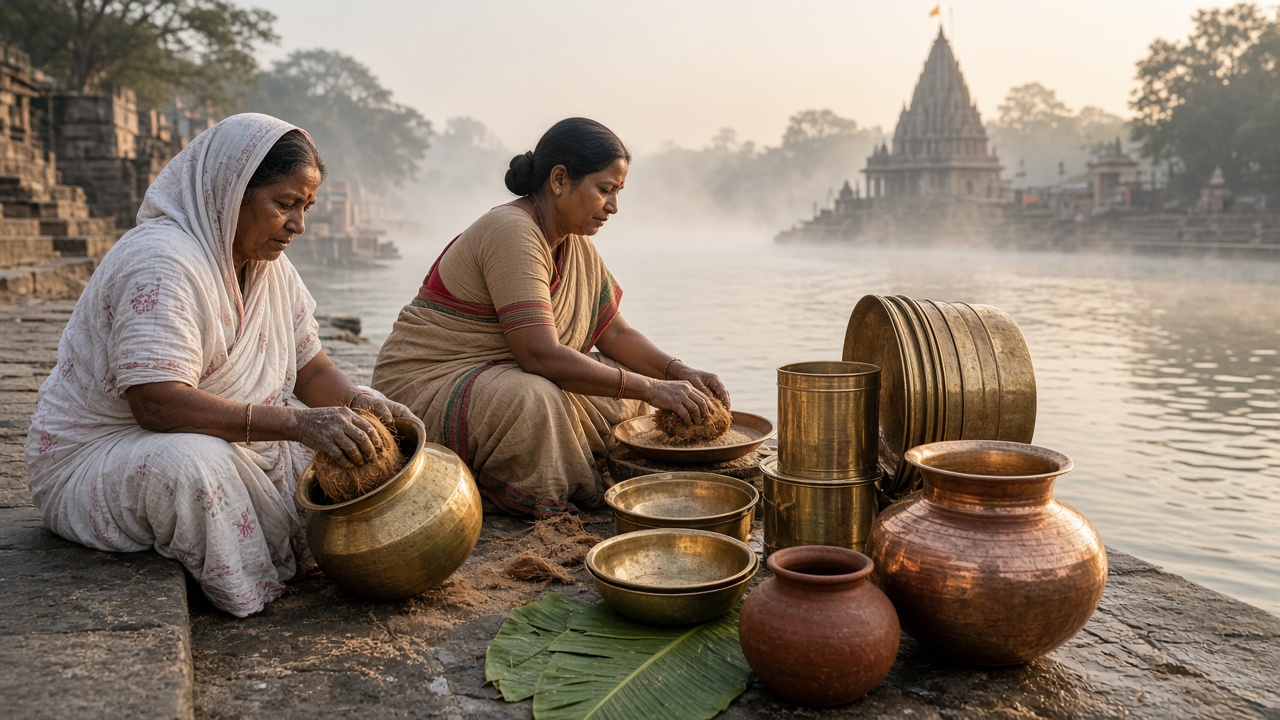
For thousands of years Indian vessels of clay, brass, copper, and bronze were scoured with river sand, ash, clay, and coconut coir, and metal was polished with tamarind and lemon. Feasts were served on banana leaves and sal-leaf plates that were thrown away, and ideas of purity meant used utensils were washed separately and promptly.
Scouring brass and copper vessels with sand and coconut coir at the ghat (artistic illustration).
c. 2500 BCE: Harappan homes use pottery and copper and bronze vessels, and wells and drains supply and remove water for washing.
Ancient times: Vessels are scoured with sand, clay, and ash using coconut coir or straw, and brass and copper are polished with tamarind, lemon, and salt.
Tradition: Banana leaves in the South and stitched sal-leaf pattal and dona in the North and East serve feasts and are discarded after the meal, so no washing is needed.
Colonial era: Travelling kalaiwalas coat the insides of brass and copper vessels with tin to stop food reacting with the metal, and aluminium utensils start to appear.
Technology
Coconut coir: Natural scrubber.
Sand and ash: Gentle abrasives.
Kalai (tinning): Protective lining.
Features
Leaf plates: No washing needed.
Tamarind polish: Shining brass.
Riverside washing: At the ghat.
🔥 Ash1947 – 1969
Chulha Ash at the Hand Pump
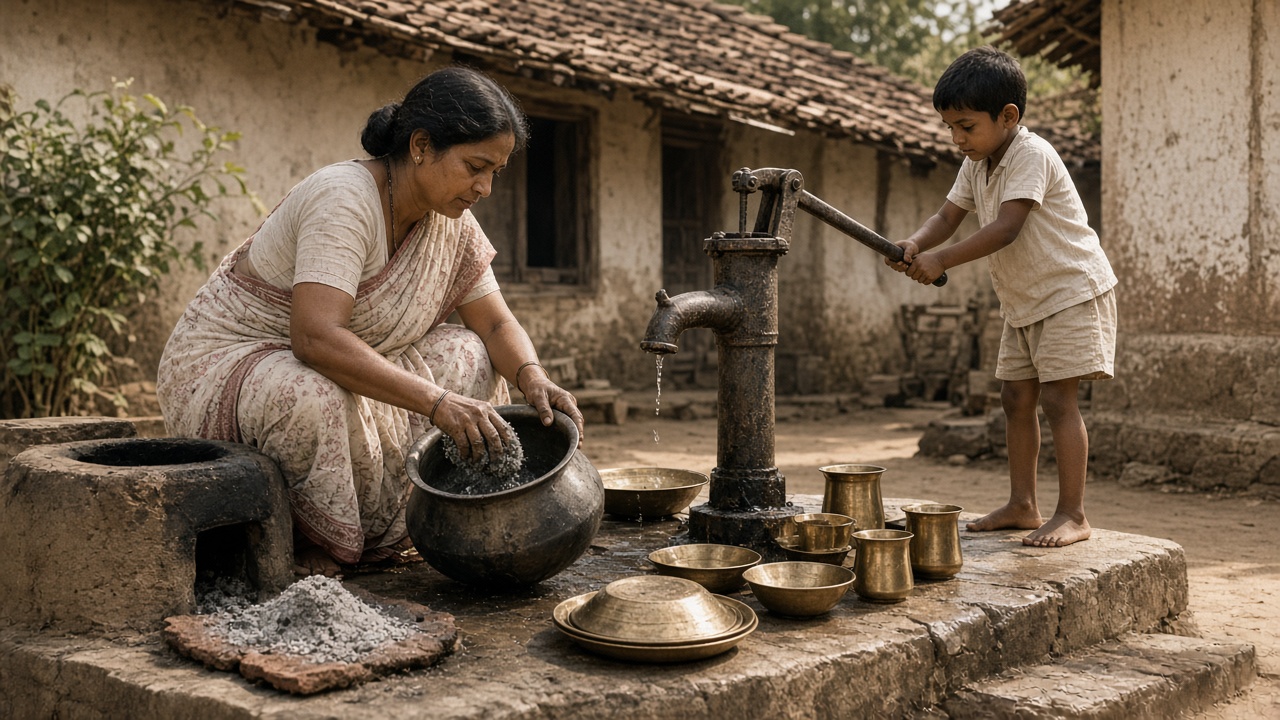
In the 1950s most homes cooked on wood or cow-dung chulhas, and the ash they left behind was the free, everyday dish cleaner. Women squatted on a stone platform by the hand pump or well, rubbed ash onto soot-blackened pots with coconut coir, rinsed them, and left brass and aluminium vessels to dry upside down in the sun.
Chulha ash and a coir scrubber at the hand pump (artistic illustration).
1950s: Ash from wood and cow-dung chulhas, rubbed on with coconut coir, is the most common dish cleaner in rural and small-town India.
1950s: Utensils are washed at hand pumps, wells, and courtyard platforms, often twice a day after the main meals, and dried in the sun.
1950s–1960s: Cheap aluminium vessels spread widely, and brass and copper still need regular tamarind polishing and re-tinning by the kalaiwala.
1960s: Stainless steel utensils start to appear in town homes and as wedding gifts, and laundry soap or washing soda is sometimes used on greasy vessels.
Technology
Chulha ash: Free grease cutter.
Hand pumps: Water at the door.
Aluminium: Light, cheap vessels.
Features
Squatting work: On a stone platform.
Sun drying: Natural sanitising.
Zero cost: Waste ash reused.
🟢 Bars1970 – 1989
Steel Utensils, Scouring Powder & Dishwash Bars
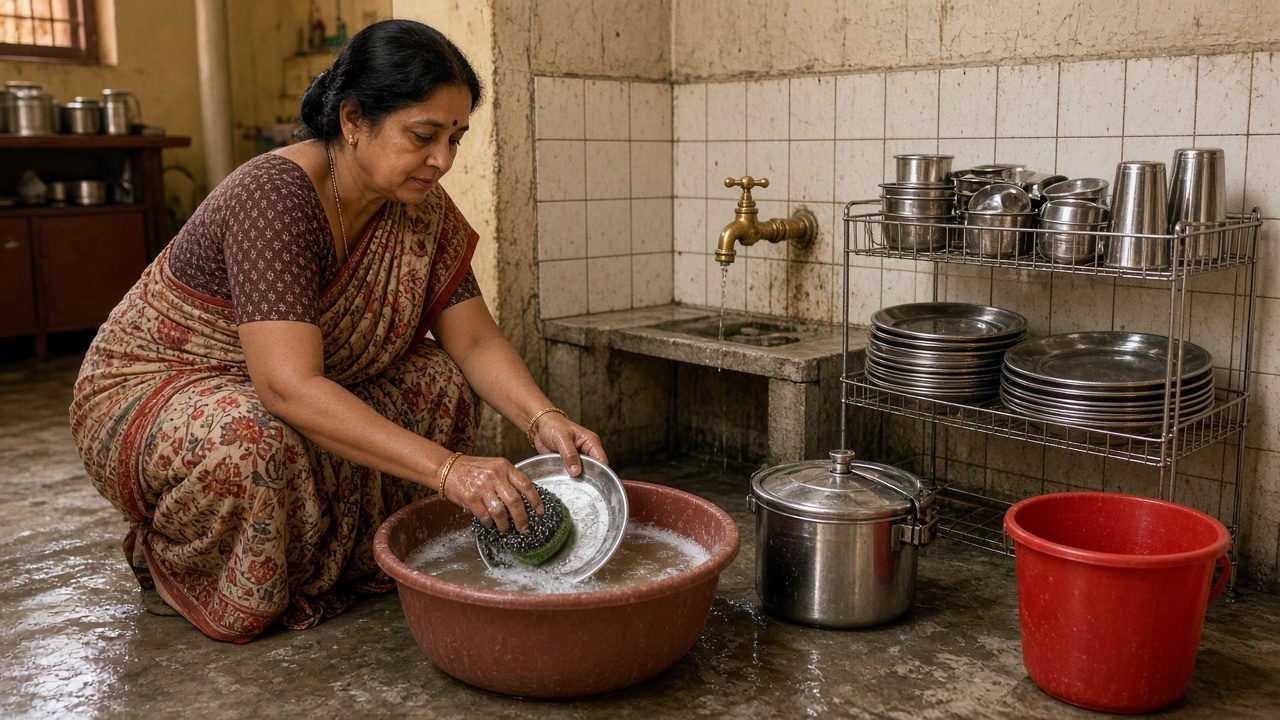
As stainless steel thalis, katoris, and tumblers replaced brass and bronze, washing became easier — no tarnish to polish. In town homes with taps, utensils were washed at a floor-level washing corner using scouring powder, and later dishwash bars in plastic tubs, with curly steel-wool and nylon scrubbers.
A dishwash bar, steel-wool scrubber, and shiny steel utensils at the washing corner (artistic illustration).
1970s: Stainless steel utensils become standard in middle-class homes and a favourite wedding gift, and steel wire racks hold the washed thalis and tumblers.
1970s: Scouring powders and even laundry detergent powder are used on greasy vessels, and Vim, which began as a scouring powder, becomes a household name.
1980s: Solid dishwash bars sold in round plastic tubs spread, along with curly steel-wool (“jaali”) and nylon scrubbers that replace coir in many city homes.
1980s: LPG stoves reduce soot on pots, pressure cookers become common, and washing moves to a tap-fed washing corner or courtyard in town homes.
Technology
Stainless steel: No tarnish.
Scouring powder: Abrasive cleaning.
Steel wool: Tough on burnt food.
Features
Dishwash bar tubs: Long-lasting.
Wire racks: Drying steel.
Tap washing: Water at home.
💧 Liquid1990 – 2009
Liquid Gels, Sponges & Kitchen Sinks
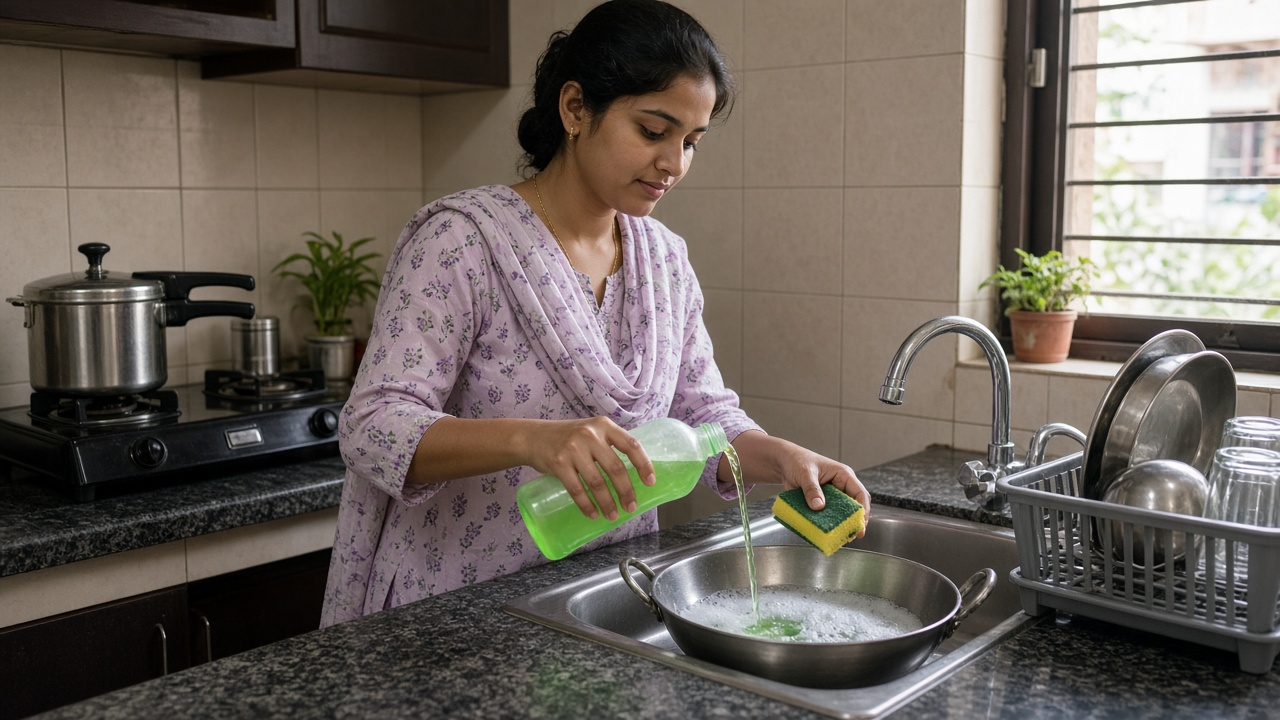
After liberalisation, city flats were built with steel kitchen sinks and taps, so people stood to wash dishes instead of squatting. Liquid dishwash gels in bottles made quick foam on sponge-scrub pads, non-stick pans needed gentler cleaning, and plastic dish racks sat beside the sink.
Liquid gel on a sponge pad at the new kitchen sink (artistic illustration).
1990s: Stainless steel sinks with taps become standard in new city flats, and washing up moves from the floor to the counter.
1990s–2000s: Liquid dishwash gels in squeeze bottles grow in cities, advertised as gentler on hands and faster to rinse.
1990s–2000s: Two-sided sponge-scrub pads replace coir and steel wool for everyday use, and non-stick pans need soft sponges to protect their coating.
2000s: Plastic and steel dish racks, lemon-scented gels, and “anti-bacterial” claims become common, while dishwash bars remain the most used cleaner across India.
Technology
Liquid gels: Concentrated foam.
Sponge pads: Scrub and wipe.
Steel sinks: Standing washing.
Features
Hand-friendly: Milder formulas.
Non-stick safe: Soft scrubbing.
Dish racks: Drip drying.
🚰 Modular2010 – 2019
Modular Kitchens & Refill Pouches
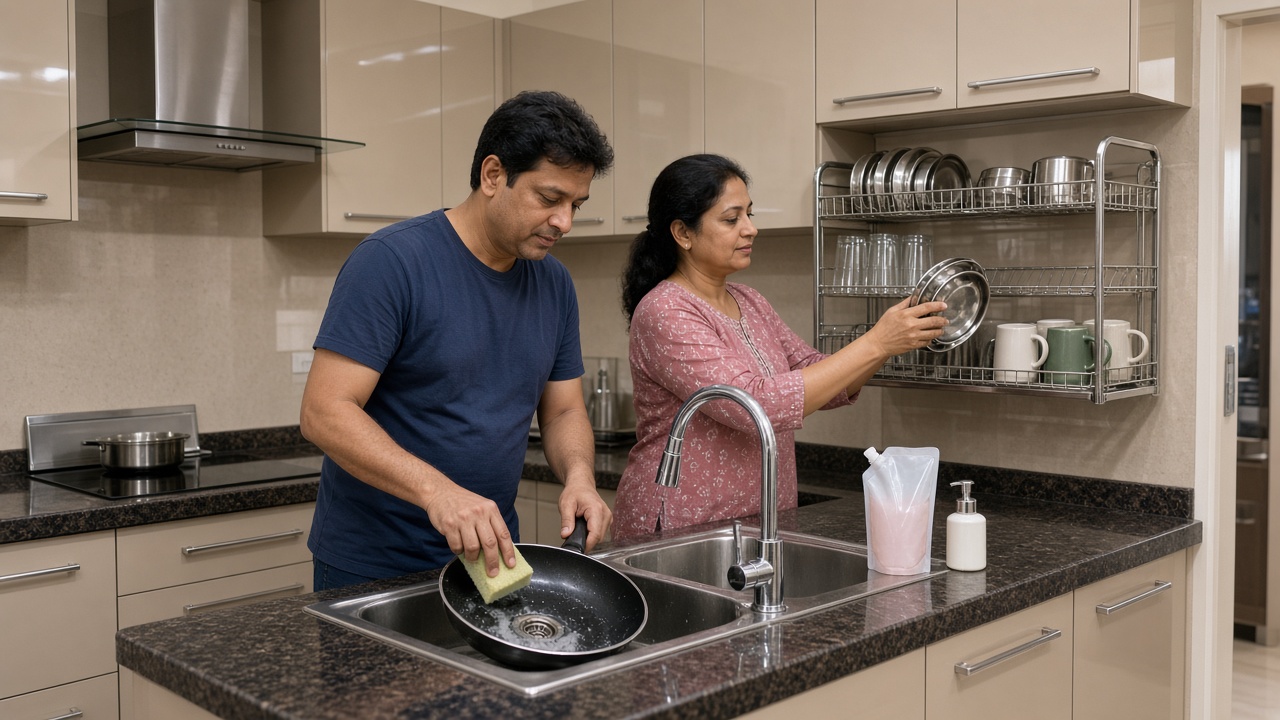
In the 2010s modular kitchens brought double-bowl sinks, pull-out taps, and wall-mounted steel dish racks. Gels came in cheaper refill pouches, more men began sharing the washing up, and the first dishwashers with programmes for Indian utensils appeared in showrooms, though very few homes bought them.
A couple shares the washing up at a double-bowl sink (artistic illustration).
2010s: Modular kitchens with double-bowl sinks, pull-out taps, and wall-mounted steel racks spread in city apartments.
2010s: Dish gels are sold in refill pouches and small sachets, and pump dispensers and silicone scrubbers appear.
2010s: Dishwashers with cycles for Indian utensils go on sale, but high prices, small kitchens, and worries about oily kadhais keep ownership very low.
Late 2010s: Eco-friendly coir and loofah scrubbers and plant-based dish liquids return as people look for plastic-free options.
Technology
Double sinks: Wash and rinse.
Refill pouches: Less plastic, lower cost.
Early dishwashers: Indian cycles.
Features
Shared chores: Men at the sink.
Wall racks: Save counter space.
Eco scrubbers: Coir comes back.
🍽️ Dishwasher2020s – Future
Dishwashers for Indian Kitchens
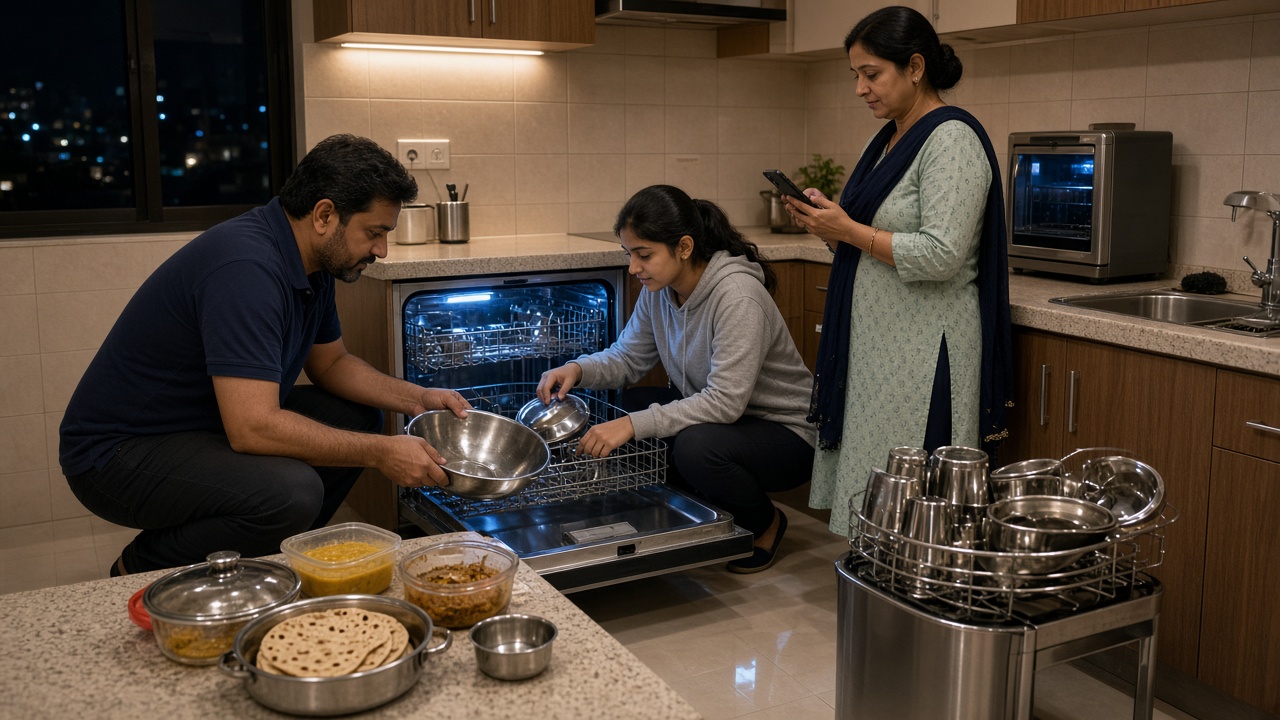
The 2020 lockdown, when household helpers could not come and families washed piles of utensils several times a day, turned the dishwasher from a luxury into a practical buy for many city homes. Today’s models have intensive cycles for oily kadhais and pressure-cooker lids, built-in water softeners for hard water, and even app control.
The whole family loads steel utensils into the dishwasher after dinner (artistic illustration).
2020–2021: During the pandemic lockdowns families wash every utensil themselves, and dishwasher sales in Indian cities rise sharply from a very small base.
2020s: Dishwashers offer Indian or intensive cycles with hot water and strong jets for oil, turmeric, and masala stains, plus steam and hygiene rinses.
2020s: Built-in water softeners handle hard water, detergent tablets and rinse aid replace gels, and compact countertop models suit small kitchens.
Future: Wi-Fi and AI-controlled cycles, water-recycling machines, plant-based tablets, and robot arms that load and unload dishes.
Technology
Hot-water jets: Cut through oil.
Water softeners: No white spots.
Sensor cycles: Adjust to the load.
Features
Kadhai cycle: Indian cooking.
Countertop models: Small kitchens.
Less water: Full loads save water.
From Raakh to Rinse Aid: Dish Cleaners Through Time
Cleaner or scrubber
Common from
What it does
Ash (raakh)
Ancient times–now
Cuts grease and scrubs off soot
Sand and clay
Ancient times
Gentle abrasive for pots
Tamarind, lemon, and salt
Traditional
Removes tarnish from brass and copper
Coconut coir
Traditional
Natural, biodegradable scrubber
Soap and washing soda
Early–mid 20th century
Loosens grease on vessels
Scouring powder
1970s
Abrasive cleaning of steel and aluminium
Steel wool (jaali)
1970s–1980s
Removes burnt-on food
Dishwash bar
1980s onwards
Cheap, long-lasting grease remover
Sponge-scrub pad
1990s onwards
Scrubs on one side, wipes on the other
Liquid dishwash gel
1990s–2000s onwards
Concentrated foam that rinses easily
Dishwasher tablets and rinse aid
2010s–2020s
Machine cleaning and spot-free drying
Indian Utensils and How They Are Cleaned
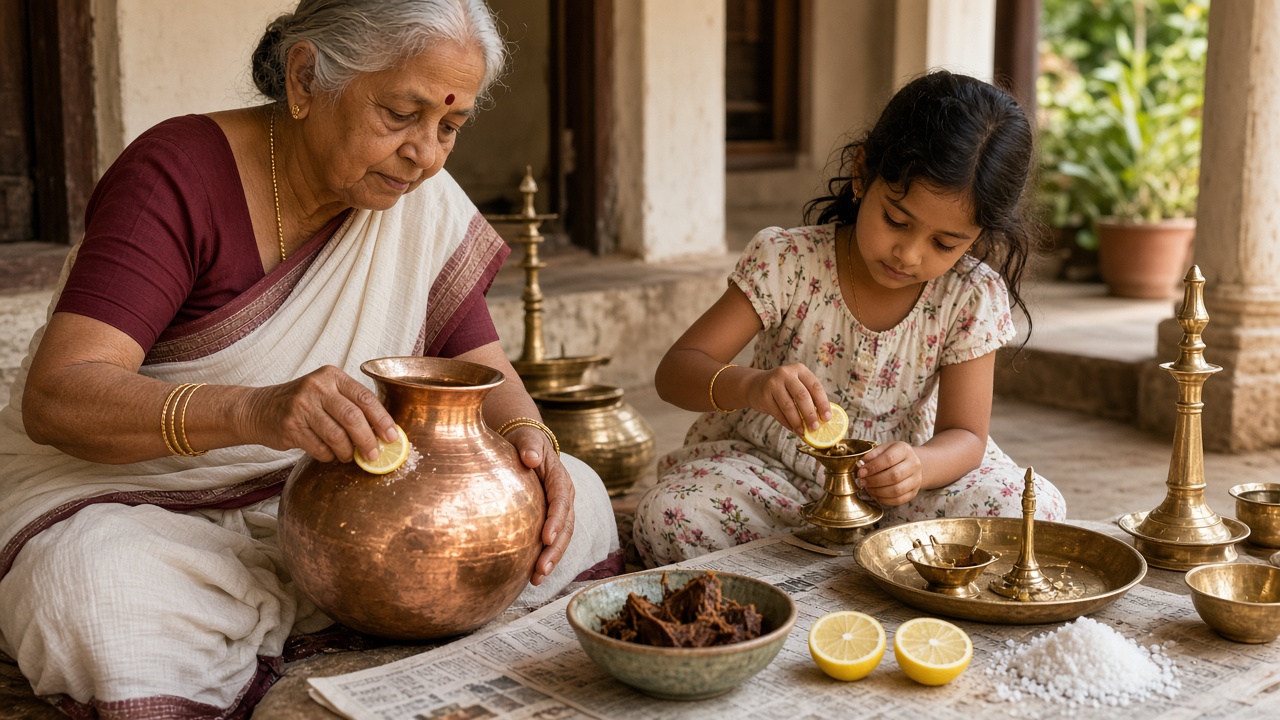
Bringing back the shine on copper and brass with lemon, tamarind, and salt (artistic illustration).
Material
Common from
How it is cleaned
Dishwasher-safe?
Clay pots
Ancient times–now
Water and a soft scrub; no soap
No
Brass and copper
Ancient times–now
Tamarind or lemon with salt to remove tarnish
No
Bronze (kansa)
Ancient times–now
Mild soap, then tamarind or ash polish
No
Cast iron kadhai and tawa
Traditional–now
Scrub, dry fully, and oil to prevent rust
No
Aluminium
1930s–now
Ash, bar, or steel wool
Can discolour
Stainless steel
1960s–now
Bar, gel, or dishwasher
Yes
Non-stick
1990s–now
Soft sponge and gel only
Some models
Glass and ceramic
1990s–now
Gel and sponge, or dishwasher
Usually yes
Leaf Plates to Disposables: What Indians Ate On
Plate
Where and when
Washing needed?
Banana leaf
South India, traditional–now
No; composted after the meal
Sal-leaf pattal and dona
North, Central, and East India, traditional
No; thrown away and decompose
Kansa and brass thali
Traditional homes
Yes; polished regularly
Stainless steel thali
1960s–now
Yes; easy to wash
Plastic and thermocol plates
1990s–2010s
No, but create waste
Areca palm leaf plates
2010s–now
No; biodegradable
Single-use plastic ban
From 1 July 2022
Bans many plastic cutlery and plate items
Dish Washing Timeline Summary
Year / Era
Milestone
c. 2500 BCE
Harappan pottery, copper vessels, and wells
Ancient times
Sand, ash, coir, and tamarind polish
Traditional
Banana leaf and sal-leaf plates at feasts
Colonial era
Kalaiwalas tin brass and copper; aluminium arrives
1950s
Chulha ash and coir at the hand pump
1960s
Stainless steel utensils appear
1970s
Steel thalis and scouring powder
1980s
Dishwash bars and steel-wool scrubbers
1990s
Kitchen sinks and sponge pads
1990s–2000s
Liquid dishwash gels
2010s
Modular kitchens and refill pouches
2010s
First dishwashers with Indian cycles
2020–2021
Lockdown dishwasher boom
2022
Single-use plastic ban
2020s
Water softeners, tablets, and countertop models
Future
AI cycles and robot loading
Test Your Knowledge
20 quick questions from the dish washing timeline. Click each question to reveal the answer.
Answer: It is mildly alkaline, which cuts grease, and its fine grains scrub off soot.
Answer: Tough fibre from coconut husk, used as a scrubber.
Answer: Tamarind and lemon.
Answer: They tarnish as the metal reacts with air and moisture.
Answer: Coated the insides of brass and copper vessels with tin.
Answer: Plates and bowls made from dried leaves, especially sal leaves.
Answer: South India.
Answer: At a hand pump, well, or courtyard platform.
Answer: They do not tarnish or rust and are easy to clean.
Answer: A curly steel-wool scrubber.
Answer: As a solid cake in a round plastic tub.
Answer: They left far less soot on pots than wood chulhas.
Answer: Kitchen sinks with taps in city flats.
Answer: Hard scrubbers scratch off the non-stick coating.
Answer: To stop it from rusting.
Answer: Household helpers could not come during the lockdowns.
Answer: White spots and scale from hard water.
Answer: Around 10 to 15 litres.
Answer: Brass, copper, clay, cast iron, or wooden items.
Answer: 1 July 2022.
Classroom activity
Students Tasks
Use these prompts for discussion or projects on how Indians have washed their utensils over time.
Timeline understandingChemistry of cleaningWater and wasteSharing housework
Interview a grandparent about what they used to wash utensils as children and where they washed them.
Make a timeline poster: ash (1950s), dishwash bars (1970s–1980s), liquid gels (1990s), modular sinks (2010s), and dishwashers (2020s).
With an adult’s help, clean a tarnished copper or brass coin with lemon and salt and explain what happens.
Test litmus or turmeric paper on ash water and lemon juice to see which is acidic and which is alkaline.
Measure how many litres of water your family uses to wash dinner utensils and suggest ways to save water.
List all the utensil materials in your kitchen and note how each one should be cleaned.
Compare coconut coir, steel wool, and sponge scrubbers on cost, cleaning power, and environmental impact.
Find out why banana leaf and sal-leaf plates are better for the environment than plastic plates.
Make a fair weekly chart for sharing the washing up among all family members.
Debate: “Every Indian home should own a dishwasher.”
Continue exploring
Dish washing changed with electricity, women’s education and work, Digital India, and the internet. Explore these connected timelines next.
Click any panel to expand and explore the visual mood.
India’s dish washing journey in pictures — scouring at the river ghat, chulha ash at the hand pump, the dishwash bar and steel utensils, liquid gel at the sink, the modular kitchen, the dishwasher, polishing brass, and then versus now.
River Ghat
Sand and coconut coir
Chulha Ash
At the hand pump
Dishwash Bar
Steel and jaali
Liquid Gel
Sponge at the sink
Modular Kitchen
Sharing the washing up
Dishwasher
Kadhai cycle
Brass Polish
Lemon and tamarind
Then vs Now
Ash to dishwasher
Explore all daily life timelines
Jump to any other daily life timeline on WorldTimelineHub.
Disclaimer: This content is AI-generated for educational purposes and may contain errors or outdated details. For correct and authoritative information, please refer to official and reliable sources such as government publications, manufacturers, museums, and academic references.