Home Entertainment Timeline of India: Radio → TV → Cable → OTT → Smart TVs
In the 1950s families gathered around a wooden radio for film songs and radio plays. In the 1980s whole neighbourhoods crowded into one home to watch Doordarshan serials, the 1990s brought
cable wallahs and dozens of satellite channels, the 2010s made OTT web series something you could watch anywhere on a phone, and in the 2020s the smart TV became the family’s window to every app.
This timeline covers puppet shows and folk theatre, gramophone records, Radio Ceylon and Vividh Bharati, transistor radios, Doordarshan, Chitrahaar and Ramayan, VCRs and video libraries,
cable operators and satellite channels, DTH dishes, digital set-top boxes, OTT platforms, free cricket streaming, and voice-controlled smart TVs.
What a family watches or listens to together shapes its language, music, festivals, and shared memories. In India the journey from one radio for a whole household to a screen for every person
shows how technology, government policy, and prices changed not only entertainment but also how families and neighbours spend their evenings together.
Big picture
India’s home entertainment journey in one view
For centuries entertainment was live — storytellers, folk theatre, and travelling performers. Gramophones and radio brought music into homes, and the radio ruled the 1950s and 1960s.
Doordarshan serials made the 1980s the decade of shared TV viewing, cable and satellite channels exploded in the 1990s, OTT streaming arrived in the 2010s, and the 2020s brought smart TVs
that combine all of these on one screen. Related timelines:
radio,
television,
the internet.
1952
Binaca Geetmala begins on Radio Ceylon
1987
Ramayan empties streets on Sundays
1992
Zee TV, first private Hindi satellite channel
2016
Netflix and Prime Video launch in India
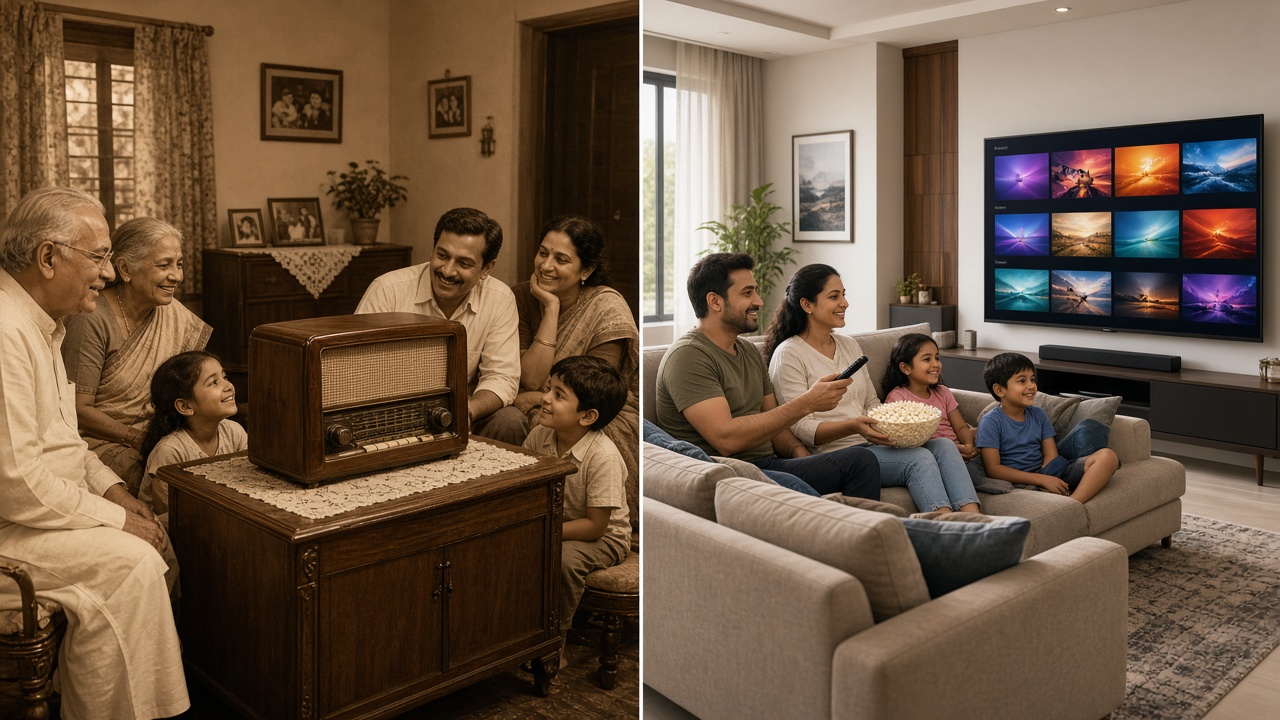
From the family radio to the family smart TV (artistic illustration).
Home Entertainment Then vs Now at a Glance
Feature
Then
Now
Main device
One radio or TV for the household
Smart TV, phone, laptop, tablet
Choice
One or two stations or channels
Hundreds of channels and apps
Timing
Fixed broadcast schedule
Watch anytime, on demand
Who watched
Whole family and neighbours together
Often each person on their own screen
Picture
Black and white, snowy antenna signal
HD, 4K, and HDR
Sound
Small speaker
Soundbars and home theatre
Films at home
Sunday film on Doordarshan, rented cassettes
New releases streamed on OTT
Cost
Buy the set, watch free
Monthly subscriptions and data
Control
Knob and rooftop antenna
Remote, voice search, phone casting
Big worry
Power cuts and poor signal
Screen time, binge-watching, privacy
🎭 Folk & GramophoneAncient – 1946
Folk Shows, Gramophones & Early Radio
For most of history Indian entertainment was live and shared: grandparents’ stories, temple kathas, bhajans, folk songs, and travelling puppeteers and theatre troupes. In the early 1900s gramophones brought recorded music into wealthy homes, cinema arrived, and radio broadcasting began in the 1920s.
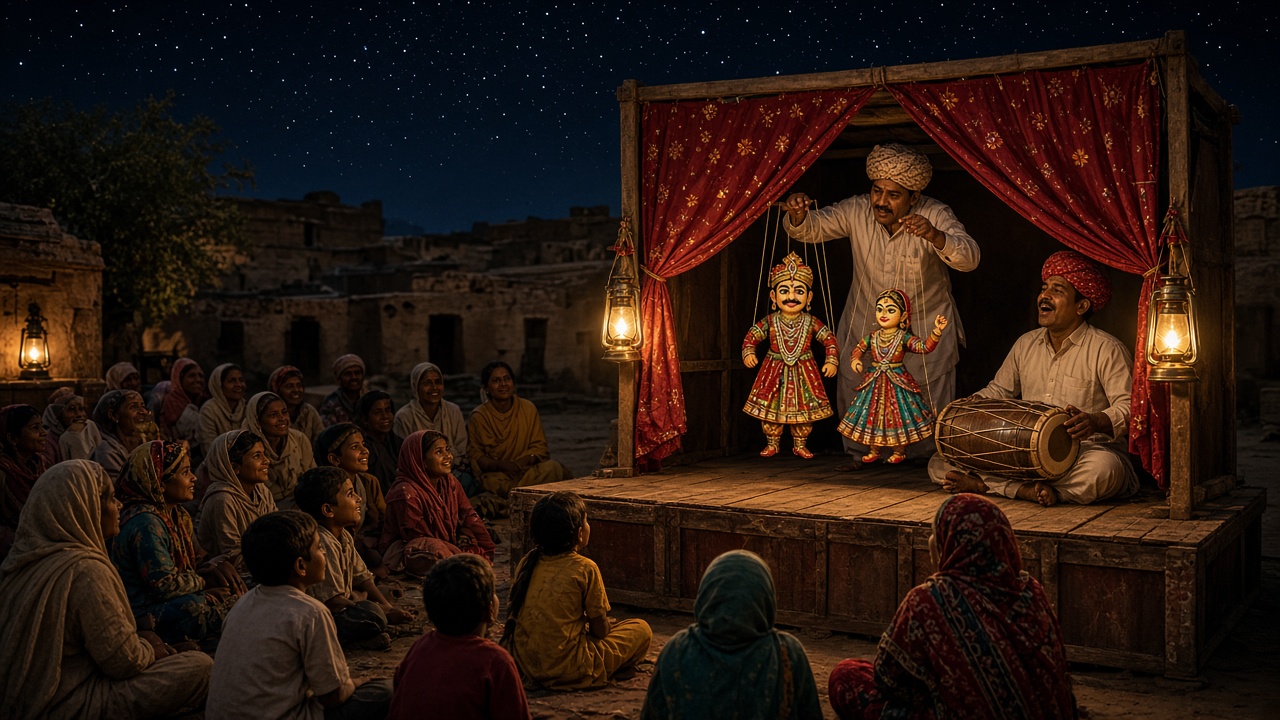
A lantern-lit kathputli puppet show — entertainment before electricity (artistic illustration).
Ancient times onwards: Storytelling, kathas, and folk theatre such as kathputli puppetry, nautanki, jatra, yakshagana, and tamasha entertain villages and towns.
1902: Some of the first Indian gramophone recordings are made in Calcutta, including songs by the singer Gauhar Jaan; 78 rpm records become prized possessions.
1913–1931: Dadasaheb Phalke’s Raja Harishchandra (1913) begins Indian cinema, and Alam Ara (1931) is the first Indian talkie; film songs become the nation’s popular music.
1927–1936: The Indian Broadcasting Company starts radio in Bombay and Calcutta in 1927, and the state service is renamed All India Radio in 1936.
Technology
Gramophones: Wind-up and horn speakers.
78 rpm records: About three minutes a side.
Valve radios: Warm up before playing.
Features
Live performers: Village gatherings.
Rare luxury: Gramophones for the rich.
Film songs: Popular music begins.
📻 Radio1947 – 1975
The Radio Golden Age
After independence the radio became the centre of home entertainment. Families tuned in for film songs, radio plays, and cricket commentary; Binaca Geetmala on Radio Ceylon became a weekly ritual, and cheap transistor radios in the 1960s carried music to fields, shops, and villages.
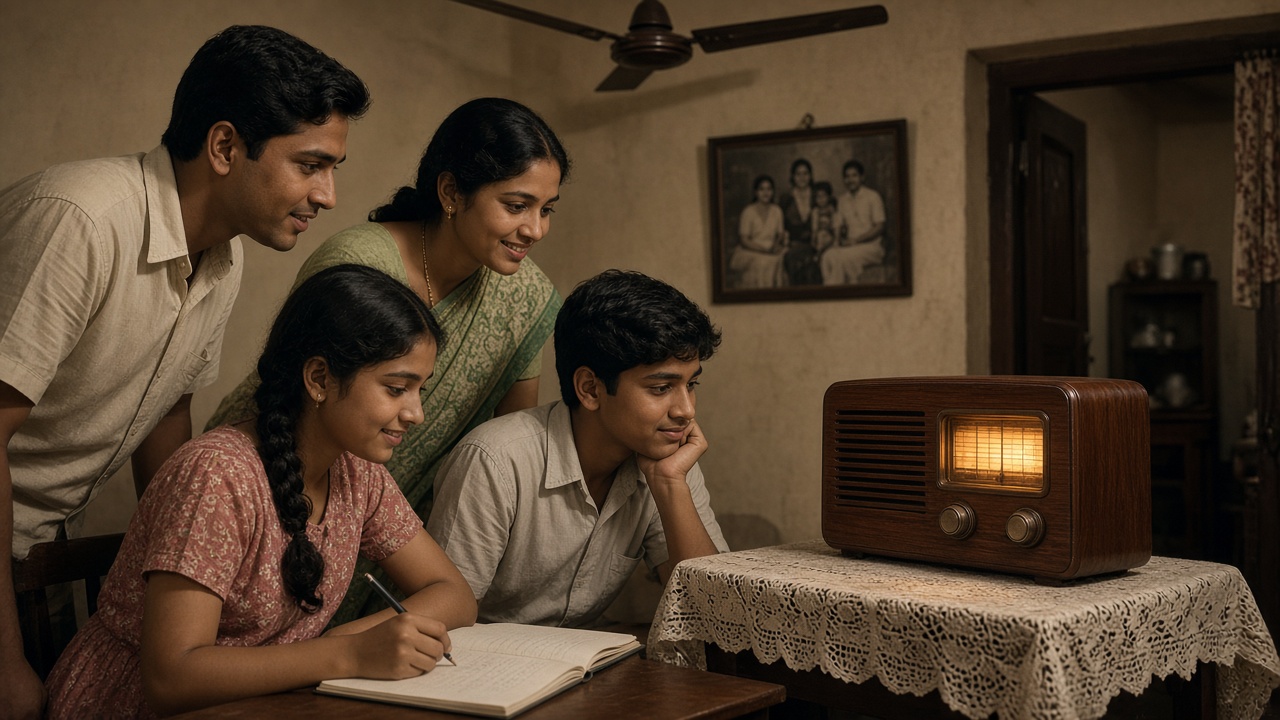
Noting down the week’s song countdown by the family radio (artistic illustration).
1952: With film songs restricted on All India Radio, listeners switch to Radio Ceylon, where Ameen Sayani’s Binaca Geetmala countdown begins in December and becomes legendary.
1957: All India Radio launches Vividh Bharati on 3 October with film music, plays, and request programmes, winning listeners back.
1960s: Low-cost transistor radios run on batteries, so music and cricket commentary reach farms, tea stalls, and homes without electricity.
1959–1975: Doordarshan starts experimental TV in Delhi (1959), and more cities get TV centres in the early 1970s, but the radio remains the family’s main entertainment.
Technology
Valve radios: Wooden cabinets.
Transistors: Portable and battery-run.
Short wave: Distant stations.
Features
Song countdowns: Weekly rituals.
Radio plays: Theatre of the mind.
Request shows: Letters from listeners.
📺 Doordarshan1976 – 1990
Doordarshan TV & VCRs
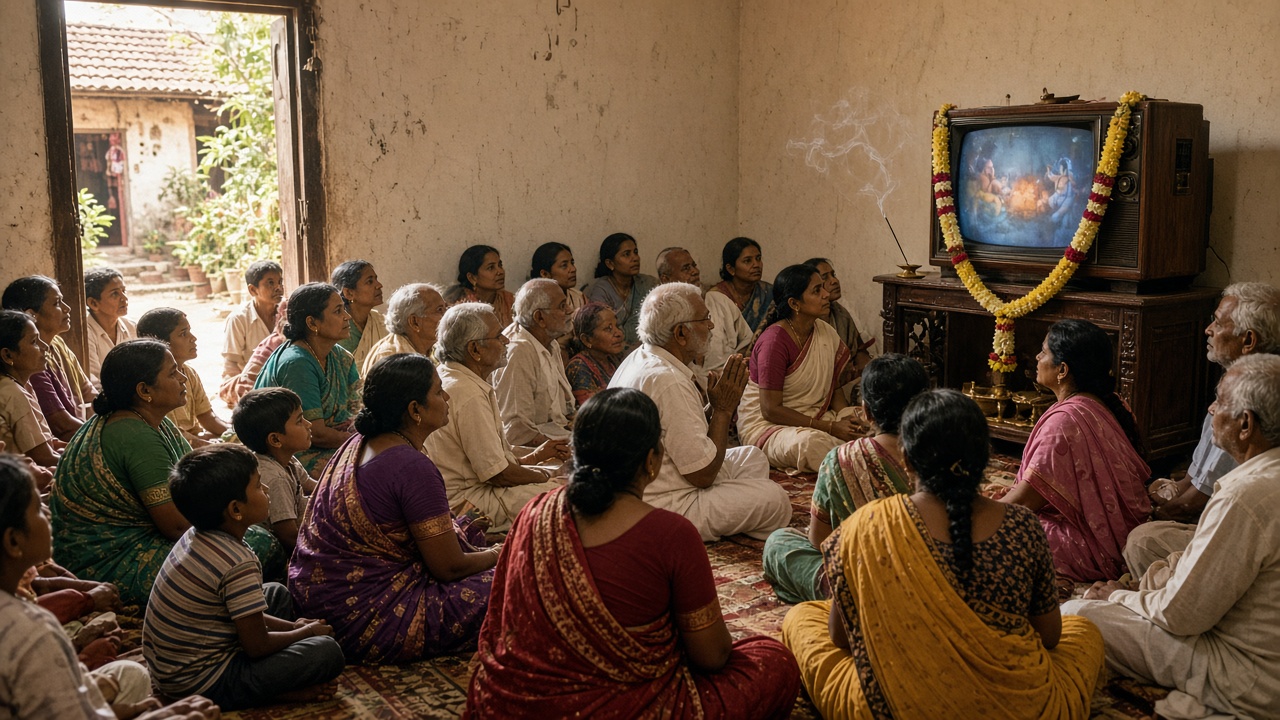
Colour TV and the expansion of Doordarshan in the 1980s made television the new family hearth. The neighbourhood gathered in the one home with a TV for Chitrahaar, the Sunday film, and serials such as Hum Log, Ramayan, and Mahabharat, while VCRs and video libraries brought films home on cassettes.
The whole neighbourhood gathers around one TV for the Sunday serial (artistic illustration).
1976–1982: Doordarshan becomes separate from All India Radio (1976) and starts advertisements; colour broadcasts begin with the 1982 Asian Games in Delhi, and film-song shows like Chitrahaar become hugely popular.
1984–1986:Hum Log (1984), India’s first TV soap opera, is followed by Buniyaad and Malgudi Days (1986).
1987–1990: Ramanand Sagar’s Ramayan (from January 1987) and B. R. Chopra’s Mahabharat (from October 1988) are watched by almost every family with access to a TV.
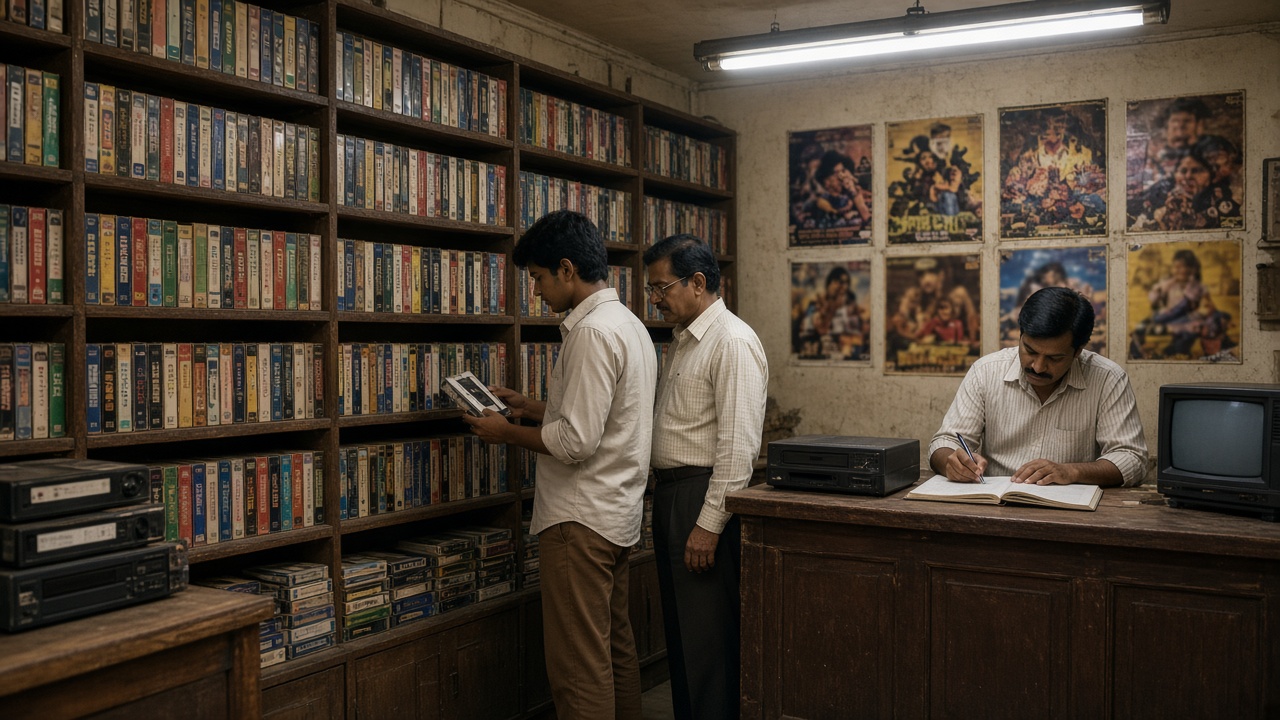
1980s: VCRs and VCPs, often brought from the Gulf, and neighbourhood video cassette libraries let families rent films; video parlours show films in small towns.
Technology
Colour TV: From 1982.
Rooftop antennas: Turned for a clear picture.
VCR and VHS: Films on tape.
Features
Community viewing: Neighbours welcome.
Sunday rituals: Serials and the film.
One channel: Everyone watched the same show.
📡 Cable1991 – 2007
Cable, Satellite & DTH
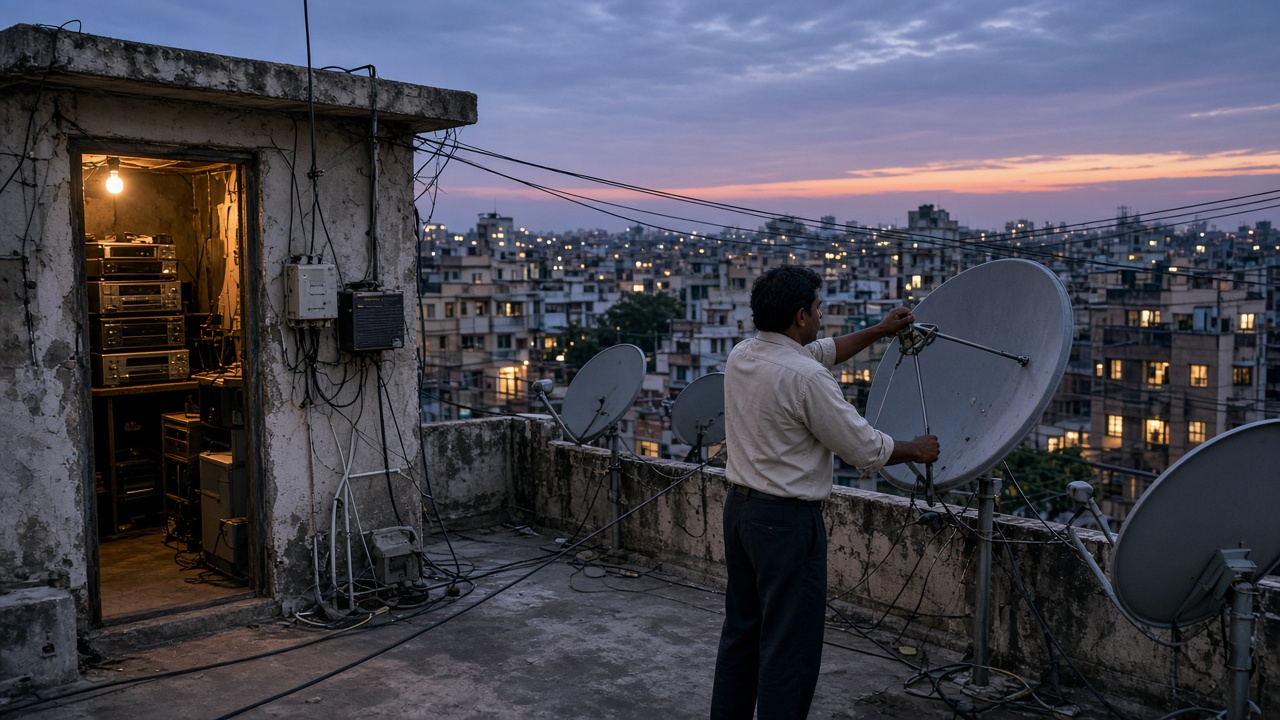
In the 1990s local cable operators put satellite dishes on rooftops and wired entire neighbourhoods. Suddenly families had dozens of channels — Hindi and regional entertainment, music, cartoons, and films around the clock — and the 2000s added quiz shows, long-running family dramas, and DTH dishes on balconies.
The neighbourhood cable wallah’s rooftop dishes and control room (artistic illustration).
1991–1995: Gulf War coverage and Star TV (1991) spark the cable boom, followed by Zee TV (1992), Sun TV (1993), and Sony Entertainment Television (1995); the Cable Television Networks (Regulation) Act is passed in 1995.
Late 1990s: Music channels, cartoon channels, and regional channels multiply; Shaktimaan (1997) on Doordarshan thrills children, and VCD players replace VCRs.
2000:Kaun Banega Crorepati with Amitabh Bachchan and long-running family dramas make Star Plus a household name.
2003–2006: DTH satellite TV begins with Dish TV (2003) and Doordarshan’s free DD Direct Plus (2004), followed by other private DTH services; DVD players become common.
Technology
Satellite dishes: Signals from space.
Coaxial cable: Wired neighbourhoods.
DTH set-top boxes: Dish on every balcony.
Features
Channel surfing: Dozens of choices.
24-hour TV: Always something on.
Remote control fights: Who picks the channel.
▶️ OTT2008 – 2019
OTT Streaming
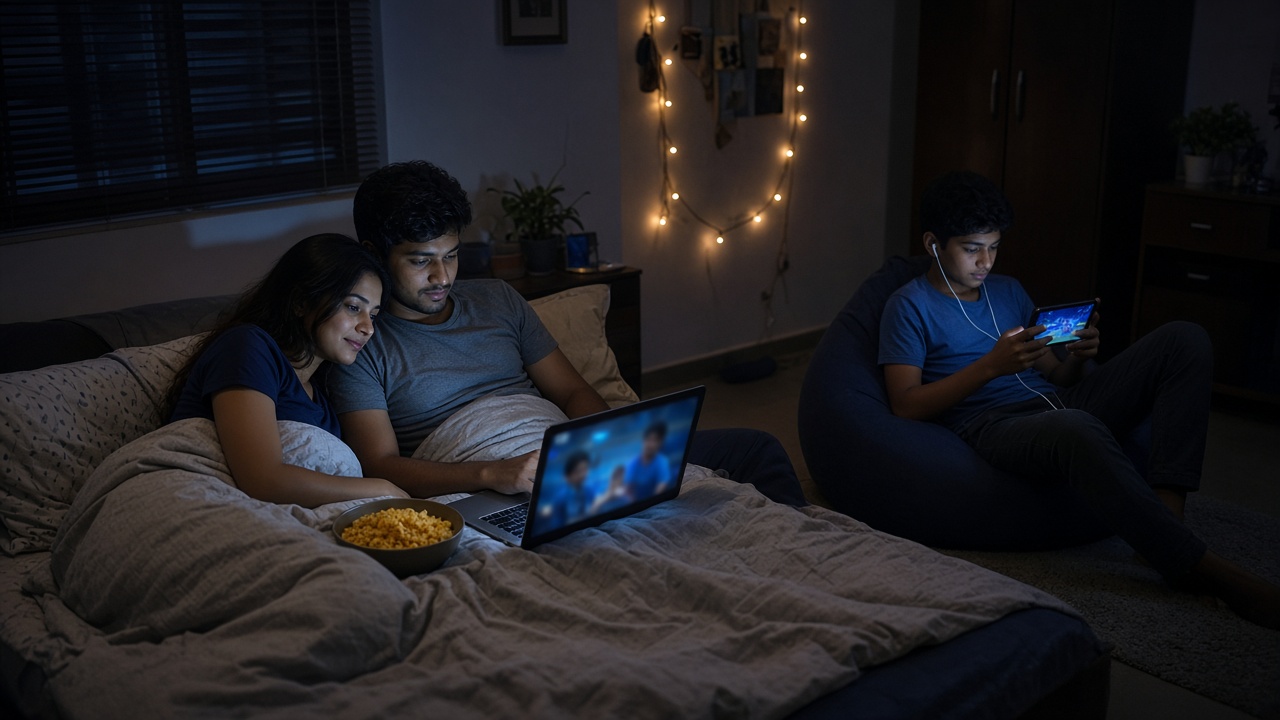
Broadband, smartphones, and then very cheap 4G data turned entertainment into something you could stream anytime, anywhere. YouTube, Hotstar, Netflix, Amazon Prime Video, and Indian platforms brought web series, live cricket, and films to phones and laptops, and binge-watching became a new habit.
Binge-watching on a laptop and cricket on a phone — every person, their own screen (artistic illustration).
2008: BIGFlix, often called India’s first OTT platform, launches, and YouTube starts a localised Indian version.
2012–2017: Cable TV is digitised in phases under the Digital Addressable System, bringing set-top boxes to cable homes.
2015–2016: Hotstar launches in February 2015; Netflix (January 2016) and Amazon Prime Video (December 2016) arrive, and Jio’s cheap 4G data from September 2016 makes mobile streaming a mass habit.
2018–2019:Sacred Games (2018), Netflix’s first Indian original, popularises web series; TRAI’s new tariff order (2019) lets viewers pay only for the channels they choose.
Technology
Video streaming: No broadcast schedule.
4G data: HD on phones.
Recommendations: Algorithms suggest shows.
Features
Web series: Bold new stories.
Binge-watching: Whole seasons at once.
Regional content: Every language.
🖥️ Smart TVs2020s – Future
Smart TVs & Connected Homes
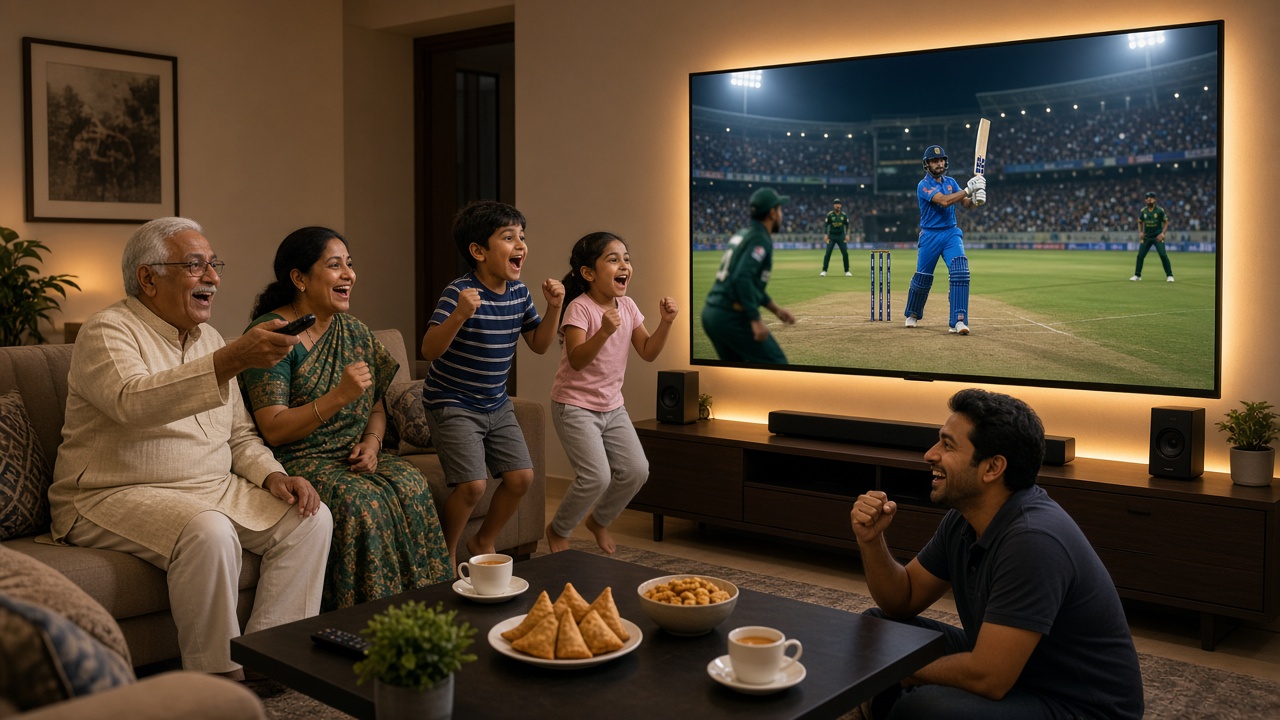
In the 2020s the big screen came back to the centre of the living room — but now it is a smart TV running apps. Families stream films, web series, and live cricket, search by voice, cast from their phones, and pair the TV with soundbars, while platforms merge and new films often premiere straight on OTT.
Three generations cheer live cricket streamed on a smart TV (artistic illustration).
2020: During the lockdown Doordarshan re-telecasts Ramayan and Mahabharat, which draw huge audiences again, and major films such as Gulabo Sitabo release directly on OTT.
2020s: Affordable smart TVs with built-in apps, voice remotes, and 4K screens become common, along with streaming sticks and fibre broadband.
2023–2025: IPL is streamed free on JioCinema in 2023, and after the Reliance–Disney merger JioCinema and Disney+ Hotstar combine as JioHotstar in 2025; Prasar Bharati launches its own OTT app, WAVES, in 2024.
Future: 8K screens, AI-personalised content, cloud gaming, virtual reality, and direct-to-mobile broadcasting may reshape home entertainment again.
Technology
Smart TV apps: All platforms on one screen.
Voice search: Speak to the remote.
4K and soundbars: Cinema at home.
Features
Family viewing returns: Big-screen cricket.
Direct-to-OTT films: Premieres at home.
Screen-time limits: Parental controls.
Iconic Shows That Brought Families Together
Show
Year
Platform
Why it mattered
Binaca Geetmala
1952
Radio Ceylon
Ameen Sayani’s weekly film-song countdown
Vividh Bharati
1957
All India Radio
Film songs, plays, and request shows
Chitrahaar
1980s
Doordarshan
Film songs on TV every week
Hum Log
1984
Doordarshan
India’s first TV soap opera
Malgudi Days
1986
Doordarshan
R. K. Narayan’s stories on screen
Ramayan
1987
Doordarshan
Emptied streets on Sunday mornings
Mahabharat
1988
Doordarshan
Epic serial watched across India
Shaktimaan
1997
Doordarshan
India’s favourite TV superhero for children
Kaun Banega Crorepati
2000
Star Plus
Quiz show that gripped the nation
Sacred Games
2018
Netflix
Netflix’s first Indian original series
From Gramophone to Smart TV: Home Entertainment Devices
Choosing the weekend film at a neighbourhood video cassette library (artistic illustration).
Device
Popular in India
What it did
Gramophone
1900s–1950s
Played 78 rpm records
Valve radio
1930s–1960s
Brought broadcasts into the home
Transistor radio
1960s–1980s
Portable, battery-powered music and commentary
Black-and-white TV
1970s–1980s
Doordarshan with a rooftop antenna
Colour TV
1982 onwards
Colour serials, films, and sport
Cassette player / two-in-one
1980s–1990s
Music cassettes and radio in one box
VCR / VCP
1980s–1990s
Played rented films on VHS tapes
VCD / DVD player
Late 1990s–2000s
Films on discs
DTH set-top box
2003 onwards
Satellite channels straight to the home
Streaming stick
2010s
Turned an ordinary TV into a smart one
Smart TV
2020s
Apps, voice search, and 4K streaming
How Entertainment Reached Indian Homes
Way
Began
How it worked
Cost to viewers
Radio broadcast
1927
Radio waves from AIR and other stations
Buy the radio
Terrestrial TV
1959
Doordarshan signal caught by a rooftop antenna
Buy the TV
Video rental
1980s
Cassettes rented from a video library
Pay per cassette
Analogue cable
Early 1990s
Local operator’s dish and wires
Monthly cable fee
DTH satellite
2003
Small dish and set-top box at home
Prepaid recharge
DD Free Dish
2004
Free-to-air satellite channels
Only the dish and box
Digital cable
2012–2017
Cable with a set-top box
Channel packs
OTT streaming
2008 onwards
Shows over the internet on any device
Subscription and data
Smart TV apps
2020s
Streaming apps built into the TV
Subscriptions and broadband
Home Entertainment Timeline Summary
Year / Era
Milestone
Ancient times
Storytelling, kathas, puppetry, and folk theatre
1902
Early Indian gramophone recordings in Calcutta
1913
Raja Harishchandra begins Indian cinema
1927
Radio broadcasting begins in Bombay and Calcutta
1931
Alam Ara, the first Indian talkie
1936
All India Radio named
1952
Binaca Geetmala on Radio Ceylon
1957
Vividh Bharati launched
1959
Experimental TV in Delhi
1960s
Transistor radios spread
1976
Doordarshan separated from AIR
1982
Colour TV with the Asian Games
1984
Hum Log, first TV soap
1987–1988
Ramayan and Mahabharat
1980s
VCRs and video libraries
1991–1992
Star TV and Zee TV; cable boom
1995
Sony TV; Cable TV Networks Act
2000
Kaun Banega Crorepati
2003–2004
DTH: Dish TV and DD Direct Plus
2008
BIGFlix; YouTube India
2012–2017
Cable digitisation with set-top boxes
2015–2016
Hotstar, Netflix, Prime Video; cheap 4G
2018
Sacred Games, first Netflix Indian original
2019
TRAI new tariff order
2020
Lockdown reruns; direct-to-OTT films
2023
Free IPL streaming on JioCinema
2025
JioHotstar formed
2020s
Smart TVs, voice search, 4K
Test Your Knowledge
20 quick questions from the home entertainment timeline. Click each question to reveal the answer.
Answer: A traditional string-puppet show from Rajasthan.
Answer: Gauhar Jaan.
Answer:Alam Ara (1931).
Answer: 1936.
Answer: Ameen Sayani.
Answer: Radio Ceylon.
Answer: 3 October 1957.
Answer: They were cheap, portable, and ran on batteries, so they worked without mains electricity.
Answer: The 1982 Asian Games in Delhi.
Answer:Hum Log (1984).
Answer: Ramanand Sagar.
Answer: It rented out VHS film cassettes, and often VCRs, for home viewing.
Answer: Zee TV.
Answer: A local cable operator who ran satellite dishes and wired homes for a monthly fee.
Answer:Kaun Banega Crorepati.
Answer: Direct-to-home satellite television.
Answer: Over-the-top — shows delivered over the internet instead of cable or satellite.
Answer: 2016.
Answer:Ramayan and Mahabharat.
Answer: Built-in streaming apps and voice search (also casting from phones and 4K screens).
Classroom activity
Students Tasks
Use these prompts for discussion or projects on how Indian families were entertained at home over time.
Click any panel to expand and explore the visual mood.
India’s home entertainment journey in pictures — the village puppet show, the 1950s family radio, Sunday serials on Doordarshan, the video library, the cable wallah, OTT binge-watching, smart TV cricket, and then versus now.
Puppet Show
Lantern-lit kathputli
1950s Radio
The song countdown
1980s TV
Neighbours around one set
Video Library
Weekend film on VHS
1990s Cable
The cable wallah’s dishes
OTT Streaming
Binge-watching nights
Smart TV
Big-screen cricket
Then vs Now
Radio to smart TV
Explore all daily life timelines
Jump to any other daily life timeline on WorldTimelineHub.
Disclaimer: This content is AI-generated for educational purposes and may contain errors or outdated details. For correct and authoritative information, please refer to official and reliable sources such as government publications, manufacturers, museums, and academic references.