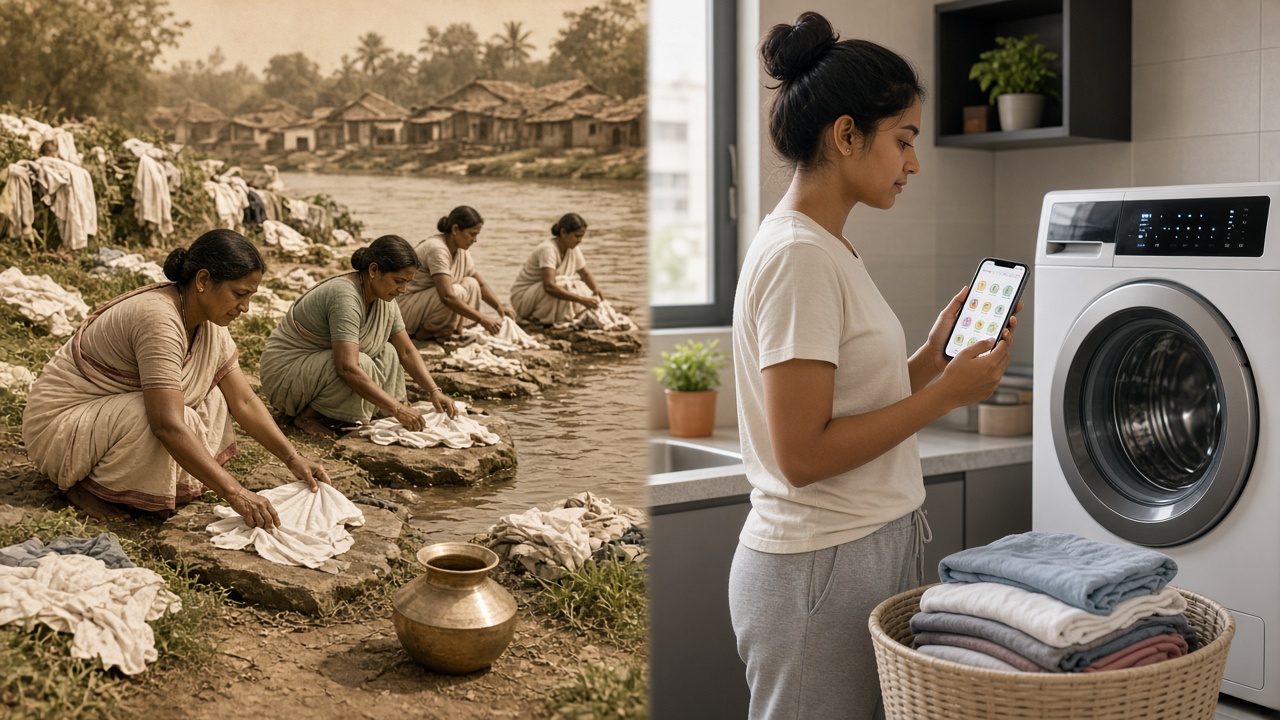
In the 1950s women carried bundles of clothes to the river, pond, or well and beat them clean on flat stones, while dhobis collected laundry from town homes. By the 1970s washing moved home to a bucket,
a brush, and cheap detergent like Nirma, twin-tub semi-automatic machines arrived in the 1990s, fully automatic machines spread in the 2000s, and in the 2020s smart washers run from a phone app.
This timeline covers reetha, shikakai and multani mitti, dhobis and dhobi ghats, bar soap, neel and rice starch, charcoal irons and istriwalas, Surf, Nirma and Wheel, buckets and brushes, twin-tub
machines, top and front loaders, liquid detergents, laundry apps, and Wi-Fi smart washers with AI, steam, and water-saving features.
Washing clothes was once one of the hardest and most time-consuming household jobs, done mostly by women and by dhobi families. How India washes its clothes shows changes in water supply, electricity,
chemistry, fabrics, incomes, and women’s time. The journey from beating saris on a river stone to tapping “start” on a phone app is a story of technology quietly changing daily life.
Big picture
India’s washing journey in one view
For centuries Indians cleaned clothes with soapnuts and ash at rivers and wells, and dhobis ran laundries at dhobi ghats. After independence bar soap and the first detergents arrived, taps and
buckets brought washing indoors in the 1970s and 1980s, twin-tub machines spread in the 1990s, fully automatic machines took over city homes in the 2000s, and smart washers arrived in the 2020s. Related timelines:
power grid,
Cotton Revolution,
artificial intelligence.
1890
Mahalaxmi Dhobi Ghat built in Bombay
1959
Surf detergent powder launched
1969
Nirma sold door to door
1990s
Twin-tub machines enter homes
From washing on river stones to a washing machine controlled by a phone app (artistic illustration).
Washing Clothes Then vs Now at a Glance
Feature
Then
Now
Where
River, pond, well, or dhobi ghat
Bathroom, balcony, or utility area
Water
Carried or washed at the source
Piped water into the machine
Cleaner
Reetha, ash, and bar soap
Detergent powder, liquid, and pods
Scrubbing
Beating on stones with a wooden bat
Drum or impeller does the work
Whitening
Neel blue and sun bleaching
Optical brighteners and liquid whiteners
Drying
Grass, bushes, and ropes in the sun
Spin cycle, drying stands, and dryers
Ironing
Charcoal box iron
Steam irons and garment steamers
Time per load
Several hours of hard work
Press a button and do other work
Who washed
Mostly women and dhobis
Machines, family members, and laundry services
Control
Experience and muscle
Programmes, sensors, and phone apps
🌿 ReethaAncient – 1946
Reetha, Dhobis & Dhobi Ghats
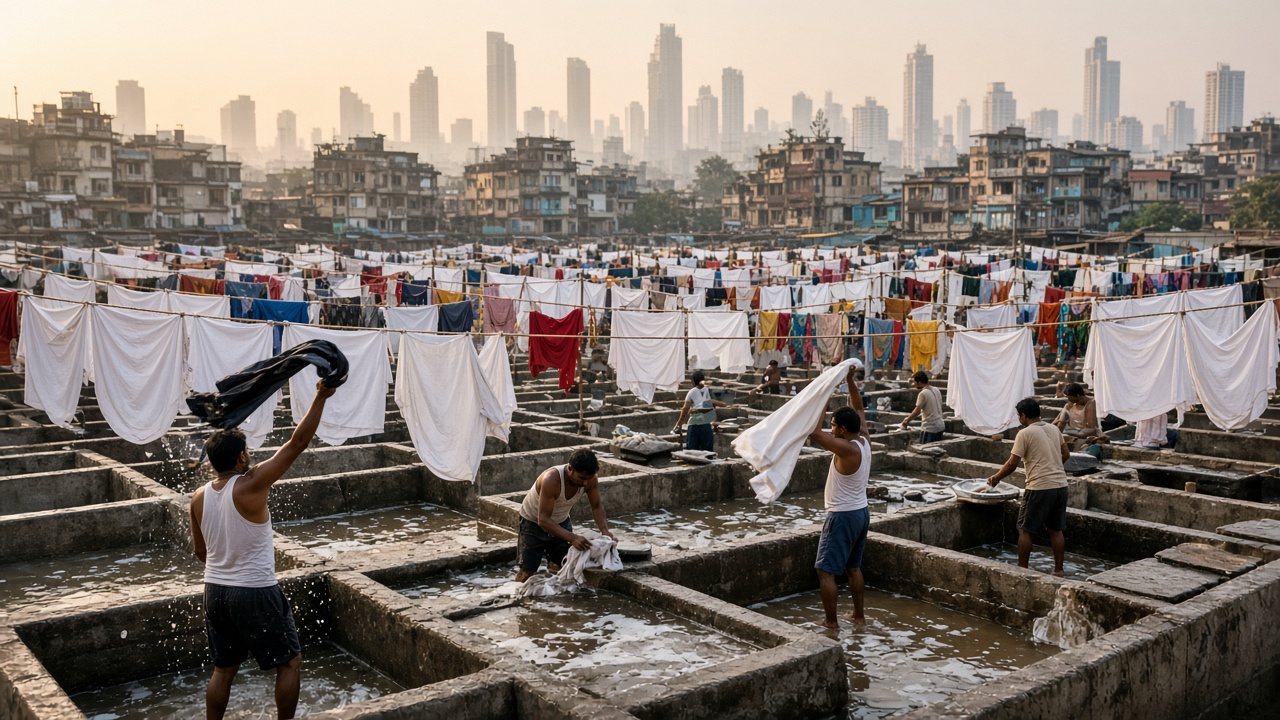
For thousands of years Indians washed cotton and silk with natural cleaners such as soapnut, shikakai, wood ash, and fuller’s earth, beating clothes on stones at rivers and tanks. Dhobi communities washed for towns and courts, and in colonial cities large dhobi ghats and the first factory-made soaps appeared.
Dhobis beating clothes on flogging stones at a Mumbai dhobi ghat (artistic illustration).
c. 2500 BCE: Cotton cloth is woven in the Indus Valley, and water tanks and drains show a strong culture of washing and bathing.
Ancient times: Reetha (soapnut), shikakai, wood ash, and multani mitti clean clothes, and texts mention the rajaka, or washerman, community.
1888–1890: Lever Brothers’ Sunlight soap arrives in India (1888), and the Mahalaxmi Dhobi Ghat is built in Bombay (1890).
1897–1918: One of India’s first soap factories opens in Meerut (1897), Tata Oil Mills is founded (1917), and Godrej launches soap made from vegetable oils (1918).
Technology
Flogging stones: Beating out dirt.
Soapnuts: Natural lather.
Box irons: Charcoal pressing.
Features
Dhobi service: Collect and return.
River washing: At the water source.
Sun bleaching: Natural whitening.
🏞️ River1947 – 1969
Rivers, Wells & Bar Soap
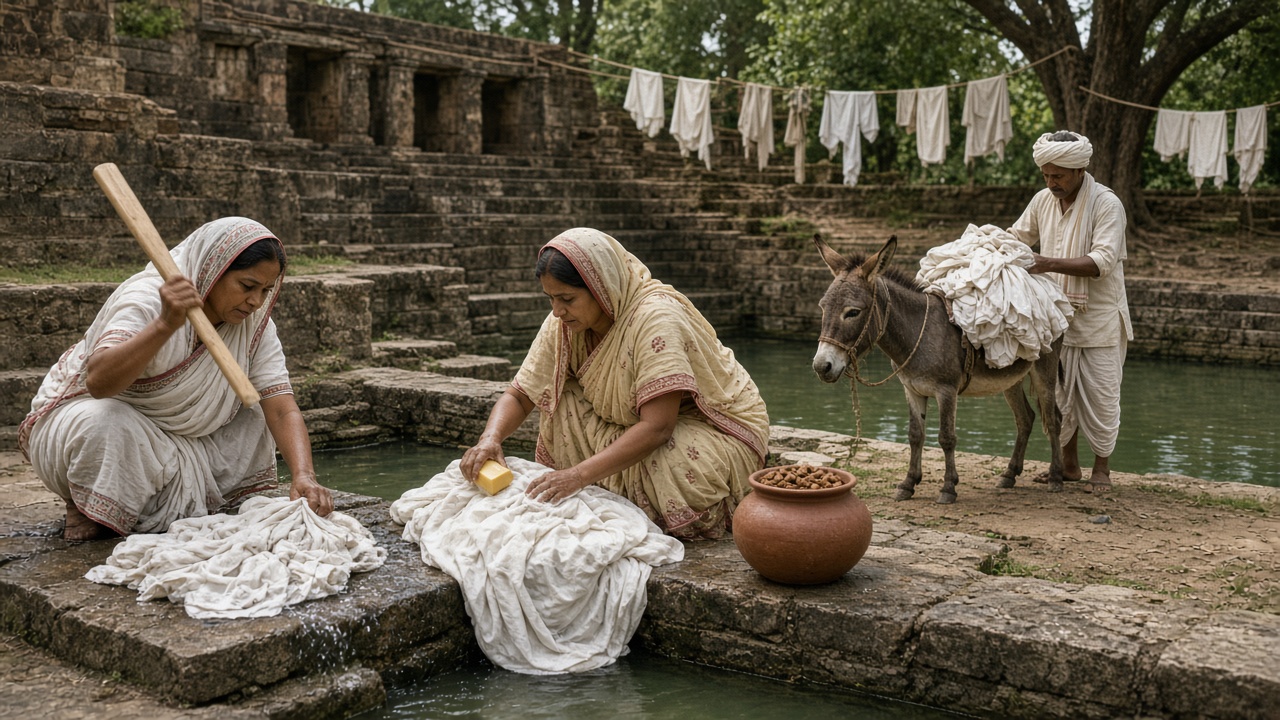
In the 1950s village women gathered at rivers, ponds, stepwells, and hand pumps to wash, beating clothes with a wooden thapi and drying them on grass and ropes. Town families handed laundry to the dhobi, who collected it on a donkey or bicycle. Bar soaps, neel for whites, and rice starch for crisp cotton were household staples.
Beating clothes with a thapi at the stepwell while the dhobi loads his donkey (artistic illustration).
1950s: Most rural families wash at rivers, ponds, wells, and hand pumps, while town families rely on the dhobi’s weekly collection.
1950s: Bar soaps, neel (laundry blue) for whites, and rice kanji starch for cotton are common, and charcoal box irons press clothes.
1956–1959: Hindustan Lever is formed (1956) and launches Surf detergent powder (1959), one of India’s first detergents.
1969: Karsanbhai Patel starts making Nirma detergent in Ahmedabad and sells it door to door on his bicycle at a fraction of the price of big brands.
Technology
Wooden thapi: Bat for beating clothes.
Bar soap: Factory-made cleaning.
Neel and starch: Bright, crisp cotton.
Features
Communal washing: Chatting at the ghat.
Dhobi’s bundle: Weekly laundry.
Hard labour: Hours each week.
🪣 Bucket1970 – 1989
Buckets, Brushes & Detergent Powder
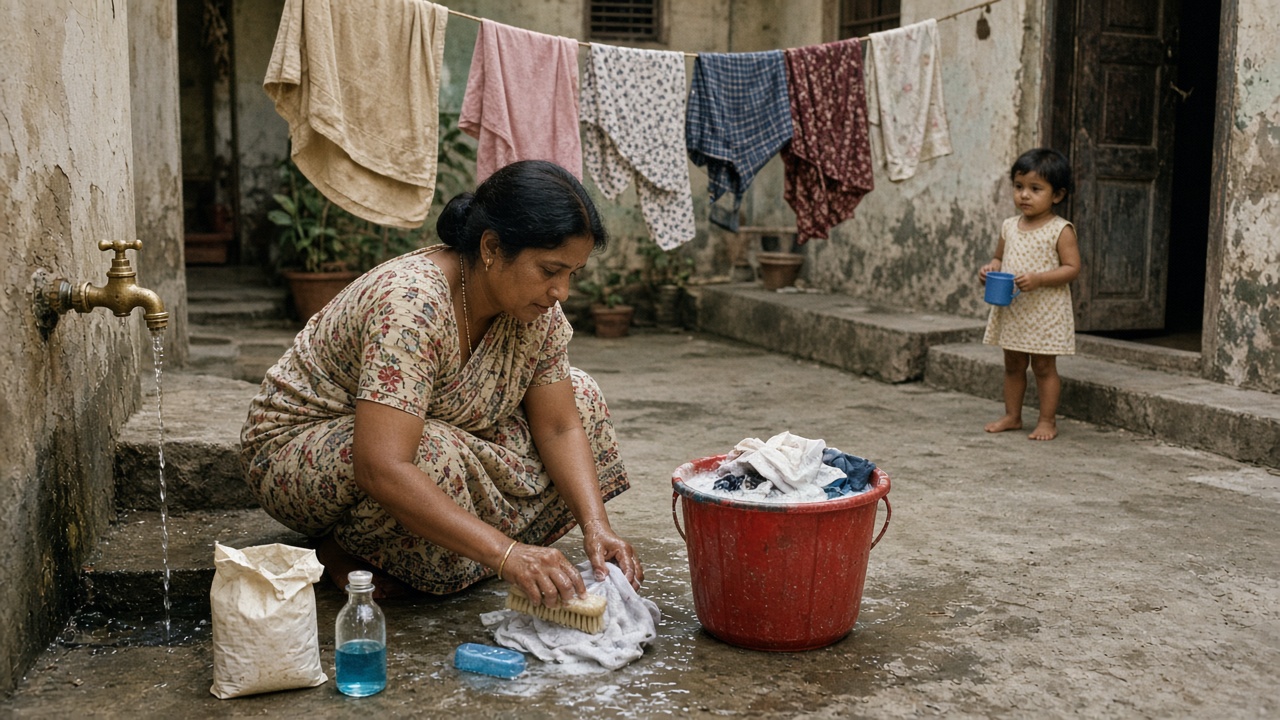
As taps and plastic buckets reached town homes, washing moved to the bathroom and courtyard. Clothes were soaked in detergent, scrubbed with a brush and bar soap on the floor, rinsed with a mug, and hung on wires and rooftops. Cheap detergent like Nirma made washing powder affordable for millions.
Bucket, brush, bar soap, and blue whitener at the courtyard tap (artistic illustration).
1970s: Piped taps and plastic buckets and mugs bring washing into city homes, bathrooms, and courtyards.
1970s–1980s: Nirma’s low price and its famous jingle make detergent powder a household product, and washing bars such as Rin are widely used.
1987: Hindustan Lever launches the low-cost detergent Wheel to compete with Nirma.
1980s: Polyester and nylon clothes dry faster and need less ironing, electric irons replace charcoal irons in many homes, and the first washing machines appear in a few wealthy households.
Technology
Plastic buckets: Soak and rinse.
Scrubbing brushes: Collars and cuffs.
Electric irons: Home pressing.
Features
Home washing: At the tap.
Cheap detergent: For every family.
Rooftop lines: Sun drying.
🌀 Semi-Auto1990 – 1999
Semi-Automatic Twin-Tub Machines
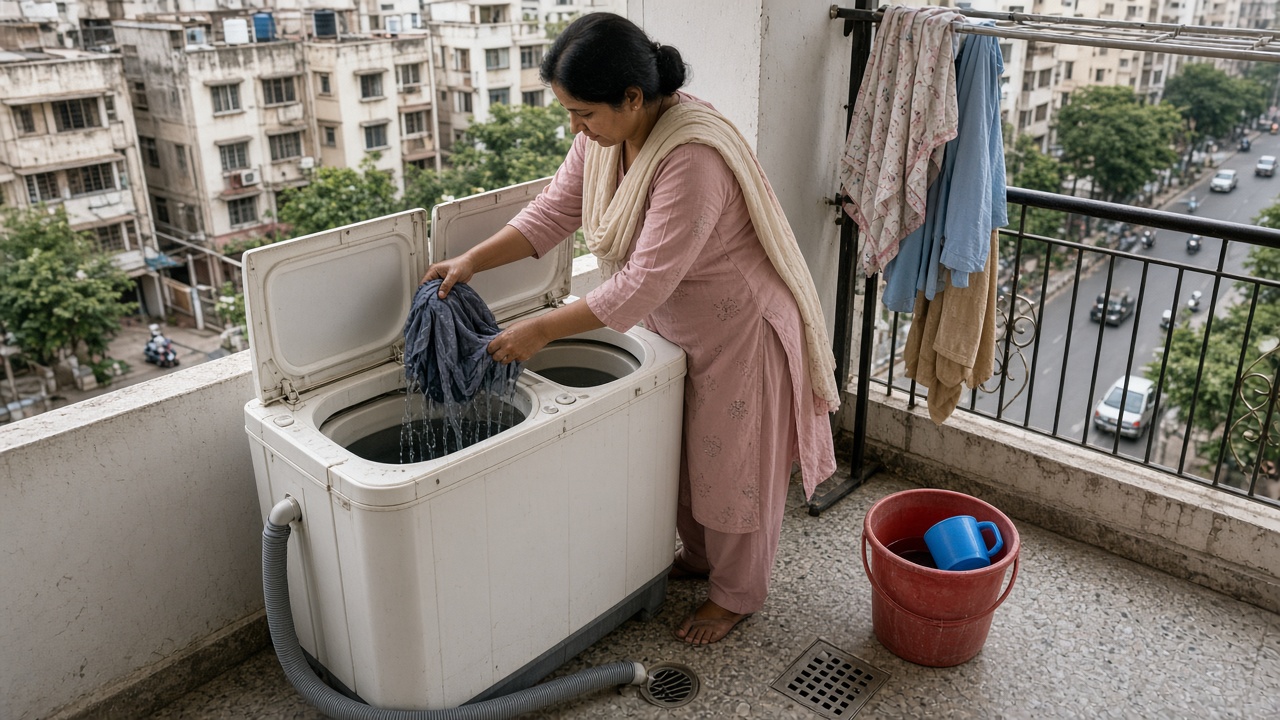
After liberalisation, the twin-tub semi-automatic machine became the first washing machine for many middle-class families. Users filled water with a hose, washed in one tub, lifted wet clothes into the spin tub, and drained water — much easier than hand washing, and suited to irregular water supply and power cuts.
Moving clothes from the wash tub to the spin tub of a twin-tub machine (artistic illustration).
1990s: Twin-tub semi-automatic machines with separate wash and spin tubs become common in middle-class city homes.
1991: IFB begins making front-loading washing machines in India with technology from Bosch.
Mid–late 1990s: Global brands such as Whirlpool, Samsung, and LG expand in India, and EMIs make machines affordable for more families.
1990s: Premium detergents such as Ariel (1991) and Surf Excel arrive, and Ujala liquid whitener (1997) replaces powder neel in many homes.
Technology
Twin tubs: Wash and spin.
Pulsator: Swirling water.
Spin dryer: Faster drying.
Features
Manual transfer: Tub to tub.
Low water need: Works with buckets.
EMIs: Pay in instalments.
⚙️ Fully Auto2000 – 2019
Fully Automatic Top & Front Loaders
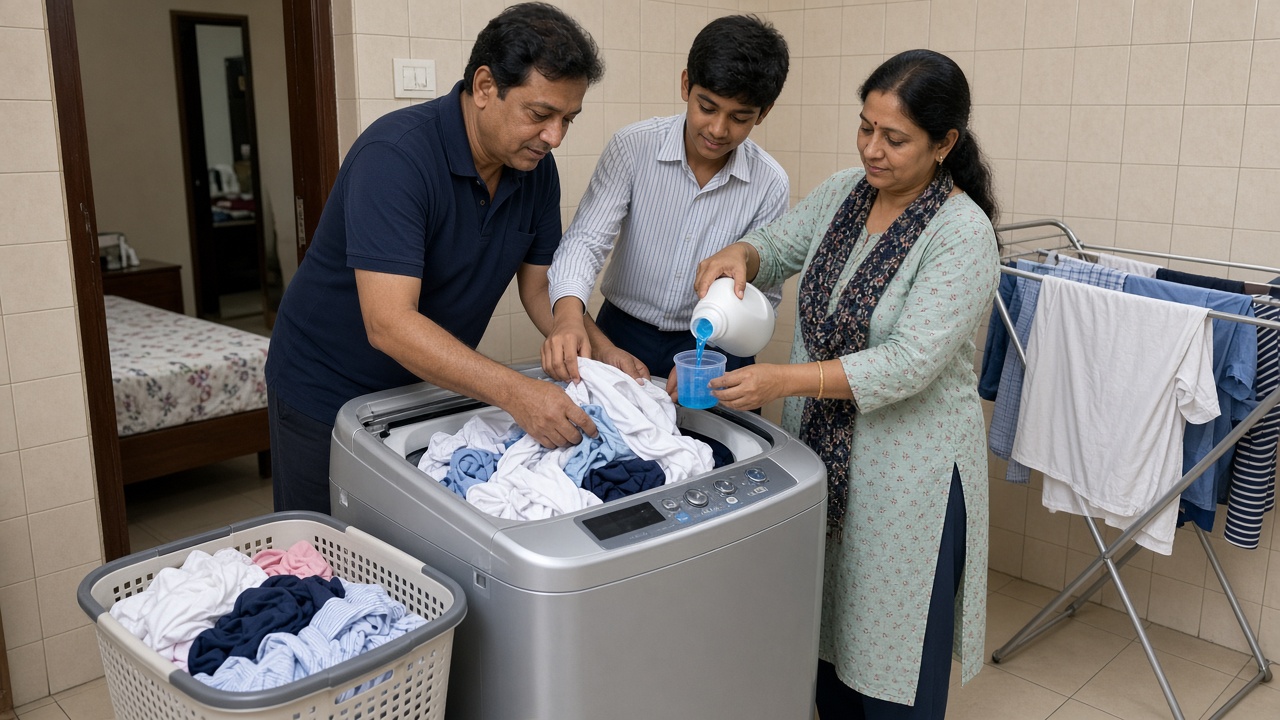
Fully automatic machines that fill, wash, rinse, and spin at the press of a button took over city homes. Top-loaders were affordable and quick, front-loaders saved water and were gentle on fabrics, and liquid detergents, fabric conditioners, and laundry apps changed the weekly routine.
The whole family loads the fully automatic top-loader (artistic illustration).
2000s: Fully automatic top-loaders with digital panels become common in cities, and front-loaders grow for their lower water and power use.
Mid-2000s: Detergent adverts such as Surf Excel’s “Daag Achhe Hain” (stains are good) change how laundry is marketed to families.
2010s: Liquid detergents, “matic” powders, and fabric conditioners grow, and BEE star labels help buyers pick energy-efficient machines.
2010s: Laundry and dry-cleaning chains and app-based pickup services spread in cities, and the Jal Jeevan Mission (2019) begins bringing tap water to rural homes.
Technology
Microprocessor: Wash programmes.
Front-load drums: Tumble washing.
Liquid detergents: Dissolve easily.
Features
One-button wash: Fill to spin.
Less water: Front-loaders.
Laundry apps: Doorstep pickup.
📶 Smart2020s – Future
Smart Washers, AI & Steam
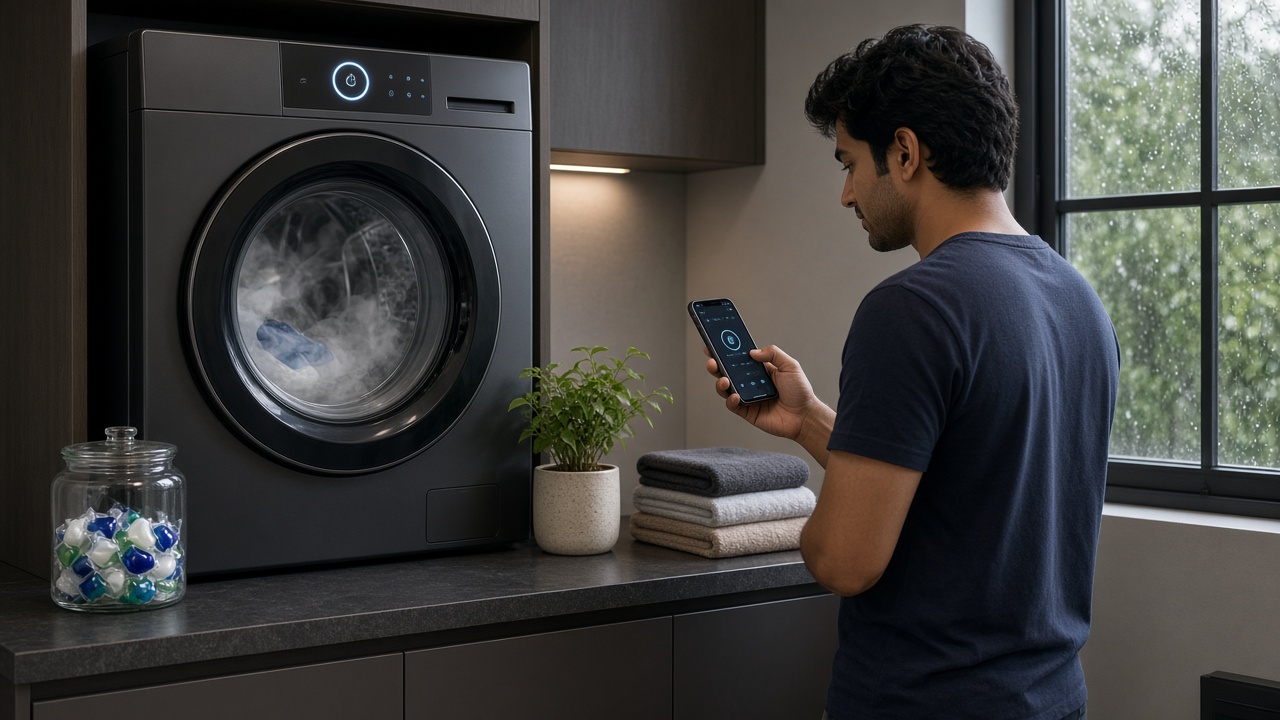
In the 2020s washing machines went online. Wi-Fi smart washers can be started and tracked from a phone, AI sensors set water and detergent for each load, steam cycles sanitise clothes, and washer-dryers solve the monsoon drying problem in small flats.
A steam cycle in a smart washer-dryer, tracked on a phone during the monsoon (artistic illustration).
2020–2021: During the pandemic, hygiene worries boost steam, hot-water, and anti-bacterial wash cycles, and washing machine sales rise as families manage without household help.
2020s: Wi-Fi smart washers are controlled by phone apps, AI detects load weight and fabric type, and inverter motors cut noise and electricity use.
2020s: Washer-dryers suit small flats and monsoon months, and detergent pods, auto-dosing, and eco-friendly detergents grow.
Future: Water-recycling machines, microfibre filters to reduce plastic pollution, solar-powered washing, and robots that fold clothes.
Technology
Wi-Fi control: Wash from anywhere.
AI sensors: Load and fabric detection.
Inverter motors: Quiet and efficient.
Features
Steam wash: Hygiene cycles.
Washer-dryers: No-sun drying.
Auto-dosing: Right detergent amount.
From Reetha to Pods: Laundry Helpers Through Time
Helper
Used since
What it does
Reetha (soapnut)
Ancient times
Natural lather for cotton, wool, and silk
Shikakai
Ancient times
Mild plant-based cleaner
Wood ash and soda
Ancient times
Alkaline cleaning for heavy dirt
Multani mitti
Ancient times
Clay that absorbs grease and oil
Bar soap
1880s onwards
Scrubbing collars, cuffs, and stains
Neel (laundry blue)
Colonial era onwards
Makes whites look brighter
Rice starch (kanji)
Traditional
Crisp cotton saris and shirts
Detergent powder
1959 onwards
Works well even in hard water
Liquid whitener
1997 onwards
Easy-to-use blue for whites
Liquid detergent and fabric conditioner
2000s–2010s
Dissolves fully; softens fabric
Pods and auto-dosing
2020s
Pre-measured detergent
Types of Washing Machines in India
Type
Common from
How it works
Good to know
Semi-automatic twin-tub
1990s
Separate wash and spin tubs; clothes moved by hand
Cheapest; works with bucket water
Fully automatic top-load
2000s
One tub fills, washes, rinses, and spins
Affordable and quick
Fully automatic front-load
1990s (premium), 2010s (common)
Tumbling drum with a front door
Uses less water; gentle on fabric
Washer-dryer
2010s
Washes and dries in one drum
Useful in monsoon and small flats
Smart Wi-Fi washer
2020s
App control, AI sensors, and steam
Remote start and energy reports
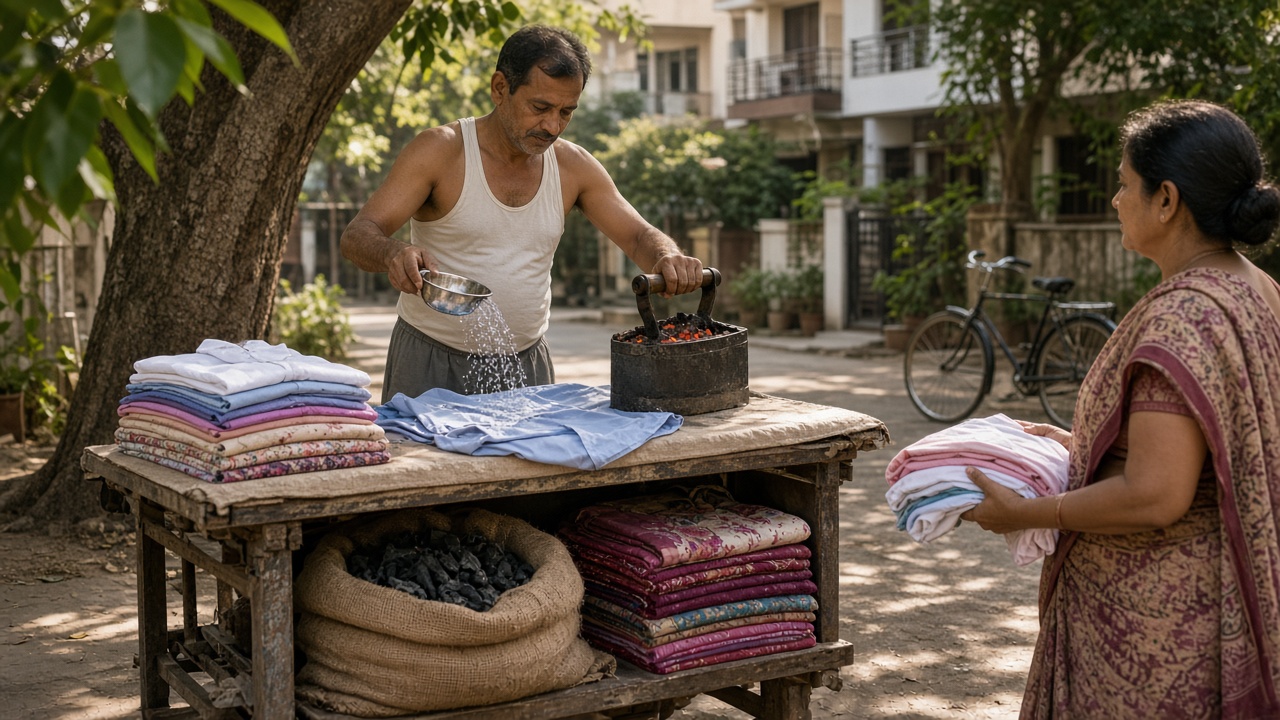
From Charcoal Iron to Steamer: How Clothes Were Pressed
The neighbourhood istriwala and his charcoal box iron (artistic illustration).
Pressing method
Era
How it worked
Folding and stone pressing
Ancient times
Clothes folded and weighed down to smooth them
Charcoal box iron
Colonial era–now
Hollow iron filled with glowing charcoal
Stove-heated flat iron
Early–mid 20th century
Solid iron heated on a stove
Electric dry iron
1950s–1980s onwards
Heating element with a temperature knob
Steam iron
1990s onwards
Water tank sprays steam for easier pressing
Garment steamer
2010s onwards
Hanging steamer removes creases quickly
Washing Clothes Timeline Summary
Year / Era
Milestone
c. 2500 BCE
Indus Valley cotton and water tanks
Ancient times
Reetha, shikakai, ash, and dhobis
1888
Sunlight soap arrives in India
1890
Mahalaxmi Dhobi Ghat, Bombay
1897
Early soap factory in Meerut
1917
Tata Oil Mills founded
1918
Godrej vegetable-oil soap
1950s
Washing at rivers, wells, and dhobi ghats
1956
Hindustan Lever formed
1959
Surf detergent powder
1969
Nirma begins in Ahmedabad
1970s
Buckets and brushes at the home tap
1987
Wheel detergent
1990s
Twin-tub semi-automatic machines
1991
IFB front-loaders; Ariel
1997
Ujala liquid whitener
2000s
Fully automatic top-loaders spread
2010s
Liquid detergents and laundry apps
2019
Jal Jeevan Mission tap water
2020–2021
Steam and hygiene cycles boom
2020s
Wi-Fi smart washers and washer-dryers
Future
Water recycling and robot folding
Test Your Knowledge
20 quick questions from the washing clothes timeline. Click each question to reveal the answer.
Answer: Soapnut, a fruit that produces natural lather for washing.
Answer: Fuller’s earth, a clay that absorbs grease and oil.
Answer: A washerman who washes clothes for others.
Answer: 1890.
Answer: Sunlight soap.
Answer: A wooden bat used to beat dirt out of wet clothes.
Answer: To hide yellowing and make whites look brighter.
Answer: As starch to make cotton clothes crisp.
Answer: Surf.
Answer: Karsanbhai Patel of Ahmedabad.
Answer: Wheel.
Answer: Synthetic fibres resist creasing and dry quickly.
Answer: Two — a wash tub and a spin tub.
Answer: IFB.
Answer: Ujala.
Answer: The front-loader.
Answer: How energy-efficient an appliance is — more stars mean less electricity.
Answer: A street ironing worker who presses clothes, often with a charcoal iron.
Answer: Be started, tracked, and controlled from a phone app.
Answer: To catch tiny plastic fibres from synthetic clothes before they pollute water.
Classroom activity
Students Tasks
Use these prompts for discussion or projects on how Indians have washed their clothes over time.
Timeline understandingScience of cleaningWater and energy savingGender and work
Interview a grandparent about where and how they washed clothes as children, and how long it took.
Make a timeline poster: river and well (1950s), bucket (1970s), semi-automatic (1990s), fully automatic (2000s), and smart washers (2020s).
Try washing a small cloth with soapnuts and another with detergent, and compare the results.
Find out why soap forms scum in hard water while detergent does not.
Estimate how many buckets of water your family uses for laundry in a week and suggest ways to save water.
Read the BEE star label on a washing machine and explain what it shows.
Talk to a local dhobi or istriwala about how their work has changed.
List who does the laundry in your home and discuss how the work could be shared fairly.
Compare a semi-automatic, top-load, and front-load washing machine on price, water use, and features.
Debate: “Washing machines changed women’s lives more than any other appliance.”
Continue exploring
Washing clothes changed with electricity, cotton and synthetic fabrics, the internet, and artificial intelligence. Explore these connected timelines next.
Click any panel to expand and explore the visual mood.
India’s washing journey in pictures — the dhobi ghat, the 1950s stepwell, the bucket and brush, the twin-tub machine, the fully automatic top-loader, the smart washer-dryer, the istriwala’s charcoal iron, and then versus now.
Dhobi Ghat
Flogging stones in Mumbai
River & Well
Thapi on stone
Bucket & Brush
At the courtyard tap
Semi-Automatic
Wash tub to spin tub
Fully Automatic
One-button wash
Smart Washer
Steam and app control
Istriwala
The charcoal box iron
Then vs Now
River stone to phone app
Explore all daily life timelines
Jump to any other daily life timeline on WorldTimelineHub.
Disclaimer: This content is AI-generated for educational purposes and may contain errors or outdated details. For correct and authoritative information, please refer to official and reliable sources such as government publications, manufacturers, museums, and academic references.