From tightly coupled switch brains to OpenFlow, SDN controllers, NFV, cloud fabrics, whitebox hardware, and intent-based automation—including India’s telecom and campus SDN journey.
1990s -> PresentOpenFlow -> IntentCloud Fabrics
Software-Defined Networking Ideas
Software-defined networking (SDN) separates the network’s control plane (deciding where traffic goes) from the data plane (moving packets), so operators can program policies from a central controller instead of configuring every box by hand.
This timeline follows that idea from research precursors through OpenFlow, campus SDN, controllers and NFV, cloud/whitebox fabrics, and intent-based automation in India and worldwide.
Big picture
SDN evolution in one view
Networks grew too complex for per-device CLI. SDN promised APIs, visibility, and automation—first with OpenFlow, later with overlays, controllers, and cloud-native fabrics that absorb SDN ideas even without a classic OpenFlow switch.
SDN: program the network from software, not only from each device CLI.
Roots1990s - 2006
Distributed Control and Active Networks
Before “SDN,” every switch and router ran its own control logic. Researchers explored active networks and cleaner control/data splits, but production gear stayed vertically integrated and hard to innovate on.
Each device thinks for itself—powerful, but hard to change globally.
Vendor-integrated control and forwarding.
Research on programmable / active networks.
Campus and ISP ops struggle with change windows.
Takeaway: The pain of closed boxes sets the stage for programmable control.
API2007 - 2011
Ethane, OpenFlow and the Clean Split
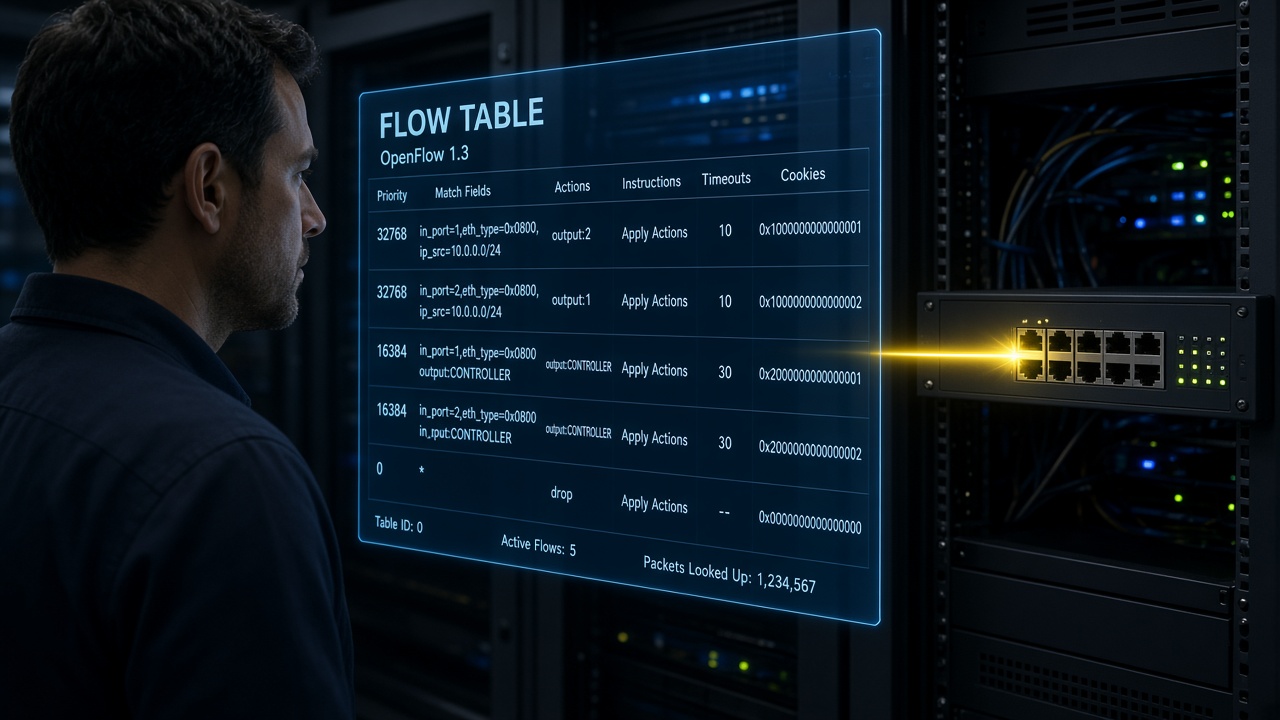
Stanford and partners demonstrated Ethane-style central policy and published OpenFlow: a practical southbound API so a controller can install flow rules on switches. Suddenly researchers could experiment on real campus gear.
Flow tables + a controller API unlock programmable forwarding.
2008 OpenFlow paper and early prototypes.
Control plane logically centralised; data plane stays fast.
Academic testbeds prove the model.
Takeaway: OpenFlow makes the control/data split real enough to ship.
Industry2011 - 2013
ONF, Hype and Campus Deployments
The Open Networking Foundation formed to promote OpenFlow. Vendors raced to announce SDN roadmaps. Campuses and labs deployed controllers; some production wins appeared alongside over-promised timelines.
Industry organises around SDN; campuses become living labs.
2011: ONF launches.
Vendor SDN messaging floods conferences.
Early production and PoC deployments.
Takeaway: SDN becomes an industry category—with real demos and real hype.
Stack2013 - 2016
Controllers, OVS and Network Functions Virtualization
Open-source controllers and Open vSwitch pushed SDN into software switches and hypervisors. NFV argued that firewalls and load balancers could be VMs too. Overlays (VXLAN and friends) often mattered more than pure OpenFlow hardware.
Software switches and controllers become the practical SDN toolkit.
Controller platforms and northbound APIs mature.
OVS and overlays in data centres.
NFV for telecom and enterprise functions.
Takeaway: SDN succeeds as software fabrics, not only as OpenFlow ASICs.
Scale2016 - 2019
Cloud Fabrics, Whitebox and Orchestration
Hyperscalers and large enterprises ran leaf-spine fabrics with automation and whitebox switches. Container networking and service meshes brought SDN-like policy closer to apps. Disaggregation challenged traditional chassis economics.
Automation + whitebox hardware scale SDN ideas in the cloud era.
Leaf-spine + EVPN/VXLAN fabrics.
Whitebox / disaggregated NOS options.
Kubernetes CNI and policy engines.
Takeaway: SDN principles go mainstream inside clouds and clusters.
Intent2020 - Present
Intent-Based Networking, SASE and Assurance
Operators state desired outcomes (“isolate this app”) and systems translate them into device configs with continuous verification. Secure Access Service Edge (SASE) blends networking and security in the cloud. India’s telcos, campuses, and cloud regions adopt automation heavily.
Say what you want; software compiles and checks the network.
Intent APIs and closed-loop assurance.
SASE / cloud-delivered security edges.
AI-assisted ops for anomaly detection.
Takeaway: Modern SDN is less a protocol, more an automation and policy platform.
Software-Defined Networking Timeline Summary
Era
Years
Focus
Precursors
1990s-2006
Distributed control, research
OpenFlow
2007-2011
Southbound API, flow tables
ONF boom
2011-2013
Industry + campus SDN
Controllers & NFV
2013-2016
OVS, overlays, virtual NFs
Cloud fabrics
2016-2019
Whitebox, leaf-spine, CNI
Intent & SASE
2020-Present
Outcomes, assurance, cloud edge
Then vs Now
Aspect
Then
Now
Control
Per-device protocols/CLI
Controllers, APIs, intent engines
Change
Manual tickets / downtime windows
Automated pipelines + assurance
Hardware
Closed chassis only
Whitebox + merchant silicon options
Apps
Network as opaque pipes
Policy near VMs/containers/services
Breakthroughs
OpenFlow: A practical controller-to-switch programming API.
Logically centralised control: Global view for policy.
OVS / overlays: SDN in software data centres.
NFV: Network functions as software workloads.
Intent + assurance: Declare outcomes and verify continuously.
Impact on Daily Life
You rarely see SDN, but it helps clouds spin networks for apps in seconds, telcos roll out services faster, and campuses isolate labs safely. Faster network changes support the apps, games, and payments people use every day.
Clouds, campuses, telcos, security edges, and data centres.
India focus
SDN in India
Indian telcos, data centres, and universities adopt SDN/NFV for 4G/5G cores, campus fabrics, and cloud regions. Skill programmes teach controllers and automation; enterprises use overlays for multi-cloud connectivity.
India: telecom, campuses, and clouds programme their networks.
Telco NFV / cloud-native core programmes.
Campus and enterprise fabric automation.
Cloud region overlays and security edges.
Engineering curricula add SDN labs.
Test Your Knowledge
Twenty quick checks on OpenFlow, controllers, NFV, and intent-based networking.
Answer: Control plane from data plane.
Answer: Forwards packets at high speed.
Answer: Southbound API / protocol between controller and switch.
Answer: Match rules and forwarding actions.
Answer: Open Networking Foundation.
Answer: 2008.
Answer: Centralised (logical) view and policy programming.
Answer: Applications / orchestration above the controller.
Answer: Software / virtual switch.
Answer: Network Functions Virtualization.
Answer: Encapsulation (e.g., VXLAN) over an underlay.
Answer: Merchant silicon + separate NOS software.
Answer: Desired outcomes / policies, not only CLI commands.
Answer: Continuously checking the network matches intent.
Answer: Networking and cloud-delivered security services.
Jump to any other technology timeline on WorldTimelineHub.
Disclaimer: This content is AI-generated for educational purposes and may contain errors or outdated details. For correct and authoritative information, please refer to official and reliable sources such as government publications, manufacturers, museums, and academic references.