From magic lanterns and film reels to overhead classrooms, LCD/DLP data projectors, laser cinema, and wall-sized LED screens that compete with lamps.
This timeline traces how projected light moved from painted glass slides to digital pixels—and how Indian classrooms, cinemas, and boardrooms rode that arc from chalk talk to HDMI and smart boards.
1650s -> PresentLantern -> LaserOHP -> 4K
Projector Invention
Projected images began with magic lanterns that shone lamp light through painted glass, then film and slide projectors for cinema and education, overhead projectors for live classroom writing, and finally LCD and DLP engines that turned computer slides into wall-sized light. Each generation solved the same problem: how to share one picture with a whole room.
The era cards and tables below cover lantern shows through laser 4K and India’s smart-classroom push, plus how brightness, throw ratio, and light engines changed what teachers and theatres could show.
Big picture
Projector evolution in one view
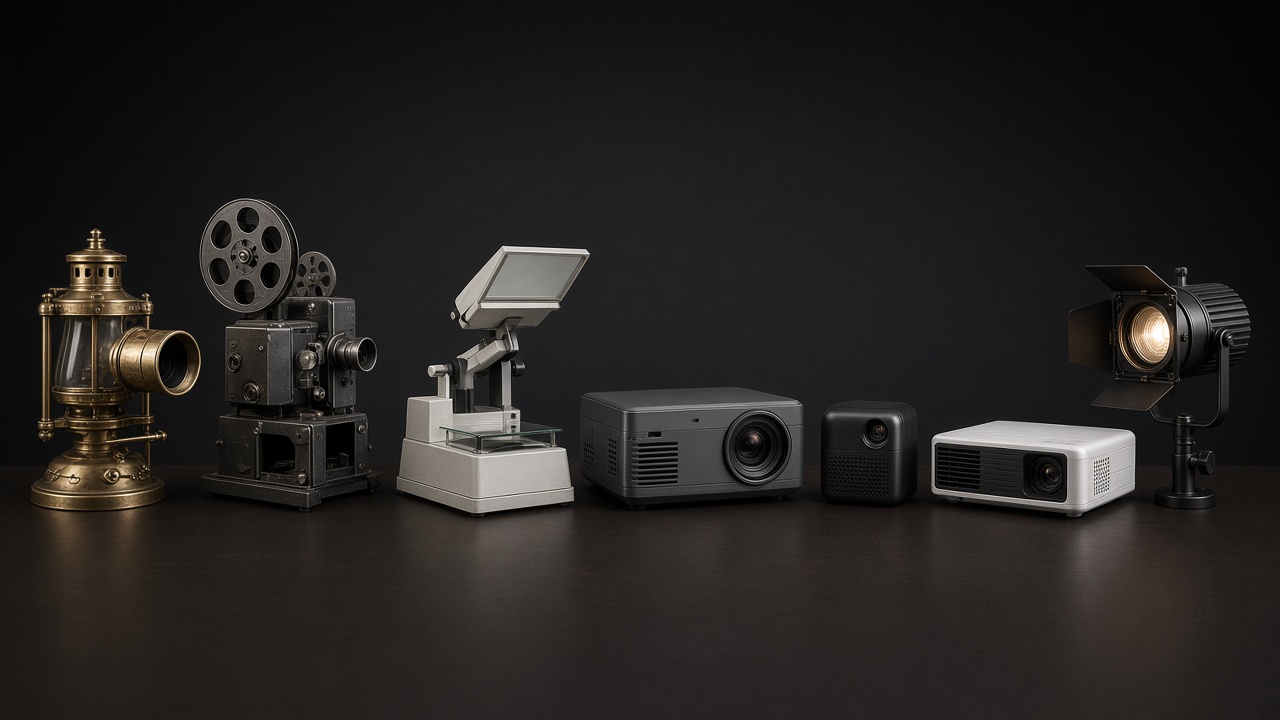
Projection moved from oil-lamp lanterns to digital pixels bright enough for daylight classrooms and laser cinema. The stats below anchor that arc to early lanterns, classroom OHP, digital data projectors, and laser light engines today.
Projector evolution: from magic lanterns and film reels to overhead classrooms, digital data projectors, and laser light engines.
Lantern Shows1650s - 1890s
Magic Lanterns and Early Light Projection
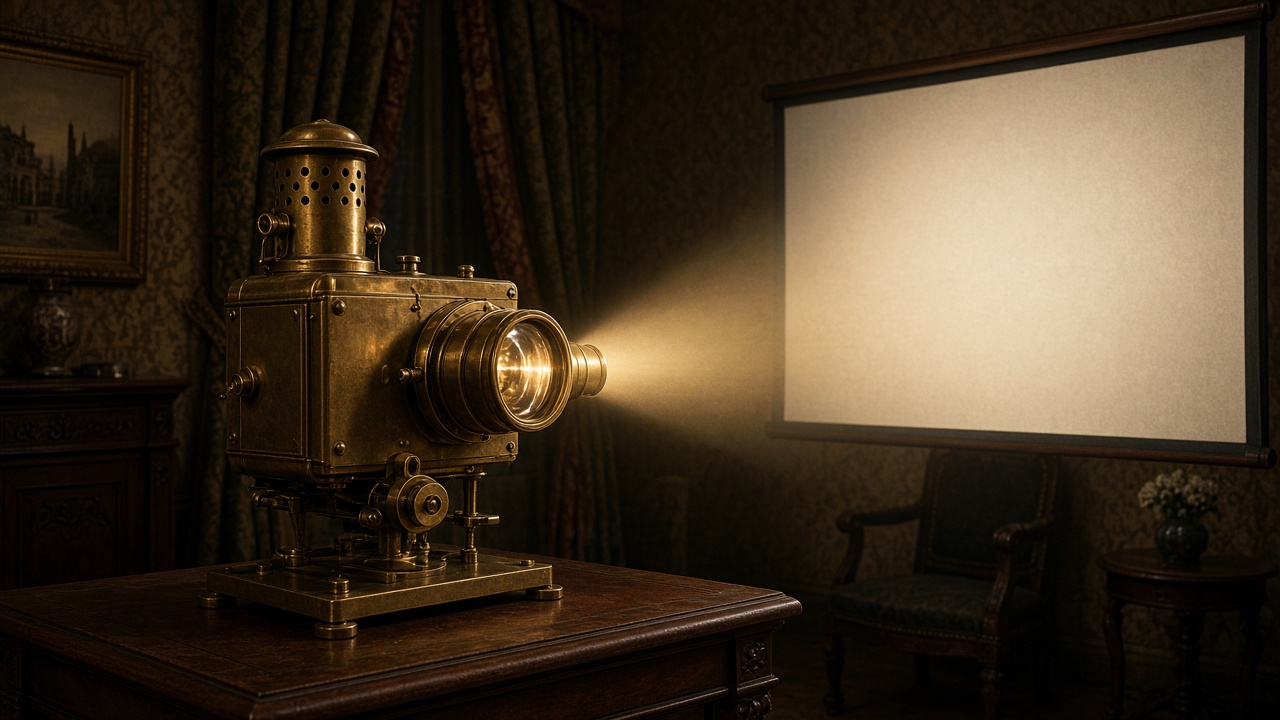
Magic lanterns used a lamp, lenses, and painted or photographic glass slides to throw images onto walls for education, entertainment, and religious teaching. They proved a room could share one picture long before electricity or cinema film.
Magic lantern era: oil or gas lamps and glass slides created public visual storytelling centuries before digital projectors.
Christiaan Huygens and others refine lantern optics in the 1600s.
Traveling showmen and schools use painted slides.
Photographic slides later replace hand-painted scenes.
Technology Used
Oil / gas / limelight: Bright lamps before electric bulbs.
Glass slides: Painted or photo emulsions.
Condenser lenses: Focus light through the slide.
Features
Public shows: One lantern, many viewers.
Educational: Astronomy, anatomy, travel lectures.
Analog only: No digital files or remote control.
Cinema Light1890s - 1950s
Film and Slide Projectors
Motion-picture projectors turned celluloid into shared stories in theatres, while 35 mm and 16 mm film, lantern slides, and later carousel slide projectors filled classrooms and lecture halls. Projection became an industry with carbon arcs, safety film, and professional projectionists.
Film and slide era: reels and carousels brought moving pictures and stills to theatres and classrooms worldwide.
Lumière Cinématographe and early cinema projection.
16 mm educational film projectors in schools.
Carousel slide projectors for lectures and sales talks.
Overhead projectors (OHP) let teachers write on transparent sheets while facing the class, replacing much of the chalk dust with bright acetate notes. Epidiascopes and opaque projectors also enlarged books and maps—the everyday AV cart before PowerPoint.
OHP era: transparency sheets and bright lamps made live teaching visible to the whole classroom.
OHP becomes standard in schools and training rooms.
Face the class: Teachers write without turning away.
Low cost media: Markers and sheets everywhere.
Heat & noise: Fans and hot stages.
Digital Data1980s - 2000s
LCD and DLP Data Projectors
Computer-connected LCD and DLP projectors replaced many OHPs and 35 mm slides in offices and schools. VGA then HDMI carried PowerPoint decks; ANSI lumen ratings and resolution (SVGA to XGA to WXGA) became the shopping checklist.
LCD/DLP era: digital data projectors turned laptop slides into shared presentations in boardrooms and classrooms.
Digital cinema begins replacing 35 mm film prints.
Technology Used
LCD / 3LCD: Liquid-crystal light valves.
DLP DMD chips: Millions of tiny tilting mirrors.
UHP lamps: High-pressure mercury bulbs.
Features
Computer native: Direct from PowerPoint and video.
Lamp life limits: Costly bulb replacements.
Portable units: Carry bags for sales teams.
Pocket Light2010 - 2018
Pico, Short-Throw and Laser Cinema
Pico projectors fitted in pockets, short-throw and ultra-short-throw models sat inches from the board, and laser light engines began replacing lamps in cinemas and classrooms. Throw ratio, interactive pens, and wireless casting entered the AV vocabulary.
Pico and laser era: pocket units, short-throw classroom boxes, and laser cinema engines reduce lamp heat and shadows.
LED pico projectors for travel and demos.
Ultra-short-throw interactive classroom systems.
Laser phosphor cinema brightens large screens.
Technology Used
LED / laser engines: Long life, fast on/off.
UST optics: Wide image from inches away.
Wireless casting: Miracast, AirPlay-class links.
Features
Fewer lamp changes: 20,000+ hour engines.
Less presenter shadow: Short throw near the wall.
Interactive pens: Write on projected boards.
Smart Screens2019 - Present
Smart Laser, 4K and LED Walls
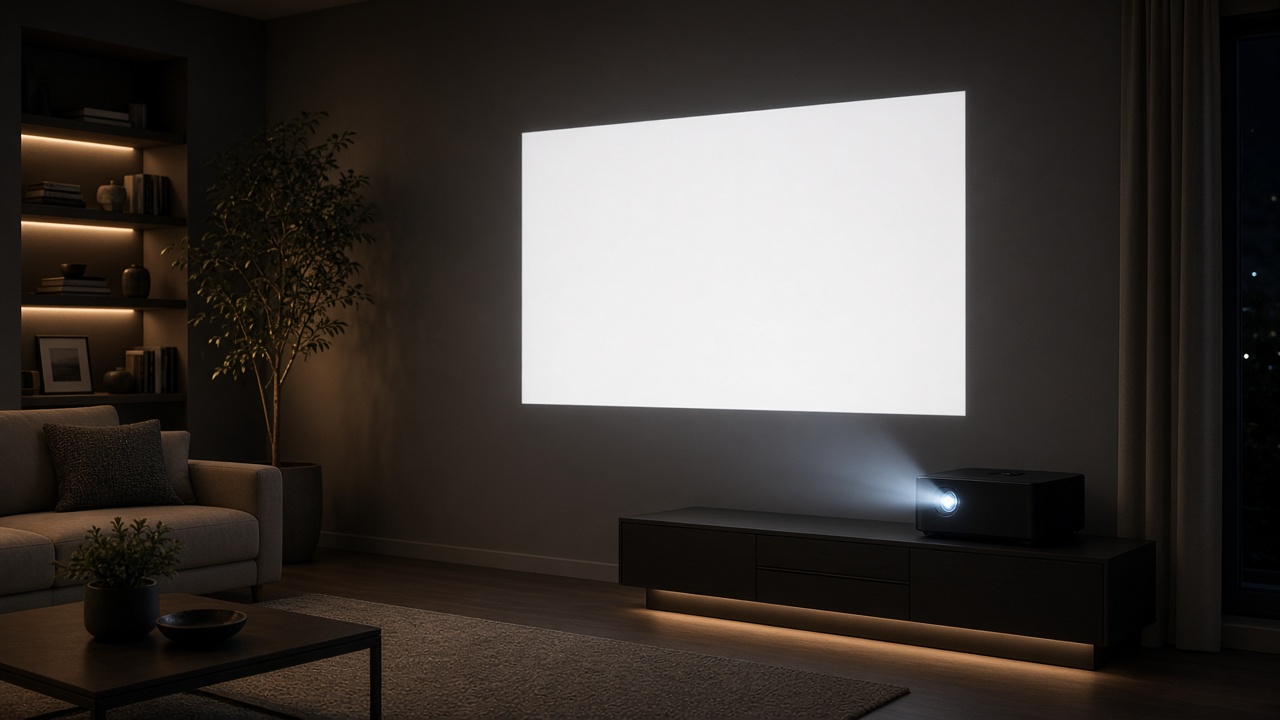
Today’s projectors deliver 4K, HDR, and smart OS apps, while fine-pitch LED walls compete for the same rooms. Hybrid teaching, home cinema laser TVs, and museum mapping keep projection alive—even as flat panels grow larger and cheaper.
Smart laser era: 4K home cinema, classroom lasers, and LED walls redefine how rooms share big images.
4K laser projectors for homes and auditoriums.
Android TV / smart OS built into many models.
LED video walls challenge lamps in conference halls.
Technology Used
RGB / laser phosphor: Cinema-grade colour.
4K / HDR pipelines: Streaming and Blu-ray.
Fine-pitch LED: Seamless wall displays.
Features
App streaming: Netflix-class apps on some units.
Auto focus / keystone: Easier setup.
Hybrid rooms: Projection + cameras + boards.
Projector Timeline Summary
Projection milestones—each row ties an era to the dominant light source and why it mattered for theatres, classrooms, and offices.
Year / Era
Milestone
Why it matters
1650s+
Magic lantern
Proved a lamp and slide could teach or entertain a whole room.
1890s–1950s
Film & slides
Cinema culture and educational reels became mass media.
1950s–80s
Overhead OHP
Teachers wrote live on acetates facing the class.
1980s–2000s
LCD / DLP
Computer slides replaced most film and OHP decks.
2010s
Pico & laser
Pocket units and long-life engines cut lamp costs.
2020s
4K smart / LED walls
Projection competes with giant panels in hybrid rooms.
Key Projector Historical Events
Turning points from lantern optics to DLP chips, digital cinema, and laser light engines that still shape classroom and theatre AV.
Event
Year
Significance
Magic lantern refined in Europe
c. 1650s
Public visual lectures and entertainment with glass slides.
Lumière Cinématographe projections
1895
Moving pictures projected for paying audiences.
Overhead projector popularized in schools
1950s–60s
Live transparency teaching becomes standard AV.
First commercial LCD data projectors
1980s–90s
Laptops drive wall-sized computer graphics.
Texas Instruments DLP technology
1990s
Micromirror chips enable bright digital cinema and business units.
Digital Cinema Initiatives (DCI)
2000s
Standards push theatres from 35 mm film to digital.
Pico / pocket LED projectors
late 2000s
Personal projection without heavy bags.
Laser phosphor cinema & classrooms
2010s
Long-life engines reduce lamp replacements.
4K UST “laser TV” living rooms
2010s–20s
Ultra-short-throw lasers rival flat-panel home theatres.
Fine-pitch LED walls
2020s
Seamless panels compete with projectors in halls.
Projector “Firsts” at a Glance
Landmark firsts in lantern shows, cinema, classroom OHP, digital data projection, DLP, pico, and laser cinema.
First
Year
Achievement
Practical magic lantern
1600s
Lamp + lens + slide for public images
Public cinema projection
1895
Lumière screenings in Paris
Widespread classroom OHP
1960s
Transparency teaching becomes routine
LCD data projector
1980s–90s
Computer graphics on walls
DLP projection
1990s
Digital micromirror cinema/business
Pocket pico projector
2000s
LED units fit in a palm
Laser cinema mainstream
2010s
Lamp-free bright auditorium projection
4K UST laser TV
2010s
Living-room wall cinema near the wall
LCD vs DLP vs Laser: Display Engines
Modern projectors mix imaging chips with light sources. LCD and DLP describe how pixels are made; lamps, LED, and laser describe how bright the beam is.
Feature
LCD / 3LCD
DLP
Laser / LED engines
How image forms
Liquid-crystal panels
Tilting micromirrors
Solid-state light through LCD/DLP/LCoS
Colour
Often rich, less rainbow
Can show rainbow effect on some eyes
Wide gamut, stable over life
Maintenance
Filter/lamp care
Lamp / filter; sealed optics vary
Very long life, fewer bulbs
Typical use
Classrooms, offices
Cinema, portable business
Premium cinema, UST home, halls
Projector Interface Evolution
Cables and wireless links decided how quickly a teacher or presenter could get an image on screen.
Interface
Era
Typical use
Notes
Composite / S-Video
1980s–90s
VHS, early media
Low resolution
VGA (analog)
1990s–2010s
Laptops, schools
Long cable runs common
DVI / HDMI
2000s+
Digital PCs, Blu-ray
HDMI became default
DisplayPort / USB-C
2010s+
Modern laptops
Adapters still common
Wireless casting
2010s+
Classrooms, huddle rooms
Wi-Fi dependent
Brightness Evolution (ANSI Lumens)
ANSI lumens measure how bright a projector looks on screen. Classrooms need more light than dark home theatres; cinema lasers push tens of thousands of lumens.
Era / type
Typical lumens
Room
Early portable LCD
500–1,500
Darkened rooms
Classroom / office
2,500–4,000
Lights partly on
Large hall / church
5,000–10,000+
Bright ambient light
Cinema laser
10,000–60,000+
Large screens
Pico LED
50–300
Small dark walls
Resolution Evolution
Projector native resolution climbed with computer graphics—from VGA slides to Full HD classrooms and 4K home cinema.
Era
Common native res
Use case
1990s
VGA / SVGA
Early data projection
2000s
XGA / WXGA
School and office decks
2010s
1080p
Video and classrooms
2020s
4K UHD
Home cinema, premium halls
Projector Pioneers
Inventors, labs, and companies that shaped lanterns, cinema, DLP chips, and classroom AV.
Person / company
Contribution
Christiaan Huygens (attributed)
Early magic lantern optics in the 1600s
Auguste & Louis Lumière
Public cinema projection (1895)
3M / classroom AV industry
Popularized overhead projectors in schools
Texas Instruments
DLP micromirror technology
Epson / Sony / Panasonic
3LCD and professional installation projectors
Barco / Christie
High-brightness cinema and event projection
Kodak (carousel era)
Slide projectors for education and sales
Then vs Now: Projection Experience
Compare a typical 1990s classroom or boardroom with projection in the 2020s.
Metric
Then (1990s)
Now (2020s)
Typical device
OHP or VGA LCD projector
Laser UST / smart projector / LED wall
Media
Acetates, 35 mm slides, VHS
HDMI, USB-C, wireless apps
Brightness
Dim rooms preferred
Daylight-capable lasers common
Lamp care
Frequent bulb swaps
20,000+ hour engines
Resolution
SVGA / XGA
1080p / 4K
Setup
Manual focus & keystone
Auto focus, auto keystone, apps
Future Projector Predictions
Projection keeps competing with giant flat panels. These trends blend brighter lasers, smarter rooms, and immersive mapping.
2025–2027: More hybrid classrooms with laser UST + interactive cameras for remote students.
2026–2028: Compact RGB laser projectors with cinema-like colour in mid-size venues.
2028–2030: Projection mapping becomes easier for museums and retail with AI edge blending.
2030s: Fine-pitch LED and projection share rooms based on cost per square metre.
2035+: Wearable AR may reduce some meeting-room projection, while large shared walls remain.
Projector Types
Different designs trade brightness, throw distance, and portability.
Type
Best for
Typical strengths
Overhead (OHP)
Live teaching notes
Write while facing the class; cheap media
Data / conference
PowerPoint, video
Portable bags; HDMI/VGA inputs
Short / ultra-short throw
Classrooms, digital boards
Less shadow; sits near the wall
Pico / pocket
Travel demos
Tiny; low brightness
Cinema / installation
Theatres, halls
Very bright; fixed optics
Laser TV (UST)
Home cinema
Large image inches from the wall
Key Specs to Understand
Shopping language for projectors—what the labels mean before you buy for a school or living room.
ANSI lumens: Brightness rating for real rooms.
Throw ratio: Distance divided by image width—short throw needs less space.
Contrast ratio: Deep blacks for movies; less critical for text slides.
Light source life: Lamp hours vs laser/LED lifetime.
India spotlight
Projectors in India
From touring magic lanterns and touring talkies to Doordarshan-era school kits, ICT labs, and smart classrooms, India scaled projection across education, cinema, and corporate training.
India spotlight: ICT schemes and smart classrooms brought digital projectors into government and private schools.
Colonial–1950s
Lanterns & touring cinema
Educational lantern slides and travelling talkies brought projected images to towns and villages.
1960s–80s
Classroom OHP & 16 mm
Colleges and training institutes adopted overhead projectors and educational film reels.
1990s–2000s
Multimedia labs
LCD projectors entered engineering colleges, coaching centres, and corporate training rooms with VGA laptops.
2010s
ICT & smart classrooms
State and central schemes added projectors, interactive boards, and digital content to government schools.
2020s
Laser & hybrid learning
UST lasers, LED panels, and hybrid teaching kits support online-offline classes after the pandemic.
Cinema: Multiplex digital projection replaced most 35 mm prints.
Coaching: Large LCD/laser units for entrance-exam classrooms.
Government: Digital India–aligned smart classroom tenders keep AV demand high.
Test Your Knowledge
20 quick questions from the projector timeline—lanterns, OHP, LCD/DLP, lumens, throw, India spotlight, and more. Click each question to reveal the answer.
Answer: The magic lantern.
Answer: The overhead projector (OHP).
Answer: DLP (Digital Light Processing).
Answer: Liquid Crystal Display.
Answer: ANSI lumens.
Answer: The screen or whiteboard.
Answer: Laser (and LED) light engines.
Answer: HDMI.
Answer: Pico projectors.
Answer: ICT in schools / smart classroom schemes.
Answer: Image width.
Answer: Texas Instruments.
Answer: Transparency / acetate sheets.
Answer: The Lumière brothers.
Answer: Ultra-short throw.
Answer: Fine-pitch LED walls / large panels.
Answer: The projector’s true pixel count (not upscaled).
Answer: UHP (high-pressure mercury) lamps.
Answer: Still photographic slides.
Answer: Brighter solid-state light, smarter setup, competition from LED walls.
Classroom activity
Students Tasks
Use these 10 prompts for discussion or projects. Each task ties to a section on this page—lanterns versus OHP, LCD versus DLP, lumens, and India’s smart classrooms.
OpticsClassroom AVCinemaDigital displays
Explain magic lantern versus overhead projector.
Draw a simple light path from lamp to screen.
Compare LCD and DLP engines.
Why do short-throw projectors reduce shadows?
What do ANSI lumens tell a buyer?
List pros and cons of laser versus lamp sources.
How did VGA-to-HDMI change classrooms?
Research one Indian smart-classroom scheme.
When would an LED wall beat a projector?
Predict classroom projection in 2035.
Continue exploring
Pair this projector story with television for home screens, education tools for classroom tech, computers for the laptops that feed slides, and scanners for paper going the other way.
Jump to any other technology timeline on WorldTimelineHub.
Disclaimer: This content is AI-generated for educational purposes and may contain errors or outdated details. For correct and authoritative information, please refer to official and reliable sources such as government publications, manufacturers, museums, and academic references.